Occupational Safety & Health Administration (OSHA)
OSHA Orientation
OSHA Video
The benefits of implementing these recommended practices
 Improvements in product, process, and service quality.
 Better workplace morale.
 Improved employee recruiting and retention.
 A more favorable image and reputation (among customers,
suppliers, and the community).
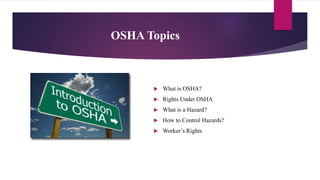
OSHA Topics
 What is OSHA?
 Rights Under OSHA
 What is a Hazard?
 How to Control Hazards?
 Worker’s Rights
 The Occupational Safety and Health Act of 1970 (OSH Act) was
passed to prevent workers from being killed or seriously harmed
at work.
 The law requires employers to provide their employees with
working conditions that are free of known dangers.
 The Act created the Occupational Safety and Health
Administration (OSHA), which sets and enforces protective
workplace safety and health standards.
 OSHA also provides information, training and assistance to
workers and employers.
 Workers may file a complaint to have OSHA inspect their
workplace if they believe that their employer is not following
OSHA standards or that there are serious hazards.
You have the right
to a safe workplace!
What is OSHA ?
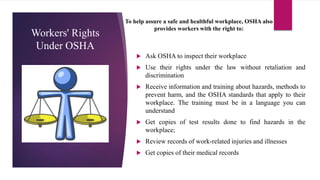
Workers' Rights
Under OSHA
 Ask OSHA to inspect their workplace
 Use their rights under the law without retaliation and
discrimination
 Receive information and training about hazards, methods to
prevent harm, and the OSHA standards that apply to their
workplace. The training must be in a language you can
understand
 Get copies of test results done to find hazards in the
workplace;
 Review records of work-related injuries and illnesses
 Get copies of their medical records
To help assure a safe and healthful workplace, OSHA also
provides workers with the right to:
Employer Responsibilities
 Employers have the responsibility to provide a safe workplace.
 Employers MUST provide their employees with a workplace that does not have serious hazards
and follow all relevant OSHA safety and health standards.
 Employers must find and correct safety and health problems.
 OSHA further requires employers to try to eliminate or reduce hazards first by making changes in
working conditions rather than just relying on masks, gloves, ear plugs or other types of personal
protective equipment (PPE).
Employers MUST also:
• Inform employees about hazards through training, labels, alarms, color-coded systems, chemical
information sheets and other methods.
• Keep accurate records of work-related injuries and illnesses.
• Perform tests in the workplace, such as air sampling required by some OSHA standards.
• Provide hearing exams or other medical tests required by OSHA standards.
• Post OSHA citations, injury and illness data, and the OSHA poster in the workplace where workers
will see them.
• Notify OSHA within 8 hours of a workplace incident in which there is a death or when three or more
workers go to a hospital.
• Not discriminate or retaliate against a worker for using their rights under the law.
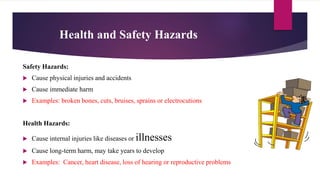
Health and Safety Hazards
Safety Hazards:
 Cause physical injuries and accidents
 Cause immediate harm
 Examples: broken bones, cuts, bruises, sprains or electrocutions
Health Hazards:
 Cause internal injuries like diseases or illnesses
 Cause long-term harm, may take years to develop
 Examples: Cancer, heart disease, loss of hearing or reproductive problems
Pair and Share Activity (10 minutes)
 Think of your personal experience with health and safety hazards
at your current or past workplace.
 Please find a partner to share your experiences.
 We will discuss those experiences as a whole group.
 Together, complete “Health & Safety Hazards” document
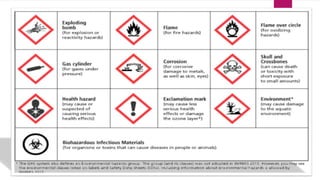
 Extensive list of the various types of hazards
 See the photo below
Types of Hazards Fact Sheet
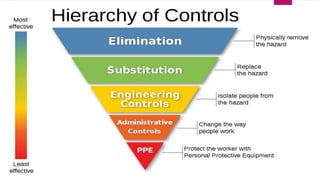
Reducing Hazards
 Employers must keep the workplace safe for workers
 There are different ways they can do this.
 Some ways work better than other ways.
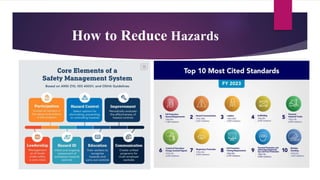
How to Reduce Hazards
Top 2 Controls
Elimination
 The best way to control a hazard is to
eliminate it entirely. It is best to do
this as early as possible.
 Example: use an electric forklift
truck rather than a gas operated
forklift truck to eliminate carbon
monoxide in a warehouse
Substitution
 When a hazard cannot be eliminated
completely, the second best alternative is
substituting the dangerous condition.
 The idea is to substitute chemicals,
equipment, or hazardous materials with ones
that are less hazardous.
 Example: using paint that does not contain
lead-based pigments
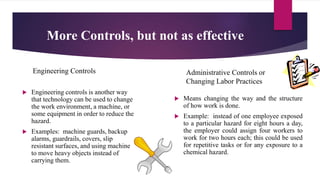
More Controls, but not as effective
Engineering Controls
 Engineering controls is another way
that technology can be used to change
the work environment, a machine, or
some equipment in order to reduce the
hazard.
 Examples: machine guards, backup
alarms, guardrails, covers, slip
resistant surfaces, and using machine
to move heavy objects instead of
carrying them.
Administrative Controls or
Changing Labor Practices
 Means changing the way and the structure
of how work is done.
 Example: instead of one employee exposed
to a particular hazard for eight hours a day,
the employer could assign four workers to
work for two hours each; this could be used
for repetitive tasks or for any exposure to a
chemical hazard.
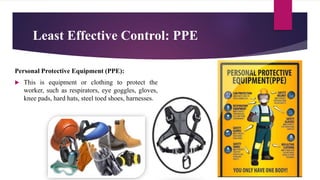
Least Effective Control: PPE
Personal Protective Equipment (PPE):
 This is equipment or clothing to protect the
worker, such as respirators, eye goggles, gloves,
knee pads, hard hats, steel toed shoes, harnesses.
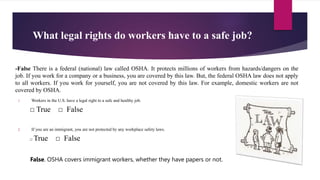
What legal rights do workers have to a safe job?
1. Workers in the U.S. have a legal right to a safe and healthy job.
□ True □ False
2. If you are an immigrant, you are not protected by any workplace safety laws.
□ True □ False
False. OSHA covers immigrant workers, whether they have papers or not.
-False There is a federal (national) law called OSHA. It protects millions of workers from hazards/dangers on the
job. If you work for a company or a business, you are covered by this law. But, the federal OSHA law does not apply
to all workers. If you work for yourself, you are not covered by this law. For example, domestic workers are not
covered by OSHA.
What legal rights do workers have to a safe job?
Legally, who is responsible for providing a safe and healthy workplace?
□ The Employer
□ The Workers
□ The Union
□ OSHA
□ All of The Above
The Employer. The OSHA law says that employers are responsible; it is their legal duty to provide a workplace
free of hazards. If employers don’t protect workers from workplace dangers, they are breaking the law. They have
the fix the hazards and pay fines. Employees can do their part to help make the workplace safe by following work
rules of their employer and OSHA standards.
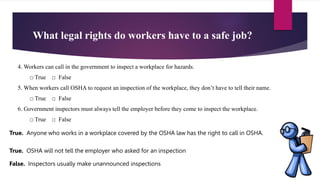
What legal rights do workers have to a safe job?
4. Workers can call in the government to inspect a workplace for hazards.
□ True □ False
5. When workers call OSHA to request an inspection of the workplace, they don’t have to tell their name.
□ True □ False
6. Government inspectors must always tell the employer before they come to inspect the workplace.
□ True □ False
True. Anyone who works in a workplace covered by the OSHA law has the right to call in OSHA.
True. OSHA will not tell the employer who asked for an inspection
False. Inspectors usually make unannounced inspections
Two Main Points to Keep in Mind
1. OSHA gives employees the right to complain about an unsafe working
environment.
 But in the Real World, it is more affective and protective to complain as a
group…Why?
 Because if it affects one person, it most likely affects many people
 Because a group complaint gets more attention
Two Main Points to Keep in Mind cont.
2. If an employee is fearful, afraid of getting fired, there are organizations, called
Worker Centers, that can represent him/her anonymously.
 Unions can also represent employees
Home Work
Risk Mapping of a Warehouse Store
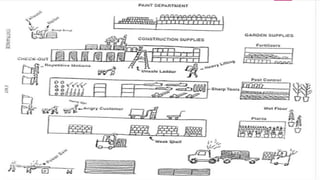
 Risk mapping is a method that employees use to identify
hazards by drawing a layout of the workplace.
 Label the various hazards that you see in this warehouse.
 Physical/Safety Hazard
 Biological/Chemical Hazard
 Other Hazards
Any Questions?

OSHA Orientation.pptx........................................

  • 1.
    Occupational Safety &Health Administration (OSHA) OSHA Orientation
  • 3.
  • 4.
    The benefits ofimplementing these recommended practices  Improvements in product, process, and service quality.  Better workplace morale.  Improved employee recruiting and retention.  A more favorable image and reputation (among customers, suppliers, and the community).
  • 7.
    OSHA Topics  Whatis OSHA?  Rights Under OSHA  What is a Hazard?  How to Control Hazards?  Worker’s Rights
  • 8.
     The OccupationalSafety and Health Act of 1970 (OSH Act) was passed to prevent workers from being killed or seriously harmed at work.  The law requires employers to provide their employees with working conditions that are free of known dangers.  The Act created the Occupational Safety and Health Administration (OSHA), which sets and enforces protective workplace safety and health standards.  OSHA also provides information, training and assistance to workers and employers.  Workers may file a complaint to have OSHA inspect their workplace if they believe that their employer is not following OSHA standards or that there are serious hazards. You have the right to a safe workplace! What is OSHA ?
  • 9.
    Workers' Rights Under OSHA Ask OSHA to inspect their workplace  Use their rights under the law without retaliation and discrimination  Receive information and training about hazards, methods to prevent harm, and the OSHA standards that apply to their workplace. The training must be in a language you can understand  Get copies of test results done to find hazards in the workplace;  Review records of work-related injuries and illnesses  Get copies of their medical records To help assure a safe and healthful workplace, OSHA also provides workers with the right to:
  • 10.
    Employer Responsibilities  Employershave the responsibility to provide a safe workplace.  Employers MUST provide their employees with a workplace that does not have serious hazards and follow all relevant OSHA safety and health standards.  Employers must find and correct safety and health problems.  OSHA further requires employers to try to eliminate or reduce hazards first by making changes in working conditions rather than just relying on masks, gloves, ear plugs or other types of personal protective equipment (PPE).
  • 11.
    Employers MUST also: •Inform employees about hazards through training, labels, alarms, color-coded systems, chemical information sheets and other methods. • Keep accurate records of work-related injuries and illnesses. • Perform tests in the workplace, such as air sampling required by some OSHA standards. • Provide hearing exams or other medical tests required by OSHA standards. • Post OSHA citations, injury and illness data, and the OSHA poster in the workplace where workers will see them. • Notify OSHA within 8 hours of a workplace incident in which there is a death or when three or more workers go to a hospital. • Not discriminate or retaliate against a worker for using their rights under the law.
  • 12.
    Health and SafetyHazards Safety Hazards:  Cause physical injuries and accidents  Cause immediate harm  Examples: broken bones, cuts, bruises, sprains or electrocutions Health Hazards:  Cause internal injuries like diseases or illnesses  Cause long-term harm, may take years to develop  Examples: Cancer, heart disease, loss of hearing or reproductive problems
  • 13.
    Pair and ShareActivity (10 minutes)  Think of your personal experience with health and safety hazards at your current or past workplace.  Please find a partner to share your experiences.  We will discuss those experiences as a whole group.  Together, complete “Health & Safety Hazards” document
  • 14.
     Extensive listof the various types of hazards  See the photo below Types of Hazards Fact Sheet
  • 16.
    Reducing Hazards  Employersmust keep the workplace safe for workers  There are different ways they can do this.  Some ways work better than other ways.
  • 17.
  • 18.
    Top 2 Controls Elimination The best way to control a hazard is to eliminate it entirely. It is best to do this as early as possible.  Example: use an electric forklift truck rather than a gas operated forklift truck to eliminate carbon monoxide in a warehouse Substitution  When a hazard cannot be eliminated completely, the second best alternative is substituting the dangerous condition.  The idea is to substitute chemicals, equipment, or hazardous materials with ones that are less hazardous.  Example: using paint that does not contain lead-based pigments
  • 19.
    More Controls, butnot as effective Engineering Controls  Engineering controls is another way that technology can be used to change the work environment, a machine, or some equipment in order to reduce the hazard.  Examples: machine guards, backup alarms, guardrails, covers, slip resistant surfaces, and using machine to move heavy objects instead of carrying them. Administrative Controls or Changing Labor Practices  Means changing the way and the structure of how work is done.  Example: instead of one employee exposed to a particular hazard for eight hours a day, the employer could assign four workers to work for two hours each; this could be used for repetitive tasks or for any exposure to a chemical hazard.
  • 20.
    Least Effective Control:PPE Personal Protective Equipment (PPE):  This is equipment or clothing to protect the worker, such as respirators, eye goggles, gloves, knee pads, hard hats, steel toed shoes, harnesses.
  • 21.
    What legal rightsdo workers have to a safe job? 1. Workers in the U.S. have a legal right to a safe and healthy job. □ True □ False 2. If you are an immigrant, you are not protected by any workplace safety laws. □ True □ False False. OSHA covers immigrant workers, whether they have papers or not. -False There is a federal (national) law called OSHA. It protects millions of workers from hazards/dangers on the job. If you work for a company or a business, you are covered by this law. But, the federal OSHA law does not apply to all workers. If you work for yourself, you are not covered by this law. For example, domestic workers are not covered by OSHA.
  • 22.
    What legal rightsdo workers have to a safe job? Legally, who is responsible for providing a safe and healthy workplace? □ The Employer □ The Workers □ The Union □ OSHA □ All of The Above The Employer. The OSHA law says that employers are responsible; it is their legal duty to provide a workplace free of hazards. If employers don’t protect workers from workplace dangers, they are breaking the law. They have the fix the hazards and pay fines. Employees can do their part to help make the workplace safe by following work rules of their employer and OSHA standards.
  • 23.
    What legal rightsdo workers have to a safe job? 4. Workers can call in the government to inspect a workplace for hazards. □ True □ False 5. When workers call OSHA to request an inspection of the workplace, they don’t have to tell their name. □ True □ False 6. Government inspectors must always tell the employer before they come to inspect the workplace. □ True □ False True. Anyone who works in a workplace covered by the OSHA law has the right to call in OSHA. True. OSHA will not tell the employer who asked for an inspection False. Inspectors usually make unannounced inspections
  • 24.
    Two Main Pointsto Keep in Mind 1. OSHA gives employees the right to complain about an unsafe working environment.  But in the Real World, it is more affective and protective to complain as a group…Why?  Because if it affects one person, it most likely affects many people  Because a group complaint gets more attention
  • 25.
    Two Main Pointsto Keep in Mind cont. 2. If an employee is fearful, afraid of getting fired, there are organizations, called Worker Centers, that can represent him/her anonymously.  Unions can also represent employees
  • 26.
  • 27.
    Risk Mapping ofa Warehouse Store  Risk mapping is a method that employees use to identify hazards by drawing a layout of the workplace.  Label the various hazards that you see in this warehouse.  Physical/Safety Hazard  Biological/Chemical Hazard  Other Hazards
  • 30.

Editor's Notes

  • #9 Ask the participants if they know what OSHA stands for? Provide fact sheet: OSHA It’s the Law! http://www.osha.gov/Publications/osha3165.pdf If they do know, then engage in a small question/answer session about OSHA. If not, assure the participants that it is ok: State that OSHA stands for Occupational Safety and Health Administration. Indicate that by the end of this orientation they will have a better understanding of OSHA.
  • #10 Say: Workers are entitled to working conditions that do not pose a risk of serious harm. Provide Fact Sheet Job Safety and Health (2 pages) http://www.osha.gov/OshDoc/data_General_Facts/jobsafetyandhealth-factsheet.pdf
  • #11 After last bullet point, say: Switching to safer chemicals, enclosing processes to trap harmful fumes, or using ventilation systems to clean the air are examples of effective ways to get rid of or minimize risks.
  • #13 Explain the definitions of safety and health hazards.
  • #14 Turn the lights on! Ask participants to pair and share their own personal experiences with health and safety hazards for 5 minutes. Complete the Health and Safety Hazards document (open Microsoft Word file “Pair and Share Activity about Hazards for PPT of Manufacturing Works”) by asking participants to categorize the health and safety hazards that they discussed. At the end of the activity, ask: Think about it: What is the main difference between a safety hazard and a health hazard? Time!!
  • #15 Provide the participants with Microsoft Word Document “Types of Hazards Fact Sheet for PPT of Manufacturing Works” Fact Sheet adapted from http://www.iwj.org/doc/HEALTH%20AND%20SAFETY%20IN%20THE%20WORKPLACE.pdf Page 22-27
  • #18 Provide the participants with the Microsoft Word Document “How to Reduce Hazards for PPT of Manufacturing Works”
  • #19 Another example for Elimination: use a chain from the floor to open an elevated valve rather than using a ladder to climb up and open the valve. Addition information for Substitution: A potential problem is when the product being used as a substitute is as dangerous as the original. For this reason, it is important to find out if the product is truly less hazardous than the original.
  • #21 It can include respirators, and protective wear for the eyes, ears, and face, gloves, and protective rope.
  • #22 True & False. There is a federal (national) law called OSHA. It protects millions of workers from hazards/dangers on the job. If you work for a company or a business, you are covered by this law. But, the federal OSHA law does not apply to all workers. If you work for yourself, you are not covered by this law. For example, domestic workers are not covered by OSHA. If you work for state or city government in Illinois, you are not covered by the federal OSHA law, but there is a state OSHA law to protect you instead. If you are a miner, railroad worker or atomic energy worker, you are covered by other safety laws, not the OSHA law. False. OSHA covers immigrant workers, whether they have papers or not.
  • #23 The Employer. The OSHA law says that employers are responsible; it is their legal duty to provide a workplace free of hazards. If employers don’t protect workers from workplace dangers, they are breaking the law. They have the fix the hazards and pay fines. Employees can do their part to help make the workplace safe by following work rules of their employer and OSHA standards.
  • #24 True. Anyone who works in a workplace covered by the OSHA law has the right to call in OSHA. Some organizations such as unions and worker centers can also call OSHA for the workers they represent. Family members can also call OSHA. True. OSHA will not tell the employer who asked for an inspection. However, it is a good idea to have a contact person representing the workers who can walk around with the inspector on the inspection. The person should be someone who knows the hazards at the workplace and is not afraid to speak out. If the workers are represented by a union at the workplace, the contact person would be a union representative, such as a shop steward. False. Inspectors usually make unannounced inspections. But, sometimes the inspectors have to tell the company they are coming: if the condition is an imminent danger (a worker could die), if the inspection must be conducted after regular work hours, or if management and worker reps are not likely to be there when the inspector comes. Image Found: http://blogs.msdn.com/b/willy-peter_schaub/archive/2009/02/26/sdlc-software-development-lifecycle-designing-the-blueprint-part-7-of-many.aspx
  • #28 Form groups of 3-4 people (if possible, according to their common line of work) and provide each group with “Sample Risk Map of a Warehouse Store” handout to identify some hazards; remind participants that they may use “Types of Hazards Fact Sheet” Handout. For each group, ask students to: Label the locations of hazards on the floor plans: Indicate “physical and safety hazards” Indicate “biological and chemical hazards” Indicate “other hazards” as stress Each group will share their selected hazards from the map, explaining what the workplace is and what dangers are represented
  • #29 Wrap up by having a discussion; sample questions to ask the class: Did you see hazards that you expected? Were you surprised by hazards that you had not thought of before? How would you propose to reduce or solve some of the hazards depicted in the maps? What did you learn from this activity?