Introduction to Neuron
Content
Introduction
Human body systems
Types of neurons system and there detail
Neuron
Parts of neuron
 Function of parts of neuron
Classes of neuron
Glial cells
Neuron growth and regeneration
Submitted by Meerab Tanveer
NEURAL TISSUES
There are trillions of cell in order to co-ordinate the functions of the
human body.
There are two control systems which exit in the human body which are
given below :
o Endocrine system
o Nervous system
Endocrine system
It is collection of the blood borne messengers that work slowly.
Nervous system
As compare to the endocrine system it is a rapid control system.
Human behavior
Endocrine and nervous system in human regulate most internal
functions and control activities which are known as human behavior.
For example: feeling angry, having an idea or remembering thing for a
long time etc.
Types of nervous system
There are following types of nervous system
o Central nervous system
o Peripheral nervous system
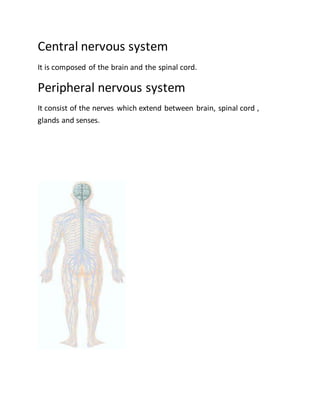
Central nervous system
It is composed of the brain and the spinal cord.
Peripheral nervous system
It consist of the nerves which extend between brain, spinal cord ,
glands and senses.
Neuron
The basic unit of the nervous system is called neuron.
Neurotransmitters
Nerve cells are operated by generating electrical signals that pass from
one part of the cell to another part of the same cell by releasing
chemical messengers these are called as neurotransmitters.
Neuron serve as a integrators
Neurons serve as a integrators because there output reflects the
balance of inputs which they receive from other neurons to impinge
upon them.
Structure of the neuron
Neurons are available in different types and shapes . There parts are
given below
o Cell body
o Dendrites
o Axon
o Axon terminals
Functions of parts of neuron
Cell body
It has nucleus and the ribosomes which contain genetic information
and machinery for protein synthesis.
Dendrites
They form a series of highly branched out growths from the cell
body.Cell body receives most of the signals from other neurons . And
dendrites are very much important in this sense because they have a
vast receptive surface area which increases the amount of receiving
signals .
Axon
It is also some time called as nerve fiber . It is a singal long process that
extend from cell body to its target cell. They are few centimeters or
metters or more in size.
Initial segment
The axon closest to the cell body, plus part of the cell body where axon
is joined is called intial segment.
It is the trigger zone where most of the electrical signals are generated
and propogated away from the cell body.
Collaterals
The main axon may have branches which is called collaterals.
The main axon and the collaterals undergo further branching and it
greater the cell sphere of influence.
Some of the axons are covered by myelin sheath.
Oligodendroglia
The myelin sheath forming cells in central nervous system are called
oligodendroglia.
Schwann cells
In peripheral nervous system the myelin sheath forming ells are called
schwann cells.
Nodes of ranvier
The space between the adjacent sections of myelin where the axon
plasma membrane is exposed to extracellular fluid is the nodes of
ranvier.
Axon transport
Various organelles and materials must be moved as much as one meter
from cell body, where they are made to the axon and its terminals in
order to maintain the structure and function of the cell axon. This
movement is termed as axon transport.
Axon terminal
Axon terminals are responsible for the release of the signals from cell
body.
Varicosities
Some neurons release there chemical messengers from a series of
bulging areas along the axon known as varicosities.
Classes of neuron
There are following classes of neurons
o Afferent neurons
o Efferent neuron
o Interneurons
Classes of neurons are explaned in following ,
I. Afferentneurons
A. Transmit information into the central nervous system
From receptors at their peripheral endings
B. Cell body and the long peripheral process of the axon
are in the peripheral nervous system;only the short
central process of the axon enters the central nervous
system
C. Have no dendrites
II. Efferentneurons
A. Transmit information out of the central nervous
system to effectorcells,particularly muscles,glands,
or other neurons
B. Cell body, dendrites,and a small segmentof the
axon are in the central nervous system;most of the
axon is in the peripheral nervous system
III. Interneurons
A. Function as integrators and signal changers
B. Integrate groups of afferentand efferentneurons into
C. Lie entirely within the central nervous system
D. Account for 99 percent of all neurons
Glial cells
o It helps to regulate the extracellular fluid composition , sustain
the neuron metabolicaly , form myelin, serve as guide for
developing neuron and provide immune function .
Neural growth and regeneration
o Neuron develops from precursor cells migrate to their final
location and send out process to their target cells.
o Cell division to form new neurons is markedly slowed after birth.
o Peripheral neuron may regrow the axon to their target organs.
CNS neurons do not regenerate.

introduction to neuron

  • 1.
    Introduction to Neuron Content Introduction Humanbody systems Types of neurons system and there detail Neuron Parts of neuron  Function of parts of neuron Classes of neuron Glial cells Neuron growth and regeneration Submitted by Meerab Tanveer
  • 2.
    NEURAL TISSUES There aretrillions of cell in order to co-ordinate the functions of the human body. There are two control systems which exit in the human body which are given below : o Endocrine system o Nervous system Endocrine system It is collection of the blood borne messengers that work slowly. Nervous system As compare to the endocrine system it is a rapid control system. Human behavior Endocrine and nervous system in human regulate most internal functions and control activities which are known as human behavior. For example: feeling angry, having an idea or remembering thing for a long time etc. Types of nervous system There are following types of nervous system o Central nervous system o Peripheral nervous system
  • 3.
    Central nervous system Itis composed of the brain and the spinal cord. Peripheral nervous system It consist of the nerves which extend between brain, spinal cord , glands and senses.
  • 4.
    Neuron The basic unitof the nervous system is called neuron. Neurotransmitters Nerve cells are operated by generating electrical signals that pass from one part of the cell to another part of the same cell by releasing chemical messengers these are called as neurotransmitters. Neuron serve as a integrators Neurons serve as a integrators because there output reflects the balance of inputs which they receive from other neurons to impinge upon them. Structure of the neuron Neurons are available in different types and shapes . There parts are given below o Cell body o Dendrites o Axon o Axon terminals
  • 5.
    Functions of partsof neuron Cell body It has nucleus and the ribosomes which contain genetic information and machinery for protein synthesis. Dendrites They form a series of highly branched out growths from the cell body.Cell body receives most of the signals from other neurons . And dendrites are very much important in this sense because they have a vast receptive surface area which increases the amount of receiving signals . Axon It is also some time called as nerve fiber . It is a singal long process that extend from cell body to its target cell. They are few centimeters or metters or more in size. Initial segment The axon closest to the cell body, plus part of the cell body where axon is joined is called intial segment. It is the trigger zone where most of the electrical signals are generated and propogated away from the cell body.
  • 6.
    Collaterals The main axonmay have branches which is called collaterals. The main axon and the collaterals undergo further branching and it greater the cell sphere of influence. Some of the axons are covered by myelin sheath. Oligodendroglia The myelin sheath forming cells in central nervous system are called oligodendroglia. Schwann cells In peripheral nervous system the myelin sheath forming ells are called schwann cells. Nodes of ranvier The space between the adjacent sections of myelin where the axon plasma membrane is exposed to extracellular fluid is the nodes of ranvier. Axon transport Various organelles and materials must be moved as much as one meter from cell body, where they are made to the axon and its terminals in order to maintain the structure and function of the cell axon. This movement is termed as axon transport.
  • 7.
    Axon terminal Axon terminalsare responsible for the release of the signals from cell body. Varicosities Some neurons release there chemical messengers from a series of bulging areas along the axon known as varicosities. Classes of neuron There are following classes of neurons o Afferent neurons o Efferent neuron o Interneurons Classes of neurons are explaned in following , I. Afferentneurons A. Transmit information into the central nervous system From receptors at their peripheral endings B. Cell body and the long peripheral process of the axon are in the peripheral nervous system;only the short central process of the axon enters the central nervous system C. Have no dendrites II. Efferentneurons A. Transmit information out of the central nervous system to effectorcells,particularly muscles,glands, or other neurons B. Cell body, dendrites,and a small segmentof the axon are in the central nervous system;most of the axon is in the peripheral nervous system
  • 8.
    III. Interneurons A. Functionas integrators and signal changers B. Integrate groups of afferentand efferentneurons into C. Lie entirely within the central nervous system D. Account for 99 percent of all neurons Glial cells o It helps to regulate the extracellular fluid composition , sustain the neuron metabolicaly , form myelin, serve as guide for developing neuron and provide immune function . Neural growth and regeneration o Neuron develops from precursor cells migrate to their final location and send out process to their target cells. o Cell division to form new neurons is markedly slowed after birth. o Peripheral neuron may regrow the axon to their target organs. CNS neurons do not regenerate.