Measurements andMeasurements and
Precision MeasuringPrecision Measuring
DevicesDevices
ObjectivesObjectives
Describe United States Customary (USC)
system of measurement
Describe metric system
Explain how to convert measurements
between two measuring systems
Explain when and how to read rulers
ObjectivesObjectives
Discuss need for feeler gauges and their
general use
Describe how to read measurements made
with micrometers
Describe dial indicators and calipers
Explain typical uses of vacuum and
pressure gauges
IntroductionIntroduction
Methods of collecting data depend on what
is being measured
Check for excessive wear or damage when
servicing components
Some shops send components out for these
measurements and tests
Measuring SystemsMeasuring Systems
Most common measurement in the U.S. is
the United States Customary (USC)
– Based on the inch
– Can be measured in decimals or fractions
– Engine measurements are expressed in
thousandths of an inch
English System?English System?
 The English system of measurement grew out of
the creative way that people measured for
themselves. Familiar objects and parts of the body
were used as measuring devices. For example,
people measured shorter distances on the ground
with their feet.
 They measured longer distances by their paces (a
"mile" was a thousand paces). They measured
capacities with common household items such as
cups, pails, and baskets. The word gallon comes
from an old name for a pail.
English systemEnglish system
In the English system the fundamental units
of force, length, and time are expressed in
the standard units of foot, pound, and
second. Unlike the metric system, the
English system has no common multiplier
and the subdivisions of the units of
measurement bear no common relation to
each other.
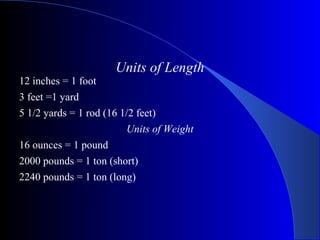
Units of Length
12 inches = 1 foot
3 feet =1 yard
5 1/2 yards = 1 rod (16 1/2 feet)
Units of Weight
16 ounces = 1 pound
2000 pounds = 1 ton (short)
2240 pounds = 1 ton (long)
.
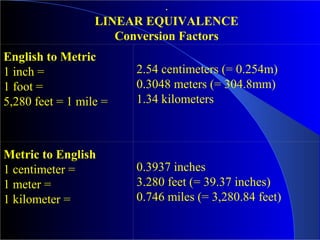
LINEAR EQUIVALENCE
Conversion Factors
English to Metric
1 inch =
1 foot =
5,280 feet = 1 mile =
2.54 centimeters (= 0.254m)
0.3048 meters (= 304.8mm)
1.34 kilometers
Metric to English
1 centimeter =
1 meter =
1 kilometer =
0.3937 inches
3.280 feet (= 39.37 inches)
0.746 miles (= 3,280.84 feet)
Measuring SystemsMeasuring Systems
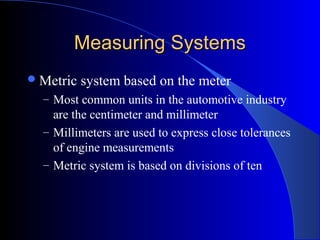
Metric system based on the meter
– Most common units in the automotive industry
are the centimeter and millimeter
– Millimeters are used to express close tolerances
of engine measurements
– Metric system is based on divisions of ten
Metric SystemMetric System
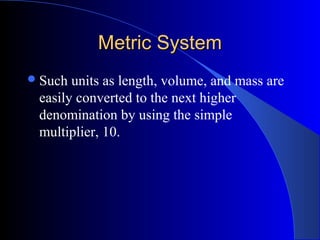
Such units as length, volume, and mass are
easily converted to the next higher
denomination by using the simple
multiplier, 10.
Units of LengthUnits of Length
 10 millimeters = 1 centimeter
 10 centimeters = 1 decimeter
 10 decimeters = 1 meter
 1000 meters = 1 kilometer
Units of Weight
 10 milligrams = 1 centigram
 10 centigrams = 1 decigram
 10 decigrams = 1 gram
 1000 grams = 1 kilogram
 1000 kilograms = 1 metric ton
Rulers and Feeler GaugesRulers and Feeler Gauges
Rulers
– Simple tools to measure straight-line distances
where tolerances are not a major factor
– May be USC or metric
– Can be made of metal, plastic, or wood
– Typical rulers are 6 inches or 12 inches
Rulers and TapesRulers and Tapes
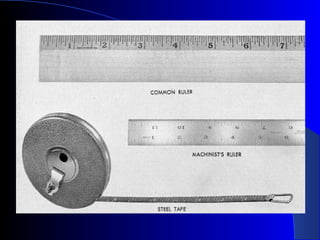
Rulers and tapes. The most common method of
obtaining simple measurements of length is by the
ruler or tape .A ruler may be graduated into feet,
inches, or fractions thereof. Rulers and tapes used
in engineering work are most frequently made of
metal and the fractions of inches may be graduated
to subdivisions as small as 1/64 or 1/100 of an
inch. Care should be exercised in using metal
rulers and tapes, especially if extreme accuracy is
required. The margin of error due to expansion or
contraction of the instrument from changes in
temperature can be considerable.
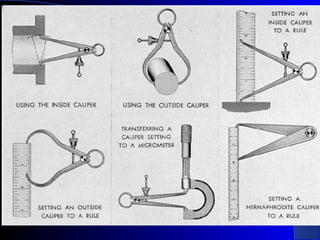
CalipersCalipers
Calipers. Engineers and machinists
frequently use calipers to secure accurate
measurements of inside and outside
diameters.
Feeler GaugesFeeler Gauges
Feeler Gauges
– Precision-machined piece of metal that is flat or
round
– May be USC or metric
– Used for measuring “gaps” or the space
between two objects
– Proper usage requires practice
Feeler GaugesFeeler Gauges
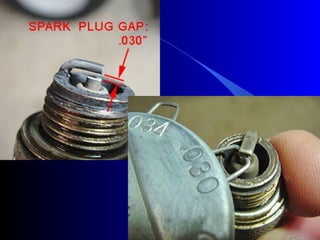
used forused for
Valve lash
Measure spark plug gap
Head flatness
Thrust distance in Crankshaft
Ignition point gap (Old Vehicles)
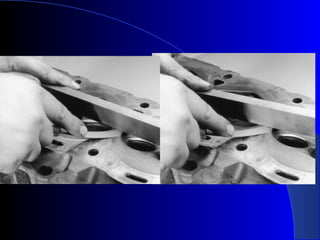
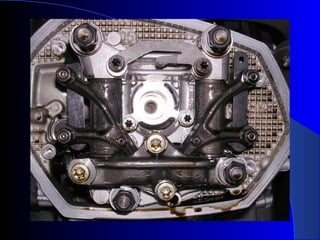
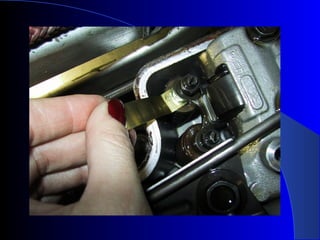
Feeler gages are principally used in determining
clearances between various parts of machinery.
Probably the most common use is determining valve
clearance. Various blades are inserted between the
tappet and the push rod until a blade of the feeler gage
is found that will just slide between the two surfaces
without too much friction or sticking. The thickness of
the blade then determines the clearance. Or, a
particular feeler of proper thickness may be selected
and the tappet adjusted until the feeler will just slide
between the tappet and push rod with out catching.
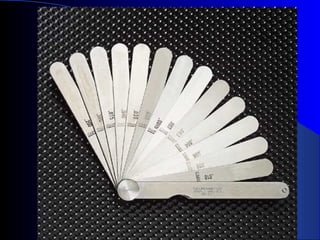
Feeler GaugesFeeler Gauges
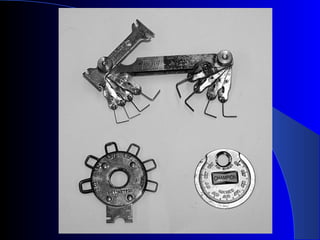
Such a gage consists of thin blades of metal
of various thicknesses. There is generally a
blade or strip for each of the most
commonly used thicknesses such as 0.002
inch, 0.010 inch, and .015 inch. The
thickness of each blade is generally etched
on the blade
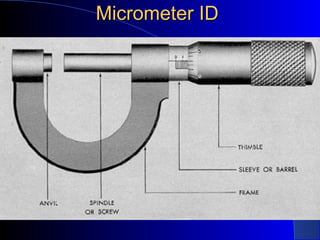
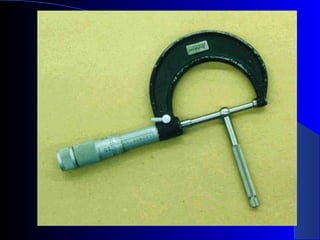
Micrometer IDMicrometer ID
MicrometersMicrometers
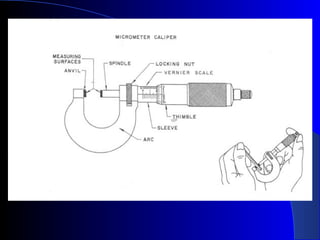
 Micrometer calipers. Engineers frequently rely on
the micrometer caliper to obtain measurements
accurate to 1/1000 of an inch. This instrument is
particularly useful for measuring relatively short
lengths and the diameter of journals or cylinders.
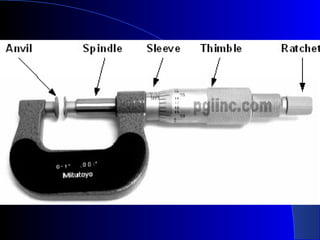
The common commercial micrometer consists of a
frame; an anvil, or fixed measuring point; a
spindle; a sleeve, or barrel; and a thimble. The
spindle has threads cut 40 to the inch on the
portion that fits inside the sleeve. The thimble fits
over the end of the sleeve, and rotating the thimble
turns the spindle.
MicrometersMicrometers
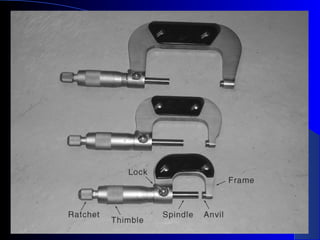
Micrometers precisely measure different
shapes of a component
Outside micrometers
– Resembles a clamp to measure linear distances
– Proper use requires practice and studying the
markings of the instrument
Reading a MicrometerReading a Micrometer
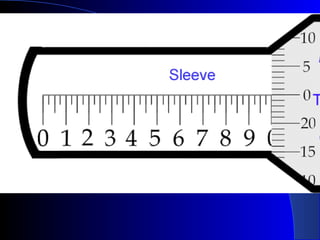
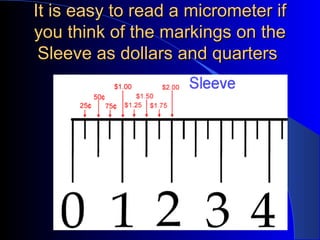
 Sleeve: The Micrometer sleeve is divided into
10 equal parts, each of these parts is equal to
.100" (1 tenth of an inch). Each of these 10
parts is divided into 4 equal parts. Each of
these 4 subdivisions is equal to .025" or one
40th of an inch. More simply, the line on the
sleeve marked "1" represents .100", the line
marked "2" represents .200" and so forth.
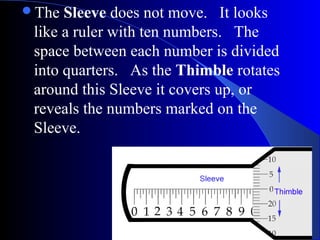
The Sleeve does not move. It looks
like a ruler with ten numbers. The
space between each number is divided
into quarters. As the Thimble rotates
around this Sleeve it covers up, or
reveals the numbers marked on the
Sleeve.
ThimbleThimble
The thimble is divided into twenty-five
equal parts, each of these parts is equal
to .001" and, one complete rotation of
the thimble coincides with the smallest
division (.025") on the sleeve.
How to read Micrometer http://www.linnbenton.edu/auto/day/mike/read
Standard Micrometer
http://www.youtube.com/watch?v=oiAutI0i5YE 
Metric Micrometer http://www.youtube.com/watch?
v=O8vMFFYNIfo
It is easy to read a micrometer ifIt is easy to read a micrometer if
you think of the markings on theyou think of the markings on the
Sleeve as dollars and quartersSleeve as dollars and quarters
MicrometersMicrometers
Micrometer Calibration
– In order to measure accurately, the micrometer
must be accurate itself
– Extreme temperatures can affect accuracy
MicrometersMicrometers
Reading a USC Outside Micrometer
– Place anvil against work
– Rotate thimble to bring spindle into contact
with opposite side of work
– Use ratchet knob to ensure sufficient contact is
made
– Remove micrometer and read dial
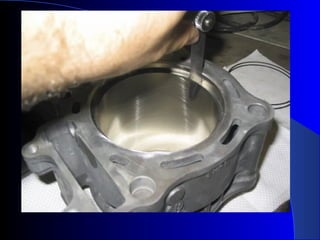
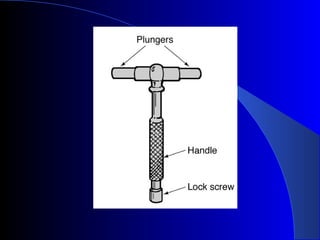
Telescopic GaugesTelescopic Gauges
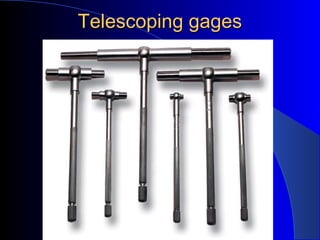
– Used with outside micrometers to
measure inside diameters
– Various lengths and T-shaped
– Extensions are spring-loaded
Telescoping gagesTelescoping gages
Telescoping GaugesTelescoping Gauges
Telescopic Gauges
– Leg has a rotatable handle to lock extensions in
place
– Once gauge is removed, measure with outside
micrometer
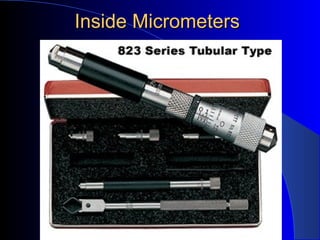
Inside MicrometersInside Micrometers
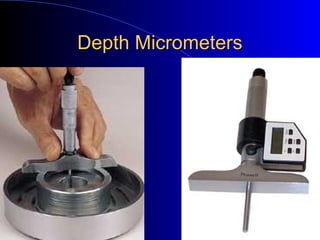
Depth MicrometersDepth Micrometers
Small Hole GaugesSmall Hole Gauges
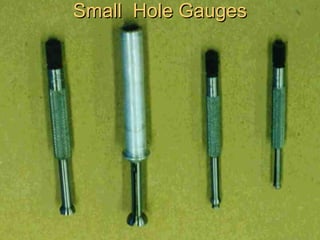
To measure small holes
Gauge is straight with a screw handle on
one end and a split ball on other
Handle is turned to expand ball
– Removed and measured with a micrometer
Small Hole GaugesSmall Hole Gauges
Dial IndicatorsDial Indicators
Dial Calipers
– For inside, outside, and depth measurements
– Manual scales or digital
– USC can measure in 0.001 inch increments
– Metric can measure in 2-millimeter increments
Dial IndicatorsDial Indicators
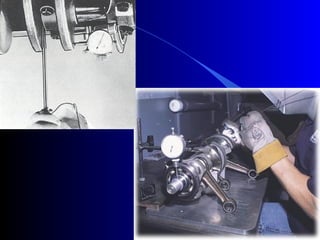
Dial Indicators
– To check how far components can move
– Scale can be USC or metric
– Face can be balanced or continuous
– To check runout or end play
Pressure and VacuumPressure and Vacuum
MeasurementsMeasurements
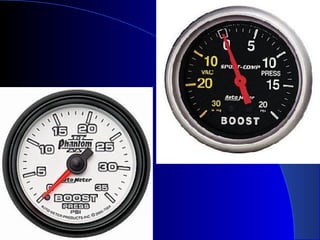
Pressure Gauges
– Measure amount of pressure applied to a
closed, sealed system
– Fitted into pressure line with appropriate
fittings
Pressure and VacuumPressure and Vacuum
MeasurementsMeasurements
Vacuum Gauges
– Mechanical gauge measures difference between
atmospheric pressure and current state of
system
SummarySummary
Most common measurement system in
United States is the United States
Customary or the English system
Base USC measurement is the inch
Base metric measurement is the meter
Use proper measuring tool for the job

Mechanical measurements and_measuring_devices_6-25-08 (1)

  • 1.
    Measurements andMeasurements and PrecisionMeasuringPrecision Measuring DevicesDevices
  • 2.
    ObjectivesObjectives Describe United StatesCustomary (USC) system of measurement Describe metric system Explain how to convert measurements between two measuring systems Explain when and how to read rulers
  • 3.
    ObjectivesObjectives Discuss need forfeeler gauges and their general use Describe how to read measurements made with micrometers Describe dial indicators and calipers Explain typical uses of vacuum and pressure gauges
  • 4.
    IntroductionIntroduction Methods of collectingdata depend on what is being measured Check for excessive wear or damage when servicing components Some shops send components out for these measurements and tests
  • 5.
    Measuring SystemsMeasuring Systems Mostcommon measurement in the U.S. is the United States Customary (USC) – Based on the inch – Can be measured in decimals or fractions – Engine measurements are expressed in thousandths of an inch
  • 6.
    English System?English System? The English system of measurement grew out of the creative way that people measured for themselves. Familiar objects and parts of the body were used as measuring devices. For example, people measured shorter distances on the ground with their feet.  They measured longer distances by their paces (a "mile" was a thousand paces). They measured capacities with common household items such as cups, pails, and baskets. The word gallon comes from an old name for a pail.
  • 7.
    English systemEnglish system Inthe English system the fundamental units of force, length, and time are expressed in the standard units of foot, pound, and second. Unlike the metric system, the English system has no common multiplier and the subdivisions of the units of measurement bear no common relation to each other.
  • 8.
    Units of Length 12inches = 1 foot 3 feet =1 yard 5 1/2 yards = 1 rod (16 1/2 feet) Units of Weight 16 ounces = 1 pound 2000 pounds = 1 ton (short) 2240 pounds = 1 ton (long)
  • 9.
    . LINEAR EQUIVALENCE Conversion Factors Englishto Metric 1 inch = 1 foot = 5,280 feet = 1 mile = 2.54 centimeters (= 0.254m) 0.3048 meters (= 304.8mm) 1.34 kilometers Metric to English 1 centimeter = 1 meter = 1 kilometer = 0.3937 inches 3.280 feet (= 39.37 inches) 0.746 miles (= 3,280.84 feet)
  • 10.
    Measuring SystemsMeasuring Systems Metricsystem based on the meter – Most common units in the automotive industry are the centimeter and millimeter – Millimeters are used to express close tolerances of engine measurements – Metric system is based on divisions of ten
  • 11.
    Metric SystemMetric System Suchunits as length, volume, and mass are easily converted to the next higher denomination by using the simple multiplier, 10.
  • 12.
    Units of LengthUnitsof Length  10 millimeters = 1 centimeter  10 centimeters = 1 decimeter  10 decimeters = 1 meter  1000 meters = 1 kilometer Units of Weight  10 milligrams = 1 centigram  10 centigrams = 1 decigram  10 decigrams = 1 gram  1000 grams = 1 kilogram  1000 kilograms = 1 metric ton
  • 13.
    Rulers and FeelerGaugesRulers and Feeler Gauges Rulers – Simple tools to measure straight-line distances where tolerances are not a major factor – May be USC or metric – Can be made of metal, plastic, or wood – Typical rulers are 6 inches or 12 inches
  • 14.
    Rulers and TapesRulersand Tapes Rulers and tapes. The most common method of obtaining simple measurements of length is by the ruler or tape .A ruler may be graduated into feet, inches, or fractions thereof. Rulers and tapes used in engineering work are most frequently made of metal and the fractions of inches may be graduated to subdivisions as small as 1/64 or 1/100 of an inch. Care should be exercised in using metal rulers and tapes, especially if extreme accuracy is required. The margin of error due to expansion or contraction of the instrument from changes in temperature can be considerable.
  • 16.
    CalipersCalipers Calipers. Engineers andmachinists frequently use calipers to secure accurate measurements of inside and outside diameters.
  • 18.
    Feeler GaugesFeeler Gauges FeelerGauges – Precision-machined piece of metal that is flat or round – May be USC or metric – Used for measuring “gaps” or the space between two objects – Proper usage requires practice
  • 20.
    Feeler GaugesFeeler Gauges usedforused for Valve lash Measure spark plug gap Head flatness Thrust distance in Crankshaft Ignition point gap (Old Vehicles)
  • 21.
    Feeler gages areprincipally used in determining clearances between various parts of machinery. Probably the most common use is determining valve clearance. Various blades are inserted between the tappet and the push rod until a blade of the feeler gage is found that will just slide between the two surfaces without too much friction or sticking. The thickness of the blade then determines the clearance. Or, a particular feeler of proper thickness may be selected and the tappet adjusted until the feeler will just slide between the tappet and push rod with out catching.
  • 25.
    Feeler GaugesFeeler Gauges Sucha gage consists of thin blades of metal of various thicknesses. There is generally a blade or strip for each of the most commonly used thicknesses such as 0.002 inch, 0.010 inch, and .015 inch. The thickness of each blade is generally etched on the blade
  • 29.
  • 32.
    MicrometersMicrometers  Micrometer calipers.Engineers frequently rely on the micrometer caliper to obtain measurements accurate to 1/1000 of an inch. This instrument is particularly useful for measuring relatively short lengths and the diameter of journals or cylinders. The common commercial micrometer consists of a frame; an anvil, or fixed measuring point; a spindle; a sleeve, or barrel; and a thimble. The spindle has threads cut 40 to the inch on the portion that fits inside the sleeve. The thimble fits over the end of the sleeve, and rotating the thimble turns the spindle.
  • 33.
    MicrometersMicrometers Micrometers precisely measuredifferent shapes of a component Outside micrometers – Resembles a clamp to measure linear distances – Proper use requires practice and studying the markings of the instrument
  • 34.
    Reading a MicrometerReadinga Micrometer  Sleeve: The Micrometer sleeve is divided into 10 equal parts, each of these parts is equal to .100" (1 tenth of an inch). Each of these 10 parts is divided into 4 equal parts. Each of these 4 subdivisions is equal to .025" or one 40th of an inch. More simply, the line on the sleeve marked "1" represents .100", the line marked "2" represents .200" and so forth.
  • 35.
    The Sleeve doesnot move. It looks like a ruler with ten numbers. The space between each number is divided into quarters. As the Thimble rotates around this Sleeve it covers up, or reveals the numbers marked on the Sleeve.
  • 36.
    ThimbleThimble The thimble isdivided into twenty-five equal parts, each of these parts is equal to .001" and, one complete rotation of the thimble coincides with the smallest division (.025") on the sleeve.
  • 37.
    How to readMicrometer http://www.linnbenton.edu/auto/day/mike/read Standard Micrometer http://www.youtube.com/watch?v=oiAutI0i5YE Metric Micrometer http://www.youtube.com/watch? v=O8vMFFYNIfo
  • 38.
    It is easyto read a micrometer ifIt is easy to read a micrometer if you think of the markings on theyou think of the markings on the Sleeve as dollars and quartersSleeve as dollars and quarters
  • 41.
    MicrometersMicrometers Micrometer Calibration – Inorder to measure accurately, the micrometer must be accurate itself – Extreme temperatures can affect accuracy
  • 42.
    MicrometersMicrometers Reading a USCOutside Micrometer – Place anvil against work – Rotate thimble to bring spindle into contact with opposite side of work – Use ratchet knob to ensure sufficient contact is made – Remove micrometer and read dial
  • 43.
    Telescopic GaugesTelescopic Gauges –Used with outside micrometers to measure inside diameters – Various lengths and T-shaped – Extensions are spring-loaded
  • 44.
  • 45.
    Telescoping GaugesTelescoping Gauges TelescopicGauges – Leg has a rotatable handle to lock extensions in place – Once gauge is removed, measure with outside micrometer
  • 48.
  • 49.
  • 50.
    Small Hole GaugesSmallHole Gauges To measure small holes Gauge is straight with a screw handle on one end and a split ball on other Handle is turned to expand ball – Removed and measured with a micrometer
  • 51.
  • 52.
    Dial IndicatorsDial Indicators DialCalipers – For inside, outside, and depth measurements – Manual scales or digital – USC can measure in 0.001 inch increments – Metric can measure in 2-millimeter increments
  • 53.
    Dial IndicatorsDial Indicators DialIndicators – To check how far components can move – Scale can be USC or metric – Face can be balanced or continuous – To check runout or end play
  • 55.
    Pressure and VacuumPressureand Vacuum MeasurementsMeasurements Pressure Gauges – Measure amount of pressure applied to a closed, sealed system – Fitted into pressure line with appropriate fittings
  • 56.
    Pressure and VacuumPressureand Vacuum MeasurementsMeasurements Vacuum Gauges – Mechanical gauge measures difference between atmospheric pressure and current state of system
  • 58.
    SummarySummary Most common measurementsystem in United States is the United States Customary or the English system Base USC measurement is the inch Base metric measurement is the meter Use proper measuring tool for the job