Dita Kovarikova
Marketing Research MKT 375, Spring 2014
Course leader: Christopher M. G. Shallow
Introduction
Historical context of ethical issues in marketing
Potential for harm and conflict
Ethical conflict
Code of Ethical Conduct
Ethical problems
Conclusion
Sources
The consideration of ethics in research, and
general business for that matter, is of growing
importance.
It is, therefore, critical that you understand the
basics of ethical research and how this might
affect your research project.
This is especially important if your research
involves interaction with businesses or
members of the general community who
serves as participants (i.e. respondents) in
your research.
It is easier than ever before for companies to
connect directly with customers and collect
individual information that goes into a
computer database and can be matched to
other pieces of data collected during unrelated
transactions.
Marketing research has experienced a
resurgence with the widespread use of the
internet and the popularity of social
networking.
Researchers are becoming closer in-term of
intimacy as well as physical proximity-to their
respondents.
Ethical problems are relationship kinds of
problems. That is, ethical problems occur only
when an individual interact with other people.
In 1963 proposed a code of ethics by Dr. Dik
Warren Twedt a Professor of Marketing and
Quantitative Management Science at the
University of Missouri in St. Louis. He was a
marketing researcher and a member of the
American Marketing Association.
The code was prompted by three main issues:
1) Desire to maintain public confidence in marketing
research procedures
2) The need to self-regulate the discipline before
outsiders decided marketing research needed
regulation
3) The concern to maintain a positive public image of
marketing in general.
What are ethics?
Simply…ethics address whether a
particular action is right or
wrong, good or bad.
A researcher has the responsibility to
treat respondents fairly in a research
study and has a responsibility to the
client to gather accurate, reliable
information.
Psychological harm: use of nudity in advertising may show
participants images that offend them.
Financial harm: researching, unethical behaviour within a
given firm – an individual being fired, share sensitive
information with a firm’s competitors – financial harm to
the organization
Social harm: researching how lifestyle affects consumption
– disclose a person’s sexual orientation when that person
wanted to keep this confidential.
Ensure that you
Behave according to appropriate ethical standards
Consider how your research might negatively affect
participants
Protect yourself, your supervisor/teachers and your
institution from being placed in situations in which
individuals could make claims of inappropriate
behaviour, resulting in public criticism or even you being
sued.
There are various ethical codes of conduct that
regulate researchers’ behaviour. These codes
discuss many issues that potentially might arise
in your research, as well as other issues
associated with professional practice.
American Marketing Association’s (AMA, 2009) –
research-related issues and specifically states that
members must ‘do not harm’
European Society for Opinion and Marketing
Research’s (ESOMR, 2009) – researchers’ broad
responsibilities.
The American Psychological Association (APA, 2009) –
a diverse range of research issues, many of which
also relate to business research.
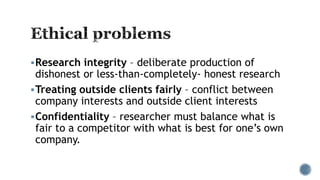
Research integrity – deliberate production of
dishonest or less-than-completely- honest research
Treating outside clients fairly – conflict between
company interests and outside client interests
Confidentiality – researcher must balance what is
fair to a competitor with what is best for one’s own
company.
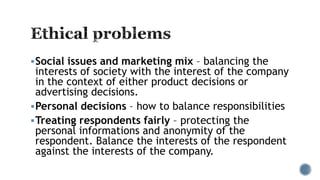
Social issues and marketing mix – balancing the
interests of society with the interest of the company
in the context of either product decisions or
advertising decisions.
Personal decisions – how to balance responsibilities
Treating respondents fairly – protecting the
personal informations and anonymity of the
respondent. Balance the interests of the respondent
against the interests of the company.
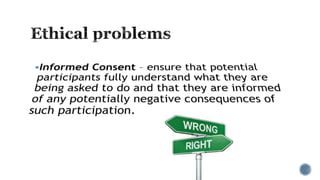
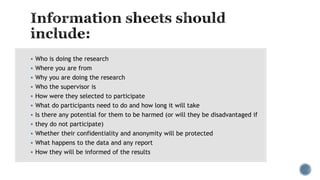
 Who is doing the research
 Where you are from
 Why you are doing the research
 Who the supervisor is
 How were they selected to participate
 What do participants need to do and how long it will take
 Is there any potential for them to be harmed (or will they be disadvantaged if
 they do not participate)
 Whether their confidentiality and anonymity will be protected
 What happens to the data and any report
 How they will be informed of the results
 Ariely, Dan. The new economics in the New World. The End of Rational Economics.
Harvard Business Review. 2009. www.hbr.org. Online. Accessed 5 March. 2014.
 Malhota and Gina L. Miller. An Integrated Model for Ethical Decisions in Marketing
Research. Journal of Business Ethics. 1998. www.springer.com. Online. Accessed 7
March. 2014.
 Sojka, Jane. Ethical concerns in marketing research. Washington State University:
1994. www.acrwebsite.org. Online. Accessed 6 March 2014.
 Masters and Dermand Media. Ethical Consideration of Marketing Research. Online.
www.smallbusiness.chron.com. Accessed 6 March 2014.
 Ethical Considerations. Journal Online. www.jstor.org. Accessed 5 March 2014
 Hunt, Lawrence B. Chonko, James B. Wilcox. Ethical Problems of Marketing
Researchers. Journal of Marketing Research. 1984. Online. www.jstor.org. Accessed
5 March 2014.

Ethical Issues in Marketing Research

  • 1.
    Dita Kovarikova Marketing ResearchMKT 375, Spring 2014 Course leader: Christopher M. G. Shallow
  • 2.
    Introduction Historical context ofethical issues in marketing Potential for harm and conflict Ethical conflict Code of Ethical Conduct Ethical problems Conclusion Sources
  • 3.
    The consideration ofethics in research, and general business for that matter, is of growing importance. It is, therefore, critical that you understand the basics of ethical research and how this might affect your research project.
  • 4.
    This is especiallyimportant if your research involves interaction with businesses or members of the general community who serves as participants (i.e. respondents) in your research.
  • 5.
    It is easierthan ever before for companies to connect directly with customers and collect individual information that goes into a computer database and can be matched to other pieces of data collected during unrelated transactions.
  • 6.
    Marketing research hasexperienced a resurgence with the widespread use of the internet and the popularity of social networking. Researchers are becoming closer in-term of intimacy as well as physical proximity-to their respondents.
  • 7.
    Ethical problems arerelationship kinds of problems. That is, ethical problems occur only when an individual interact with other people.
  • 8.
    In 1963 proposeda code of ethics by Dr. Dik Warren Twedt a Professor of Marketing and Quantitative Management Science at the University of Missouri in St. Louis. He was a marketing researcher and a member of the American Marketing Association.
  • 9.
    The code wasprompted by three main issues: 1) Desire to maintain public confidence in marketing research procedures 2) The need to self-regulate the discipline before outsiders decided marketing research needed regulation 3) The concern to maintain a positive public image of marketing in general.
  • 11.
  • 12.
    Simply…ethics address whethera particular action is right or wrong, good or bad.
  • 15.
    A researcher hasthe responsibility to treat respondents fairly in a research study and has a responsibility to the client to gather accurate, reliable information.
  • 17.
    Psychological harm: useof nudity in advertising may show participants images that offend them. Financial harm: researching, unethical behaviour within a given firm – an individual being fired, share sensitive information with a firm’s competitors – financial harm to the organization Social harm: researching how lifestyle affects consumption – disclose a person’s sexual orientation when that person wanted to keep this confidential.
  • 18.
    Ensure that you Behaveaccording to appropriate ethical standards Consider how your research might negatively affect participants Protect yourself, your supervisor/teachers and your institution from being placed in situations in which individuals could make claims of inappropriate behaviour, resulting in public criticism or even you being sued.
  • 21.
    There are variousethical codes of conduct that regulate researchers’ behaviour. These codes discuss many issues that potentially might arise in your research, as well as other issues associated with professional practice.
  • 22.
    American Marketing Association’s(AMA, 2009) – research-related issues and specifically states that members must ‘do not harm’ European Society for Opinion and Marketing Research’s (ESOMR, 2009) – researchers’ broad responsibilities. The American Psychological Association (APA, 2009) – a diverse range of research issues, many of which also relate to business research.
  • 24.
    Research integrity –deliberate production of dishonest or less-than-completely- honest research Treating outside clients fairly – conflict between company interests and outside client interests Confidentiality – researcher must balance what is fair to a competitor with what is best for one’s own company.
  • 25.
    Social issues andmarketing mix – balancing the interests of society with the interest of the company in the context of either product decisions or advertising decisions. Personal decisions – how to balance responsibilities Treating respondents fairly – protecting the personal informations and anonymity of the respondent. Balance the interests of the respondent against the interests of the company.
  • 27.
     Who isdoing the research  Where you are from  Why you are doing the research  Who the supervisor is  How were they selected to participate  What do participants need to do and how long it will take  Is there any potential for them to be harmed (or will they be disadvantaged if  they do not participate)  Whether their confidentiality and anonymity will be protected  What happens to the data and any report  How they will be informed of the results
  • 36.
     Ariely, Dan.The new economics in the New World. The End of Rational Economics. Harvard Business Review. 2009. www.hbr.org. Online. Accessed 5 March. 2014.  Malhota and Gina L. Miller. An Integrated Model for Ethical Decisions in Marketing Research. Journal of Business Ethics. 1998. www.springer.com. Online. Accessed 7 March. 2014.  Sojka, Jane. Ethical concerns in marketing research. Washington State University: 1994. www.acrwebsite.org. Online. Accessed 6 March 2014.  Masters and Dermand Media. Ethical Consideration of Marketing Research. Online. www.smallbusiness.chron.com. Accessed 6 March 2014.  Ethical Considerations. Journal Online. www.jstor.org. Accessed 5 March 2014  Hunt, Lawrence B. Chonko, James B. Wilcox. Ethical Problems of Marketing Researchers. Journal of Marketing Research. 1984. Online. www.jstor.org. Accessed 5 March 2014.