Managing Marketing Information
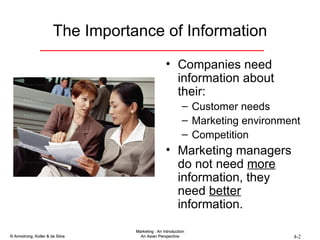
The Importance of Information Companies need information about their: Customer needs Marketing environment Competition Marketing managers do not need  more  information, they need  better  information.
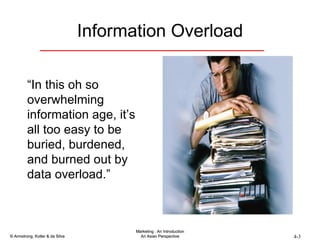
Information Overload “ In this oh so overwhelming information age, it’s all too easy to be buried, burdened, and burned out by data overload.”
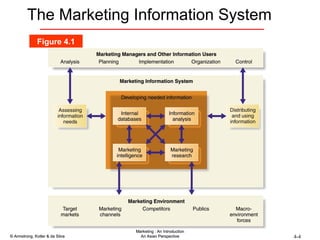
The Marketing Information System Figure 4.1
Marketing Information System An MIS consists of people, equipment, and procedures to gather, sort, analyze, evaluate, and distribute needed, timely, and accurate information to marketing decision makers. The MIS helps managers to:  Assess Information Needs Develop Needed Information Distribute Information
Assessing Information Needs A good MIS balances the information users would  like  against what they really  need  and what is  feasible  to offer. Sometimes the company cannot provide the needed information because it is not available or due to MIS limitations. Have to decide whether the benefits of more information are worth the costs.
Developing Marketing Information Internal Databases :  Electronic collections of information obtained from data sources within the company. Marketing Intelligence : Systematic collection and analysis of publicly available information about competitors and developments in the marketing environment. Marketing Research : Systematic design, collection, analysis, and reporting of data relevant to a specific marketing situation facing an organization.
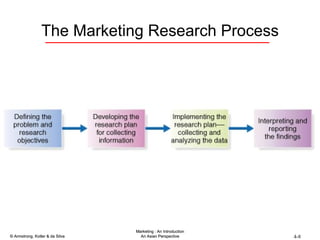
The Marketing Research Process
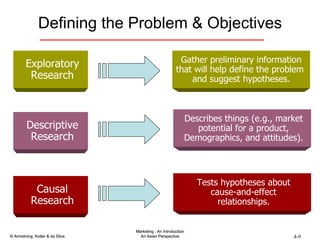
Defining the Problem & Objectives Gather preliminary information  that will help define the problem  and suggest hypotheses. Exploratory Research Descriptive Research Causal Research Describes things (e.g., market potential for a product, Demographics, and attitudes). Tests hypotheses about cause-and-effect relationships.
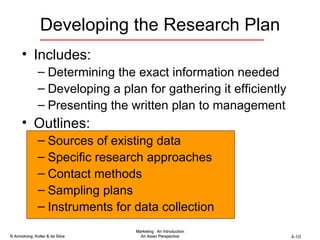
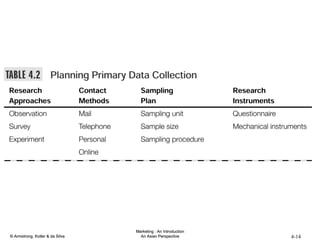
Developing the Research Plan Includes: Determining the exact information needed Developing a plan for gathering it efficiently Presenting the written plan to management Outlines: Sources of existing data Specific research approaches Contact methods Sampling plans Instruments for data collection
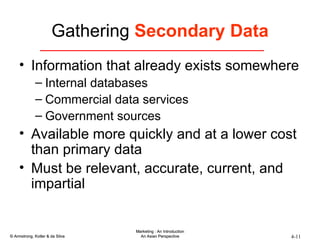
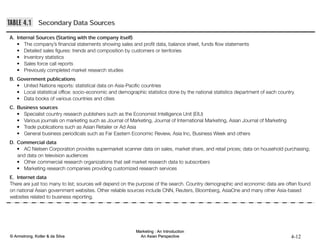
Gathering  Secondary Data Information that already exists somewhere Internal databases Commercial data services Government sources Available more quickly and at a lower cost than primary data Must be relevant, accurate, current, and impartial
 
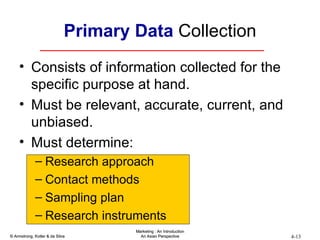
Primary Data  Collection Consists of information collected for the specific purpose at hand. Must be relevant, accurate, current, and unbiased. Must determine: Research approach Contact methods Sampling plan Research instruments
 
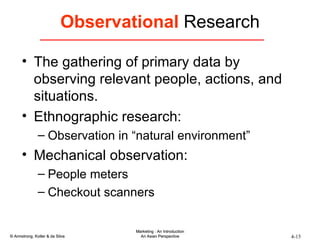
Observational  Research The gathering of primary data by observing relevant people, actions, and situations. Ethnographic research: Observation in “natural environment” Mechanical observation: People meters Checkout scanners
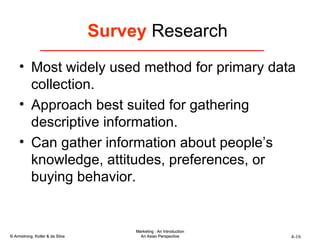
Survey  Research  Most widely used method for primary data collection. Approach best suited for gathering descriptive information. Can gather information about people’s knowledge, attitudes, preferences, or buying behavior.
Experimental  Research Tries to explain cause-and-effect relationships. Involves: selecting matched groups of subjects,  giving different treatments,  controlling unrelated factors, and  checking differences in group responses.
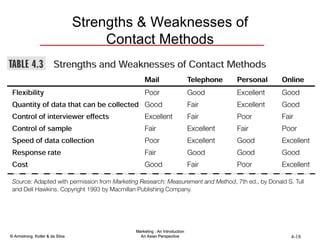
Strengths & Weaknesses of Contact Methods
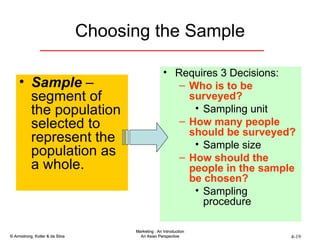
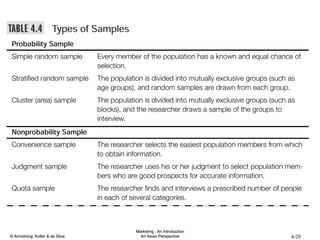
Choosing the Sample Sample  – segment of the population selected to represent the population as a whole. Requires 3 Decisions: Who is to be surveyed? Sampling unit  How many people should be surveyed? Sample size How should the people in the sample be chosen? Sampling procedure
 
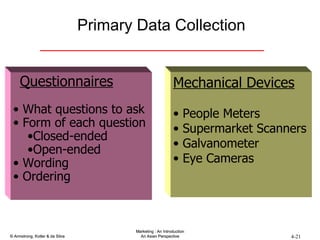
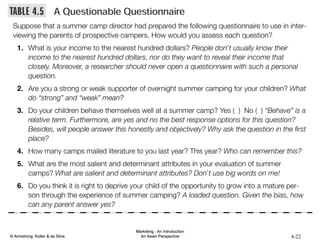
Primary Data Collection Mechanical Devices People Meters Supermarket Scanners Galvanometer Eye Cameras Questionnaires What questions to ask Form of each question Closed-ended Open-ended Wording Ordering Research Instruments
 
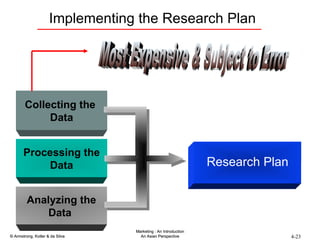
Implementing the Research Plan Collecting the  Data Processing the Data Analyzing the Data   Research Plan Most Expensive & Subject to Error
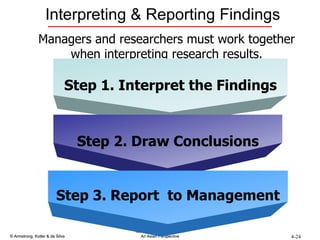
Interpreting & Reporting Findings Managers and researchers must work together when interpreting research results. Step 1. Interpret the Findings Step 2. Draw Conclusions Step 3. Report  to Management
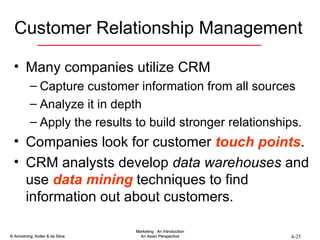
Customer Relationship Management Many companies utilize CRM Capture customer information from all sources Analyze it in depth Apply the results to build stronger relationships. Companies look for customer  touch points . CRM analysts develop  data warehouses  and use  data mining  techniques to find information out about customers.
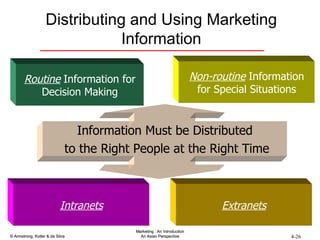
Distributing and Using Marketing Information Information Must be Distributed  to the Right People at the Right Time Routine   Information for Decision Making Non-routine   Information for Special Situations Intranets Extranets
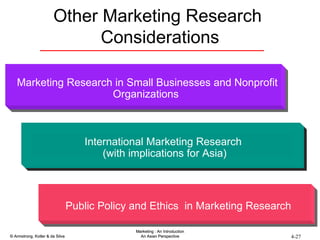
Other Marketing Research  Considerations Marketing Research in Small Businesses and Nonprofit Organizations   International Marketing Research  (with implications for Asia) Public Policy and Ethics  in Marketing Research

MARKETING-CH3

  • 1.
  • 2.
    The Importance ofInformation Companies need information about their: Customer needs Marketing environment Competition Marketing managers do not need more information, they need better information.
  • 3.
    Information Overload “In this oh so overwhelming information age, it’s all too easy to be buried, burdened, and burned out by data overload.”
  • 4.
    The Marketing InformationSystem Figure 4.1
  • 5.
    Marketing Information SystemAn MIS consists of people, equipment, and procedures to gather, sort, analyze, evaluate, and distribute needed, timely, and accurate information to marketing decision makers. The MIS helps managers to: Assess Information Needs Develop Needed Information Distribute Information
  • 6.
    Assessing Information NeedsA good MIS balances the information users would like against what they really need and what is feasible to offer. Sometimes the company cannot provide the needed information because it is not available or due to MIS limitations. Have to decide whether the benefits of more information are worth the costs.
  • 7.
    Developing Marketing InformationInternal Databases : Electronic collections of information obtained from data sources within the company. Marketing Intelligence : Systematic collection and analysis of publicly available information about competitors and developments in the marketing environment. Marketing Research : Systematic design, collection, analysis, and reporting of data relevant to a specific marketing situation facing an organization.
  • 8.
  • 9.
    Defining the Problem& Objectives Gather preliminary information that will help define the problem and suggest hypotheses. Exploratory Research Descriptive Research Causal Research Describes things (e.g., market potential for a product, Demographics, and attitudes). Tests hypotheses about cause-and-effect relationships.
  • 10.
    Developing the ResearchPlan Includes: Determining the exact information needed Developing a plan for gathering it efficiently Presenting the written plan to management Outlines: Sources of existing data Specific research approaches Contact methods Sampling plans Instruments for data collection
  • 11.
    Gathering SecondaryData Information that already exists somewhere Internal databases Commercial data services Government sources Available more quickly and at a lower cost than primary data Must be relevant, accurate, current, and impartial
  • 12.
  • 13.
    Primary Data Collection Consists of information collected for the specific purpose at hand. Must be relevant, accurate, current, and unbiased. Must determine: Research approach Contact methods Sampling plan Research instruments
  • 14.
  • 15.
    Observational ResearchThe gathering of primary data by observing relevant people, actions, and situations. Ethnographic research: Observation in “natural environment” Mechanical observation: People meters Checkout scanners
  • 16.
    Survey Research Most widely used method for primary data collection. Approach best suited for gathering descriptive information. Can gather information about people’s knowledge, attitudes, preferences, or buying behavior.
  • 17.
    Experimental ResearchTries to explain cause-and-effect relationships. Involves: selecting matched groups of subjects, giving different treatments, controlling unrelated factors, and checking differences in group responses.
  • 18.
    Strengths & Weaknessesof Contact Methods
  • 19.
    Choosing the SampleSample – segment of the population selected to represent the population as a whole. Requires 3 Decisions: Who is to be surveyed? Sampling unit How many people should be surveyed? Sample size How should the people in the sample be chosen? Sampling procedure
  • 20.
  • 21.
    Primary Data CollectionMechanical Devices People Meters Supermarket Scanners Galvanometer Eye Cameras Questionnaires What questions to ask Form of each question Closed-ended Open-ended Wording Ordering Research Instruments
  • 22.
  • 23.
    Implementing the ResearchPlan Collecting the Data Processing the Data Analyzing the Data Research Plan Most Expensive & Subject to Error
  • 24.
    Interpreting & ReportingFindings Managers and researchers must work together when interpreting research results. Step 1. Interpret the Findings Step 2. Draw Conclusions Step 3. Report to Management
  • 25.
    Customer Relationship ManagementMany companies utilize CRM Capture customer information from all sources Analyze it in depth Apply the results to build stronger relationships. Companies look for customer touch points . CRM analysts develop data warehouses and use data mining techniques to find information out about customers.
  • 26.
    Distributing and UsingMarketing Information Information Must be Distributed to the Right People at the Right Time Routine Information for Decision Making Non-routine Information for Special Situations Intranets Extranets
  • 27.
    Other Marketing Research Considerations Marketing Research in Small Businesses and Nonprofit Organizations International Marketing Research (with implications for Asia) Public Policy and Ethics in Marketing Research