INTRODUCTIONTO
IMMUNOLOGY
Immunotechnology
By Dr. B.P. Nayak.
INTRODUCTIONTO
IMMUNOLOGY
IMMUNOLOGY ANDTHE IMMUNE
SYSTEM
 Immunology
 Study of the components and function of the immune
system
 Immune System
 Molecules, cells, tissues and organs which provide non-
specific and specific protection against
 Microorganisms
 Microbial toxins
 Tumor cells
 Crucial to human survival
THE IMMUNE RESPONSE AND
IMMUNITY
 Immune response
 Innate (non-specific)
 Adaptive (specific)
 Primary
 Secondary
 Immunity
 State of non-specific and specific protection
 Acquisition of Immunity
 Natural
 Artificial
NATURALLY ACQUIRED IMMUNITY
 Active
 Antigens enter body naturally with response of
 Innate and adaptive immune systems
 Provides long term protection
 Passive
 Antibodies pass from mother to
 Fetus across placenta
 Infant in breast milk
 Provides immediate short term protection
ARTIFICIALLY ACQUIRED IMMUNITY
 Active
 Antigens enter body through vaccination with response of
 Innate and adaptive immune systems
 Provides long term protection
 Passive
 Antibodies from immune individuals injected into body
 Referred to as
 Immune serum globulins (ISG)
 Immune globulins (IG)
 Gamma globulins
 Provides immediate short term protection
PRINCIPAL FUNCTION OFTHE
IMMUNE SYSTEM
To protect humans from pathogenic microorganisms
 Pathogenic microorganisms (Pathogens)
 Microorganisms capable of causing infection and/or
disease
 Infection
 Ability of pathogen to enter host, multiply and stimulate
an immune response
 Disease
 Clinical manifestations associated with infection
PRINCIPAL FUNCTION OFTHE
IMMUNE SYSTEM
Defense against the growth of tumor cells
 kills the growth of tumor cells
Homeostasis
 destruction of abnormal or dead cells
(e.g. dead red or white blood cells, antigen-antibody
complex)
BACTERIA,VIRUSES, FUNGI,
PARASITES
 Streptococcus pyogenes (Group A Streptococcus)
 Klebsiella pneumoniae
 Mycobacterium tuberculosis
 Ebola virus
 Human Immunodeficiency Virus (HIV)
 Aspergillus fumigatus
 Candida albicans
 Cryptococcus neoformans
 Cryptosporidium parvum
 Stronglyoides stercoralis
 Ascaris lumbricoides
 Plasmodium falciparum
DEFENSE MECHANISMS OFTHE
HUMAN HOST
 Innate Mechanisms (Innate immunity)
 First line of defense
 Non-specific
 Adaptive Mechanisms (Adaptive immunity)
 Second line of defense
 Highly specific with memory
 Cooperation between mechanisms
CELLS OF IMMUNE SYSTEM
ORIGIN OF CELLS OFTHE IMMUNE
SYSTEM
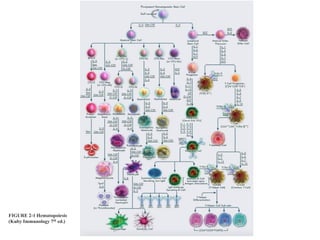
 Derived from common progenitor cell in bone marrow
 Pluripotent hematopoietic stem cell
 Progenitor Stem Cells
 Erythroid lineage
 Erythrocytes and Megakaryocytes
 Myeloid lineage
 Monocyte/macrophage, dendritic cells, PMN’s, mast cells
 Lymphoid lineage
 Small and large lymphocytes
FIGURE 2-1 Hematopoiesis
(Kuby Immunology 7th ed.)
CELLS OF INNATE AND ADAPTIVE
IMMUNITY
 Myeloid Lineage
 Neutrophil
 Eosinophil
 Basophil
 Functions similar to eosinophils and mast cells
Referred to as
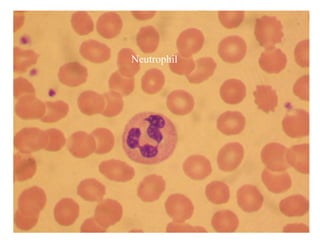
 Polymorphonuclear leukocytes (PMN’s)
 Nuclei are multilobed (2 to 5)
 Granulocytes
 Cytoplasmic granules
CELLS OF INNATE AND ADAPTIVE
IMMUNITY
 Myeloid Lineage
 Neutrophil
 Principal phagocytic cell of innate immunity
 Eosinophil
 Principal defender against parasites
 Basophil
 Functions similar to eosinophils and mast cells
Referred to as
 Polymorphonuclear leukocytes (PMN’s)
 Nuclei are multilobed (2 to 5)
 Granulocytes
 Cytoplasmic granules
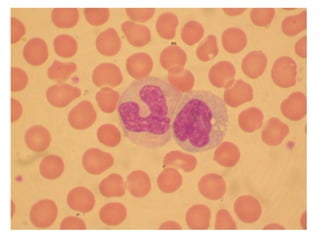
Neutrophil
Eosinophil
Basophil
CELLS OF INNATE AND ADAPTIVE
IMMUNITY
 Myeloid lineage
 Monocytes
 Leukocytes with bean shaped or brain-like convoluted nuclei
 Circulate in blood with half life of 8 hours
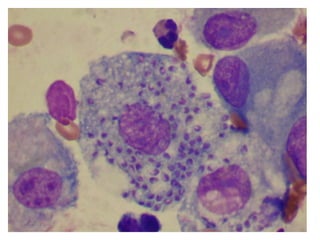
 Macrophages
 Mononuclear phagocytic cells in tissue
 Derive from blood monocytes
CELLS OF INNATE AND ADAPTIVE
IMMUNITY
 Myeloid lineage
 Monocytes
 Leukocytes with bean shaped or brain-like convoluted nuclei
 Circulate in blood with half life of 8 hours
 Precursors of tissue macrophages
 Macrophages
 Mononuclear phagocytic cells in tissue
 Derive from blood monocytes
 Participate in innate and adaptive immunity
CELLS OF INNATE AND ADAPTIVE
IMMUNITY
Myeloid lineage
 Dendritic cells
 Cells with dendriform (star shaped)
morphology
 Mast cells
 Located in mucous membrane and connective
tissue throughout body
CELLS OF INNATE AND ADAPTIVE
IMMUNITY
 Myeloid lineage
 Dendritic cells
 Cells with dendriform (star shaped) morphology
 Interdigitating reticular cells (synonym)
 Capture and present antigens toT lymphocytes
 Mast cells
 Located in mucous membrane and connective tissue
throughout body
 Major effector cell in allergy
 Modulation of initial immune response
CELLS OF INNATE AND ADAPTIVE
IMMUNITY
 Lymphoid Lineage
 Large lymphocytes (large granular lymphocytes)
 Natural killer (NK) cells (CD16, CD56)
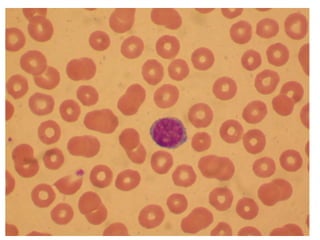
 Small lymphocytes
 B cells (CD19)
 T cells (CD3, CD4 or CD8)
 Lymphocytes refers to small lymphocytes
CELLS OF INNATE AND ADAPTIVE
IMMUNITY
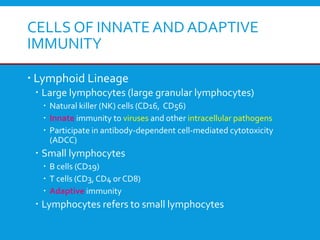
 Lymphoid Lineage
 Large lymphocytes (large granular lymphocytes)
 Natural killer (NK) cells (CD16, CD56)
 Innate immunity to viruses and other intracellular pathogens
 Participate in antibody-dependent cell-mediated cytotoxicity
(ADCC)
 Small lymphocytes
 B cells (CD19)
 T cells (CD3, CD4 or CD8)
 Adaptive immunity
 Lymphocytes refers to small lymphocytes
THE CLUSTER OF DIFFERENTIATION
(CD)
 A protocol for identification and investigation of cell surface
molecules
 CD number assigned on basis of 1 cell surface molecule
recognized by 2 specific monoclonal antibodies
 CD nomenclature established in 1982
 1st International Workshop and Conference on Human Leukocyte
DifferentiationAntigens (HLDA)
THE CLUSTER OF DIFFERENTIATION
(CD)
 CD markers on leukocytes
Granulocyte CD45+, CD15+
Monocyte CD45+, CD14+
T lymphocyte CD45+, CD3+
T helper lymphocyte CD45+, CD3+, CD4+
T cytotoxic lymphocyte CD45+, CD3+, CD8+
B lymphocyte CD45+, CD19+
Natural killer cell CD45+, CD16+, CD56+, CD3-
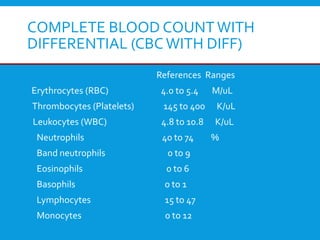
COMPLETE BLOOD COUNTWITH
DIFFERENTIAL (CBCWITH DIFF)
References Ranges
Erythrocytes (RBC) 4.0 to 5.4 M/uL
Thrombocytes (Platelets) 145 to 400 K/uL
Leukocytes (WBC) 4.8 to 10.8 K/uL
Neutrophils 40 to 74 %
Band neutrophils 0 to 9
Eosinophils 0 to 6
Basophils 0 to 1
Lymphocytes 15 to 47
Monocytes 0 to 12
ORGANS OF IMMUNE SYSTEM
LYMPHOCYTES, LYMPHOID
TISSUES AND ORGANS
 Lymphocytes originate in bone marrow
 Lymphoid tissues and organs
 Primary
 Development and maturation of lymphocytes
 Secondary
 Mature lymphocytes meet pathogens
LYMPHOCYTES, LYMPHOID
TISSUES AND ORGANS
 Lymphocytes originate in bone marrow
 Lymphoid tissues and organs
 Primary
 Development and maturation of lymphocytes
 Bone Marrow (B cells) and thymus gland (T cells)
 Secondary
 Mature lymphocytes meet pathogens
 Spleen, adenoids, tonsils, appendix, lymph nodes, Peyer’s
patches, mucosa-associated lymphoid tissue (MALT)
THE LYMPHATIC SYSTEM
 Lymph
 Fluid and cells in lymphatic vessels
 Lymphatic vessels
 Lymph nodes
 Kidney shaped organs at intervals along lymphatic
vessels
 Other secondary lymphatic tissues and organs
THE LYMPHATIC SYSTEM
 Lymph
 Fluid and cells in lymphatic vessels
 Lymphatic vessels
 Collect and return interstitial fluid to blood
 Transport immune cells throughout body
 Transport lipid from intestine to blood
 Lymph nodes
 Kidney shaped organs at intervals along lymphatic vessels
 Other secondary lymphatic tissues and organs
LYMPHOCYTES ANDTHE LYMPH
NODES
 Naïve lymphocytes circulate between blood, lymph and
secondary lymph nodes
 Pathogens from infected tissue sites are picked up by lymphatic
vessels and arrive at closest lymph node
 T and B cells congregate at specific regions of nodes
 Architecture and size of nodes change in response to activation
of lymphocytes
LYMPHOCYTES ANDTHE SPLEEN
 Spleen
 Lymphoid organ in upper left abdomen
 Architecture of Spleen
 Red pulp
 Erythrocytes removed
 White pulp
 Lymphocytes stimulated
LYMPHOCYTES ANDTHE SPLEEN
 Spleen
 Lymphoid organ in upper left abdomen
 Functions
 Remove damaged or old erythrocytes
 Activation of lymphocytes from blood borne pathogens
 Architecture of Spleen
 Red pulp
 Erythrocytes removed
 White pulp
 Lymphocytes stimulated
SECONDARY LYMPHOIDTISSUES
ASSOCIATEDWITH MUCOUS
MEMBRANES
 Primary portals of entry for pathogens
 Respiratory tract
 Gastrointestinal tract
 Secondary lymphoid tissues
 Bronchial-associated lymphoid tissue (BALT)
 Gut-associated lymphoid tissues (GALT)
 Tonsils, adenoids, appendix, Peyer’s patches
 Pathogens are directly transferred across mucosa by “M”
cells
MOLECULES OF IMMUNE SYSTEM
MOLECULES
 Antibodies
 Complements
 Cytokines
 Interleukines
 Interferons
IMMUNE RESPONSE
INNATE
THE INNATE IMMUNE RESPONSE
 Mediated (initiated) by phagocytes, NK cells and soluble
proteins
 Phagocytes
 Cells specialized in the process of phagocytosis
 Macrophages
 Reside in tissues and recruit neutrophils
 Neutrophils
 Enter infected tissues in large numbers
 Recognize common molecules of bacterial cell surface
using a few surface receptors
 Phagocytosis
 Capture, engulfment and breakdown of bacterial
pathogen
THE INNATE IMMUNE RESPONSE
 Inflammatory response enhances phagocytosis through
acute phase proteins
 Mannose-binding lectin (MBL)
 Binds to bacterial surface with particular spatial arrangement of
mannose or fucose
 C-reactive protein (CRP)
 Binds to phosphorylcholine on bacterial surface
 Complement
 Set of proteins which bind to bacterial surface
 Inflammatory response
 Accumulation of fluid and cells at infection site (swelling,
redness, heat and pain)
ADAPTIVE
ANTIGEN & ANTIBODY
REFER TO ANTIBODY SLIDE
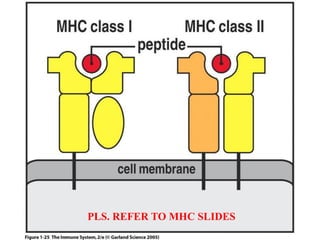
PLS. REFER TO MHC SLIDES

L1 Immunology.pdf

  • 1.
  • 2.
  • 3.
    IMMUNOLOGY ANDTHE IMMUNE SYSTEM Immunology  Study of the components and function of the immune system  Immune System  Molecules, cells, tissues and organs which provide non- specific and specific protection against  Microorganisms  Microbial toxins  Tumor cells  Crucial to human survival
  • 4.
    THE IMMUNE RESPONSEAND IMMUNITY  Immune response  Innate (non-specific)  Adaptive (specific)  Primary  Secondary  Immunity  State of non-specific and specific protection  Acquisition of Immunity  Natural  Artificial
  • 5.
    NATURALLY ACQUIRED IMMUNITY Active  Antigens enter body naturally with response of  Innate and adaptive immune systems  Provides long term protection  Passive  Antibodies pass from mother to  Fetus across placenta  Infant in breast milk  Provides immediate short term protection
  • 6.
    ARTIFICIALLY ACQUIRED IMMUNITY Active  Antigens enter body through vaccination with response of  Innate and adaptive immune systems  Provides long term protection  Passive  Antibodies from immune individuals injected into body  Referred to as  Immune serum globulins (ISG)  Immune globulins (IG)  Gamma globulins  Provides immediate short term protection
  • 7.
    PRINCIPAL FUNCTION OFTHE IMMUNESYSTEM To protect humans from pathogenic microorganisms  Pathogenic microorganisms (Pathogens)  Microorganisms capable of causing infection and/or disease  Infection  Ability of pathogen to enter host, multiply and stimulate an immune response  Disease  Clinical manifestations associated with infection
  • 8.
    PRINCIPAL FUNCTION OFTHE IMMUNESYSTEM Defense against the growth of tumor cells  kills the growth of tumor cells Homeostasis  destruction of abnormal or dead cells (e.g. dead red or white blood cells, antigen-antibody complex)
  • 9.
    BACTERIA,VIRUSES, FUNGI, PARASITES  Streptococcuspyogenes (Group A Streptococcus)  Klebsiella pneumoniae  Mycobacterium tuberculosis  Ebola virus  Human Immunodeficiency Virus (HIV)  Aspergillus fumigatus  Candida albicans  Cryptococcus neoformans  Cryptosporidium parvum  Stronglyoides stercoralis  Ascaris lumbricoides  Plasmodium falciparum
  • 10.
    DEFENSE MECHANISMS OFTHE HUMANHOST  Innate Mechanisms (Innate immunity)  First line of defense  Non-specific  Adaptive Mechanisms (Adaptive immunity)  Second line of defense  Highly specific with memory  Cooperation between mechanisms
  • 11.
  • 12.
    ORIGIN OF CELLSOFTHE IMMUNE SYSTEM  Derived from common progenitor cell in bone marrow  Pluripotent hematopoietic stem cell  Progenitor Stem Cells  Erythroid lineage  Erythrocytes and Megakaryocytes  Myeloid lineage  Monocyte/macrophage, dendritic cells, PMN’s, mast cells  Lymphoid lineage  Small and large lymphocytes
  • 13.
    FIGURE 2-1 Hematopoiesis (KubyImmunology 7th ed.)
  • 15.
    CELLS OF INNATEAND ADAPTIVE IMMUNITY  Myeloid Lineage  Neutrophil  Eosinophil  Basophil  Functions similar to eosinophils and mast cells Referred to as  Polymorphonuclear leukocytes (PMN’s)  Nuclei are multilobed (2 to 5)  Granulocytes  Cytoplasmic granules
  • 16.
    CELLS OF INNATEAND ADAPTIVE IMMUNITY  Myeloid Lineage  Neutrophil  Principal phagocytic cell of innate immunity  Eosinophil  Principal defender against parasites  Basophil  Functions similar to eosinophils and mast cells Referred to as  Polymorphonuclear leukocytes (PMN’s)  Nuclei are multilobed (2 to 5)  Granulocytes  Cytoplasmic granules
  • 17.
  • 18.
  • 19.
  • 23.
    CELLS OF INNATEAND ADAPTIVE IMMUNITY  Myeloid lineage  Monocytes  Leukocytes with bean shaped or brain-like convoluted nuclei  Circulate in blood with half life of 8 hours  Macrophages  Mononuclear phagocytic cells in tissue  Derive from blood monocytes
  • 24.
    CELLS OF INNATEAND ADAPTIVE IMMUNITY  Myeloid lineage  Monocytes  Leukocytes with bean shaped or brain-like convoluted nuclei  Circulate in blood with half life of 8 hours  Precursors of tissue macrophages  Macrophages  Mononuclear phagocytic cells in tissue  Derive from blood monocytes  Participate in innate and adaptive immunity
  • 31.
    CELLS OF INNATEAND ADAPTIVE IMMUNITY Myeloid lineage  Dendritic cells  Cells with dendriform (star shaped) morphology  Mast cells  Located in mucous membrane and connective tissue throughout body
  • 32.
    CELLS OF INNATEAND ADAPTIVE IMMUNITY  Myeloid lineage  Dendritic cells  Cells with dendriform (star shaped) morphology  Interdigitating reticular cells (synonym)  Capture and present antigens toT lymphocytes  Mast cells  Located in mucous membrane and connective tissue throughout body  Major effector cell in allergy  Modulation of initial immune response
  • 37.
    CELLS OF INNATEAND ADAPTIVE IMMUNITY  Lymphoid Lineage  Large lymphocytes (large granular lymphocytes)  Natural killer (NK) cells (CD16, CD56)  Small lymphocytes  B cells (CD19)  T cells (CD3, CD4 or CD8)  Lymphocytes refers to small lymphocytes
  • 38.
    CELLS OF INNATEAND ADAPTIVE IMMUNITY  Lymphoid Lineage  Large lymphocytes (large granular lymphocytes)  Natural killer (NK) cells (CD16, CD56)  Innate immunity to viruses and other intracellular pathogens  Participate in antibody-dependent cell-mediated cytotoxicity (ADCC)  Small lymphocytes  B cells (CD19)  T cells (CD3, CD4 or CD8)  Adaptive immunity  Lymphocytes refers to small lymphocytes
  • 39.
    THE CLUSTER OFDIFFERENTIATION (CD)  A protocol for identification and investigation of cell surface molecules  CD number assigned on basis of 1 cell surface molecule recognized by 2 specific monoclonal antibodies  CD nomenclature established in 1982  1st International Workshop and Conference on Human Leukocyte DifferentiationAntigens (HLDA)
  • 40.
    THE CLUSTER OFDIFFERENTIATION (CD)  CD markers on leukocytes Granulocyte CD45+, CD15+ Monocyte CD45+, CD14+ T lymphocyte CD45+, CD3+ T helper lymphocyte CD45+, CD3+, CD4+ T cytotoxic lymphocyte CD45+, CD3+, CD8+ B lymphocyte CD45+, CD19+ Natural killer cell CD45+, CD16+, CD56+, CD3-
  • 44.
    COMPLETE BLOOD COUNTWITH DIFFERENTIAL(CBCWITH DIFF) References Ranges Erythrocytes (RBC) 4.0 to 5.4 M/uL Thrombocytes (Platelets) 145 to 400 K/uL Leukocytes (WBC) 4.8 to 10.8 K/uL Neutrophils 40 to 74 % Band neutrophils 0 to 9 Eosinophils 0 to 6 Basophils 0 to 1 Lymphocytes 15 to 47 Monocytes 0 to 12
  • 45.
  • 46.
    LYMPHOCYTES, LYMPHOID TISSUES ANDORGANS  Lymphocytes originate in bone marrow  Lymphoid tissues and organs  Primary  Development and maturation of lymphocytes  Secondary  Mature lymphocytes meet pathogens
  • 47.
    LYMPHOCYTES, LYMPHOID TISSUES ANDORGANS  Lymphocytes originate in bone marrow  Lymphoid tissues and organs  Primary  Development and maturation of lymphocytes  Bone Marrow (B cells) and thymus gland (T cells)  Secondary  Mature lymphocytes meet pathogens  Spleen, adenoids, tonsils, appendix, lymph nodes, Peyer’s patches, mucosa-associated lymphoid tissue (MALT)
  • 49.
    THE LYMPHATIC SYSTEM Lymph  Fluid and cells in lymphatic vessels  Lymphatic vessels  Lymph nodes  Kidney shaped organs at intervals along lymphatic vessels  Other secondary lymphatic tissues and organs
  • 50.
    THE LYMPHATIC SYSTEM Lymph  Fluid and cells in lymphatic vessels  Lymphatic vessels  Collect and return interstitial fluid to blood  Transport immune cells throughout body  Transport lipid from intestine to blood  Lymph nodes  Kidney shaped organs at intervals along lymphatic vessels  Other secondary lymphatic tissues and organs
  • 51.
    LYMPHOCYTES ANDTHE LYMPH NODES Naïve lymphocytes circulate between blood, lymph and secondary lymph nodes  Pathogens from infected tissue sites are picked up by lymphatic vessels and arrive at closest lymph node  T and B cells congregate at specific regions of nodes  Architecture and size of nodes change in response to activation of lymphocytes
  • 54.
    LYMPHOCYTES ANDTHE SPLEEN Spleen  Lymphoid organ in upper left abdomen  Architecture of Spleen  Red pulp  Erythrocytes removed  White pulp  Lymphocytes stimulated
  • 55.
    LYMPHOCYTES ANDTHE SPLEEN Spleen  Lymphoid organ in upper left abdomen  Functions  Remove damaged or old erythrocytes  Activation of lymphocytes from blood borne pathogens  Architecture of Spleen  Red pulp  Erythrocytes removed  White pulp  Lymphocytes stimulated
  • 57.
    SECONDARY LYMPHOIDTISSUES ASSOCIATEDWITH MUCOUS MEMBRANES Primary portals of entry for pathogens  Respiratory tract  Gastrointestinal tract  Secondary lymphoid tissues  Bronchial-associated lymphoid tissue (BALT)  Gut-associated lymphoid tissues (GALT)  Tonsils, adenoids, appendix, Peyer’s patches  Pathogens are directly transferred across mucosa by “M” cells
  • 59.
  • 60.
    MOLECULES  Antibodies  Complements Cytokines  Interleukines  Interferons
  • 61.
  • 62.
  • 63.
    THE INNATE IMMUNERESPONSE  Mediated (initiated) by phagocytes, NK cells and soluble proteins  Phagocytes  Cells specialized in the process of phagocytosis  Macrophages  Reside in tissues and recruit neutrophils  Neutrophils  Enter infected tissues in large numbers  Recognize common molecules of bacterial cell surface using a few surface receptors  Phagocytosis  Capture, engulfment and breakdown of bacterial pathogen
  • 65.
    THE INNATE IMMUNERESPONSE  Inflammatory response enhances phagocytosis through acute phase proteins  Mannose-binding lectin (MBL)  Binds to bacterial surface with particular spatial arrangement of mannose or fucose  C-reactive protein (CRP)  Binds to phosphorylcholine on bacterial surface  Complement  Set of proteins which bind to bacterial surface  Inflammatory response  Accumulation of fluid and cells at infection site (swelling, redness, heat and pain)
  • 67.
  • 69.
    ANTIGEN & ANTIBODY REFERTO ANTIBODY SLIDE
  • 70.
    PLS. REFER TOMHC SLIDES