‫الرحيم‬ ‫الرحمن‬ ‫اللة‬ ‫بسم‬‫الرحيم‬ ‫الرحمن‬ ‫اللة‬ ‫بسم‬
Innate ImmunityInnate Immunity
PRESENTER
Shakira
Ghazanfar
PhDScholar
Shakira_sulehri@yahoo.com
‫الرحيم‬ ‫الرحمن‬ ‫اللة‬ ‫بسم‬‫الرحيم‬ ‫الرحمن‬ ‫اللة‬ ‫بسم‬
Innate ImmunityInnate Immunity
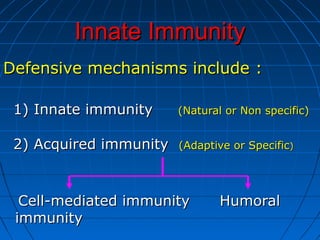
Defensive mechanisms include :Defensive mechanisms include :
1) Innate immunity1) Innate immunity (Natural or Non specific)(Natural or Non specific)
2) Acquired immunity2) Acquired immunity (Adaptive or Specific(Adaptive or Specific))
Cell-mediated immunity HumoralCell-mediated immunity Humoral
immunityimmunity
Component of Innate ImmunityComponent of Innate Immunity
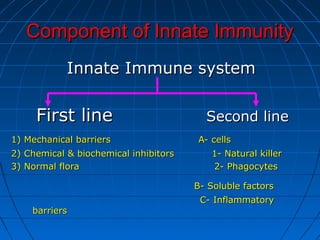
Innate Immune systemInnate Immune system
First lineFirst line Second lineSecond line
1) Mechanical barriers A- cells1) Mechanical barriers A- cells
2) Chemical & biochemical inhibitors 1- Natural killer2) Chemical & biochemical inhibitors 1- Natural killer
3) Normal flora 2- Phagocytes3) Normal flora 2- Phagocytes
B- Soluble factorsB- Soluble factors
C- InflammatoryC- Inflammatory
barriersbarriers
First lineFirst line
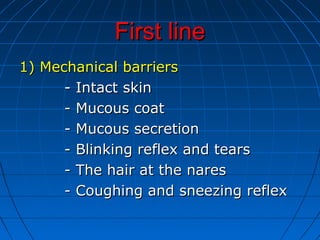
1) Mechanical barriers1) Mechanical barriers
- Intact skin- Intact skin
- Mucous coat- Mucous coat
- Mucous secretion- Mucous secretion
- Blinking reflex and tears- Blinking reflex and tears
- The hair at the nares- The hair at the nares
- Coughing and sneezing reflex- Coughing and sneezing reflex
First lineFirst line
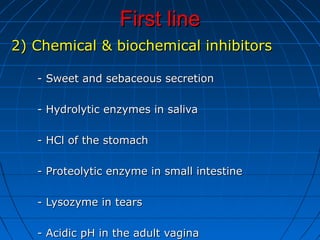
2) Chemical & biochemical inhibitors2) Chemical & biochemical inhibitors
- Sweet and sebaceous secretion- Sweet and sebaceous secretion
- Hydrolytic enzymes in saliva- Hydrolytic enzymes in saliva
- HCl of the stomach- HCl of the stomach
- Proteolytic enzyme in small intestine- Proteolytic enzyme in small intestine
- Lysozyme in tears- Lysozyme in tears
- Acidic pH in the adult vagina- Acidic pH in the adult vagina
First lineFirst line
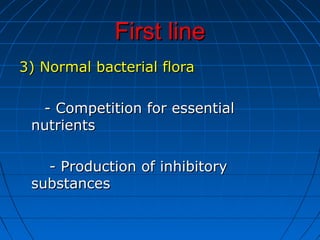
3) Normal bacterial flora3) Normal bacterial flora
- Competition for essential- Competition for essential
nutrientsnutrients
- Production of inhibitory- Production of inhibitory
substancessubstances
Second lineSecond line
A) cellsA) cells
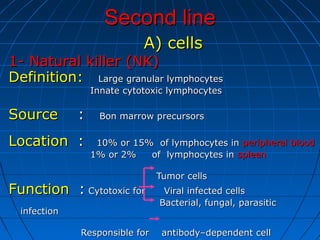
1- Natural killer (NK)1- Natural killer (NK)
Definition:Definition: Large granular lymphocytesLarge granular lymphocytes
Innate cytotoxic lymphocytesInnate cytotoxic lymphocytes
SourceSource :: Bon marrow precursorsBon marrow precursors
LocationLocation :: 10% or 15% of lymphocytes in10% or 15% of lymphocytes in peripheral bloodperipheral blood
1% or 2% of lymphocytes in1% or 2% of lymphocytes in spleenspleen
Tumor cellsTumor cells
FunctionFunction :: Cytotoxic for Viral infected cellsCytotoxic for Viral infected cells
Bacterial, fungal, parasiticBacterial, fungal, parasitic
infectioninfection
Responsible for antibody–dependent cellResponsible for antibody–dependent cell
Second lineSecond line
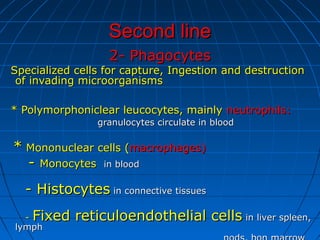
2- Phagocytes2- Phagocytes
Specialized cells for capture, Ingestion and destructionSpecialized cells for capture, Ingestion and destruction
of invading microorganismsof invading microorganisms
* Polymorphoniclear leucocytes, mainly* Polymorphoniclear leucocytes, mainly neutrophils:neutrophils:
granulocytes circulate in bloodgranulocytes circulate in blood
** Mononuclear cells (Mononuclear cells (macrophages)macrophages)
-- MonocytesMonocytes in bloodin blood
- Histocytes- Histocytes in connective tissuesin connective tissues
-- Fixed reticuloendothelial cellsFixed reticuloendothelial cells in liver spleen,in liver spleen,
lymphlymph
Second lineSecond line
B- Soluble factorsB- Soluble factors
1- Acute phase protein1- Acute phase protein (Plasma protein,(Plasma protein,
CRP=C reactive protein, Fibrin.)CRP=C reactive protein, Fibrin.)
2- Complement2- Complement (proteins in serum,(proteins in serum,
body fluids)body fluids)
2- Interferons2- Interferons (Proteins against viral(Proteins against viral
infections)infections)
3- Properdin3- Properdin (Complement(Complement
activation)activation)
4- Beta lysine4- Beta lysine (Antibacterial protein(Antibacterial protein
from Platelets)from Platelets)
InterferonsInterferons
Proteins usually produced by virally infected cellsProteins usually produced by virally infected cells
* Types of interferons:* Types of interferons:
1- Alpha interferon1- Alpha interferon Secreted by MacrophagesSecreted by Macrophages
Induced by Viruses or PolynucleotideInduced by Viruses or Polynucleotide
2- Beta interferon2- Beta interferon Secreted by Fibroblasts, VirusesSecreted by Fibroblasts, Viruses
3- Gamma interferon3- Gamma interferon T- lymphocytes, Specific antigensT- lymphocytes, Specific antigens
InterferonsInterferons
Protective action of interferons:Protective action of interferons:
1) Activate T-cells1) Activate T-cells
2) Activate macrophages2) Activate macrophages
3) Activate NK3) Activate NK
PhagocytosisPhagocytosis
The engulfment, digestion, and subsequent processingThe engulfment, digestion, and subsequent processing
of microorganisms by macrophages and neutrophilsof microorganisms by macrophages and neutrophils
1) Chemotaxis & attachment:1) Chemotaxis & attachment:
a- Attraction by chemotactic substancesa- Attraction by chemotactic substances
(microbes, damaged tissues)(microbes, damaged tissues)
b- Attachment by receptors on surfacesb- Attachment by receptors on surfaces
PhagocytosisPhagocytosis
2) Ingestion:2) Ingestion:
* Phagocyte pseudopodia surround* Phagocyte pseudopodia surround
organism forming phagosomorganism forming phagosom
* Opsinins and co-factors enhance* Opsinins and co-factors enhance
phagocytosisphagocytosis
* Fusion with phagocyte granules and* Fusion with phagocyte granules and
releaserelease
digestive, toxic contentsdigestive, toxic contents
PhagocytosisPhagocytosis
3- Killing (two microbicidal routes)3- Killing (two microbicidal routes)
a- Oxygen depended system (powerful microbicidala- Oxygen depended system (powerful microbicidal
agents)agents)
Oxygen converted to superoxide, anion,Oxygen converted to superoxide, anion,
hydrogen peroxide, activated oxygen andhydrogen peroxide, activated oxygen and
hydroxyl radicals.hydroxyl radicals.
b- Oxygen-independent system (anaerobicb- Oxygen-independent system (anaerobic
conditions)conditions)
Digestion and killing by lysozyme. Lactoferrin,Digestion and killing by lysozyme. Lactoferrin,
low pH, cationic proteins and hydrolytic andlow pH, cationic proteins and hydrolytic and
proteolytic enzymesproteolytic enzymes
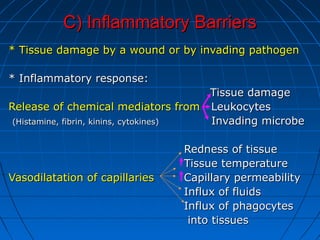
C) Inflammatory BarriersC) Inflammatory Barriers
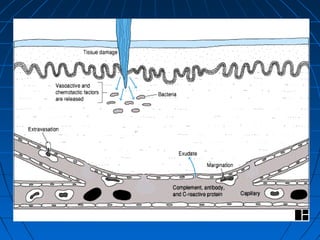
* Tissue damage by a wound or by invading pathogen* Tissue damage by a wound or by invading pathogen
* Inflammatory response:* Inflammatory response:
Tissue damageTissue damage
Release of chemical mediators fromRelease of chemical mediators from LeukocytesLeukocytes
(Histamine, fibrin, kinins, cytokines)(Histamine, fibrin, kinins, cytokines) Invading microbeInvading microbe
Redness of tissueRedness of tissue
Tissue temperatureTissue temperature
Vasodilatation of capillariesVasodilatation of capillaries Capillary permeabilityCapillary permeability
Influx of fluidsInflux of fluids
Influx of phagocytesInflux of phagocytes
into tissuesinto tissues
ThanksThanks

Innate immunity

  • 1.
    ‫الرحيم‬ ‫الرحمن‬ ‫اللة‬‫بسم‬‫الرحيم‬ ‫الرحمن‬ ‫اللة‬ ‫بسم‬
  • 2.
    Innate ImmunityInnate Immunity PRESENTER Shakira Ghazanfar PhDScholar Shakira_sulehri@yahoo.com ‫الرحيم‬‫الرحمن‬ ‫اللة‬ ‫بسم‬‫الرحيم‬ ‫الرحمن‬ ‫اللة‬ ‫بسم‬
  • 3.
    Innate ImmunityInnate Immunity Defensivemechanisms include :Defensive mechanisms include : 1) Innate immunity1) Innate immunity (Natural or Non specific)(Natural or Non specific) 2) Acquired immunity2) Acquired immunity (Adaptive or Specific(Adaptive or Specific)) Cell-mediated immunity HumoralCell-mediated immunity Humoral immunityimmunity
  • 4.
    Component of InnateImmunityComponent of Innate Immunity Innate Immune systemInnate Immune system First lineFirst line Second lineSecond line 1) Mechanical barriers A- cells1) Mechanical barriers A- cells 2) Chemical & biochemical inhibitors 1- Natural killer2) Chemical & biochemical inhibitors 1- Natural killer 3) Normal flora 2- Phagocytes3) Normal flora 2- Phagocytes B- Soluble factorsB- Soluble factors C- InflammatoryC- Inflammatory barriersbarriers
  • 5.
    First lineFirst line 1)Mechanical barriers1) Mechanical barriers - Intact skin- Intact skin - Mucous coat- Mucous coat - Mucous secretion- Mucous secretion - Blinking reflex and tears- Blinking reflex and tears - The hair at the nares- The hair at the nares - Coughing and sneezing reflex- Coughing and sneezing reflex
  • 6.
    First lineFirst line 2)Chemical & biochemical inhibitors2) Chemical & biochemical inhibitors - Sweet and sebaceous secretion- Sweet and sebaceous secretion - Hydrolytic enzymes in saliva- Hydrolytic enzymes in saliva - HCl of the stomach- HCl of the stomach - Proteolytic enzyme in small intestine- Proteolytic enzyme in small intestine - Lysozyme in tears- Lysozyme in tears - Acidic pH in the adult vagina- Acidic pH in the adult vagina
  • 7.
    First lineFirst line 3)Normal bacterial flora3) Normal bacterial flora - Competition for essential- Competition for essential nutrientsnutrients - Production of inhibitory- Production of inhibitory substancessubstances
  • 8.
    Second lineSecond line A)cellsA) cells 1- Natural killer (NK)1- Natural killer (NK) Definition:Definition: Large granular lymphocytesLarge granular lymphocytes Innate cytotoxic lymphocytesInnate cytotoxic lymphocytes SourceSource :: Bon marrow precursorsBon marrow precursors LocationLocation :: 10% or 15% of lymphocytes in10% or 15% of lymphocytes in peripheral bloodperipheral blood 1% or 2% of lymphocytes in1% or 2% of lymphocytes in spleenspleen Tumor cellsTumor cells FunctionFunction :: Cytotoxic for Viral infected cellsCytotoxic for Viral infected cells Bacterial, fungal, parasiticBacterial, fungal, parasitic infectioninfection Responsible for antibody–dependent cellResponsible for antibody–dependent cell
  • 9.
    Second lineSecond line 2-Phagocytes2- Phagocytes Specialized cells for capture, Ingestion and destructionSpecialized cells for capture, Ingestion and destruction of invading microorganismsof invading microorganisms * Polymorphoniclear leucocytes, mainly* Polymorphoniclear leucocytes, mainly neutrophils:neutrophils: granulocytes circulate in bloodgranulocytes circulate in blood ** Mononuclear cells (Mononuclear cells (macrophages)macrophages) -- MonocytesMonocytes in bloodin blood - Histocytes- Histocytes in connective tissuesin connective tissues -- Fixed reticuloendothelial cellsFixed reticuloendothelial cells in liver spleen,in liver spleen, lymphlymph
  • 10.
    Second lineSecond line B-Soluble factorsB- Soluble factors 1- Acute phase protein1- Acute phase protein (Plasma protein,(Plasma protein, CRP=C reactive protein, Fibrin.)CRP=C reactive protein, Fibrin.) 2- Complement2- Complement (proteins in serum,(proteins in serum, body fluids)body fluids) 2- Interferons2- Interferons (Proteins against viral(Proteins against viral infections)infections) 3- Properdin3- Properdin (Complement(Complement activation)activation) 4- Beta lysine4- Beta lysine (Antibacterial protein(Antibacterial protein from Platelets)from Platelets)
  • 11.
    InterferonsInterferons Proteins usually producedby virally infected cellsProteins usually produced by virally infected cells * Types of interferons:* Types of interferons: 1- Alpha interferon1- Alpha interferon Secreted by MacrophagesSecreted by Macrophages Induced by Viruses or PolynucleotideInduced by Viruses or Polynucleotide 2- Beta interferon2- Beta interferon Secreted by Fibroblasts, VirusesSecreted by Fibroblasts, Viruses 3- Gamma interferon3- Gamma interferon T- lymphocytes, Specific antigensT- lymphocytes, Specific antigens
  • 12.
    InterferonsInterferons Protective action ofinterferons:Protective action of interferons: 1) Activate T-cells1) Activate T-cells 2) Activate macrophages2) Activate macrophages 3) Activate NK3) Activate NK
  • 13.
    PhagocytosisPhagocytosis The engulfment, digestion,and subsequent processingThe engulfment, digestion, and subsequent processing of microorganisms by macrophages and neutrophilsof microorganisms by macrophages and neutrophils 1) Chemotaxis & attachment:1) Chemotaxis & attachment: a- Attraction by chemotactic substancesa- Attraction by chemotactic substances (microbes, damaged tissues)(microbes, damaged tissues) b- Attachment by receptors on surfacesb- Attachment by receptors on surfaces
  • 14.
    PhagocytosisPhagocytosis 2) Ingestion:2) Ingestion: *Phagocyte pseudopodia surround* Phagocyte pseudopodia surround organism forming phagosomorganism forming phagosom * Opsinins and co-factors enhance* Opsinins and co-factors enhance phagocytosisphagocytosis * Fusion with phagocyte granules and* Fusion with phagocyte granules and releaserelease digestive, toxic contentsdigestive, toxic contents
  • 15.
    PhagocytosisPhagocytosis 3- Killing (twomicrobicidal routes)3- Killing (two microbicidal routes) a- Oxygen depended system (powerful microbicidala- Oxygen depended system (powerful microbicidal agents)agents) Oxygen converted to superoxide, anion,Oxygen converted to superoxide, anion, hydrogen peroxide, activated oxygen andhydrogen peroxide, activated oxygen and hydroxyl radicals.hydroxyl radicals. b- Oxygen-independent system (anaerobicb- Oxygen-independent system (anaerobic conditions)conditions) Digestion and killing by lysozyme. Lactoferrin,Digestion and killing by lysozyme. Lactoferrin, low pH, cationic proteins and hydrolytic andlow pH, cationic proteins and hydrolytic and proteolytic enzymesproteolytic enzymes
  • 16.
    C) Inflammatory BarriersC)Inflammatory Barriers * Tissue damage by a wound or by invading pathogen* Tissue damage by a wound or by invading pathogen * Inflammatory response:* Inflammatory response: Tissue damageTissue damage Release of chemical mediators fromRelease of chemical mediators from LeukocytesLeukocytes (Histamine, fibrin, kinins, cytokines)(Histamine, fibrin, kinins, cytokines) Invading microbeInvading microbe Redness of tissueRedness of tissue Tissue temperatureTissue temperature Vasodilatation of capillariesVasodilatation of capillaries Capillary permeabilityCapillary permeability Influx of fluidsInflux of fluids Influx of phagocytesInflux of phagocytes into tissuesinto tissues
  • 18.