







INTRODUCTION TO ICU
DR. MAHESWARI JAIKUMAR
maheswarijaikumar2103@gmail.com
INTRODUCTION TO ICU
DR.MAHESWARI JAIKUMAR
maheswarijaikumar2103@gmail.com
DEFINITION
• ICU is a geographical area in a
hospital where the patients
with life-threatening illness or
injuries are cared
CLASSIFICATION
• ICU may be classified according
to the availability of qualified
staff, the complexity of the care
delivered and specialty
TYPES
• Level I ICU
• Level II ICU
• Level III ICU
LEVEL - I ICU
• Is located in a small hospital,
providing resuscitation and short
term pulmonary support for less
than 24 hours
LEVEL - II ICU
• Is an adult ICU located in a larger
hospital with a well qualified
intensivist and provides
multisystem support.
• It may lack in some form of
advanced therapy
LEVEL - II
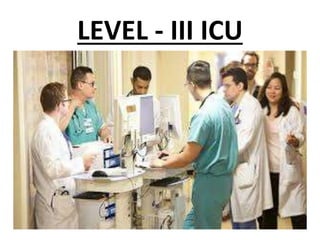
LEVEL - III ICU
• Is an adult ICU located in a large
tertiary care centre with the
capability of providing
comprehensive critical care for a
prolonged period of time
• This type of ICU is manned by a
qualified multidisciplinary team
consisting of critical care
medicine consultant, fellowship
trainee, specialist from other
discipline, critical care specialized
nurses, nurse practitioners, and
qualified allied health personnel
LEVEL - III ICU
OTHER TYPES
• 1. OPEN ICU
• 2. CLOSED ICU
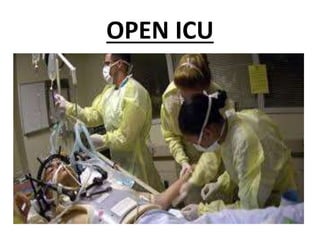
OPEN ICU
• Is one where a group of critically
ill patients may be treated and
managed not by critical care
medicine qualified consultants
but by different specialist.
OPEN ICU
CLOSED ICU
• Is an ICU that is managed by a
qualified critical care specialized
physicians round the clock
(24X7).
• Patient care management
decisions are taken primarily by
the intensive care consultant
CLOSED ICU
SINLGE SPECIALTY Vs MULTI
SPECIALTY ICU
• Based on the type of patients,
the ICU can be classified as
multidisciplinary critical care unit
or single specialty critical units
EXAMPLE
• Medical ICU
• Surgical ICU
• Cardio Thoracic ICU
• Renal ICU
• Since the pathophysological
processes and the management
modalities are the same
irrespective of cause,
multidisciplinary ICU is
considered as cost effective
compared with single Specialty
ICU
HIGH DEPENDENCY UNIT
• A HDU provides intermediary care, a
unit that can provide smooth
transition from ICU to the general
ward
• It can be a step-down unit for the
patients at risk of developing
another acute episode of a serious
ailment
• In the HDU, invasive monitoring
and support for single – organ
failure is offered for those with a
high risk of clinical deterioration
or unpredicted clinical course.
• The HDU is managed by a
qualified Intensivist and team
THANK YOU

INTRODUCTION TO ICU

  • 1.
    INTRODUCTION TO ICU DR.MAHESWARI JAIKUMAR maheswarijaikumar2103@gmail.com
  • 2.
    INTRODUCTION TO ICU DR.MAHESWARIJAIKUMAR maheswarijaikumar2103@gmail.com
  • 3.
    DEFINITION • ICU isa geographical area in a hospital where the patients with life-threatening illness or injuries are cared
  • 4.
    CLASSIFICATION • ICU maybe classified according to the availability of qualified staff, the complexity of the care delivered and specialty
  • 5.
    TYPES • Level IICU • Level II ICU • Level III ICU
  • 6.
    LEVEL - IICU • Is located in a small hospital, providing resuscitation and short term pulmonary support for less than 24 hours
  • 7.
    LEVEL - IIICU • Is an adult ICU located in a larger hospital with a well qualified intensivist and provides multisystem support. • It may lack in some form of advanced therapy
  • 8.
  • 9.
    LEVEL - IIIICU • Is an adult ICU located in a large tertiary care centre with the capability of providing comprehensive critical care for a prolonged period of time
  • 10.
    • This typeof ICU is manned by a qualified multidisciplinary team consisting of critical care medicine consultant, fellowship trainee, specialist from other discipline, critical care specialized nurses, nurse practitioners, and qualified allied health personnel
  • 11.
  • 12.
    OTHER TYPES • 1.OPEN ICU • 2. CLOSED ICU
  • 13.
    OPEN ICU • Isone where a group of critically ill patients may be treated and managed not by critical care medicine qualified consultants but by different specialist.
  • 14.
  • 15.
    CLOSED ICU • Isan ICU that is managed by a qualified critical care specialized physicians round the clock (24X7). • Patient care management decisions are taken primarily by the intensive care consultant
  • 16.
  • 17.
    SINLGE SPECIALTY VsMULTI SPECIALTY ICU • Based on the type of patients, the ICU can be classified as multidisciplinary critical care unit or single specialty critical units
  • 18.
    EXAMPLE • Medical ICU •Surgical ICU • Cardio Thoracic ICU • Renal ICU
  • 19.
    • Since thepathophysological processes and the management modalities are the same irrespective of cause, multidisciplinary ICU is considered as cost effective compared with single Specialty ICU
  • 20.
    HIGH DEPENDENCY UNIT •A HDU provides intermediary care, a unit that can provide smooth transition from ICU to the general ward • It can be a step-down unit for the patients at risk of developing another acute episode of a serious ailment
  • 21.
    • In theHDU, invasive monitoring and support for single – organ failure is offered for those with a high risk of clinical deterioration or unpredicted clinical course. • The HDU is managed by a qualified Intensivist and team
  • 22.