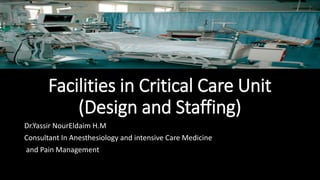
Facilities in Critical Care Unit
(Design and Staffing)
Dr.Yassir NourEldaim H.M
Consultant In Anesthesiology and intensive Care Medicine
and Pain Management
Definition:
• The intensive care unit (ICU) is a distinct organizational and geographic entity
for clinical activity and care, operating in cooperation with other departments
integrated in a hospital.
• The ICU is used to monitor and support threatened or failing vital functions in
critically ill patients, who have illnesses with the potential to endanger life, so
that adequate diagnostic measures and medical or surgical therapies can be
performed to improve outcome.
• ICU staff are required to provide services outside of the ICU such as
emergency response (eg rapid response teams) and outreach services.
• “critical care medicine "Is defined as the triad of :
1. Resuscitation.
2. emergency care for life-threatening conditions.
3. intensive care; including all components of the emergency and critical care
medicine delivery system, prehospital and hospital.
GENERIC REQUIREMENTS
Staffing:
 Medical staffing, including a director, with sufficient experience to provide for patient care,
administration, teaching, research, audit, outreach
 Nursing staff: Australian College of Critical Care Nurses requires 1:1 for ventilated patients
and 1:2 for lower acuity patients. Nurse in charge with post registration ICU qualification.
 Allied health and ancillary staff.
Operational:
• Documented educational programme
• Agreed policies
• Aeam approach
• Surge capacity for emergencies
• Documented procedures for audit
• Peer review
• Quality assurance
Site
• separate unit
• appropriate access to ED, theatre, radiology
Design
• Patient cubicles (> 20 m2), wash basin, service outlets,
appropriate electrical standards, privacy
• Work areas, equipment and storage areas, staff facilities, seminar
room, offices, relatives area
• Equipment: appropriate equipment and regular system for
checking safety
• Monitoring equipment: for each patient, for unit (.eg. gas supply
alarms), and for patient transport
• Criteria for a level I, II and III ICU and a PICU&NICU
CLASSIFICATION OF INTENSIVE CARE UNITS
(LEVELS)
1. Level I ICU:
• a Level I ICU has a role in small district hospitals.
• It should be able to provide resuscitation and short-term
cardiorespiratory support of critically ill patients.
• It will have a major role in monitoring and preventing complications
in ‘at-risk’ medical and surgical patients.
• It must be capable of providing mechanical ventilation and simple
invasive cardiovascular monitoring for a period of several hours.
• A Level I ICU should have an established relationship with a Level II
or a Level III unit that should include mutual transfer and back
transfer policies and an established joint review process.
Cont.CLASSIFICATION
2. Level II ICU:
• a Level II ICU is located in larger general hospitals.
• It should be capable of providing a high standard of general
intensive care, including multisystem life support, in accordance
with the role of its hospital (e.g. regional centre for acute
medicine, general surgery, trauma).
• It should have a medical officer on site and access to pharmacy,
pathology and radiology facilities at all times, but it may not
have all forms of complex therapy and investigations (e.g.
interventional radiology, cardiac surgical service).
• Referral and transport policies should be in place with a Level III
unit to enable escalation of care.
• Minimum of 6 beds
Cont.CLASSIFICATION
3. Level III ICU:
• A Level III ICU is located in a major tertiary referral hospital.
• should provide all aspects of intensive care management
required by its referral role for indefinite periods.
• The unit should be staffed by intensive care specialists with
trainees, critical care nurses, allied health professionals and
clerical and scientific staff.
• Complex investigations and imaging and support by specialists
of all disciplines required by the referral role of the hospital must
be available at all times.
• should have a demonstrated commitment to academic
education and research.
TYPE AND SIZE OF AN ICU2
• An institution may organise its intensive care beds into multiple
units under separate management by single discipline
specialists:
1. Medical ICU.
2. surgical ICU.
3. Burns ICU.
4. Dialysis units.
5. Coronary care units (CCU) .
6. PICU (patients under the age of 16 years).
7. NICU (Neonatal ICU).
• The ICU may constitute up to 10% of total hospital beds.
HIGH-DEPENDENCY UNIT (HDU)
• An HDU is a specially staffed and equipped area of a hospital that
provides a level of care intermediate between intensive care and
the general ward care.
• HDUs may be located in or near specialty wards or located within
or immediately adjacent to an ICU complex .
• are often staffed by the ICU.
• The HDU provides invasive monitoring and support for patients
with or at risk of developing acute (or acute-on-chronic) single-
organ failure.
• It may act as a ‘step-up’ or ‘step-down’ unit between the level of
care delivered on a general ward and that in an ICU.
?
Facilities in critical care unit

Facilities in critical care unit

  • 1.
    Facilities in CriticalCare Unit (Design and Staffing) Dr.Yassir NourEldaim H.M Consultant In Anesthesiology and intensive Care Medicine and Pain Management
  • 2.
    Definition: • The intensivecare unit (ICU) is a distinct organizational and geographic entity for clinical activity and care, operating in cooperation with other departments integrated in a hospital. • The ICU is used to monitor and support threatened or failing vital functions in critically ill patients, who have illnesses with the potential to endanger life, so that adequate diagnostic measures and medical or surgical therapies can be performed to improve outcome. • ICU staff are required to provide services outside of the ICU such as emergency response (eg rapid response teams) and outreach services. • “critical care medicine "Is defined as the triad of : 1. Resuscitation. 2. emergency care for life-threatening conditions. 3. intensive care; including all components of the emergency and critical care medicine delivery system, prehospital and hospital.
  • 3.
    GENERIC REQUIREMENTS Staffing:  Medicalstaffing, including a director, with sufficient experience to provide for patient care, administration, teaching, research, audit, outreach  Nursing staff: Australian College of Critical Care Nurses requires 1:1 for ventilated patients and 1:2 for lower acuity patients. Nurse in charge with post registration ICU qualification.  Allied health and ancillary staff. Operational: • Documented educational programme • Agreed policies • Aeam approach • Surge capacity for emergencies • Documented procedures for audit • Peer review • Quality assurance
  • 4.
    Site • separate unit •appropriate access to ED, theatre, radiology
  • 5.
    Design • Patient cubicles(> 20 m2), wash basin, service outlets, appropriate electrical standards, privacy • Work areas, equipment and storage areas, staff facilities, seminar room, offices, relatives area • Equipment: appropriate equipment and regular system for checking safety • Monitoring equipment: for each patient, for unit (.eg. gas supply alarms), and for patient transport • Criteria for a level I, II and III ICU and a PICU&NICU
  • 6.
    CLASSIFICATION OF INTENSIVECARE UNITS (LEVELS) 1. Level I ICU: • a Level I ICU has a role in small district hospitals. • It should be able to provide resuscitation and short-term cardiorespiratory support of critically ill patients. • It will have a major role in monitoring and preventing complications in ‘at-risk’ medical and surgical patients. • It must be capable of providing mechanical ventilation and simple invasive cardiovascular monitoring for a period of several hours. • A Level I ICU should have an established relationship with a Level II or a Level III unit that should include mutual transfer and back transfer policies and an established joint review process.
  • 7.
    Cont.CLASSIFICATION 2. Level IIICU: • a Level II ICU is located in larger general hospitals. • It should be capable of providing a high standard of general intensive care, including multisystem life support, in accordance with the role of its hospital (e.g. regional centre for acute medicine, general surgery, trauma). • It should have a medical officer on site and access to pharmacy, pathology and radiology facilities at all times, but it may not have all forms of complex therapy and investigations (e.g. interventional radiology, cardiac surgical service). • Referral and transport policies should be in place with a Level III unit to enable escalation of care. • Minimum of 6 beds
  • 8.
    Cont.CLASSIFICATION 3. Level IIIICU: • A Level III ICU is located in a major tertiary referral hospital. • should provide all aspects of intensive care management required by its referral role for indefinite periods. • The unit should be staffed by intensive care specialists with trainees, critical care nurses, allied health professionals and clerical and scientific staff. • Complex investigations and imaging and support by specialists of all disciplines required by the referral role of the hospital must be available at all times. • should have a demonstrated commitment to academic education and research.
  • 9.
    TYPE AND SIZEOF AN ICU2 • An institution may organise its intensive care beds into multiple units under separate management by single discipline specialists: 1. Medical ICU. 2. surgical ICU. 3. Burns ICU. 4. Dialysis units. 5. Coronary care units (CCU) . 6. PICU (patients under the age of 16 years). 7. NICU (Neonatal ICU). • The ICU may constitute up to 10% of total hospital beds.
  • 10.
    HIGH-DEPENDENCY UNIT (HDU) •An HDU is a specially staffed and equipped area of a hospital that provides a level of care intermediate between intensive care and the general ward care. • HDUs may be located in or near specialty wards or located within or immediately adjacent to an ICU complex . • are often staffed by the ICU. • The HDU provides invasive monitoring and support for patients with or at risk of developing acute (or acute-on-chronic) single- organ failure. • It may act as a ‘step-up’ or ‘step-down’ unit between the level of care delivered on a general ward and that in an ICU.
  • 13.