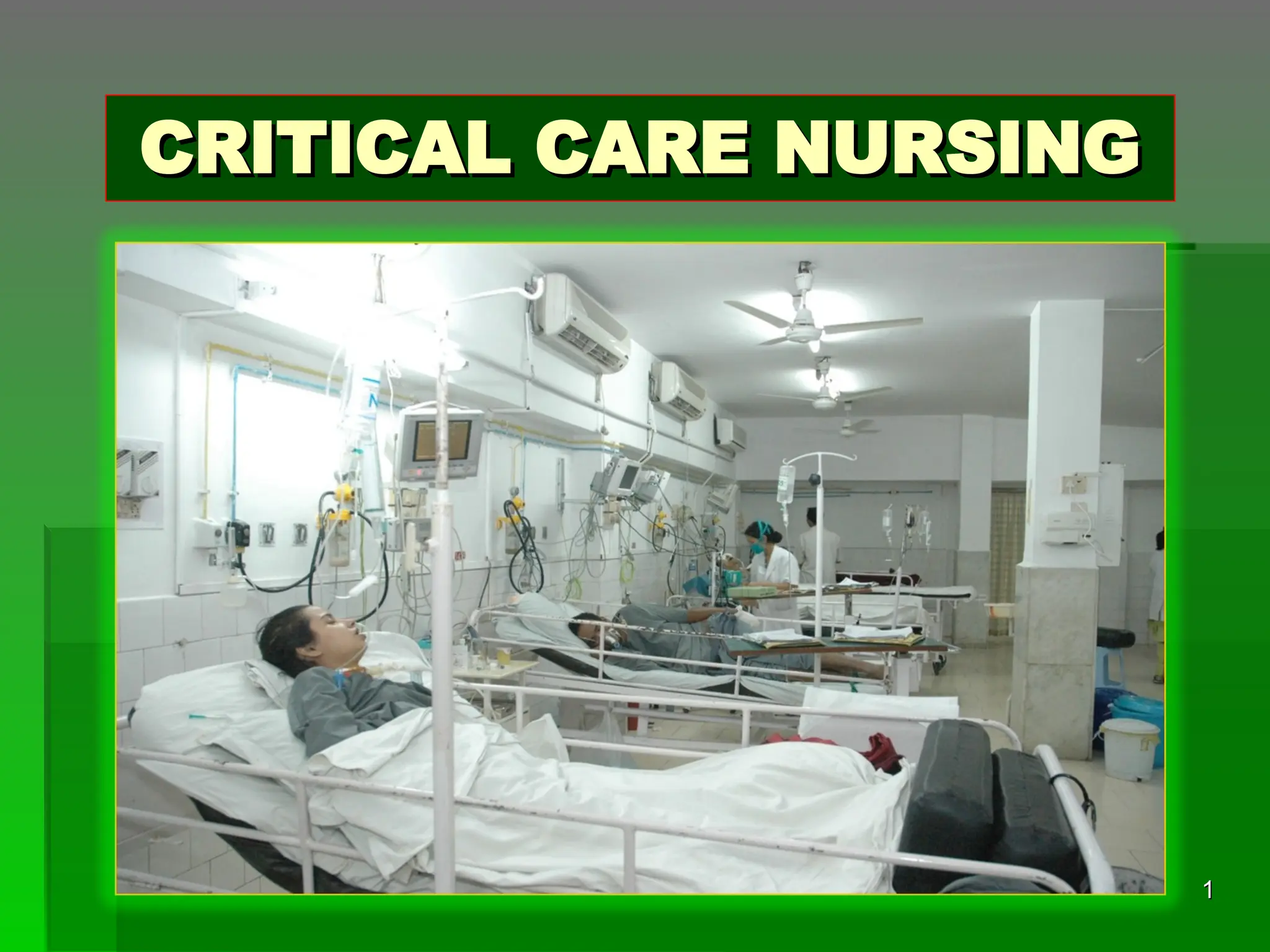
CRITICAL CARE NURSING
1
1
Critical Care Unit/ICU
 ICU is highly specialized and
ICU is highly specialized and
sophisticated area of a hospital which is
specifically designed, staffed, located,
furnished and equipped, dedicated to the
management of critically sick patients,
injuries or complications. It is department
with dedicated medical, nursing and
allied staffs.
allied staffs.
2
2
ICU…
ICU…
 An ICU is, “a specially staffed and
An ICU is, “a specially staffed and
equipped, separate and self-contained
are of hospital dedicated to the
management of patients with life-
threatening illnesses, injuries and
complications, and monitoring of
potentially life-threatening conditions”.
3
3
HDU
HDU (High Dependency Unit)
(High Dependency Unit)
 A specifically staffed and equipped
A specifically staffed and equipped
section of an intensive care complex that
provides level of care intermediate
between intensive care and general ward
care.
care.
 It must be near ICU Geographically and
It must be near ICU Geographically and
functionally, with intenvist service.
4
4
CRITICAL
CRITICAL
 Crucial
Crucial
 Crisis
Crisis
 Emergency
Emergency
 Serious
Serious
 Requiring immediate action
Requiring immediate action
 Thorough and constant observation
Thorough and constant observation
 Total dependent
Total dependent
(Oxford Dictionary)
(Oxford Dictionary)
5
5
CRITICAL CARE NURSING
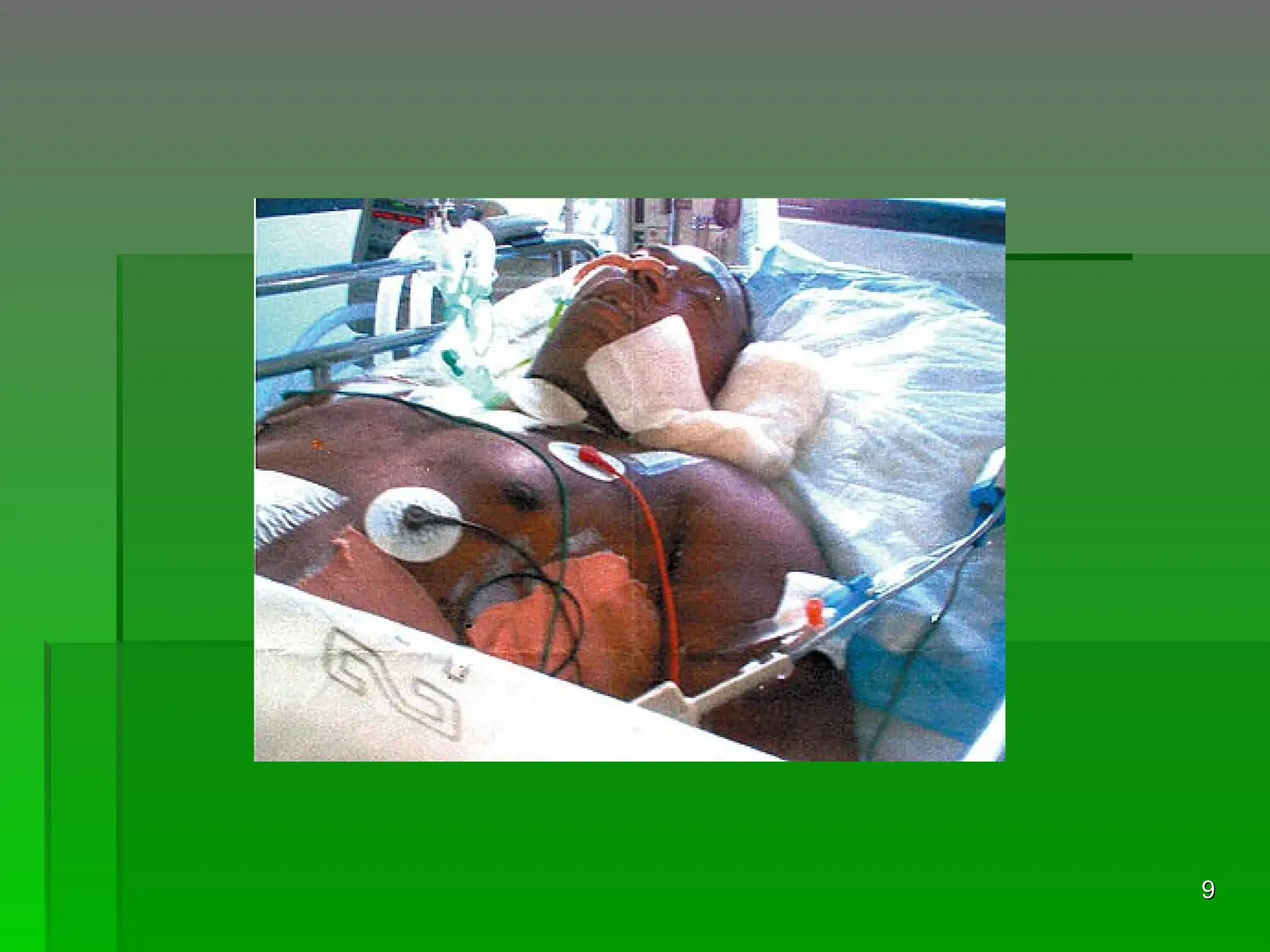
 The care of seriously ill clients from point
The care of seriously ill clients from point
of injury or illness until discharge from
intensive care
intensive care
 Deals with human responses to life
Deals with human responses to life
threatening problems -trauma /major
surgery
surgery
(Mary,L.S., Deborah, G.K. & Marthe, J.M. 2005)
6
6
CRITICAL CARE NURSE
CRITICAL CARE NURSE
 care for clients who are very ill
care for clients who are very ill
 provide direct one to one care
provide direct one to one care
 Responsible for making life-and death decision
Responsible for making life-and death decision
 At high risk of injury or illness from possible
At high risk of injury or illness from possible
exposure to infections
 Communication skill is of optimal importance
Communication skill is of optimal importance
 Specialty dealing with human responses to life-
Specialty dealing with human responses to life-
threatening problems
 Requires Extensive Knowledge and a Continual
Requires Extensive Knowledge and a Continual
Desire to Learn
Desire to Learn
7
7
CRITICALLY ILL CLIENT
 At high risk for actual or potential life-
At high risk for actual or potential life-
threatening health problems
 More ill
More ill
 Required more intensive and careful
Required more intensive and careful
nursing care
nursing care
8
8
Prof. Dr. R S Mehta, BPKIHS
9
9
DEFINITIONS
DEFINITIONS
 CRITICAL CARE
CRITICAL CARE :
:
CRITICAL CARE IS A TERM USED
TO DESCRIBE AS THE CARE OF
PATIENTS WHO ARE EXTREMELY
ILL AND WHOSE CLINICAL
CONDITION IS UNSTABLE OR
POTENTIALLY UNSTABLE.
10
10
 CRITICAL CARE UNIT
CRITICAL CARE UNIT :
:
IT IS DEFINED AS THE UNIT IN
WHICH COMPREHENSIVE CARE
OF A CRITICALLY ILL PATIENT
WHICH IS DEEMED TO
WHICH IS DEEMED TO
RECOVERABLE STAGE IS
CARRIED OUT.
CARRIED OUT.
11
11
 CRITICAL CARE NURSING
CRITICAL CARE NURSING :
:
IT REFERS TO THOSE
IT REFERS TO THOSE
COMPREHENSIVE, SPECIALIZED
AND INDIVIDUALIZED NURSING
CARE SERVICES WHICH ARE
RENDERED TO PATIENTS WITH
LIFE THREATENING CONDITIONS
AND THEIR FAMILIES.
AND THEIR FAMILIES.
12
12
Prof. Dr. R S Mehta, BPKIHS
Economic Impact of ICU (1994)
* <10% of hospital beds
* 30% of acute care hospital cost
* >20% of hospital budget
* 1% of GNP expended for ICU care
With aging of the population

 Demand for critical care service will
Demand for critical care service will
increase
increase
13
13
Prof. Dr. R S Mehta, BPKIHS
Prof. Dr. R S Mehta, BPKIHS 14
14
Historical Background
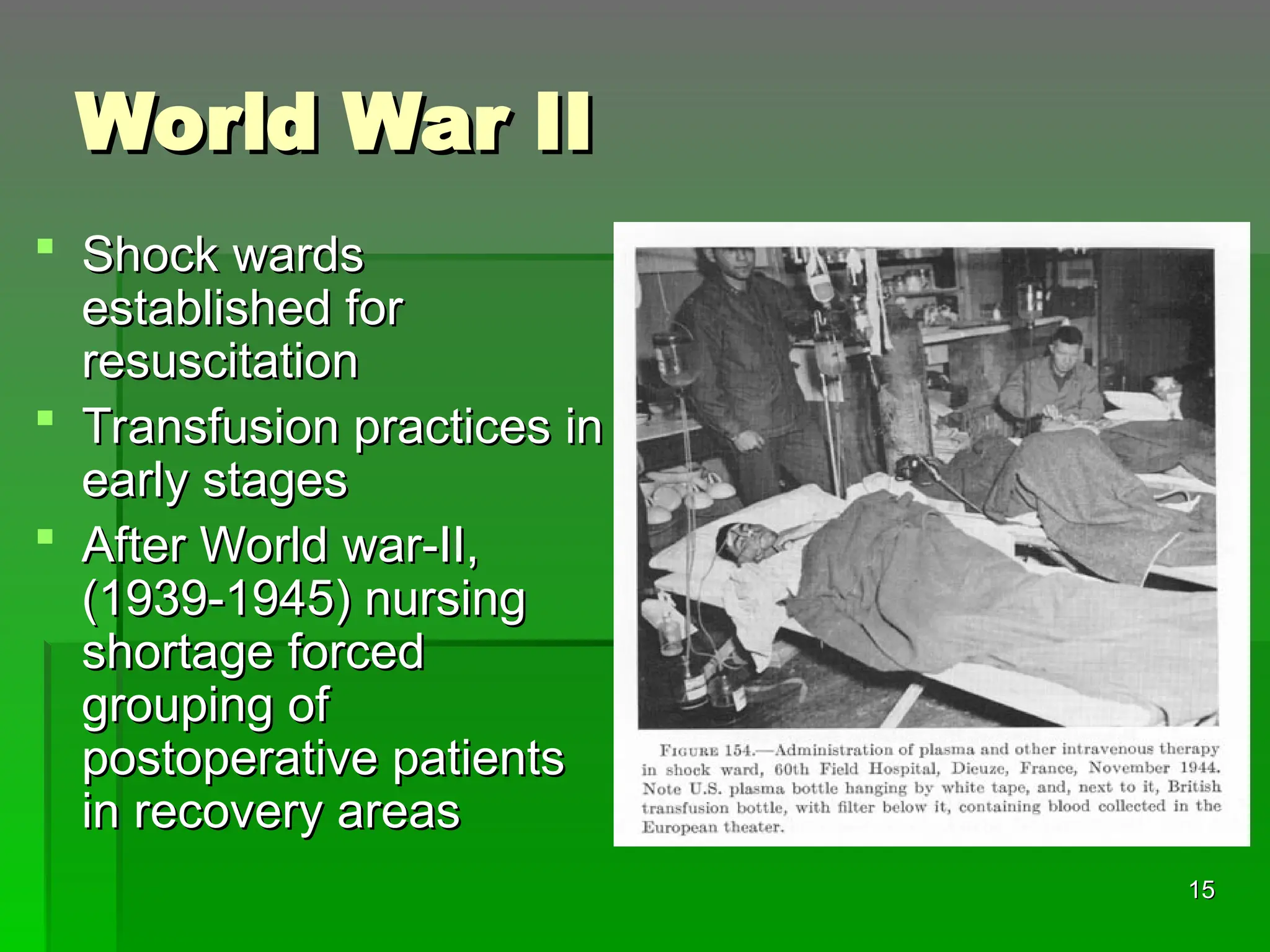
World War II
World War II
 Shock wards
Shock wards
established for
established for
resuscitation
resuscitation
 Transfusion practices in
Transfusion practices in
early stages
early stages
 After World war-II,
After World war-II,
(1939-1945) nursing
(1939-1945) nursing
shortage forced
shortage forced
grouping of
grouping of
postoperative patients
in recovery areas
in recovery areas
15
15
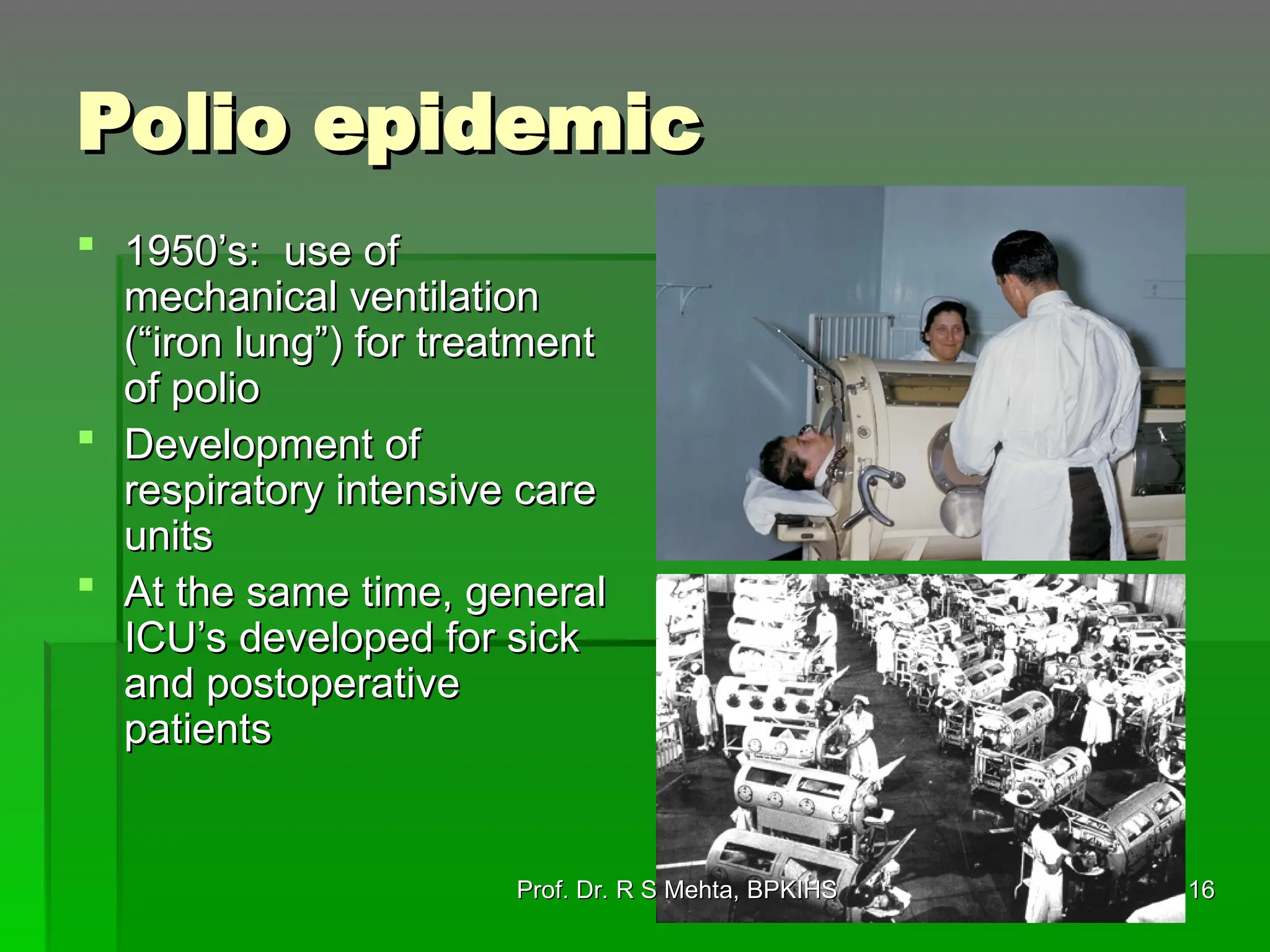
Polio epidemic
Polio epidemic
 1950’s: use of
1950’s: use of
mechanical ventilation
(“iron lung”) for treatment
of polio
of polio
 Development of
Development of
respiratory intensive care
units
units
 At the same time, general
At the same time, general
ICU’s developed for sick
and postoperative
and postoperative
patients
patients
16
16
Prof. Dr. R S Mehta, BPKIHS
17
17
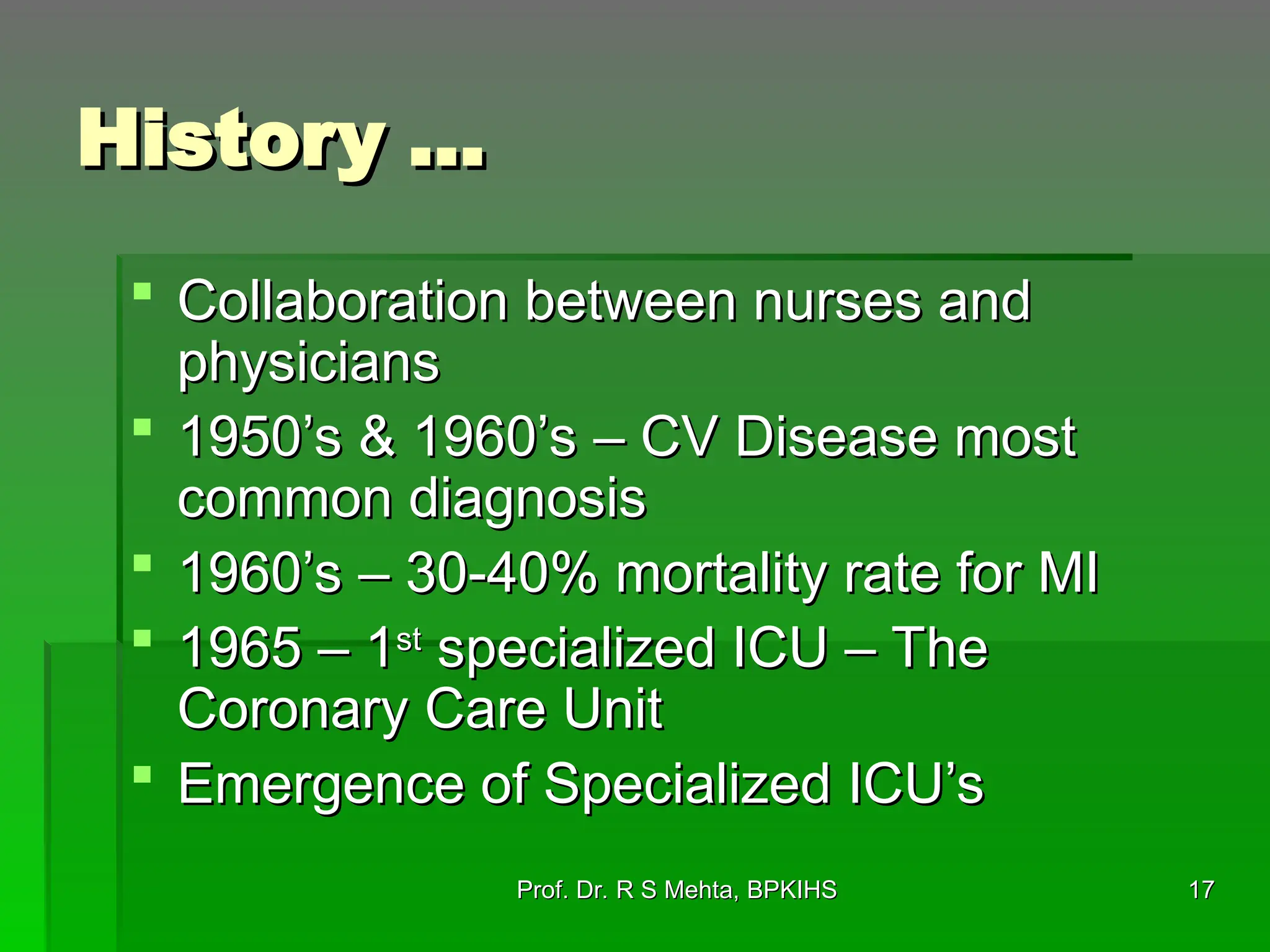
History …
History …
 Collaboration between nurses and
Collaboration between nurses and
physicians
physicians
 1950’s & 1960’s – CV Disease most
1950’s & 1960’s – CV Disease most
common diagnosis
common diagnosis
 1960’s – 30-40% mortality rate for MI
1960’s – 30-40% mortality rate for MI
 1965 – 1
1965 – 1st
st
specialized ICU – The
Coronary Care Unit
Coronary Care Unit
 Emergence of Specialized ICU’s
Emergence of Specialized ICU’s
Prof. Dr. R S Mehta, BPKIHS
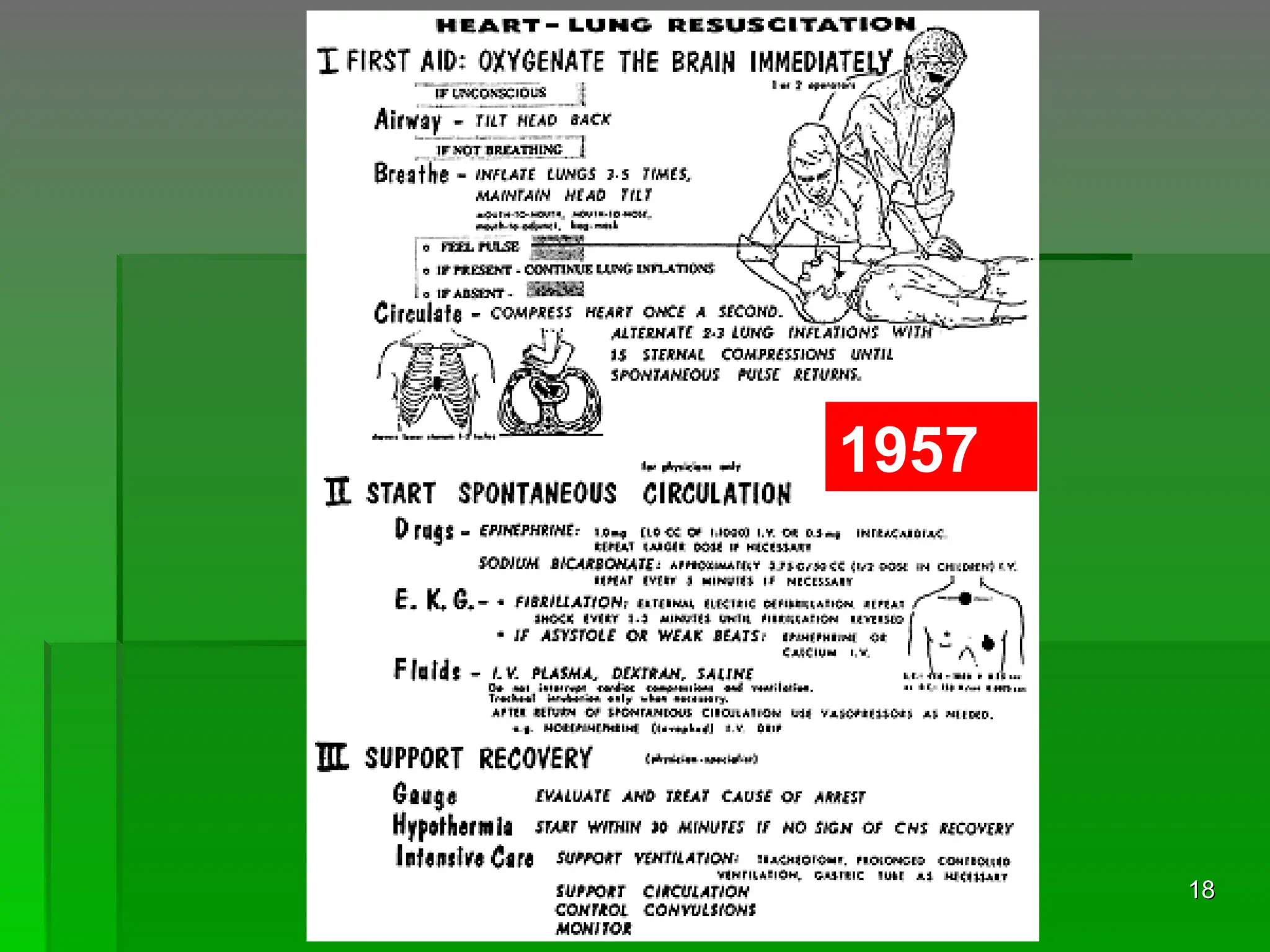
1957
18
18
19
19
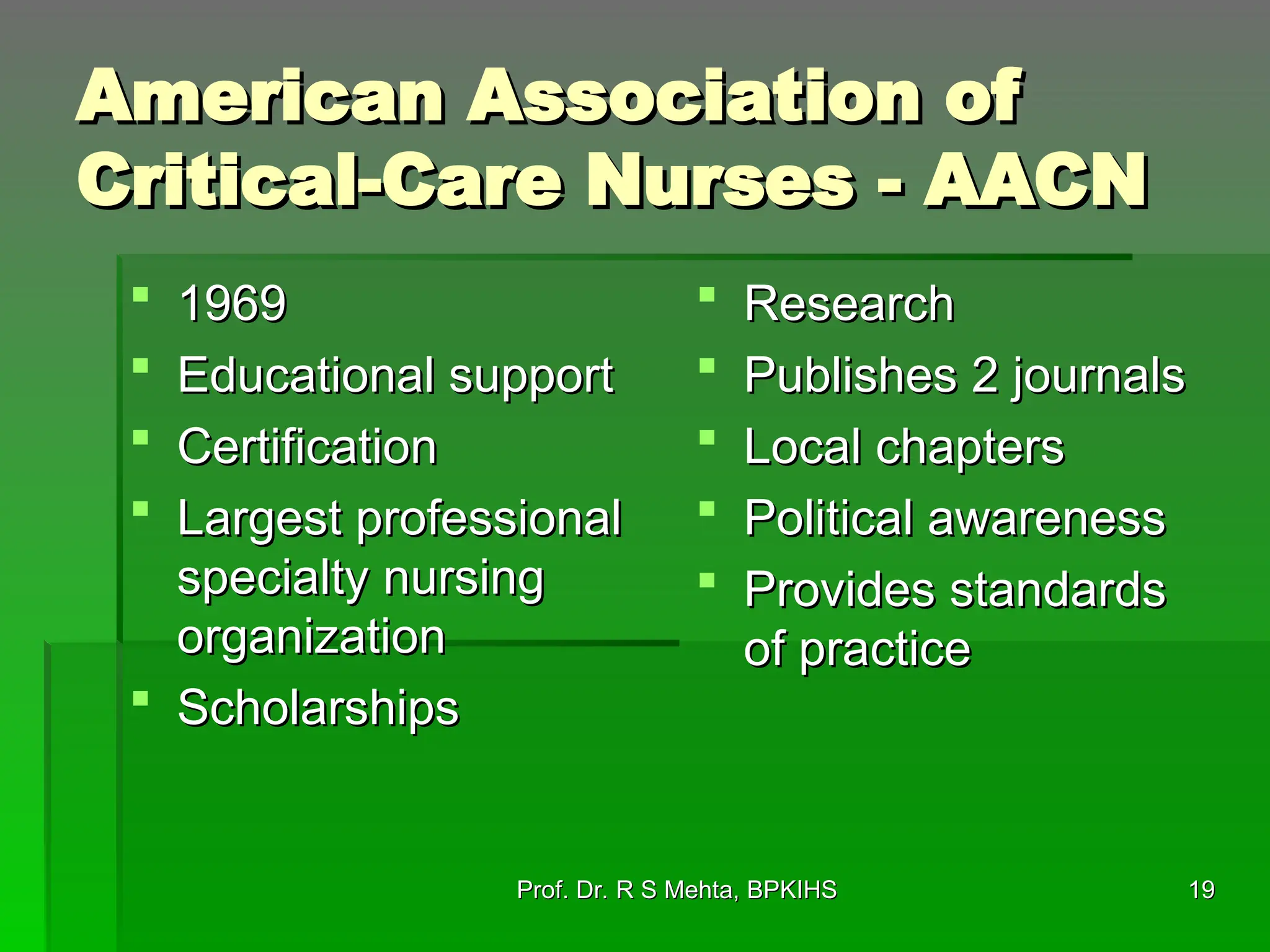
American Association of
Critical-Care Nurses - AACN
 1969
1969
 Educational support
Educational support
 Certification
Certification
 Largest professional
Largest professional
specialty nursing
specialty nursing
organization
organization
 Scholarships
Scholarships
 Research
Research
 Publishes 2 journals
Publishes 2 journals
 Local chapters
Local chapters
 Political awareness
Political awareness
 Provides standards
Provides standards
of practice
of practice
Prof. Dr. R S Mehta, BPKIHS
An Ideal ICU
An Ideal ICU
20
20
Prof. Dr. R S Mehta, BPKIHS
Multidisciplinary & Collaborative
approach to ICU care
 Medical & nursing directors :
Medical & nursing directors :
co-responsibility for ICU management
•
• a team approach :
a team approach :
doctors, nurses, R/T, pharmacist
•
• use of standard, protocol, guideline
use of standard, protocol, guideline
consistent approach to all issues
•
• dedication to coordination and communication
dedication to coordination and communication
for all aspects of ICU management
•
• emphasis on research, education, ethical
emphasis on research, education, ethical
issues, patient advocacy
21
21
Prof. Dr. R S Mehta, BPKIHS
ICU Model Care
ICU Model Care
 Full-time intensivist model :
Full-time intensivist model :
 patient care is provided by an intensivist
patient care is provided by an intensivist
 Consultant intensivist model :
Consultant intensivist model :
 an intensivist consults for another physician to
an intensivist consults for another physician to
coordinate or assist in critical care, but dose not
have primary responsibility for care
 Multiple consultant model:
Multiple consultant model:
 multiple specialists are involved in the patient care,
multiple specialists are involved in the patient care,
(esp. R/T doctors for ventilators), but none is
designated especially as the consultant intensivist
 Single physician model :
Single physician model :
 primary physician provides all ICU care
primary physician provides all ICU care
22
22
Prof. Dr. R S Mehta, BPKIHS
A Good ICU
A Good ICU
 Well organized: trust & coordinated care
Well organized: trust & coordinated care
•
• Full-time intensivist: daily round, critical care
Full-time intensivist: daily round, critical care
trained, available in a timely fashion (24hr/day)
•
• protocol & policies
protocol & policies
•
• bedside nurses: adequate (master degree)
bedside nurses: adequate (master degree)

 no intern
no intern
 Team of: doctors, nurses, R/T, pharmacists
Team of: doctors, nurses, R/T, pharmacists
•
• closed units, if resources allow
closed units, if resources allow
23
23
Prof. Dr. R S Mehta, BPKIHS
HIGH DEPENDENCY CARE
 Coronary care units (CCU)
Coronary care units (CCU)
 Renal high dependency unit (HDU)
Renal high dependency unit (HDU)
 Post-operative recovery room
Post-operative recovery room
 Accident and emergency departments
Accident and emergency departments
(A&E)
(A&E)
 Intensive care units (ICU)
Intensive care units (ICU)
24
24
Prof. Dr. R S Mehta, BPKIHS
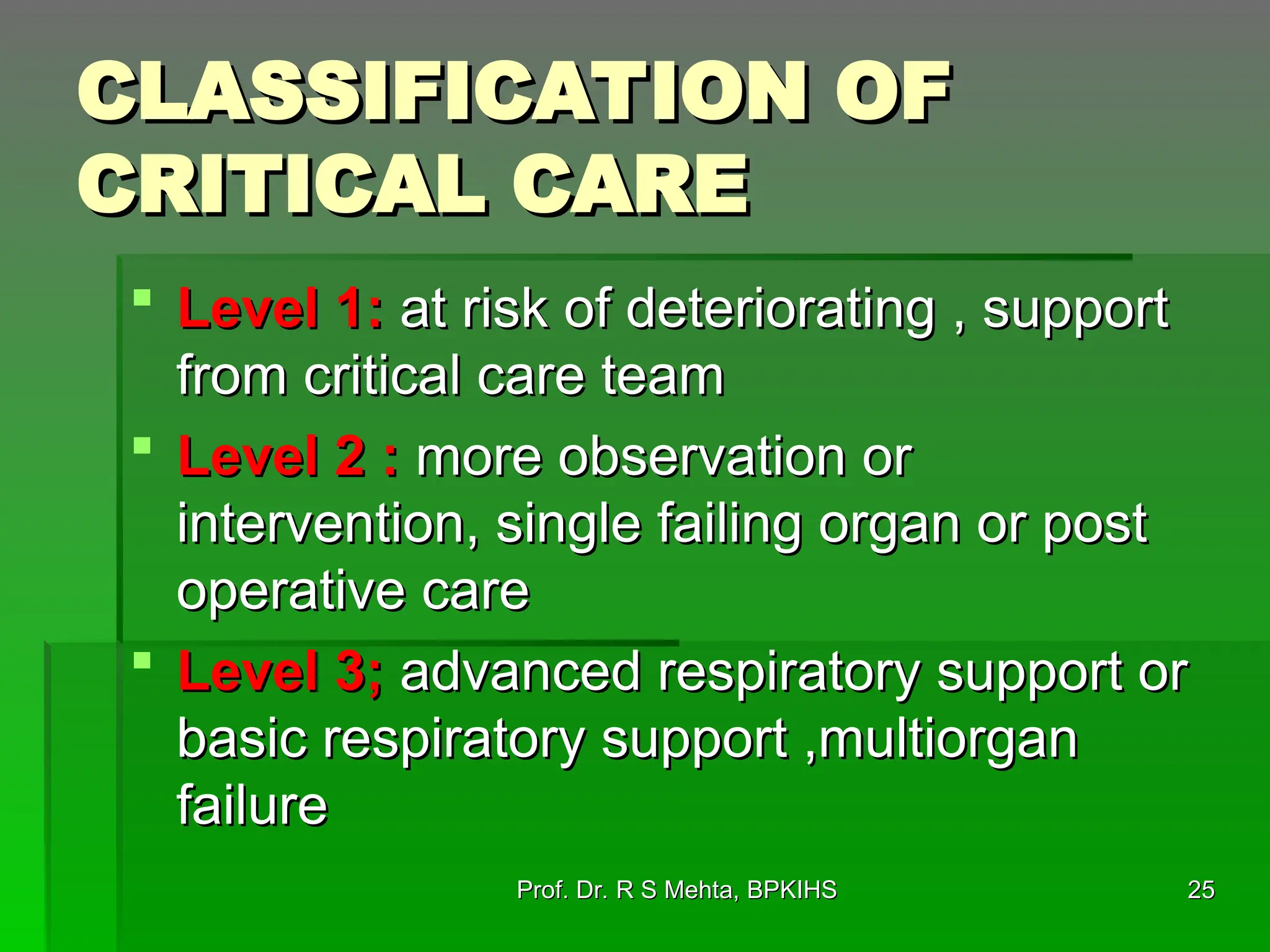
CLASSIFICATION OF
CLASSIFICATION OF
CRITICAL CARE
CRITICAL CARE
 Level 1:
Level 1: at risk of deteriorating , support
at risk of deteriorating , support
from critical care team
 Level 2 :
Level 2 : more observation or
more observation or
intervention, single failing organ or post
operative care
operative care
 Level 3;
Level 3; advanced respiratory support or
advanced respiratory support or
basic respiratory support ,multiorgan
failure
failure
25
25
Prof. Dr. R S Mehta, BPKIHS
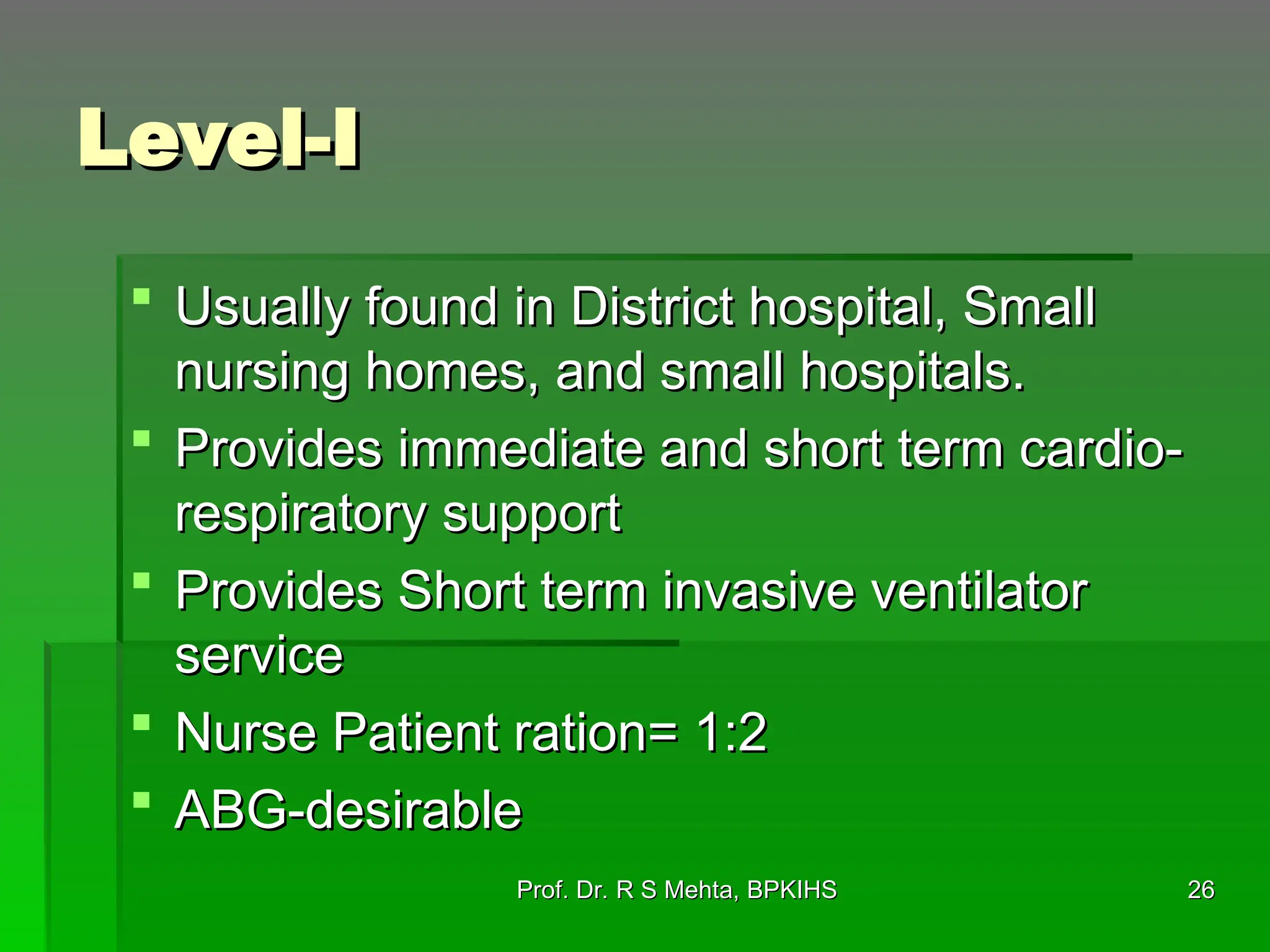
Level-I
Level-I
 Usually found in District hospital, Small
Usually found in District hospital, Small
nursing homes, and small hospitals.
 Provides immediate and short term cardio-
Provides immediate and short term cardio-
respiratory support
respiratory support
 Provides Short term invasive ventilator
Provides Short term invasive ventilator
service
service
 Nurse Patient ration= 1:2
Nurse Patient ration= 1:2
 ABG-desirable
ABG-desirable
Prof. Dr. R S Mehta, BPKIHS
Prof. Dr. R S Mehta, BPKIHS 26
26
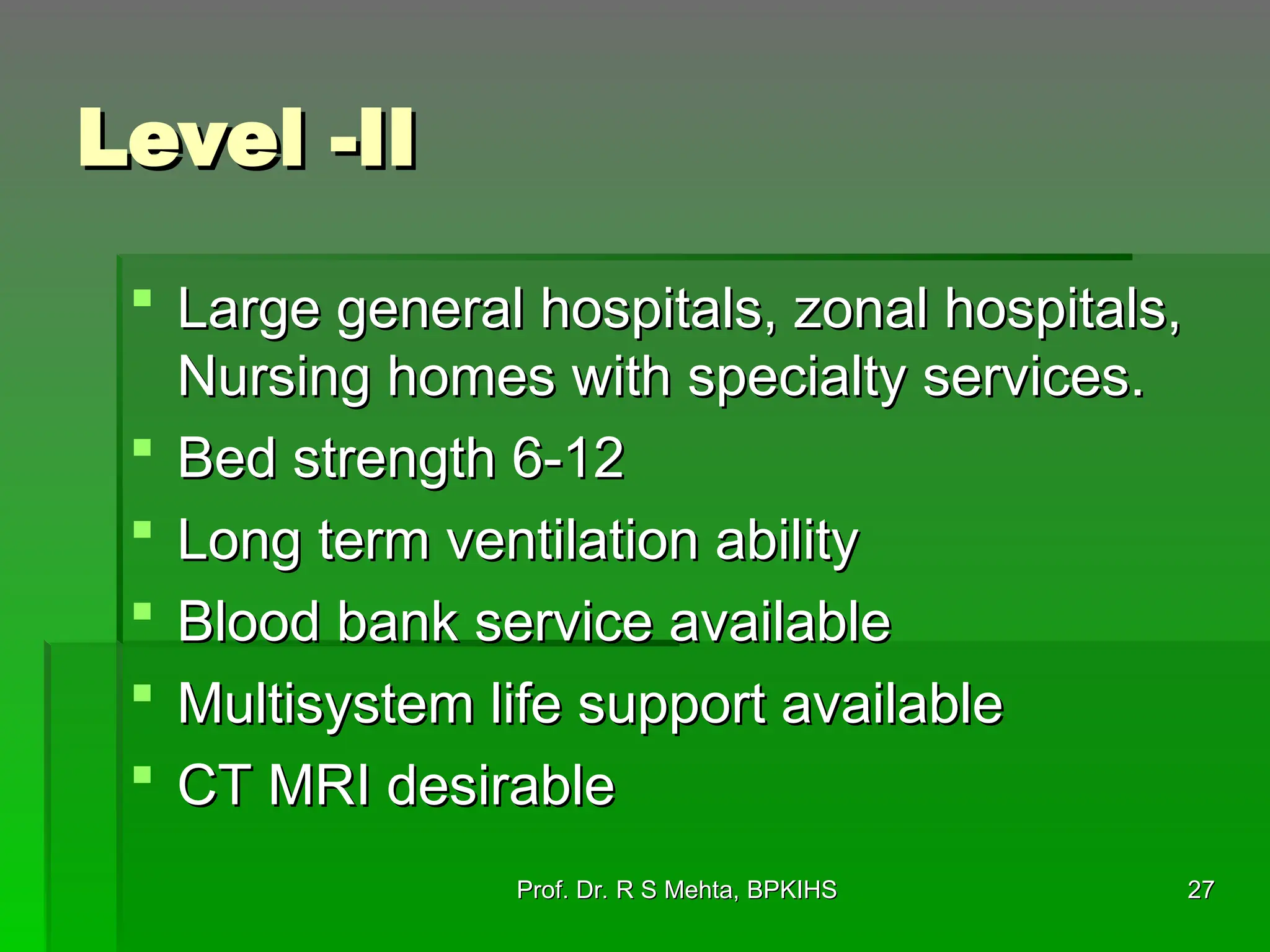
Level -II
Level -II
 Large general hospitals, zonal hospitals,
Large general hospitals, zonal hospitals,
Nursing homes with specialty services.
 Bed strength 6-12
Bed strength 6-12
 Long term ventilation ability
Long term ventilation ability
 Blood bank service available
Blood bank service available
 Multisystem life support available
Multisystem life support available
 CT MRI desirable
CT MRI desirable
Prof. Dr. R S Mehta, BPKIHS
Prof. Dr. R S Mehta, BPKIHS 27
27
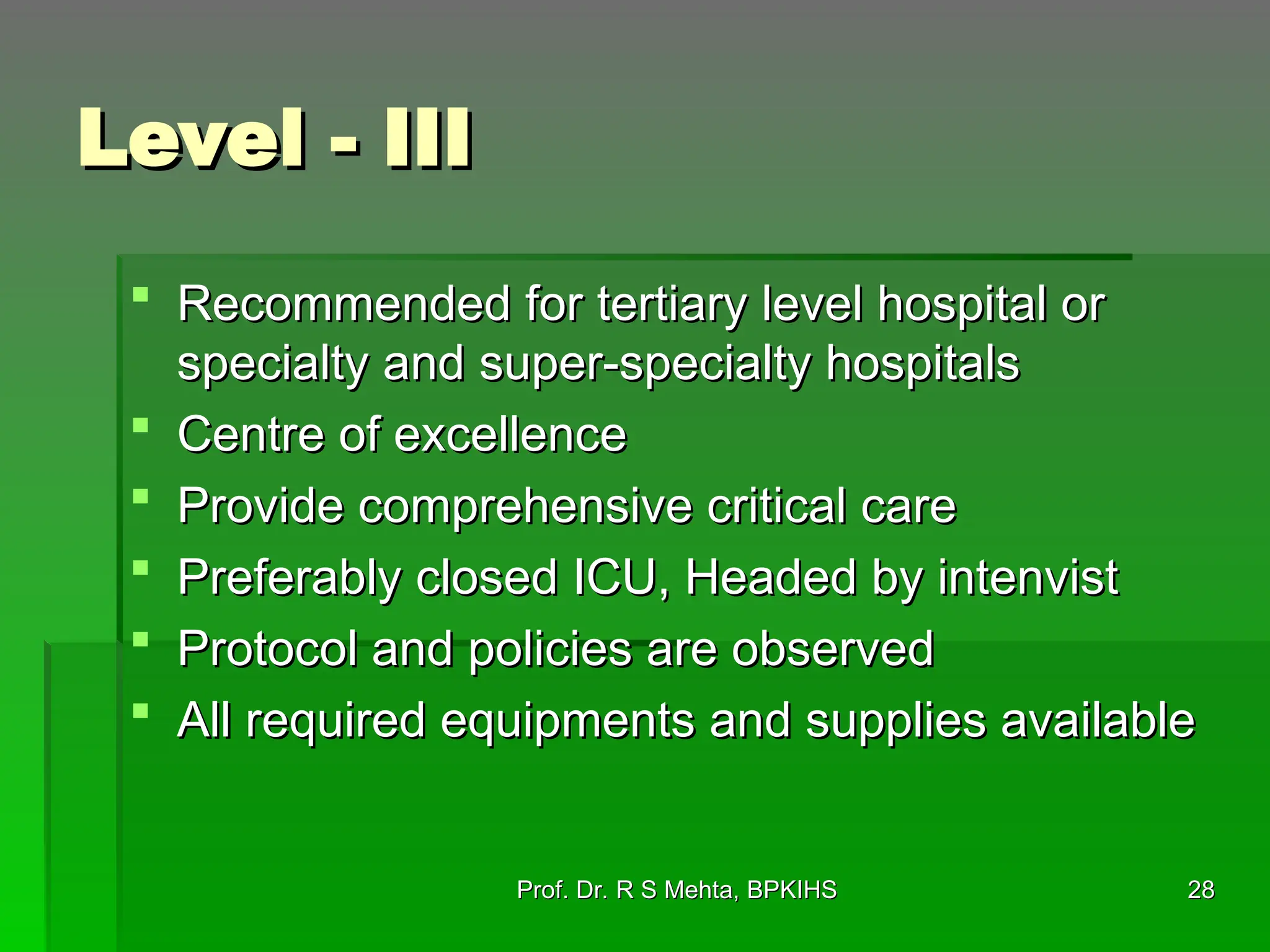
Level - III
Level - III
 Recommended for tertiary level hospital or
Recommended for tertiary level hospital or
specialty and super-specialty hospitals
 Centre of excellence
Centre of excellence
 Provide comprehensive critical care
Provide comprehensive critical care
 Preferably closed ICU, Headed by intenvist
Preferably closed ICU, Headed by intenvist
 Protocol and policies are observed
Protocol and policies are observed
 All required equipments and supplies available
All required equipments and supplies available
Prof. Dr. R S Mehta, BPKIHS
Prof. Dr. R S Mehta, BPKIHS 28
28
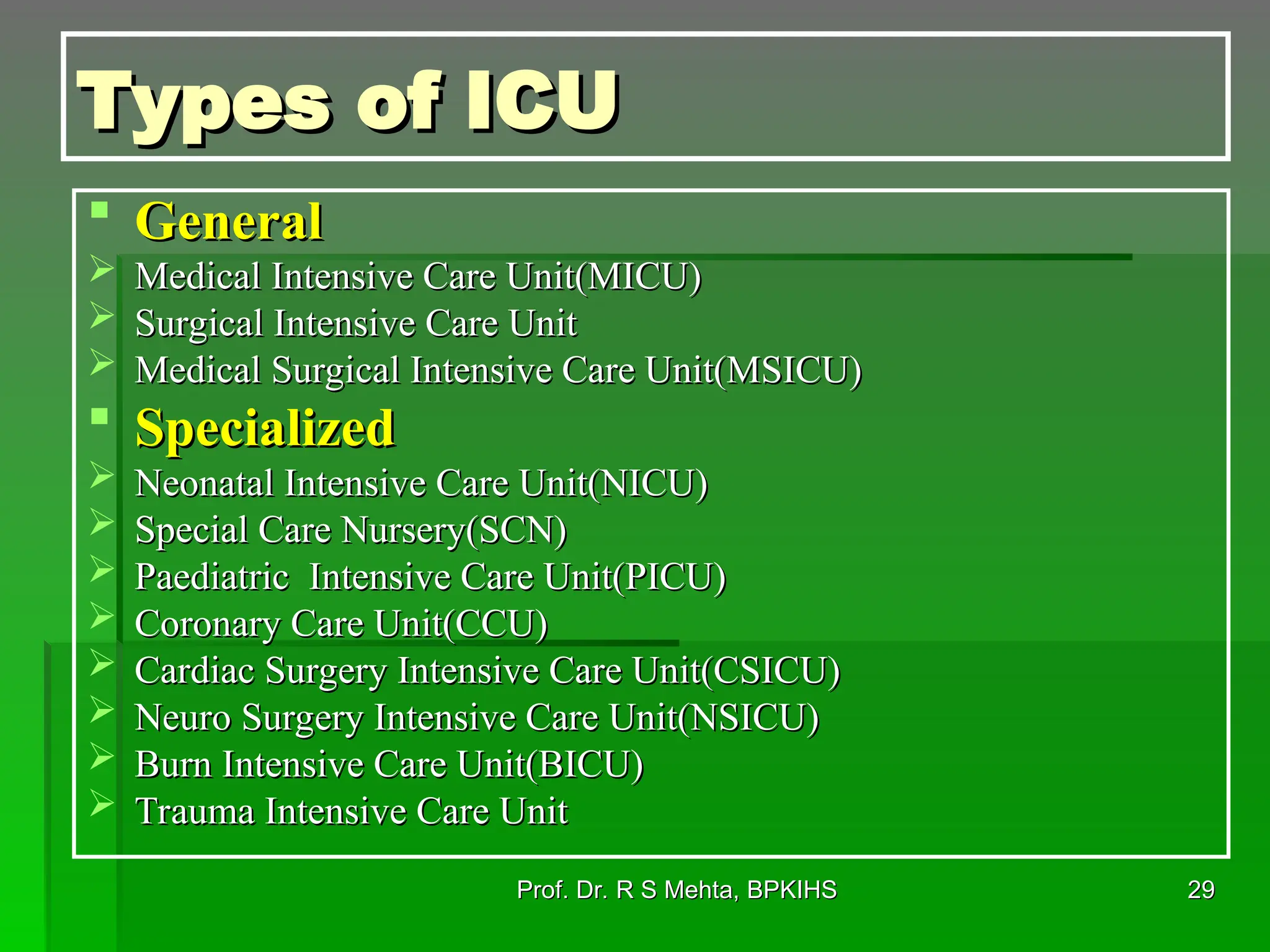
Types of ICU
Types of ICU
 General
General
 Medical Intensive Care Unit(MICU)
Medical Intensive Care Unit(MICU)
 Surgical Intensive Care Unit
Surgical Intensive Care Unit
 Medical Surgical Intensive Care Unit(MSICU)
Medical Surgical Intensive Care Unit(MSICU)
 Specialized
Specialized
 Neonatal Intensive Care Unit(NICU)
Neonatal Intensive Care Unit(NICU)
 Special Care Nursery(SCN)
Special Care Nursery(SCN)
 Paediatric Intensive Care Unit(PICU)
Paediatric Intensive Care Unit(PICU)
 Coronary Care Unit(CCU)
Coronary Care Unit(CCU)
 Cardiac Surgery Intensive Care Unit(CSICU)
Cardiac Surgery Intensive Care Unit(CSICU)
 Neuro Surgery Intensive Care Unit(NSICU)
Neuro Surgery Intensive Care Unit(NSICU)
 Burn Intensive Care Unit(BICU)
Burn Intensive Care Unit(BICU)
 Trauma Intensive Care Unit
Trauma Intensive Care Unit
29
29
Prof. Dr. R S Mehta, BPKIHS
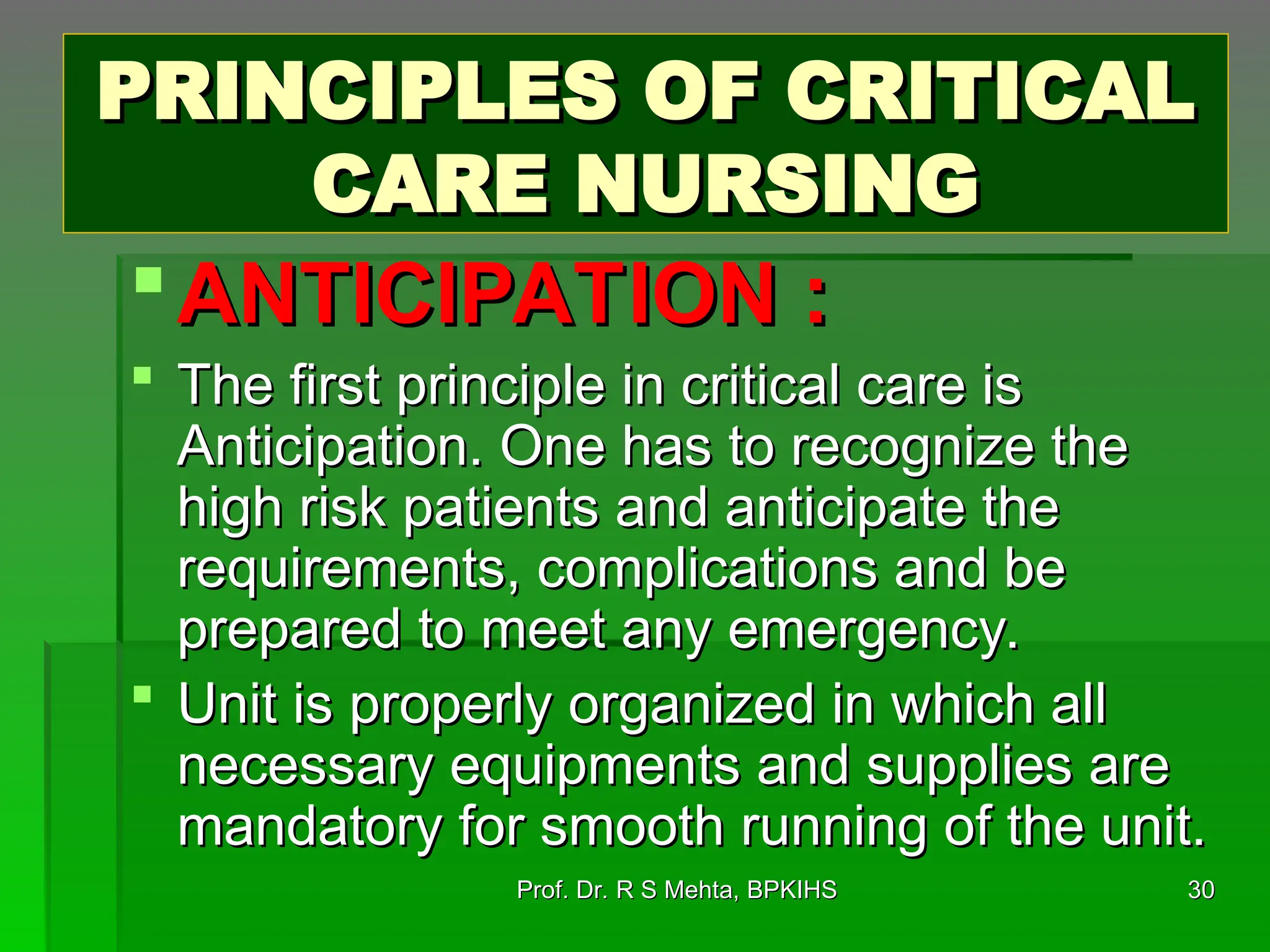
PRINCIPLES OF CRITICAL
CARE NURSING
CARE NURSING
ANTICIPATION :
ANTICIPATION :
 The first principle in critical care is
The first principle in critical care is
Anticipation. One has to recognize the
high risk patients and anticipate the
requirements, complications and be
prepared to meet any emergency.
 Unit is properly organized in which all
Unit is properly organized in which all
necessary equipments and supplies are
mandatory for smooth running of the unit.
30
30
Prof. Dr. R S Mehta, BPKIHS
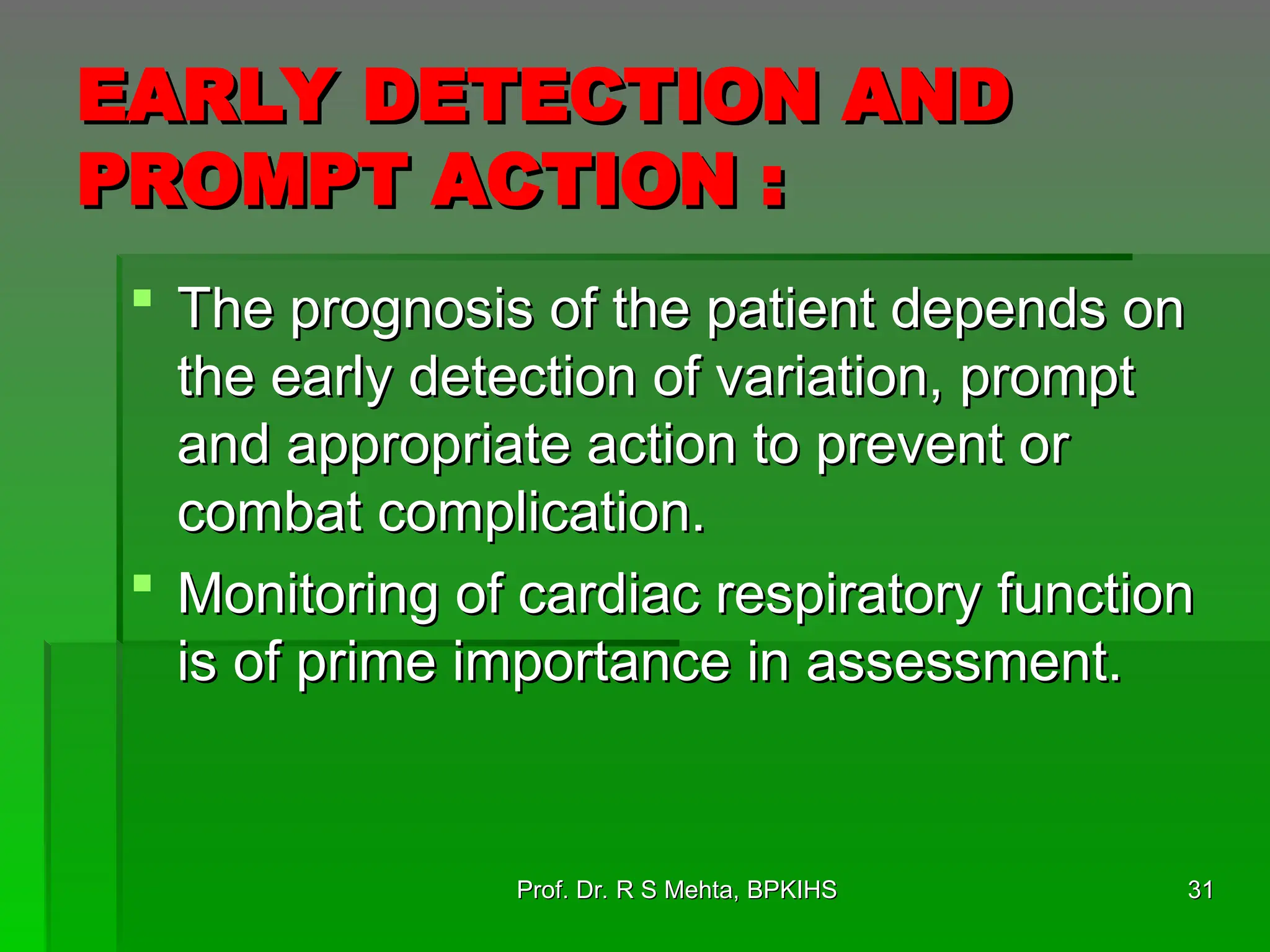
EARLY DETECTION AND
EARLY DETECTION AND
PROMPT ACTION :
PROMPT ACTION :
 The prognosis of the patient depends on
The prognosis of the patient depends on
the early detection of variation, prompt
and appropriate action to prevent or
combat complication.
 Monitoring of cardiac respiratory function
Monitoring of cardiac respiratory function
is of prime importance in assessment.
Prof. Dr. R S Mehta, BPKIHS
Prof. Dr. R S Mehta, BPKIHS 31
31
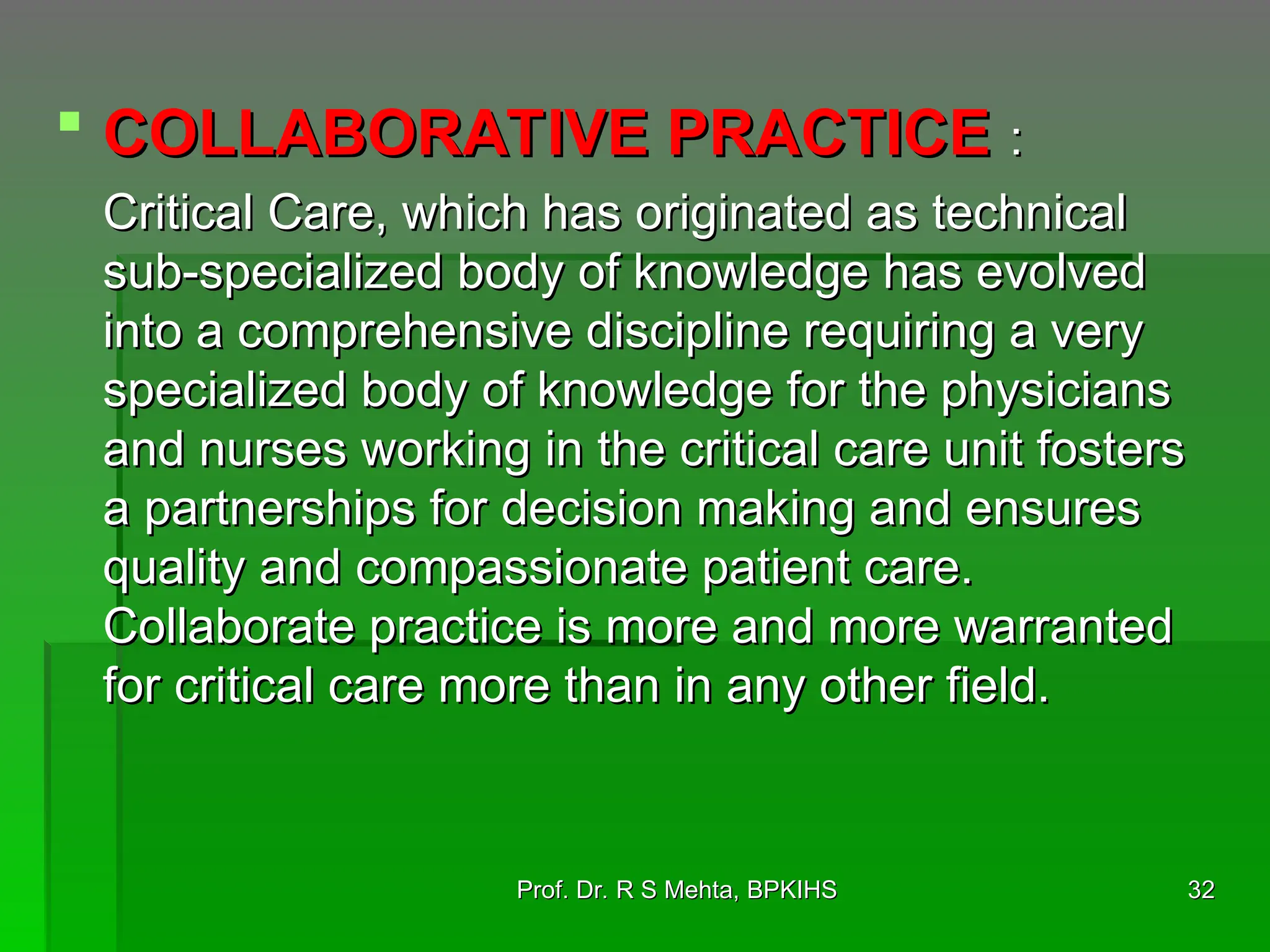
 COLLABORATIVE PRACTICE
COLLABORATIVE PRACTICE :
:
Critical Care, which has originated as technical
sub-specialized body of knowledge has evolved
into a comprehensive discipline requiring a very
specialized body of knowledge for the physicians
and nurses working in the critical care unit fosters
a partnerships for decision making and ensures
quality and compassionate patient care.
Collaborate practice is more and more warranted
for critical care more than in any other field.
32
32
Prof. Dr. R S Mehta, BPKIHS
COMMUNICATION :
COMMUNICATION :
 Intra professional, inter departmental and
Intra professional, inter departmental and
inter personal communication has a
significant importance in the smooth
running of unit. Collaborative practice of
communication model
communication model
Prof. Dr. R S Mehta, BPKIHS
Prof. Dr. R S Mehta, BPKIHS 33
33
 Prevention of Infection :
Prevention of Infection :
 Nosocomial infection cost a lot in the health
Nosocomial infection cost a lot in the health
care services.
care services.
 Critically ill patients requiring intensive care
Critically ill patients requiring intensive care
are at a greater risk than other patients due
to the immunocompromised state with the
antibiotic usage and stress, invasive lines,
mechanical ventilators, prolonged stay and
severity of illness and environment of the
critical unit itself.
34
34
Prof. Dr. R S Mehta, BPKIHS
 Crisis Intervention and Stress
Crisis Intervention and Stress
Reduction :
Reduction :
 partnerships are formulated during crisis.
partnerships are formulated during crisis.
Bonds between nurses, patients and
families are stronger during hospitalization.
 As patient advocates, nurses assist the
As patient advocates, nurses assist the
patient to express fear and identify their
grieving patttern and provide avenues for
positive coping.
positive coping.
35
35
Prof. Dr. R S Mehta, BPKIHS
ICU & CCU Service of
BPKIHS
BPKIHS
Nursing Care and Protocols
36
36
Prof. Dr. R S Mehta, BPKIHS
Critical Care
Critical Care
Considerations
Considerations
 F=
F=Feeding/fluid
Feeding/fluid
 A=
A=Analgesics
Analgesics
 S=
S=Sedation
Sedation
 T=
T=Thrombolytic agents
Thrombolytic agents
 H=
H=Head elevation
Head elevation
 U=
U=Ulcer – bed sore
Ulcer – bed sore
 G=
G=Glucose monitoring
Glucose monitoring
37
37
Prof. Dr. R S Mehta, BPKIHS
Feeding and Fluids
Feeding and Fluids
 It includes
It includes
 Enteral feeding
Enteral feeding
o Oro - gastric and Naso - gastric feeding
Oro - gastric and Naso - gastric feeding
o Churn diet
Churn diet
o Dairy and poultry products (Milk, egg,
Dairy and poultry products (Milk, egg,
youghort)
youghort)
o High protein liquid diet
High protein liquid diet
o Medications
Medications
38
38
Prof. Dr. R S Mehta, BPKIHS
 Oral feeding
Oral feeding
o Hospital diet
Hospital diet
o Bland diet
Bland diet
o Normal diet
Normal diet
o Liquid intake
Liquid intake
39
39
Prof. Dr. R S Mehta, BPKIHS
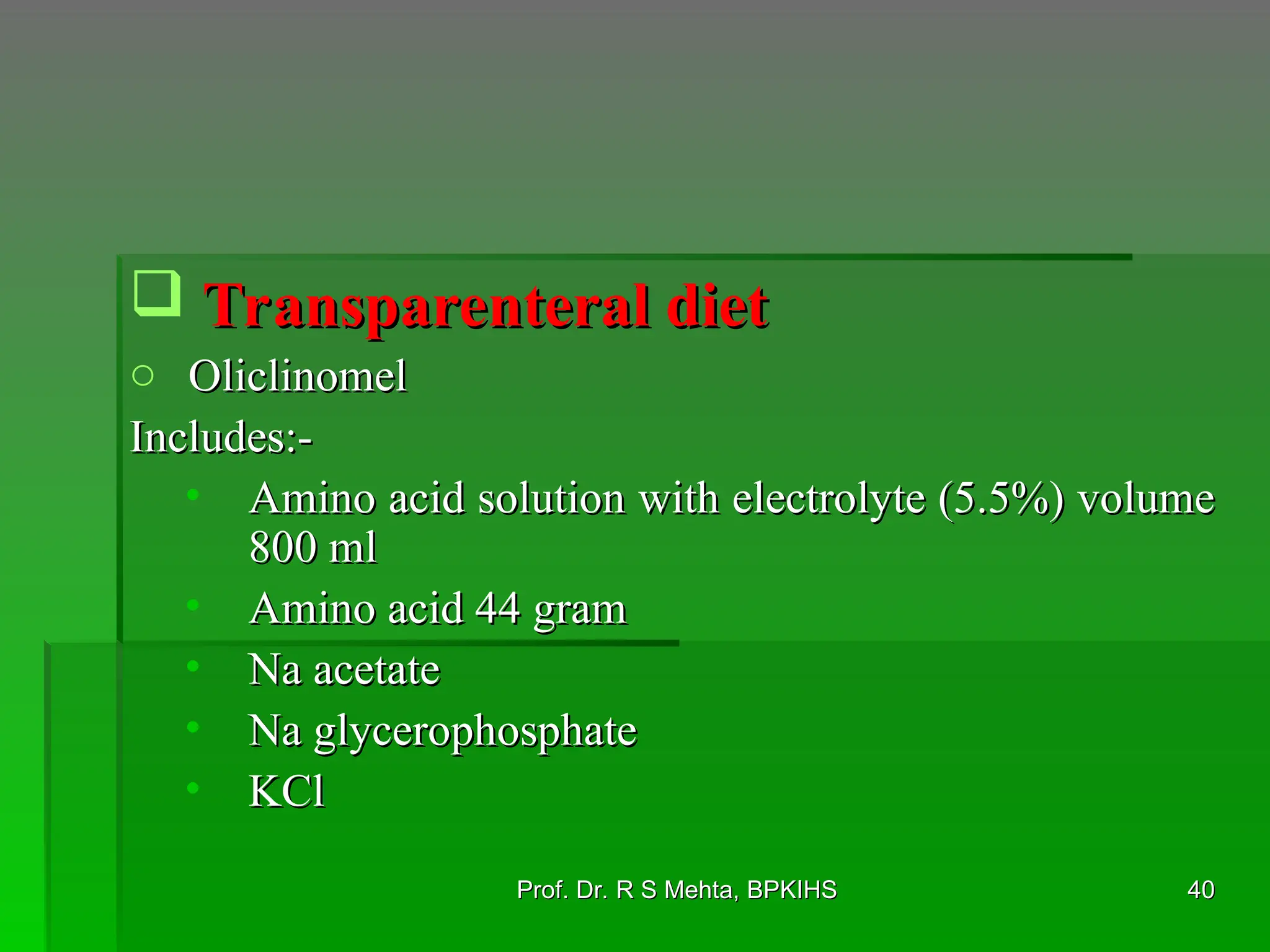
 Transparenteral diet
Transparenteral diet
o Oliclinomel
Oliclinomel
Includes:-
Includes:-
• Amino acid solution with electrolyte (5.5%) volume
Amino acid solution with electrolyte (5.5%) volume
800 ml
800 ml
• Amino acid 44 gram
Amino acid 44 gram
• Na acetate
Na acetate
• Na glycerophosphate
Na glycerophosphate
• KCl
KCl
40
40
Prof. Dr. R S Mehta, BPKIHS
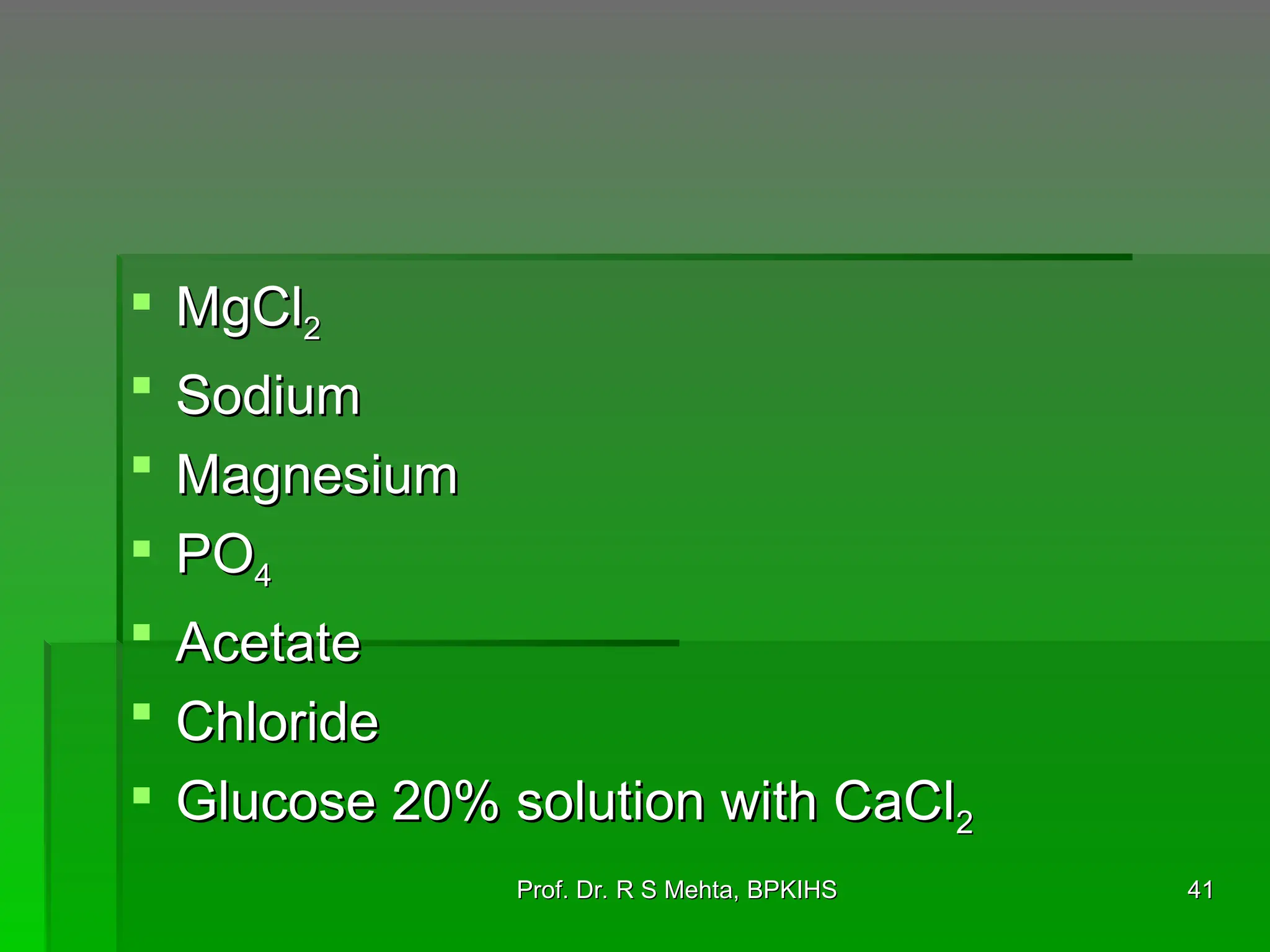
 MgCl
MgCl2
2
 Sodium
Sodium
 Magnesium
Magnesium
 PO
PO4
4
 Acetate
Acetate
 Chloride
Chloride
 Glucose 20% solution with CaCl
Glucose 20% solution with CaCl2
2
41
41
Prof. Dr. R S Mehta, BPKIHS
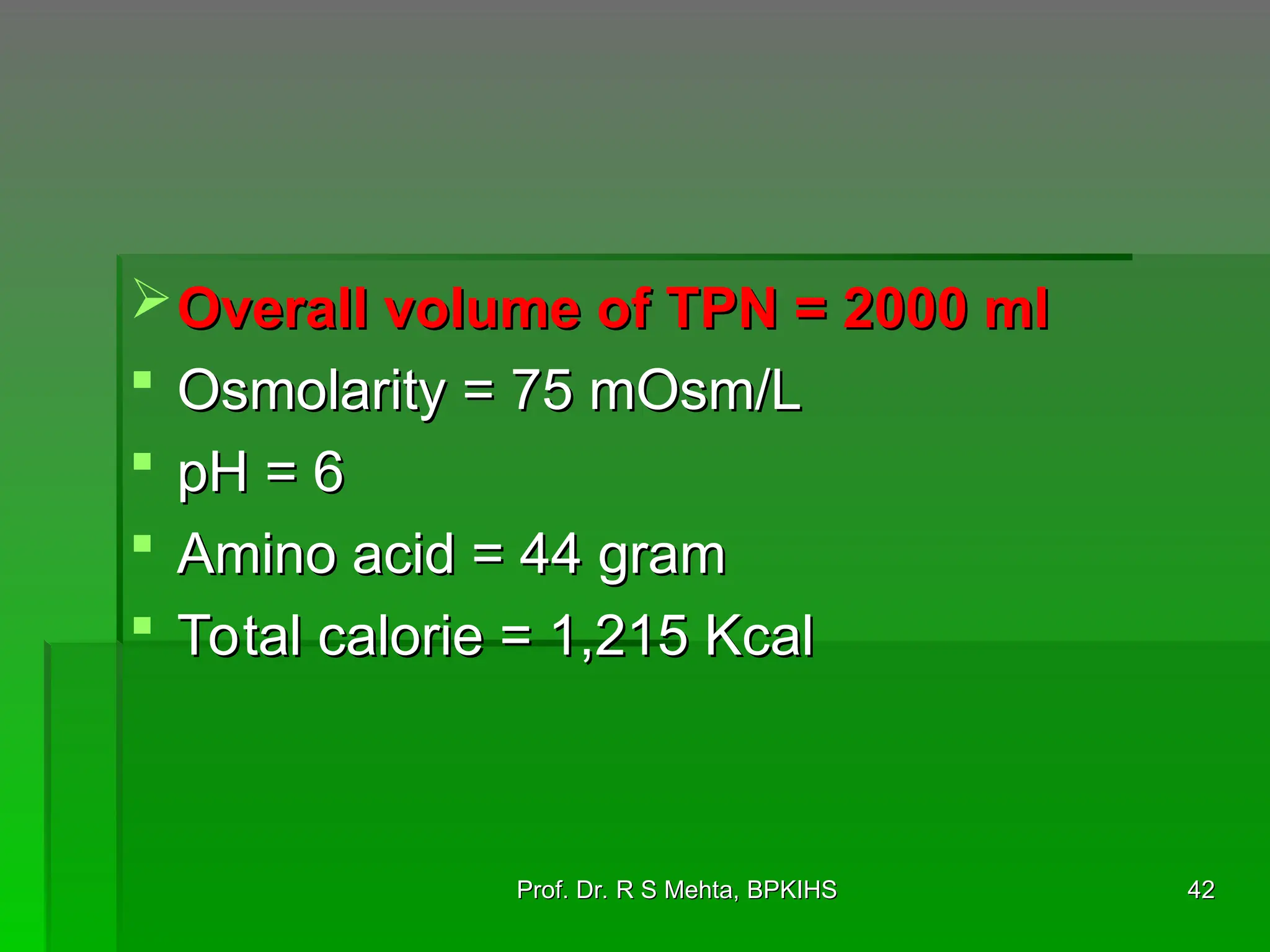
Overall volume of TPN = 2000 ml
Overall volume of TPN = 2000 ml
 Osmolarity = 75 mOsm/L
Osmolarity = 75 mOsm/L
 pH = 6
pH = 6
 Amino acid = 44 gram
Amino acid = 44 gram
 Total calorie = 1,215 Kcal
Total calorie = 1,215 Kcal
42
42
Prof. Dr. R S Mehta, BPKIHS
 Fluids
Fluids
 IV fluids like NS, RL, 5% D, 10% D, DNS
IV fluids like NS, RL, 5% D, 10% D, DNS
43
43
Prof. Dr. R S Mehta, BPKIHS
Analgesics
Analgesics
 Fentanyl
Fentanyl
o It works 600 times more effectively than
It works 600 times more effectively than
Morphine and reduces the pain and
increases the pain threshold
o Used in moderate and severe pain
Used in moderate and severe pain
o In ICU 50 – 100 µg per Kg
In ICU 50 – 100 µg per Kg
o Antidote Naloxone 0.05 mg/ Kg
Antidote Naloxone 0.05 mg/ Kg
44
44
Prof. Dr. R S Mehta, BPKIHS
 Morphine
Morphine
o Reduces pain
Reduces pain
o Chiefly used in MI
Chiefly used in MI
o 2-4 mg dissolved in 10 ml NS
2-4 mg dissolved in 10 ml NS
o Antidote: Naloxone
Antidote: Naloxone
o Supplied by hospital.
Supplied by hospital.
45
45
Prof. Dr. R S Mehta, BPKIHS
 Acetaminophen and NSAIDs
Acetaminophen and NSAIDs
o Often more effective than opioids in reducing
Often more effective than opioids in reducing
pain from pleural or pericardial rubs, a pain that
responds poorly to opioids.
o particularly effective in reducing muscular and
particularly effective in reducing muscular and
skeletal pain
skeletal pain
o Tab form: 500mg OD
Tab form: 500mg OD
46
46
Prof. Dr. R S Mehta, BPKIHS
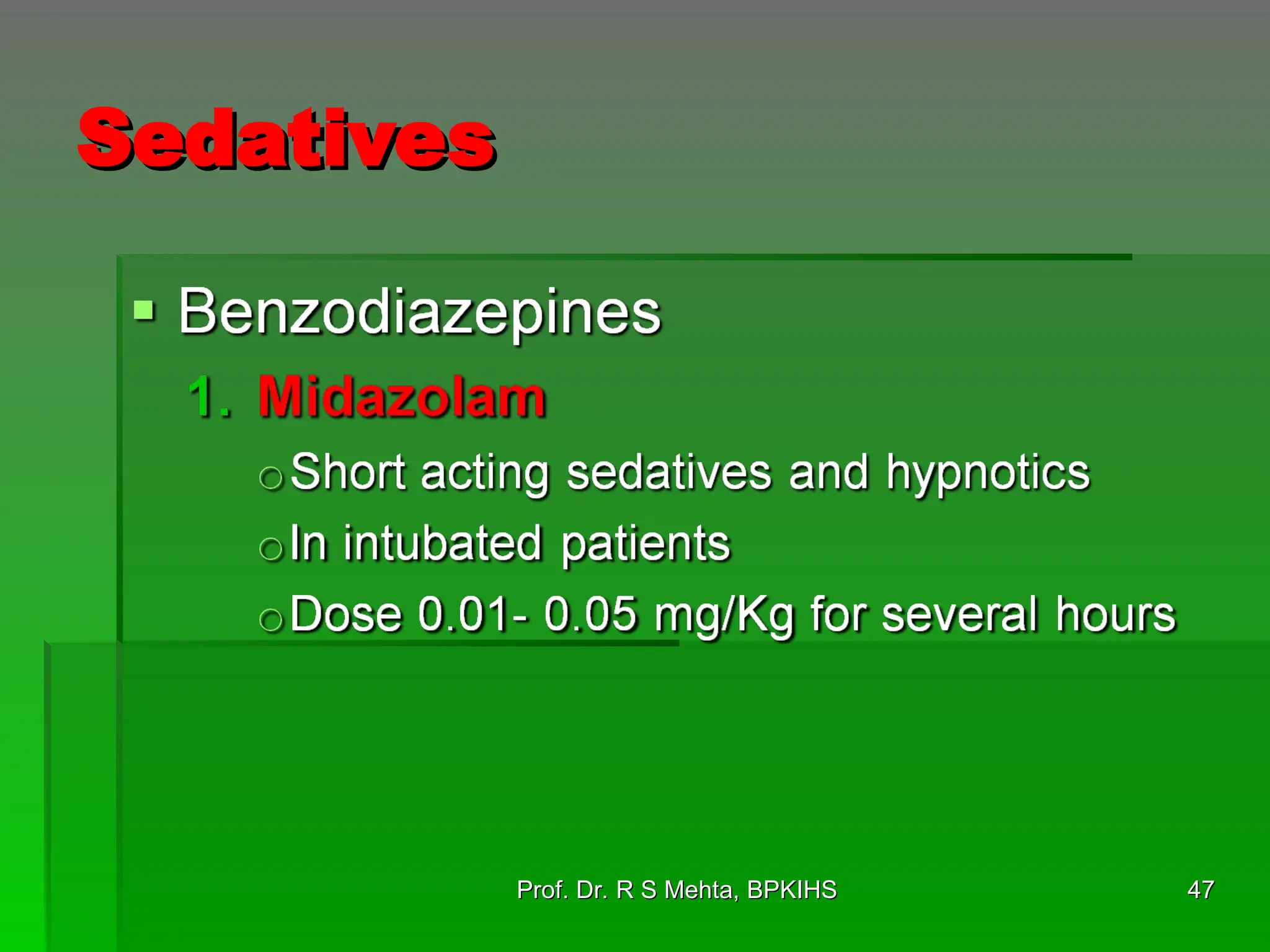
Sedatives
Sedatives
47
47
Prof. Dr. R S Mehta, BPKIHS
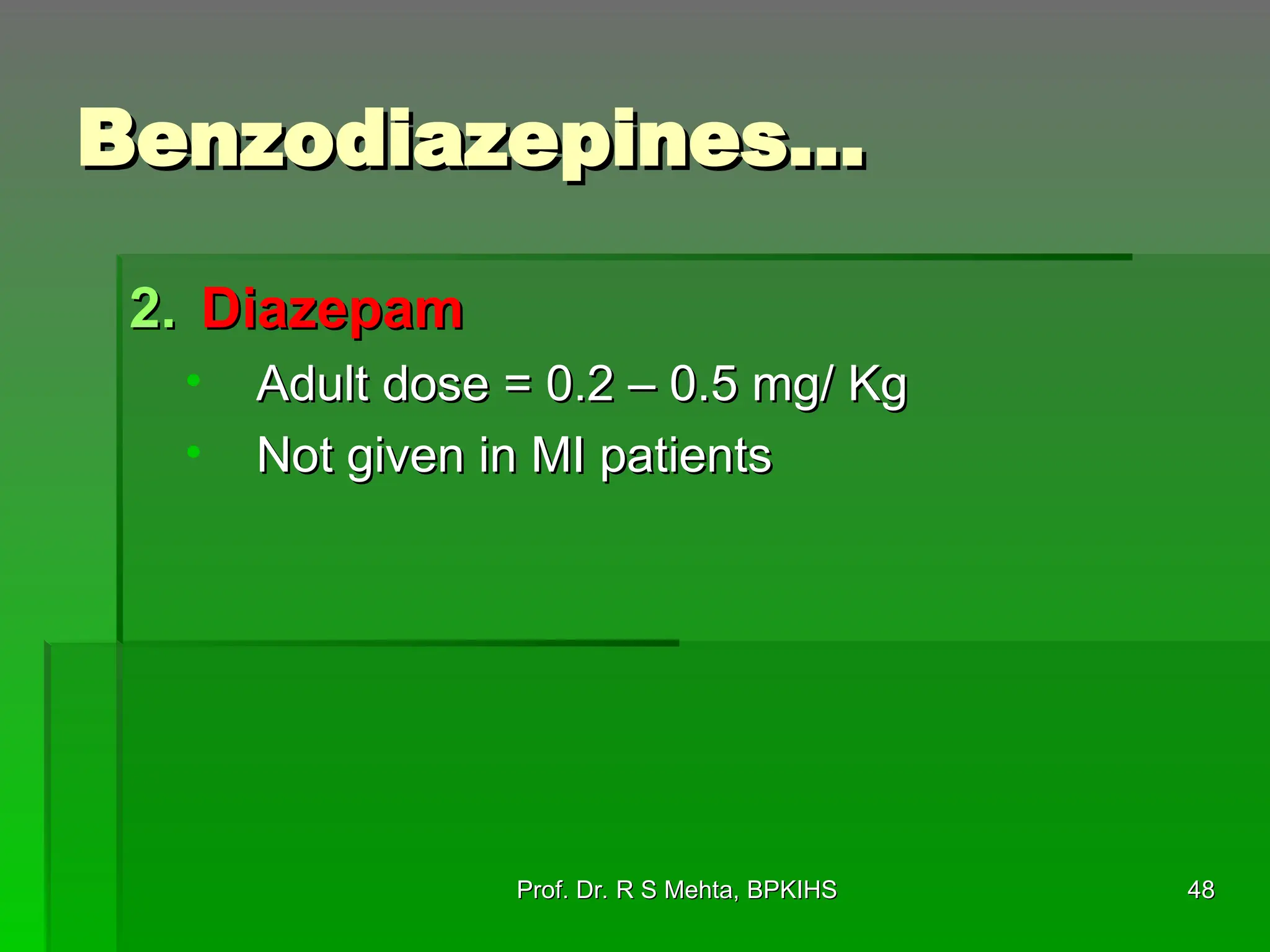
Benzodiazepines…
Benzodiazepines…
2.
2. Diazepam
Diazepam
• Adult dose = 0.2 – 0.5 mg/ Kg
Adult dose = 0.2 – 0.5 mg/ Kg
• Not given in MI patients
Not given in MI patients
48
48
Prof. Dr. R S Mehta, BPKIHS
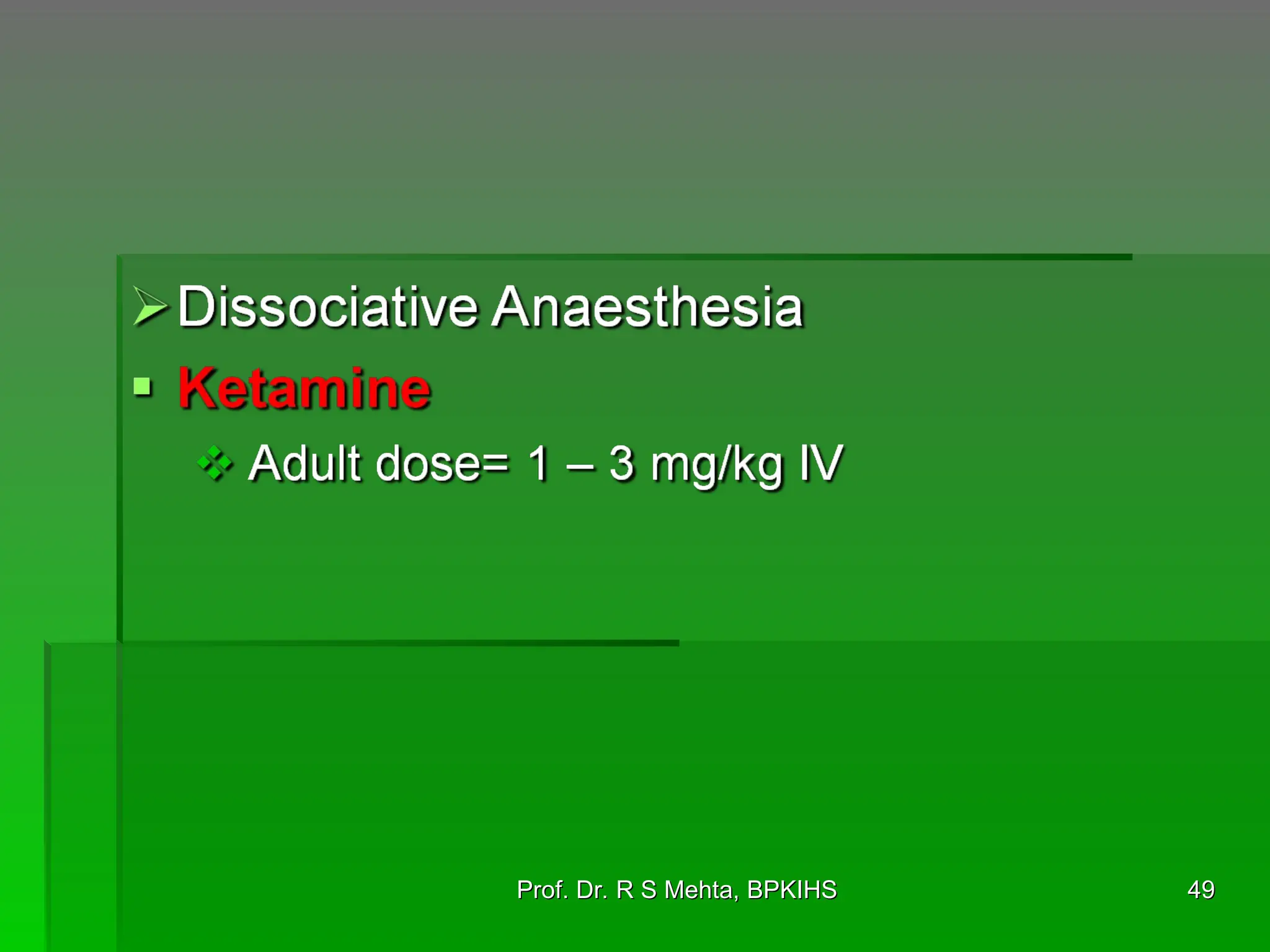
49
49
Prof. Dr. R S Mehta, BPKIHS
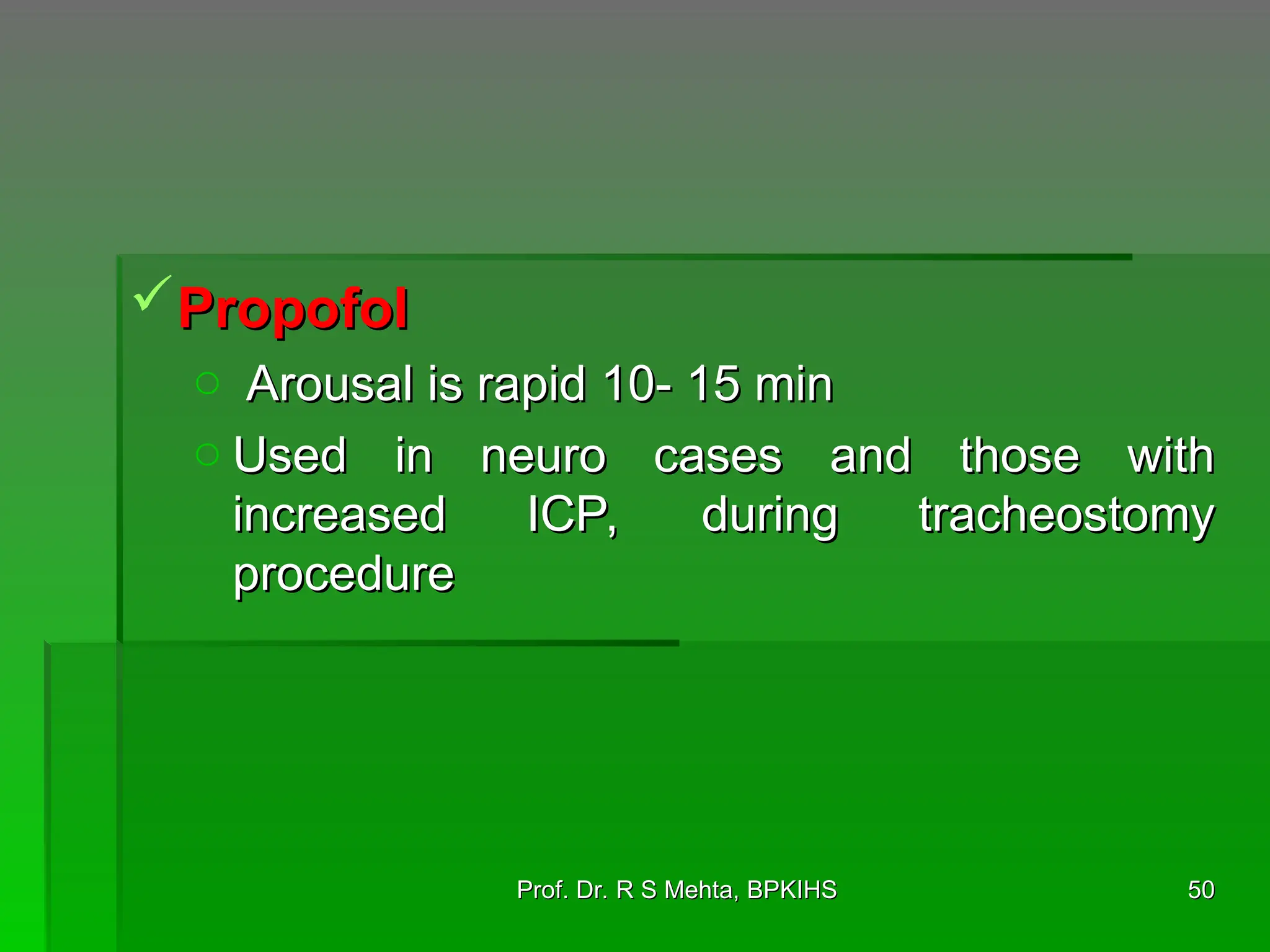
Propofol
Propofol
o Arousal is rapid 10- 15 min
Arousal is rapid 10- 15 min
o Used in neuro cases and those with
Used in neuro cases and those with
increased ICP, during tracheostomy
procedure
procedure
50
50
Prof. Dr. R S Mehta, BPKIHS
Inotropes
Inotropes
 Dopamine
Dopamine
 Dobutamine
Dobutamine
 Nor- adrenaline
Nor- adrenaline
51
51
Prof. Dr. R S Mehta, BPKIHS
Thrombolytic agents
Thrombolytic agents
 Compressive stocking
Compressive stocking
 SCD (Systematic Compressive Device)
SCD (Systematic Compressive Device)
 LMWX
LMWX
 Heparin flush
Heparin flush
52
52
Prof. Dr. R S Mehta, BPKIHS
Head elevation
Head elevation
 Head is elevated to 30 degree.
Head is elevated to 30 degree.
53
53
Prof. Dr. R S Mehta, BPKIHS
Ulcer
Ulcer
 Two hourly position change
Two hourly position change
 Back care in each shift
Back care in each shift
 Oxygen therapy
Oxygen therapy
 Each shift dressing of pressure sore
Each shift dressing of pressure sore
 Air mattresses
Air mattresses
54
54
Prof. Dr. R S Mehta, BPKIHS
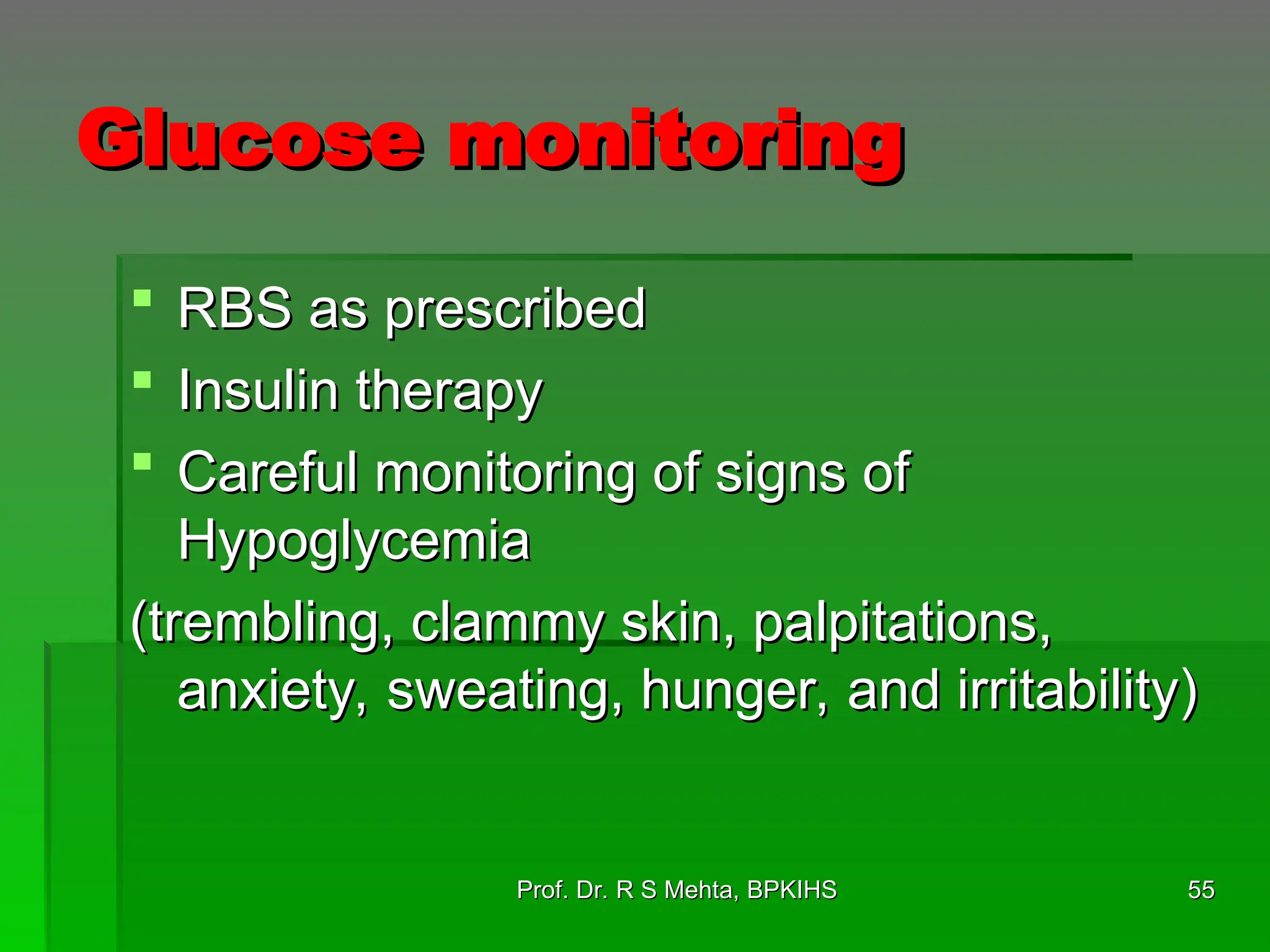
Glucose monitoring
Glucose monitoring
 RBS as prescribed
RBS as prescribed
 Insulin therapy
Insulin therapy
 Careful monitoring of signs of
Careful monitoring of signs of
Hypoglycemia
Hypoglycemia
(trembling, clammy skin, palpitations,
anxiety, sweating, hunger, and irritability)
55
55
Prof. Dr. R S Mehta, BPKIHS
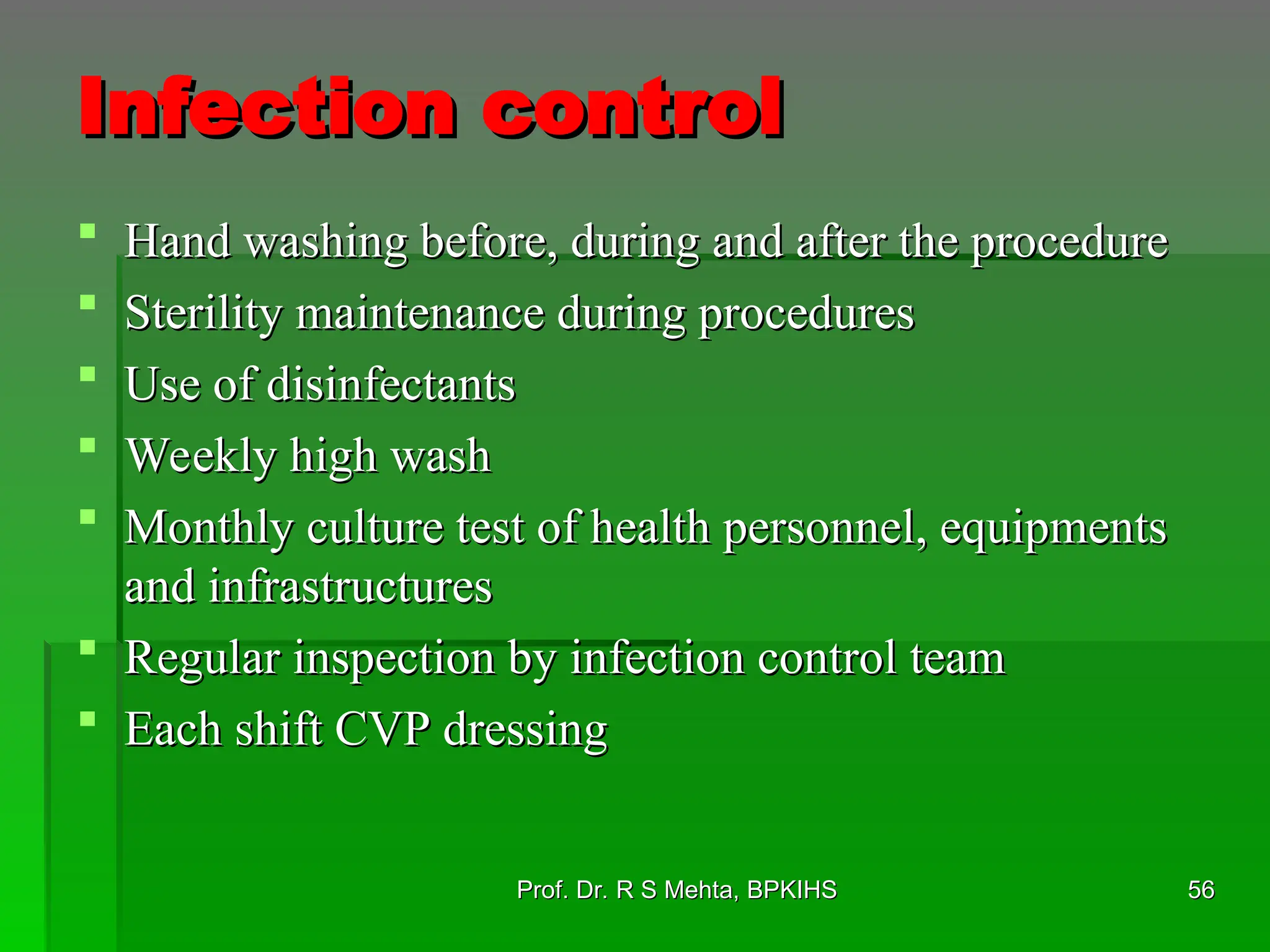
Infection control
Infection control
 Hand washing before, during and after the procedure
Hand washing before, during and after the procedure
 Sterility maintenance during procedures
Sterility maintenance during procedures
 Use of disinfectants
Use of disinfectants
 Weekly high wash
Weekly high wash
 Monthly culture test of health personnel, equipments
Monthly culture test of health personnel, equipments
and infrastructures
and infrastructures
 Regular inspection by infection control team
Regular inspection by infection control team
 Each shift CVP dressing
Each shift CVP dressing
56
56
Prof. Dr. R S Mehta, BPKIHS
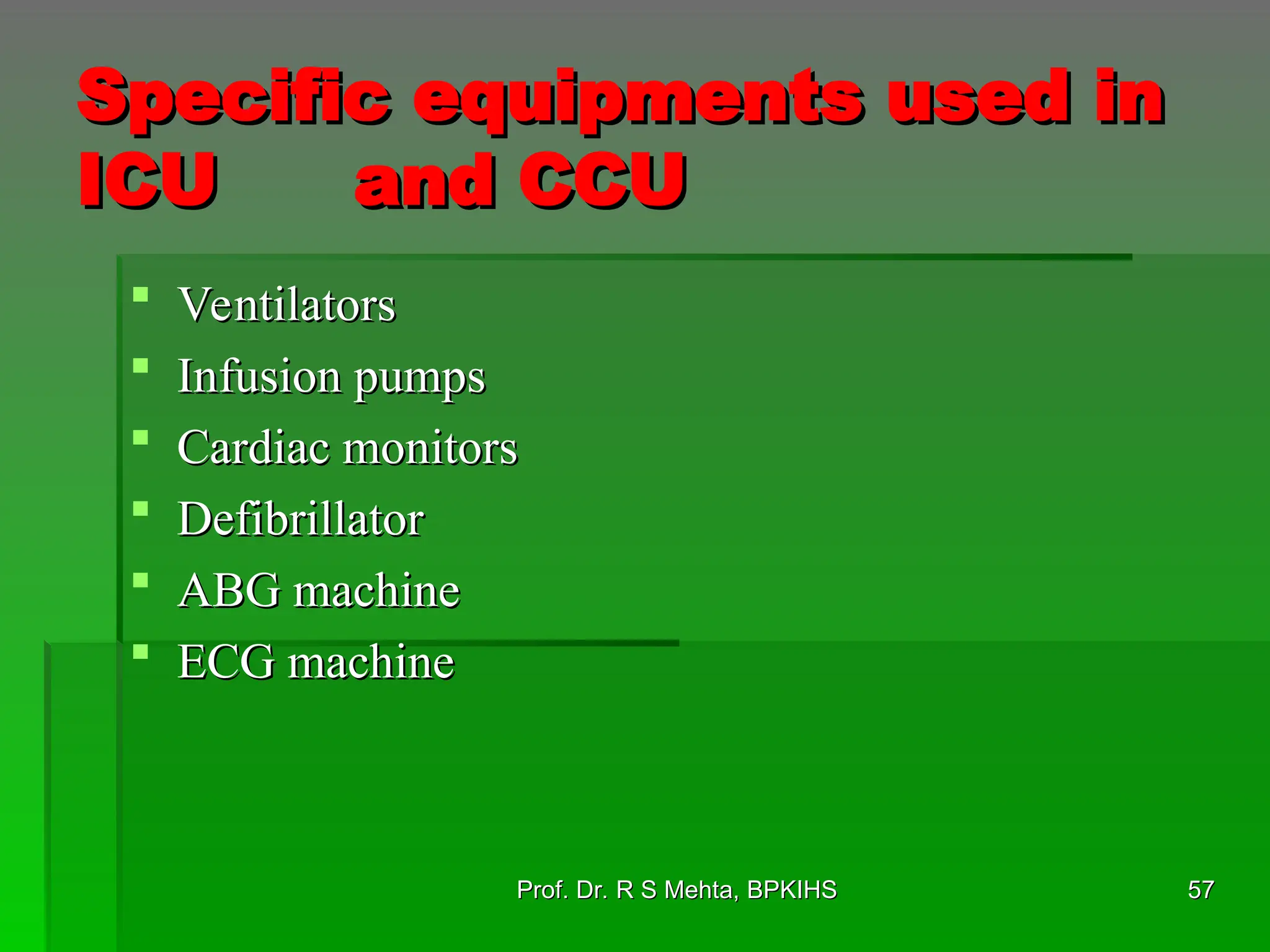
Specific equipments used in
ICU
ICU and CCU
and CCU
 Ventilators
Ventilators
 Infusion pumps
Infusion pumps
 Cardiac monitors
Cardiac monitors
 Defibrillator
Defibrillator
 ABG machine
ABG machine
 ECG machine
ECG machine
57
57
Prof. Dr. R S Mehta, BPKIHS
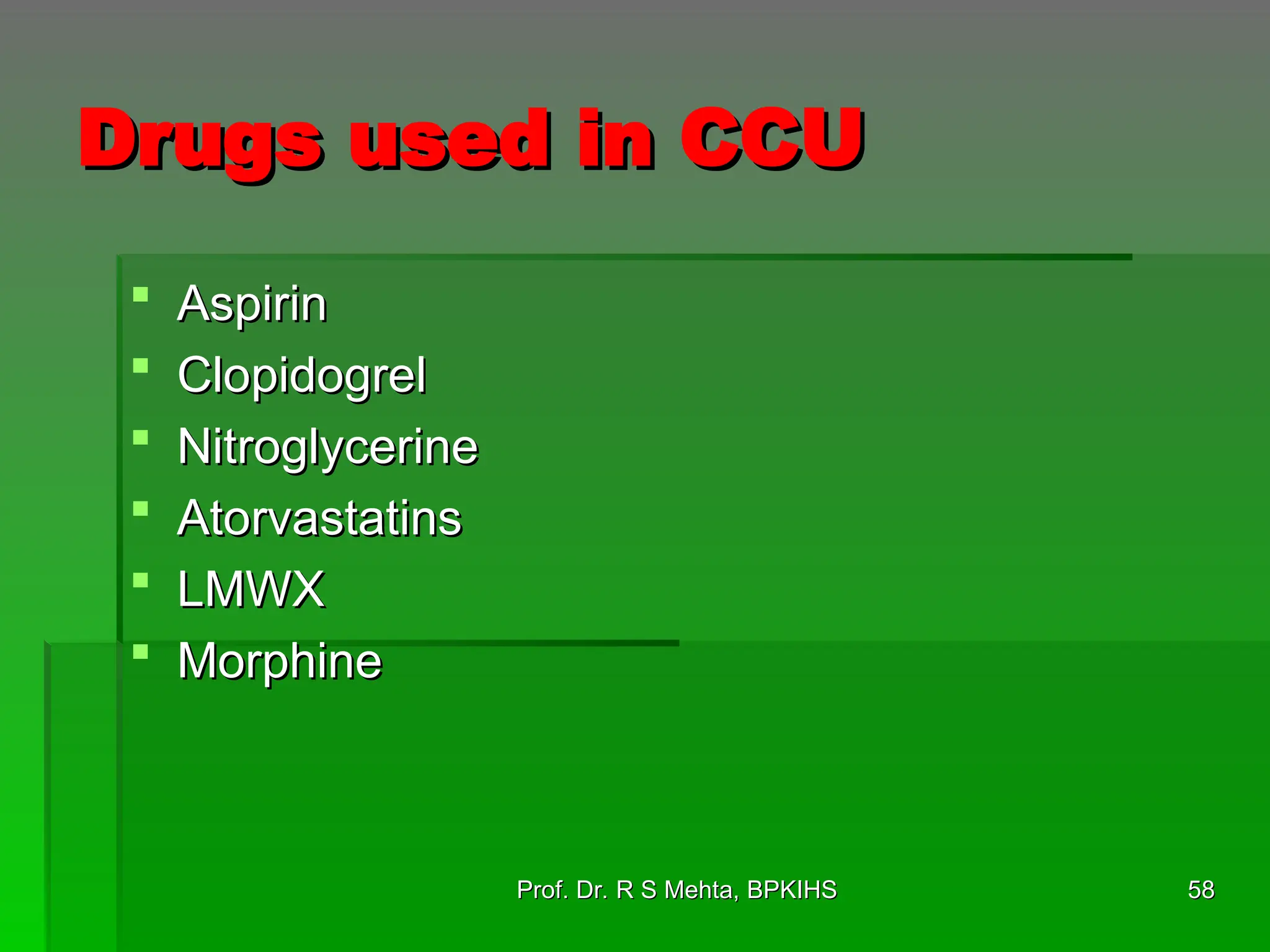
Drugs used in CCU
Drugs used in CCU
 Aspirin
Aspirin
 Clopidogrel
Clopidogrel
 Nitroglycerine
Nitroglycerine
 Atorvastatins
Atorvastatins
 LMWX
LMWX
 Morphine
Morphine
58
58
Prof. Dr. R S Mehta, BPKIHS
Sedation score in ICU is
done by RASS
done by RASS
59
59
Prof. Dr. R S Mehta, BPKIHS
(Richmond Agitation Sedation Scale = RASS)
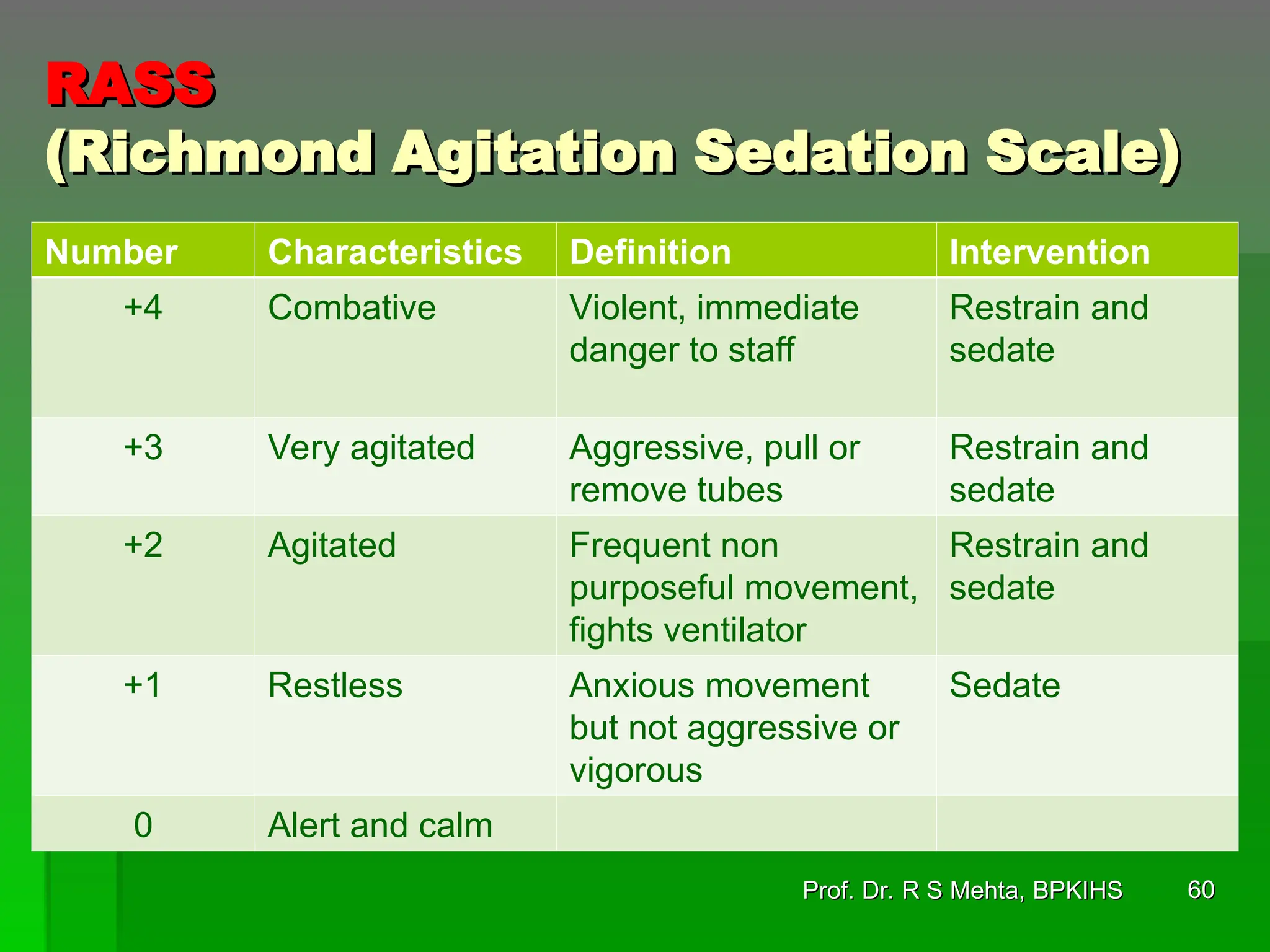
RASS
RASS
(Richmond Agitation Sedation Scale)
Number Characteristics Definition Intervention
+4 Combative Violent, immediate
danger to staff
Restrain and
sedate
+3 Very agitated Aggressive, pull or
remove tubes
Restrain and
sedate
+2 Agitated Frequent non
purposeful movement,
fights ventilator
Restrain and
sedate
+1 Restless Anxious movement
but not aggressive or
vigorous
Sedate
0 Alert and calm
60
60
Prof. Dr. R S Mehta, BPKIHS
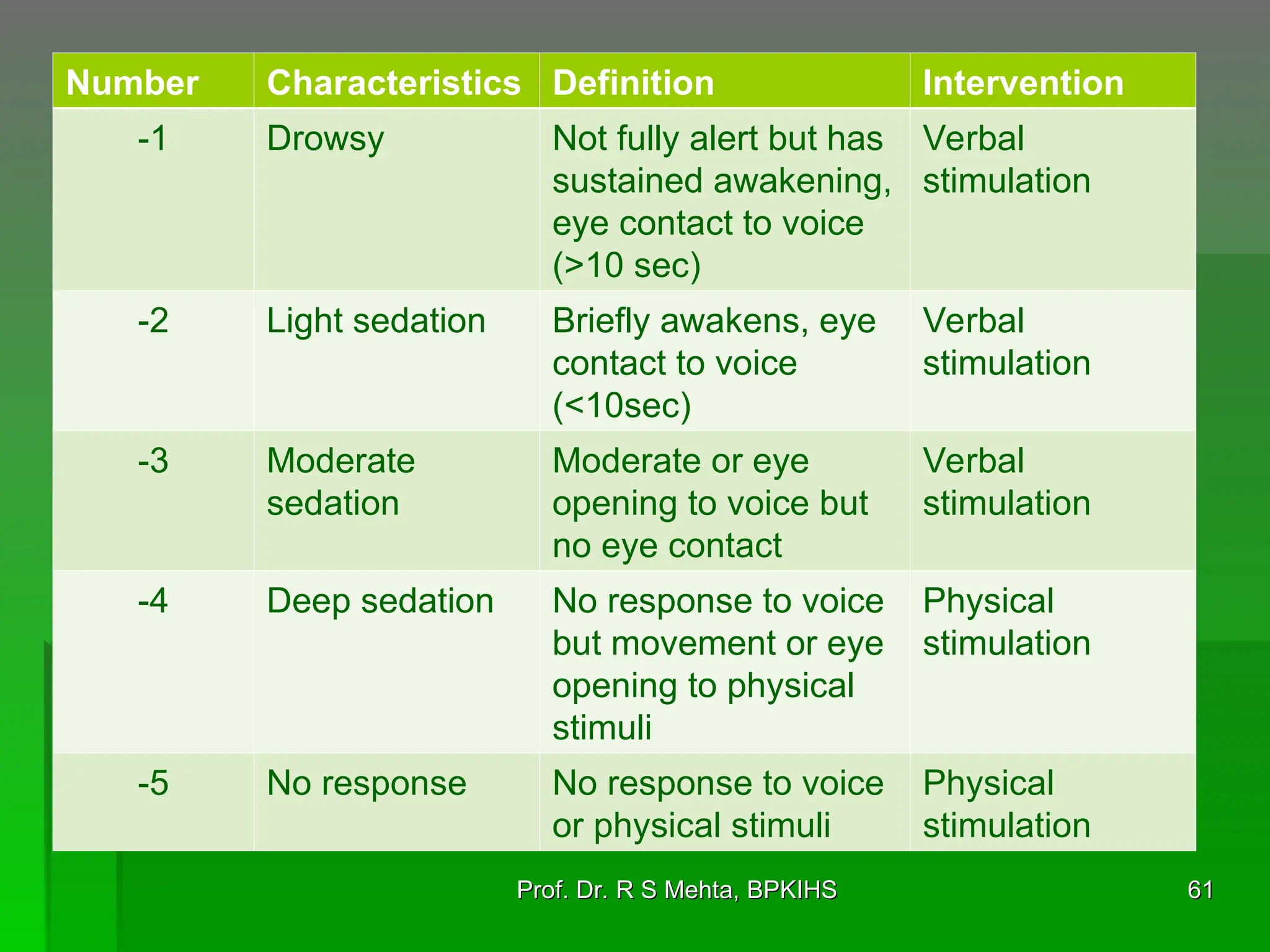
Number Characteristics Definition Intervention
-1 Drowsy Not fully alert but has
sustained awakening,
eye contact to voice
(>10 sec)
Verbal
stimulation
-2 Light sedation Briefly awakens, eye
contact to voice
(<10sec)
Verbal
stimulation
-3 Moderate
sedation
Moderate or eye
opening to voice but
no eye contact
Verbal
stimulation
-4 Deep sedation No response to voice
but movement or eye
opening to physical
stimuli
Physical
stimulation
-5 No response No response to voice
or physical stimuli
Physical
stimulation
61
61
Prof. Dr. R S Mehta, BPKIHS
“It may seem a
strange principle to
articulate as the very
first requirement in a
Hospital that it should
do the sick no harm.”
[1859]
62
62
Prof. Dr. R S Mehta, BPKIHS
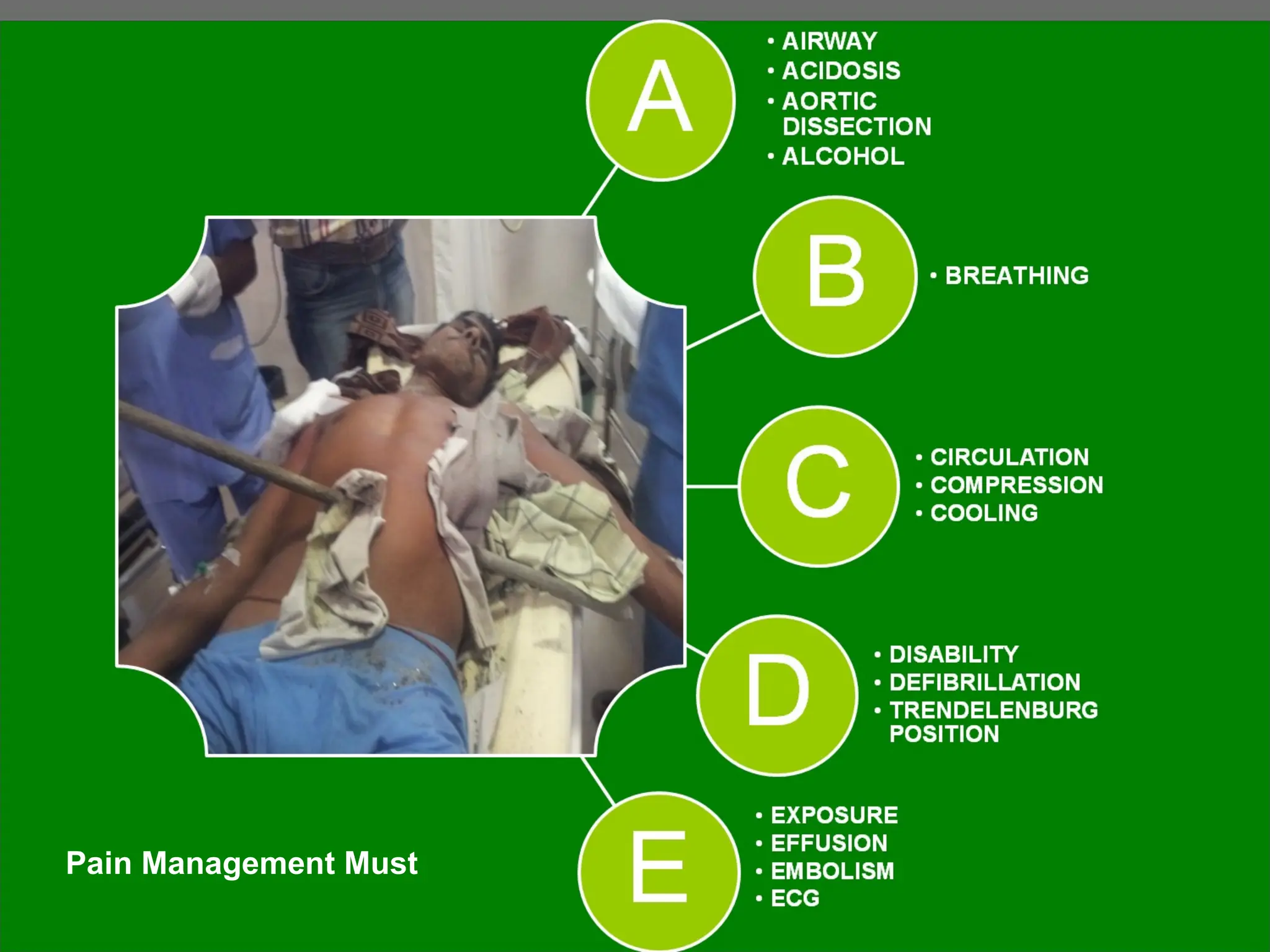
Pain Management Must

505549557-1-Critical-Care-Introduction-Concept.ppt

  • 1.
  • 2.
    Critical Care Unit/ICU CriticalCare Unit/ICU  ICU is highly specialized and ICU is highly specialized and sophisticated area of a hospital which is sophisticated area of a hospital which is specifically designed, staffed, located, specifically designed, staffed, located, furnished and equipped, dedicated to the furnished and equipped, dedicated to the management of critically sick patients, management of critically sick patients, injuries or complications. It is department injuries or complications. It is department with dedicated medical, nursing and with dedicated medical, nursing and allied staffs. allied staffs. 2 2
  • 3.
    ICU… ICU…  An ICUis, “a specially staffed and An ICU is, “a specially staffed and equipped, separate and self-contained equipped, separate and self-contained are of hospital dedicated to the are of hospital dedicated to the management of patients with life- management of patients with life- threatening illnesses, injuries and threatening illnesses, injuries and complications, and monitoring of complications, and monitoring of potentially life-threatening conditions”. potentially life-threatening conditions”. 3 3
  • 4.
    HDU HDU (High DependencyUnit) (High Dependency Unit)  A specifically staffed and equipped A specifically staffed and equipped section of an intensive care complex that section of an intensive care complex that provides level of care intermediate provides level of care intermediate between intensive care and general ward between intensive care and general ward care. care.  It must be near ICU Geographically and It must be near ICU Geographically and functionally, with intenvist service. functionally, with intenvist service. 4 4
  • 5.
    CRITICAL CRITICAL  Crucial Crucial  Crisis Crisis Emergency Emergency  Serious Serious  Requiring immediate action Requiring immediate action  Thorough and constant observation Thorough and constant observation  Total dependent Total dependent (Oxford Dictionary) (Oxford Dictionary) 5 5
  • 6.
    CRITICAL CARE NURSING CRITICALCARE NURSING  The care of seriously ill clients from point The care of seriously ill clients from point of injury or illness until discharge from of injury or illness until discharge from intensive care intensive care  Deals with human responses to life Deals with human responses to life threatening problems -trauma /major threatening problems -trauma /major surgery surgery (Mary,L.S., Deborah, G.K. & Marthe, J.M. 2005) (Mary,L.S., Deborah, G.K. & Marthe, J.M. 2005) 6 6
  • 7.
    CRITICAL CARE NURSE CRITICALCARE NURSE  care for clients who are very ill care for clients who are very ill  provide direct one to one care provide direct one to one care  Responsible for making life-and death decision Responsible for making life-and death decision  At high risk of injury or illness from possible At high risk of injury or illness from possible exposure to infections exposure to infections  Communication skill is of optimal importance Communication skill is of optimal importance  Specialty dealing with human responses to life- Specialty dealing with human responses to life- threatening problems threatening problems  Requires Extensive Knowledge and a Continual Requires Extensive Knowledge and a Continual Desire to Learn Desire to Learn 7 7
  • 8.
    CRITICALLY ILL CLIENT CRITICALLYILL CLIENT  At high risk for actual or potential life- At high risk for actual or potential life- threatening health problems threatening health problems  More ill More ill  Required more intensive and careful Required more intensive and careful nursing care nursing care 8 8 Prof. Dr. R S Mehta, BPKIHS Prof. Dr. R S Mehta, BPKIHS
  • 9.
  • 10.
    DEFINITIONS DEFINITIONS  CRITICAL CARE CRITICALCARE : : CRITICAL CARE IS A TERM USED CRITICAL CARE IS A TERM USED TO DESCRIBE AS THE CARE OF TO DESCRIBE AS THE CARE OF PATIENTS WHO ARE EXTREMELY PATIENTS WHO ARE EXTREMELY ILL AND WHOSE CLINICAL ILL AND WHOSE CLINICAL CONDITION IS UNSTABLE OR CONDITION IS UNSTABLE OR POTENTIALLY UNSTABLE. POTENTIALLY UNSTABLE. 10 10
  • 11.
     CRITICAL CAREUNIT CRITICAL CARE UNIT : : IT IS DEFINED AS THE UNIT IN IT IS DEFINED AS THE UNIT IN WHICH COMPREHENSIVE CARE WHICH COMPREHENSIVE CARE OF A CRITICALLY ILL PATIENT OF A CRITICALLY ILL PATIENT WHICH IS DEEMED TO WHICH IS DEEMED TO RECOVERABLE STAGE IS RECOVERABLE STAGE IS CARRIED OUT. CARRIED OUT. 11 11
  • 12.
     CRITICAL CARENURSING CRITICAL CARE NURSING : : IT REFERS TO THOSE IT REFERS TO THOSE COMPREHENSIVE, SPECIALIZED COMPREHENSIVE, SPECIALIZED AND INDIVIDUALIZED NURSING AND INDIVIDUALIZED NURSING CARE SERVICES WHICH ARE CARE SERVICES WHICH ARE RENDERED TO PATIENTS WITH RENDERED TO PATIENTS WITH LIFE THREATENING CONDITIONS LIFE THREATENING CONDITIONS AND THEIR FAMILIES. AND THEIR FAMILIES. 12 12 Prof. Dr. R S Mehta, BPKIHS Prof. Dr. R S Mehta, BPKIHS
  • 13.
    Economic Impact ofICU (1994) Economic Impact of ICU (1994) * <10% of hospital beds * <10% of hospital beds * 30% of acute care hospital cost * 30% of acute care hospital cost * >20% of hospital budget * >20% of hospital budget * 1% of GNP expended for ICU care * 1% of GNP expended for ICU care With aging of the population With aging of the population   Demand for critical care service will Demand for critical care service will increase increase 13 13 Prof. Dr. R S Mehta, BPKIHS Prof. Dr. R S Mehta, BPKIHS
  • 14.
    Prof. Dr. RS Mehta, BPKIHS Prof. Dr. R S Mehta, BPKIHS 14 14 Historical Background
  • 15.
    World War II WorldWar II  Shock wards Shock wards established for established for resuscitation resuscitation  Transfusion practices in Transfusion practices in early stages early stages  After World war-II, After World war-II, (1939-1945) nursing (1939-1945) nursing shortage forced shortage forced grouping of grouping of postoperative patients postoperative patients in recovery areas in recovery areas 15 15
  • 16.
    Polio epidemic Polio epidemic 1950’s: use of 1950’s: use of mechanical ventilation mechanical ventilation (“iron lung”) for treatment (“iron lung”) for treatment of polio of polio  Development of Development of respiratory intensive care respiratory intensive care units units  At the same time, general At the same time, general ICU’s developed for sick ICU’s developed for sick and postoperative and postoperative patients patients 16 16 Prof. Dr. R S Mehta, BPKIHS Prof. Dr. R S Mehta, BPKIHS
  • 17.
    17 17 History … History … Collaboration between nurses and Collaboration between nurses and physicians physicians  1950’s & 1960’s – CV Disease most 1950’s & 1960’s – CV Disease most common diagnosis common diagnosis  1960’s – 30-40% mortality rate for MI 1960’s – 30-40% mortality rate for MI  1965 – 1 1965 – 1st st specialized ICU – The specialized ICU – The Coronary Care Unit Coronary Care Unit  Emergence of Specialized ICU’s Emergence of Specialized ICU’s Prof. Dr. R S Mehta, BPKIHS Prof. Dr. R S Mehta, BPKIHS
  • 18.
  • 19.
    19 19 American Association of AmericanAssociation of Critical-Care Nurses - AACN Critical-Care Nurses - AACN  1969 1969  Educational support Educational support  Certification Certification  Largest professional Largest professional specialty nursing specialty nursing organization organization  Scholarships Scholarships  Research Research  Publishes 2 journals Publishes 2 journals  Local chapters Local chapters  Political awareness Political awareness  Provides standards Provides standards of practice of practice Prof. Dr. R S Mehta, BPKIHS Prof. Dr. R S Mehta, BPKIHS
  • 20.
    An Ideal ICU AnIdeal ICU 20 20 Prof. Dr. R S Mehta, BPKIHS Prof. Dr. R S Mehta, BPKIHS
  • 21.
    Multidisciplinary & Collaborative Multidisciplinary& Collaborative approach to ICU care approach to ICU care  Medical & nursing directors : Medical & nursing directors : co-responsibility for ICU management co-responsibility for ICU management • • a team approach : a team approach : doctors, nurses, R/T, pharmacist doctors, nurses, R/T, pharmacist • • use of standard, protocol, guideline use of standard, protocol, guideline consistent approach to all issues consistent approach to all issues • • dedication to coordination and communication dedication to coordination and communication for all aspects of ICU management for all aspects of ICU management • • emphasis on research, education, ethical emphasis on research, education, ethical issues, patient advocacy issues, patient advocacy 21 21 Prof. Dr. R S Mehta, BPKIHS Prof. Dr. R S Mehta, BPKIHS
  • 22.
    ICU Model Care ICUModel Care  Full-time intensivist model : Full-time intensivist model :  patient care is provided by an intensivist patient care is provided by an intensivist  Consultant intensivist model : Consultant intensivist model :  an intensivist consults for another physician to an intensivist consults for another physician to coordinate or assist in critical care, but dose not coordinate or assist in critical care, but dose not have primary responsibility for care have primary responsibility for care  Multiple consultant model: Multiple consultant model:  multiple specialists are involved in the patient care, multiple specialists are involved in the patient care, (esp. R/T doctors for ventilators), but none is (esp. R/T doctors for ventilators), but none is designated especially as the consultant intensivist designated especially as the consultant intensivist  Single physician model : Single physician model :  primary physician provides all ICU care primary physician provides all ICU care 22 22 Prof. Dr. R S Mehta, BPKIHS Prof. Dr. R S Mehta, BPKIHS
  • 23.
    A Good ICU AGood ICU  Well organized: trust & coordinated care Well organized: trust & coordinated care • • Full-time intensivist: daily round, critical care Full-time intensivist: daily round, critical care trained, available in a timely fashion (24hr/day) trained, available in a timely fashion (24hr/day) • • protocol & policies protocol & policies • • bedside nurses: adequate (master degree) bedside nurses: adequate (master degree)   no intern no intern  Team of: doctors, nurses, R/T, pharmacists Team of: doctors, nurses, R/T, pharmacists • • closed units, if resources allow closed units, if resources allow 23 23 Prof. Dr. R S Mehta, BPKIHS Prof. Dr. R S Mehta, BPKIHS
  • 24.
    HIGH DEPENDENCY CARE HIGHDEPENDENCY CARE  Coronary care units (CCU) Coronary care units (CCU)  Renal high dependency unit (HDU) Renal high dependency unit (HDU)  Post-operative recovery room Post-operative recovery room  Accident and emergency departments Accident and emergency departments (A&E) (A&E)  Intensive care units (ICU) Intensive care units (ICU) 24 24 Prof. Dr. R S Mehta, BPKIHS Prof. Dr. R S Mehta, BPKIHS
  • 25.
    CLASSIFICATION OF CLASSIFICATION OF CRITICALCARE CRITICAL CARE  Level 1: Level 1: at risk of deteriorating , support at risk of deteriorating , support from critical care team from critical care team  Level 2 : Level 2 : more observation or more observation or intervention, single failing organ or post intervention, single failing organ or post operative care operative care  Level 3; Level 3; advanced respiratory support or advanced respiratory support or basic respiratory support ,multiorgan basic respiratory support ,multiorgan failure failure 25 25 Prof. Dr. R S Mehta, BPKIHS Prof. Dr. R S Mehta, BPKIHS
  • 26.
    Level-I Level-I  Usually foundin District hospital, Small Usually found in District hospital, Small nursing homes, and small hospitals. nursing homes, and small hospitals.  Provides immediate and short term cardio- Provides immediate and short term cardio- respiratory support respiratory support  Provides Short term invasive ventilator Provides Short term invasive ventilator service service  Nurse Patient ration= 1:2 Nurse Patient ration= 1:2  ABG-desirable ABG-desirable Prof. Dr. R S Mehta, BPKIHS Prof. Dr. R S Mehta, BPKIHS 26 26
  • 27.
    Level -II Level -II Large general hospitals, zonal hospitals, Large general hospitals, zonal hospitals, Nursing homes with specialty services. Nursing homes with specialty services.  Bed strength 6-12 Bed strength 6-12  Long term ventilation ability Long term ventilation ability  Blood bank service available Blood bank service available  Multisystem life support available Multisystem life support available  CT MRI desirable CT MRI desirable Prof. Dr. R S Mehta, BPKIHS Prof. Dr. R S Mehta, BPKIHS 27 27
  • 28.
    Level - III Level- III  Recommended for tertiary level hospital or Recommended for tertiary level hospital or specialty and super-specialty hospitals specialty and super-specialty hospitals  Centre of excellence Centre of excellence  Provide comprehensive critical care Provide comprehensive critical care  Preferably closed ICU, Headed by intenvist Preferably closed ICU, Headed by intenvist  Protocol and policies are observed Protocol and policies are observed  All required equipments and supplies available All required equipments and supplies available Prof. Dr. R S Mehta, BPKIHS Prof. Dr. R S Mehta, BPKIHS 28 28
  • 29.
    Types of ICU Typesof ICU  General General  Medical Intensive Care Unit(MICU) Medical Intensive Care Unit(MICU)  Surgical Intensive Care Unit Surgical Intensive Care Unit  Medical Surgical Intensive Care Unit(MSICU) Medical Surgical Intensive Care Unit(MSICU)  Specialized Specialized  Neonatal Intensive Care Unit(NICU) Neonatal Intensive Care Unit(NICU)  Special Care Nursery(SCN) Special Care Nursery(SCN)  Paediatric Intensive Care Unit(PICU) Paediatric Intensive Care Unit(PICU)  Coronary Care Unit(CCU) Coronary Care Unit(CCU)  Cardiac Surgery Intensive Care Unit(CSICU) Cardiac Surgery Intensive Care Unit(CSICU)  Neuro Surgery Intensive Care Unit(NSICU) Neuro Surgery Intensive Care Unit(NSICU)  Burn Intensive Care Unit(BICU) Burn Intensive Care Unit(BICU)  Trauma Intensive Care Unit Trauma Intensive Care Unit 29 29 Prof. Dr. R S Mehta, BPKIHS Prof. Dr. R S Mehta, BPKIHS
  • 30.
    PRINCIPLES OF CRITICAL PRINCIPLESOF CRITICAL CARE NURSING CARE NURSING ANTICIPATION : ANTICIPATION :  The first principle in critical care is The first principle in critical care is Anticipation. One has to recognize the Anticipation. One has to recognize the high risk patients and anticipate the high risk patients and anticipate the requirements, complications and be requirements, complications and be prepared to meet any emergency. prepared to meet any emergency.  Unit is properly organized in which all Unit is properly organized in which all necessary equipments and supplies are necessary equipments and supplies are mandatory for smooth running of the unit. mandatory for smooth running of the unit. 30 30 Prof. Dr. R S Mehta, BPKIHS Prof. Dr. R S Mehta, BPKIHS
  • 31.
    EARLY DETECTION AND EARLYDETECTION AND PROMPT ACTION : PROMPT ACTION :  The prognosis of the patient depends on The prognosis of the patient depends on the early detection of variation, prompt the early detection of variation, prompt and appropriate action to prevent or and appropriate action to prevent or combat complication. combat complication.  Monitoring of cardiac respiratory function Monitoring of cardiac respiratory function is of prime importance in assessment. is of prime importance in assessment. Prof. Dr. R S Mehta, BPKIHS Prof. Dr. R S Mehta, BPKIHS 31 31
  • 32.
     COLLABORATIVE PRACTICE COLLABORATIVEPRACTICE : : Critical Care, which has originated as technical Critical Care, which has originated as technical sub-specialized body of knowledge has evolved sub-specialized body of knowledge has evolved into a comprehensive discipline requiring a very into a comprehensive discipline requiring a very specialized body of knowledge for the physicians specialized body of knowledge for the physicians and nurses working in the critical care unit fosters and nurses working in the critical care unit fosters a partnerships for decision making and ensures a partnerships for decision making and ensures quality and compassionate patient care. quality and compassionate patient care. Collaborate practice is more and more warranted Collaborate practice is more and more warranted for critical care more than in any other field. for critical care more than in any other field. 32 32 Prof. Dr. R S Mehta, BPKIHS Prof. Dr. R S Mehta, BPKIHS
  • 33.
    COMMUNICATION : COMMUNICATION : Intra professional, inter departmental and Intra professional, inter departmental and inter personal communication has a inter personal communication has a significant importance in the smooth significant importance in the smooth running of unit. Collaborative practice of running of unit. Collaborative practice of communication model communication model Prof. Dr. R S Mehta, BPKIHS Prof. Dr. R S Mehta, BPKIHS 33 33
  • 34.
     Prevention ofInfection : Prevention of Infection :  Nosocomial infection cost a lot in the health Nosocomial infection cost a lot in the health care services. care services.  Critically ill patients requiring intensive care Critically ill patients requiring intensive care are at a greater risk than other patients due are at a greater risk than other patients due to the immunocompromised state with the to the immunocompromised state with the antibiotic usage and stress, invasive lines, antibiotic usage and stress, invasive lines, mechanical ventilators, prolonged stay and mechanical ventilators, prolonged stay and severity of illness and environment of the severity of illness and environment of the critical unit itself. critical unit itself. 34 34 Prof. Dr. R S Mehta, BPKIHS Prof. Dr. R S Mehta, BPKIHS
  • 35.
     Crisis Interventionand Stress Crisis Intervention and Stress Reduction : Reduction :  partnerships are formulated during crisis. partnerships are formulated during crisis. Bonds between nurses, patients and Bonds between nurses, patients and families are stronger during hospitalization. families are stronger during hospitalization.  As patient advocates, nurses assist the As patient advocates, nurses assist the patient to express fear and identify their patient to express fear and identify their grieving patttern and provide avenues for grieving patttern and provide avenues for positive coping. positive coping. 35 35 Prof. Dr. R S Mehta, BPKIHS Prof. Dr. R S Mehta, BPKIHS
  • 36.
    ICU & CCUService of ICU & CCU Service of BPKIHS BPKIHS Nursing Care and Protocols Nursing Care and Protocols 36 36 Prof. Dr. R S Mehta, BPKIHS Prof. Dr. R S Mehta, BPKIHS
  • 37.
    Critical Care Critical Care Considerations Considerations F= F=Feeding/fluid Feeding/fluid  A= A=Analgesics Analgesics  S= S=Sedation Sedation  T= T=Thrombolytic agents Thrombolytic agents  H= H=Head elevation Head elevation  U= U=Ulcer – bed sore Ulcer – bed sore  G= G=Glucose monitoring Glucose monitoring 37 37 Prof. Dr. R S Mehta, BPKIHS Prof. Dr. R S Mehta, BPKIHS
  • 38.
    Feeding and Fluids Feedingand Fluids  It includes It includes  Enteral feeding Enteral feeding o Oro - gastric and Naso - gastric feeding Oro - gastric and Naso - gastric feeding o Churn diet Churn diet o Dairy and poultry products (Milk, egg, Dairy and poultry products (Milk, egg, youghort) youghort) o High protein liquid diet High protein liquid diet o Medications Medications 38 38 Prof. Dr. R S Mehta, BPKIHS Prof. Dr. R S Mehta, BPKIHS
  • 39.
     Oral feeding Oralfeeding o Hospital diet Hospital diet o Bland diet Bland diet o Normal diet Normal diet o Liquid intake Liquid intake 39 39 Prof. Dr. R S Mehta, BPKIHS Prof. Dr. R S Mehta, BPKIHS
  • 40.
     Transparenteral diet Transparenteraldiet o Oliclinomel Oliclinomel Includes:- Includes:- • Amino acid solution with electrolyte (5.5%) volume Amino acid solution with electrolyte (5.5%) volume 800 ml 800 ml • Amino acid 44 gram Amino acid 44 gram • Na acetate Na acetate • Na glycerophosphate Na glycerophosphate • KCl KCl 40 40 Prof. Dr. R S Mehta, BPKIHS Prof. Dr. R S Mehta, BPKIHS
  • 41.
     MgCl MgCl2 2  Sodium Sodium Magnesium Magnesium  PO PO4 4  Acetate Acetate  Chloride Chloride  Glucose 20% solution with CaCl Glucose 20% solution with CaCl2 2 41 41 Prof. Dr. R S Mehta, BPKIHS Prof. Dr. R S Mehta, BPKIHS
  • 42.
    Overall volume ofTPN = 2000 ml Overall volume of TPN = 2000 ml  Osmolarity = 75 mOsm/L Osmolarity = 75 mOsm/L  pH = 6 pH = 6  Amino acid = 44 gram Amino acid = 44 gram  Total calorie = 1,215 Kcal Total calorie = 1,215 Kcal 42 42 Prof. Dr. R S Mehta, BPKIHS Prof. Dr. R S Mehta, BPKIHS
  • 43.
     Fluids Fluids  IVfluids like NS, RL, 5% D, 10% D, DNS IV fluids like NS, RL, 5% D, 10% D, DNS 43 43 Prof. Dr. R S Mehta, BPKIHS Prof. Dr. R S Mehta, BPKIHS
  • 44.
    Analgesics Analgesics  Fentanyl Fentanyl o Itworks 600 times more effectively than It works 600 times more effectively than Morphine and reduces the pain and Morphine and reduces the pain and increases the pain threshold increases the pain threshold o Used in moderate and severe pain Used in moderate and severe pain o In ICU 50 – 100 µg per Kg In ICU 50 – 100 µg per Kg o Antidote Naloxone 0.05 mg/ Kg Antidote Naloxone 0.05 mg/ Kg 44 44 Prof. Dr. R S Mehta, BPKIHS Prof. Dr. R S Mehta, BPKIHS
  • 45.
     Morphine Morphine o Reducespain Reduces pain o Chiefly used in MI Chiefly used in MI o 2-4 mg dissolved in 10 ml NS 2-4 mg dissolved in 10 ml NS o Antidote: Naloxone Antidote: Naloxone o Supplied by hospital. Supplied by hospital. 45 45 Prof. Dr. R S Mehta, BPKIHS Prof. Dr. R S Mehta, BPKIHS
  • 46.
     Acetaminophen andNSAIDs Acetaminophen and NSAIDs o Often more effective than opioids in reducing Often more effective than opioids in reducing pain from pleural or pericardial rubs, a pain that pain from pleural or pericardial rubs, a pain that responds poorly to opioids. responds poorly to opioids. o particularly effective in reducing muscular and particularly effective in reducing muscular and skeletal pain skeletal pain o Tab form: 500mg OD Tab form: 500mg OD 46 46 Prof. Dr. R S Mehta, BPKIHS Prof. Dr. R S Mehta, BPKIHS
  • 47.
    Sedatives Sedatives 47 47 Prof. Dr. RS Mehta, BPKIHS Prof. Dr. R S Mehta, BPKIHS
  • 48.
    Benzodiazepines… Benzodiazepines… 2. 2. Diazepam Diazepam • Adultdose = 0.2 – 0.5 mg/ Kg Adult dose = 0.2 – 0.5 mg/ Kg • Not given in MI patients Not given in MI patients 48 48 Prof. Dr. R S Mehta, BPKIHS Prof. Dr. R S Mehta, BPKIHS
  • 49.
    49 49 Prof. Dr. RS Mehta, BPKIHS Prof. Dr. R S Mehta, BPKIHS
  • 50.
    Propofol Propofol o Arousal israpid 10- 15 min Arousal is rapid 10- 15 min o Used in neuro cases and those with Used in neuro cases and those with increased ICP, during tracheostomy increased ICP, during tracheostomy procedure procedure 50 50 Prof. Dr. R S Mehta, BPKIHS Prof. Dr. R S Mehta, BPKIHS
  • 51.
    Inotropes Inotropes  Dopamine Dopamine  Dobutamine Dobutamine Nor- adrenaline Nor- adrenaline 51 51 Prof. Dr. R S Mehta, BPKIHS Prof. Dr. R S Mehta, BPKIHS
  • 52.
    Thrombolytic agents Thrombolytic agents Compressive stocking Compressive stocking  SCD (Systematic Compressive Device) SCD (Systematic Compressive Device)  LMWX LMWX  Heparin flush Heparin flush 52 52 Prof. Dr. R S Mehta, BPKIHS Prof. Dr. R S Mehta, BPKIHS
  • 53.
    Head elevation Head elevation Head is elevated to 30 degree. Head is elevated to 30 degree. 53 53 Prof. Dr. R S Mehta, BPKIHS Prof. Dr. R S Mehta, BPKIHS
  • 54.
    Ulcer Ulcer  Two hourlyposition change Two hourly position change  Back care in each shift Back care in each shift  Oxygen therapy Oxygen therapy  Each shift dressing of pressure sore Each shift dressing of pressure sore  Air mattresses Air mattresses 54 54 Prof. Dr. R S Mehta, BPKIHS Prof. Dr. R S Mehta, BPKIHS
  • 55.
    Glucose monitoring Glucose monitoring RBS as prescribed RBS as prescribed  Insulin therapy Insulin therapy  Careful monitoring of signs of Careful monitoring of signs of Hypoglycemia Hypoglycemia (trembling, clammy skin, palpitations, (trembling, clammy skin, palpitations, anxiety, sweating, hunger, and irritability) anxiety, sweating, hunger, and irritability) 55 55 Prof. Dr. R S Mehta, BPKIHS Prof. Dr. R S Mehta, BPKIHS
  • 56.
    Infection control Infection control Hand washing before, during and after the procedure Hand washing before, during and after the procedure  Sterility maintenance during procedures Sterility maintenance during procedures  Use of disinfectants Use of disinfectants  Weekly high wash Weekly high wash  Monthly culture test of health personnel, equipments Monthly culture test of health personnel, equipments and infrastructures and infrastructures  Regular inspection by infection control team Regular inspection by infection control team  Each shift CVP dressing Each shift CVP dressing 56 56 Prof. Dr. R S Mehta, BPKIHS Prof. Dr. R S Mehta, BPKIHS
  • 57.
    Specific equipments usedin Specific equipments used in ICU ICU and CCU and CCU  Ventilators Ventilators  Infusion pumps Infusion pumps  Cardiac monitors Cardiac monitors  Defibrillator Defibrillator  ABG machine ABG machine  ECG machine ECG machine 57 57 Prof. Dr. R S Mehta, BPKIHS Prof. Dr. R S Mehta, BPKIHS
  • 58.
    Drugs used inCCU Drugs used in CCU  Aspirin Aspirin  Clopidogrel Clopidogrel  Nitroglycerine Nitroglycerine  Atorvastatins Atorvastatins  LMWX LMWX  Morphine Morphine 58 58 Prof. Dr. R S Mehta, BPKIHS Prof. Dr. R S Mehta, BPKIHS
  • 59.
    Sedation score inICU is Sedation score in ICU is done by RASS done by RASS 59 59 Prof. Dr. R S Mehta, BPKIHS Prof. Dr. R S Mehta, BPKIHS (Richmond Agitation Sedation Scale = RASS)
  • 60.
    RASS RASS (Richmond Agitation SedationScale) (Richmond Agitation Sedation Scale) Number Characteristics Definition Intervention +4 Combative Violent, immediate danger to staff Restrain and sedate +3 Very agitated Aggressive, pull or remove tubes Restrain and sedate +2 Agitated Frequent non purposeful movement, fights ventilator Restrain and sedate +1 Restless Anxious movement but not aggressive or vigorous Sedate 0 Alert and calm 60 60 Prof. Dr. R S Mehta, BPKIHS Prof. Dr. R S Mehta, BPKIHS
  • 61.
    Number Characteristics DefinitionIntervention -1 Drowsy Not fully alert but has sustained awakening, eye contact to voice (>10 sec) Verbal stimulation -2 Light sedation Briefly awakens, eye contact to voice (<10sec) Verbal stimulation -3 Moderate sedation Moderate or eye opening to voice but no eye contact Verbal stimulation -4 Deep sedation No response to voice but movement or eye opening to physical stimuli Physical stimulation -5 No response No response to voice or physical stimuli Physical stimulation 61 61 Prof. Dr. R S Mehta, BPKIHS Prof. Dr. R S Mehta, BPKIHS
  • 62.
    “It may seema strange principle to articulate as the very first requirement in a Hospital that it should do the sick no harm.” [1859] 62 62 Prof. Dr. R S Mehta, BPKIHS Prof. Dr. R S Mehta, BPKIHS
  • 63.