INTRODUCTION
TO ICT
ICT- Information and Communication
It deals with the use of different
communication technologies such as
mobile phones, telephone, Internet to
locate, save, send and edit
information
 Is a study of computers as data
processing tools. It introduces students
to the fundamental of using computer
systems in an internet environment.
ICT in the Philippines
Philippines is dub as the ‘’ICT
Hub of Asia” because of huge growth
of ICT-related jobs, one of which is
BPO, Business Process Outsourcing,
or call centers.
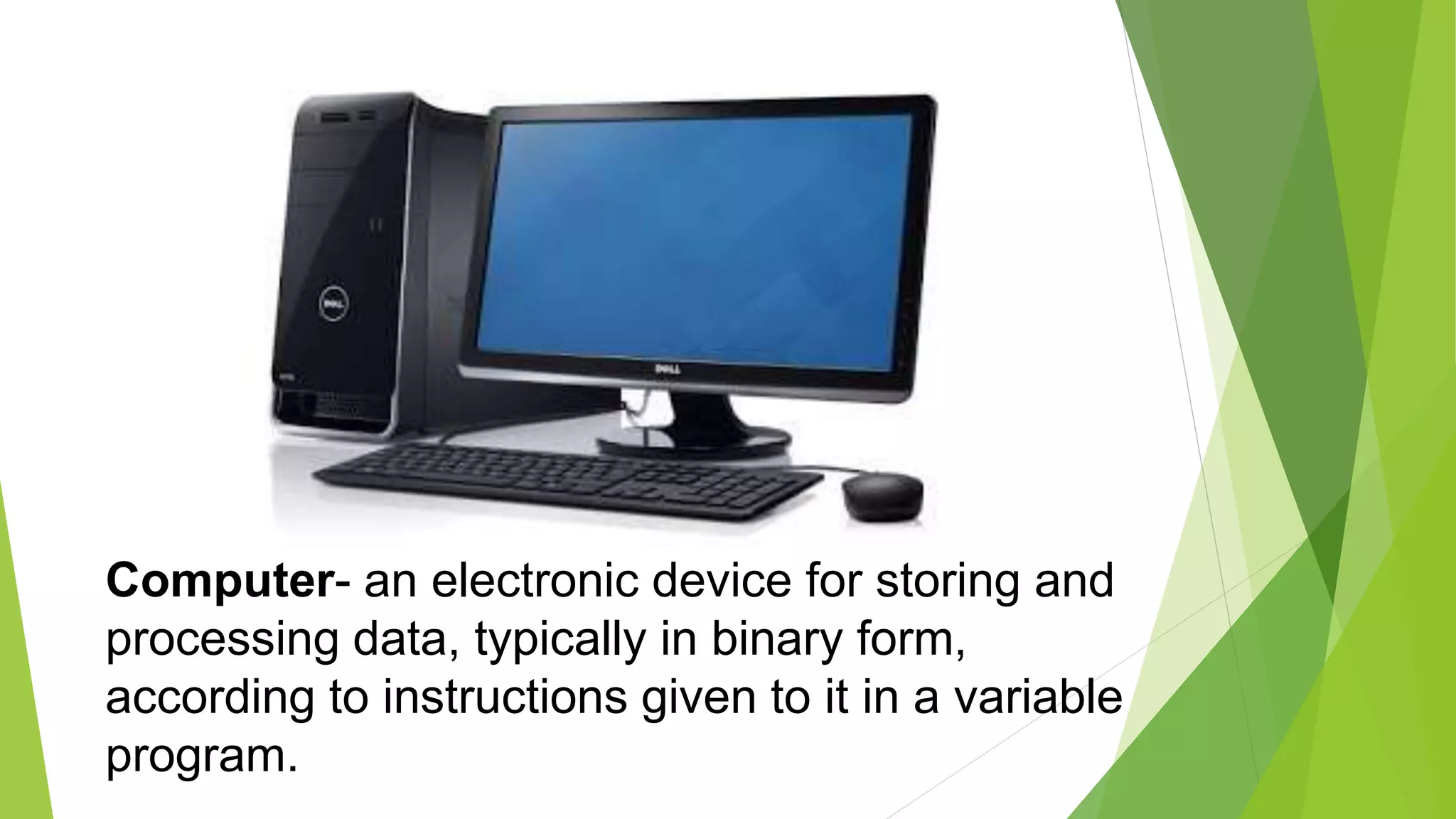
Computer- an electronic device for storing and
processing data, typically in binary form,
according to instructions given to it in a variable
program.
Internet
 is the global system of interconnected computer
networks that use the internet protocol suite (IP)
to link billions of devices worldwide.
 Means of connecting a computer to any other
computer anywhere in the world via dedicated
routers and servers.
 Sometimes called simply ‘’the Net’’, is a
worldwide system of computer networks- a network
of networks in which the users at any one computer
can get information from any other computer.
World Wide Web
 An information system on the internet that allows
documents to be connected to other documents by
hypertext links, enabling the user to search for
information by moving from one document to another.
 Is an information space where documents and
other web resources are identified by URLs,
interlinked by hypertext links, and can be accessed via
the Internet.
 Invented by Tim-Berners Lee
Web Pages
 Web page is a hypertext document
connected to the World Wide Web. It is a
document that is suitable for the World
Wide Web.
ACTIVITY: watch me and react..
 With the same group..
 Categorize the applications you have downloaded
on your mobile phone whether it is web 1.0, 2.0
and 3.0.
 Explain your output.
The different online platforms of World
Wide Web:
 1. Web 1.0 – refers to the first stage in the World Wide Web, which was
entirely made up of the Web pages connected by hyperlinks. It is also called
as the static web page.
 2. Web 2.0 – is the evolution of Web 1.0 by adding dynamic pages. The user
is able to see a website differently than others.
– Allows users to interact with the page; instead of just reading the
page, the user may be able to comment or create user account.
 3. Web 3.0 – this platform is all about semantic web.
– Aims to have machines (or servers) understand the user’s
preferences to be able to deliver web content.
 Static Web Page- is known as a flat page or
stationary age in the sense that the page is ‘’as is’’
and cannot be manipulated by the user. The
content is also the same for all users that is
referred to as Web 1.0

Dynamic Web Pages- web 2.0 is the evolution of
web 1.0 by adding dynamic web pages. The user
is able to see website differently than others e.g.
social networking sites, wikis, video sharing sites.
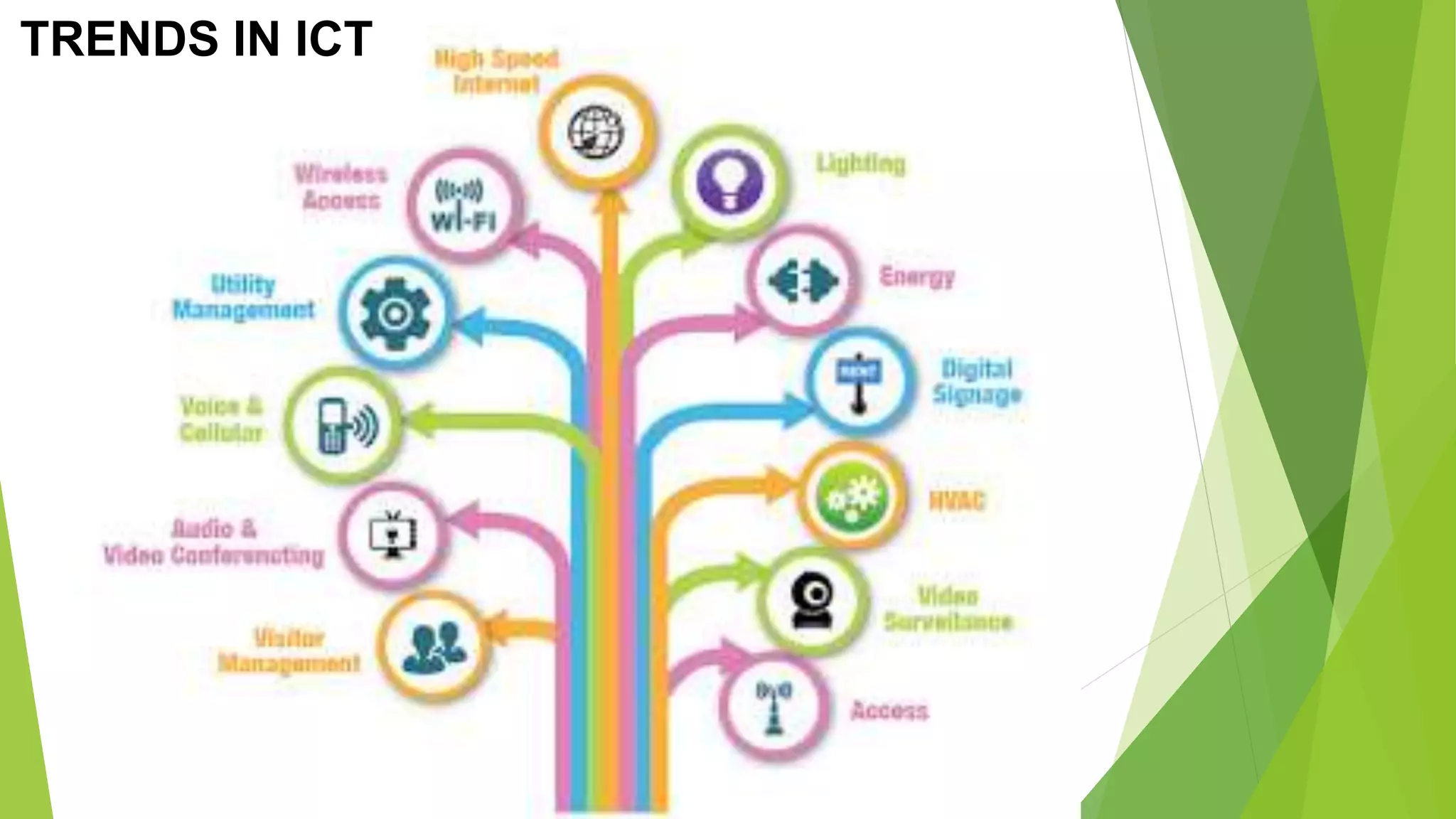
TRENDS IN ICT
Convergent Technologies
 is the synergy of technological advancements
to work on a similar goal or task.
Social Media
 is a website, application,
or online channel that
enables web users
to create , co-create,
discuss, modify, and
exchange user generated
content.
Six types of Social Media:
1. Social Networks - These are
sites that allows you to connect
with other people with the same
interests or background. Once the
user creates his/her account,
he/she can set up a profile, add
people, share content, etc.)
2. Bookmarking Sites - Sites
that allow you to store and
manage links to various
website and resources. Most of
the sites allow you to create a
tag to others.
3. Social News – Sites that
allow users to post their
own news items or links to
other news sources. The
users can also comment on
the post and comments
may also be rankage links
to various website and
resources.
4. Media Sharing –
sites that allow you to
upload and share
media content like
images,
music and video.
5. Microblogging - focus on short
updates from the user. Those that
subscribed to the user will be able to
receive these updates.
6. Blogs and Forums
allow user to post their
content. Other users are able
to comment on the said
topic.
Mobile Media- This refers to mobile
phones.
The popularity of smartphones and tablets
has taken a major rise over the years.
This is largely because of the devices
capability to do the tasks that were
originally found in PCs.
Several of these devices are capable of
using a high-speed internet. Today the
latest model devices use 4G Networking
(LTE), which is currently the fastest.
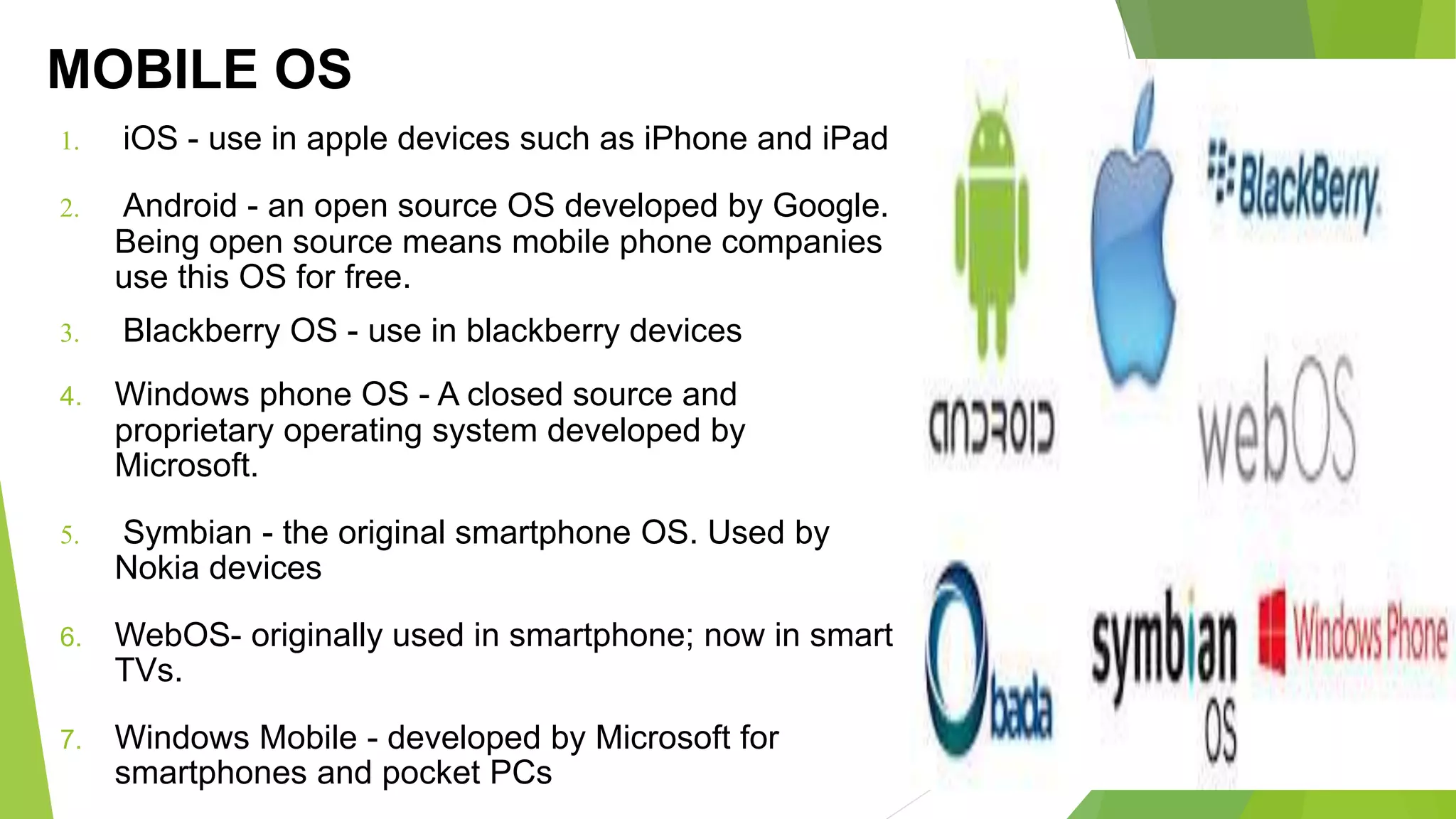
MOBILE OS
1. iOS - use in apple devices such as iPhone and iPad
2. Android - an open source OS developed by Google.
Being open source means mobile phone companies
use this OS for free.
3. Blackberry OS - use in blackberry devices
4. Windows phone OS - A closed source and
proprietary operating system developed by
Microsoft.
5. Symbian - the original smartphone OS. Used by
Nokia devices
6. WebOS- originally used in smartphone; now in smart
TVs.
7. Windows Mobile - developed by Microsoft for
smartphones and pocket PCs
4.Assistive Media - is a non- profit
service designed to help people who
have visual and reading impairments. A
database of audio recordings is used to
read to the user.
Collaborative Platforms
Is a category of business
software that adds social
networking capabilities to work
processes.

lesson_1.pptx

  • 1.
  • 2.
    ICT- Information andCommunication It deals with the use of different communication technologies such as mobile phones, telephone, Internet to locate, save, send and edit information  Is a study of computers as data processing tools. It introduces students to the fundamental of using computer systems in an internet environment.
  • 3.
    ICT in thePhilippines Philippines is dub as the ‘’ICT Hub of Asia” because of huge growth of ICT-related jobs, one of which is BPO, Business Process Outsourcing, or call centers.
  • 4.
    Computer- an electronicdevice for storing and processing data, typically in binary form, according to instructions given to it in a variable program.
  • 5.
    Internet  is theglobal system of interconnected computer networks that use the internet protocol suite (IP) to link billions of devices worldwide.  Means of connecting a computer to any other computer anywhere in the world via dedicated routers and servers.  Sometimes called simply ‘’the Net’’, is a worldwide system of computer networks- a network of networks in which the users at any one computer can get information from any other computer.
  • 6.
    World Wide Web An information system on the internet that allows documents to be connected to other documents by hypertext links, enabling the user to search for information by moving from one document to another.  Is an information space where documents and other web resources are identified by URLs, interlinked by hypertext links, and can be accessed via the Internet.  Invented by Tim-Berners Lee
  • 7.
    Web Pages  Webpage is a hypertext document connected to the World Wide Web. It is a document that is suitable for the World Wide Web.
  • 8.
    ACTIVITY: watch meand react..  With the same group..  Categorize the applications you have downloaded on your mobile phone whether it is web 1.0, 2.0 and 3.0.  Explain your output.
  • 9.
    The different onlineplatforms of World Wide Web:  1. Web 1.0 – refers to the first stage in the World Wide Web, which was entirely made up of the Web pages connected by hyperlinks. It is also called as the static web page.  2. Web 2.0 – is the evolution of Web 1.0 by adding dynamic pages. The user is able to see a website differently than others. – Allows users to interact with the page; instead of just reading the page, the user may be able to comment or create user account.  3. Web 3.0 – this platform is all about semantic web. – Aims to have machines (or servers) understand the user’s preferences to be able to deliver web content.
  • 10.
     Static WebPage- is known as a flat page or stationary age in the sense that the page is ‘’as is’’ and cannot be manipulated by the user. The content is also the same for all users that is referred to as Web 1.0  Dynamic Web Pages- web 2.0 is the evolution of web 1.0 by adding dynamic web pages. The user is able to see website differently than others e.g. social networking sites, wikis, video sharing sites.
  • 11.
  • 12.
    Convergent Technologies  isthe synergy of technological advancements to work on a similar goal or task.
  • 13.
    Social Media  isa website, application, or online channel that enables web users to create , co-create, discuss, modify, and exchange user generated content.
  • 14.
    Six types ofSocial Media: 1. Social Networks - These are sites that allows you to connect with other people with the same interests or background. Once the user creates his/her account, he/she can set up a profile, add people, share content, etc.)
  • 15.
    2. Bookmarking Sites- Sites that allow you to store and manage links to various website and resources. Most of the sites allow you to create a tag to others.
  • 16.
    3. Social News– Sites that allow users to post their own news items or links to other news sources. The users can also comment on the post and comments may also be rankage links to various website and resources.
  • 17.
    4. Media Sharing– sites that allow you to upload and share media content like images, music and video.
  • 18.
    5. Microblogging -focus on short updates from the user. Those that subscribed to the user will be able to receive these updates.
  • 19.
    6. Blogs andForums allow user to post their content. Other users are able to comment on the said topic.
  • 20.
    Mobile Media- Thisrefers to mobile phones. The popularity of smartphones and tablets has taken a major rise over the years. This is largely because of the devices capability to do the tasks that were originally found in PCs. Several of these devices are capable of using a high-speed internet. Today the latest model devices use 4G Networking (LTE), which is currently the fastest.
  • 21.
    MOBILE OS 1. iOS- use in apple devices such as iPhone and iPad 2. Android - an open source OS developed by Google. Being open source means mobile phone companies use this OS for free. 3. Blackberry OS - use in blackberry devices 4. Windows phone OS - A closed source and proprietary operating system developed by Microsoft. 5. Symbian - the original smartphone OS. Used by Nokia devices 6. WebOS- originally used in smartphone; now in smart TVs. 7. Windows Mobile - developed by Microsoft for smartphones and pocket PCs
  • 22.
    4.Assistive Media -is a non- profit service designed to help people who have visual and reading impairments. A database of audio recordings is used to read to the user.
  • 23.
    Collaborative Platforms Is acategory of business software that adds social networking capabilities to work processes.

Editor's Notes

  • #22 Os is an operating system that manages computer hardware.