Module 1:
ICT Today
Prepared by: Jess Henson
INFORMATION
COMMUNICATIONS
TECHNOLOGY
EVOLUTI
of ICT
4 main periods that divide
the era of ICT
around
3000 BCE
The Premechanical Period
around
1 450 CE
3100 BCE
words, and
pictograms
curved in
rocks
These gave rise to our modern day alphabet.
A Sumerian pictogram dating shows the earliest form of
communication among humans.
around
3000 BCE
The Premechanical Period
around
1 450 CE
3100 BCE
words, and
pictograms
curved in
rocks
paper
was
produced
This is when
early humans
realized that
stone tablets
are too heavy.
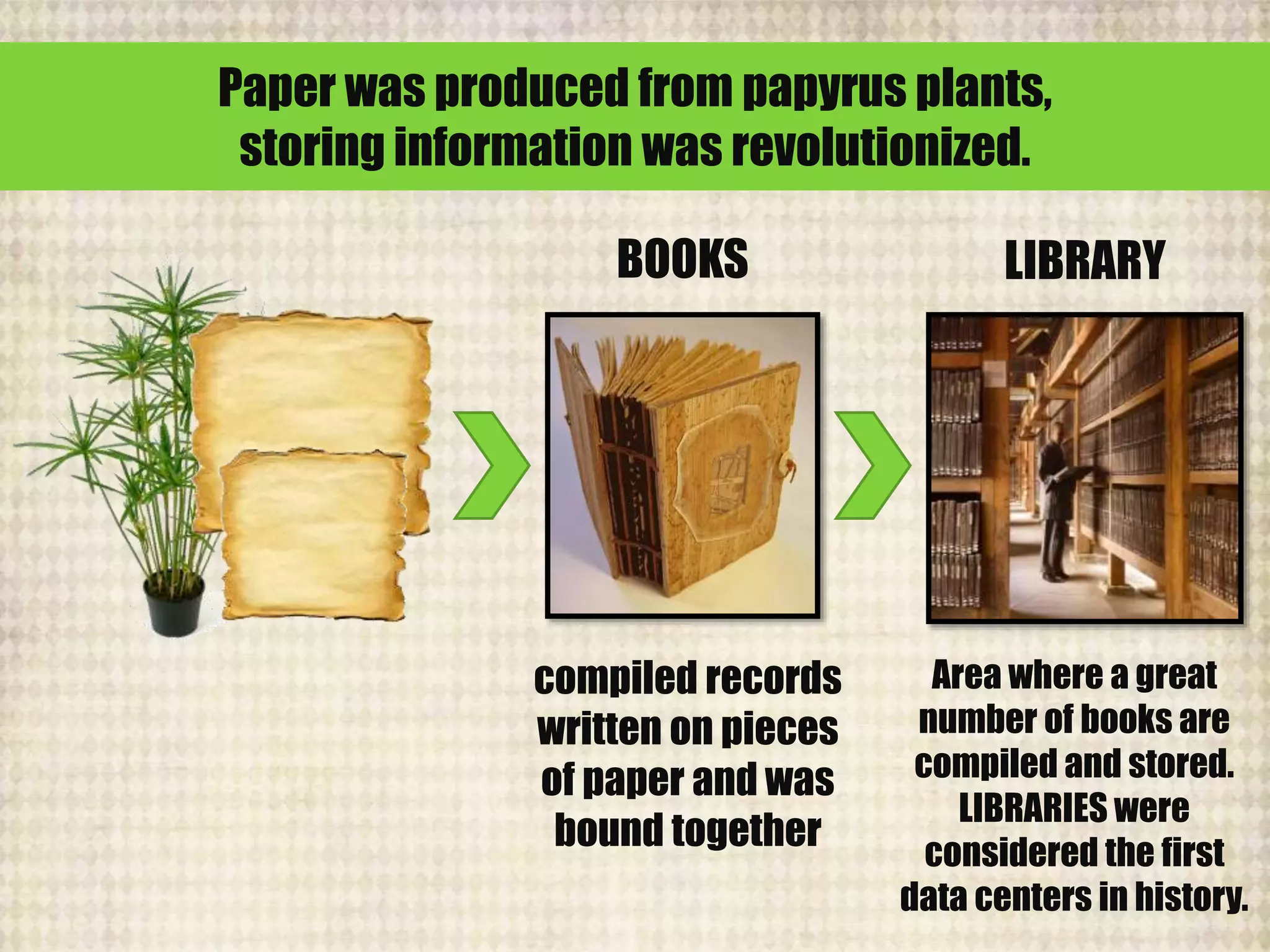
Paper was produced from papyrus plants,
storing information was revolutionized.
BOOKS
compiled records
written on pieces
of paper and was
bound together
LIBRARY
Area where a great
number of books are
compiled and stored.
LIBRARIES were
considered the first
data centers in history.
around
3000 BCE
The Premechanical Period
around
1 450 CE
3100 BCE;
words, and
pictograms
curved in
rocks
paper
was
produced
This is when
early humans
realized that
stone tablets
are too heavy.
In the last
stages of
this period;
numerical
systems
The most popular
device created in
premechanical
period is said to
have come from
China – the
ABACUS.
The abacus, considered to be the first counting device, was
introduced in the 2nd century BCE. It is manually operated
device similar to the modern calculator.
around
3000 BCE
The Premechanical Period
around
1 450 CE
3100 BCE;
words, and
pictograms
curved in
rocks
paper
was
produced
This is when
early humans
realized that
stone tablets
are too heavy.
In the last
stages of
this period;
numerical
systems
The Mechanical Period
around
1840
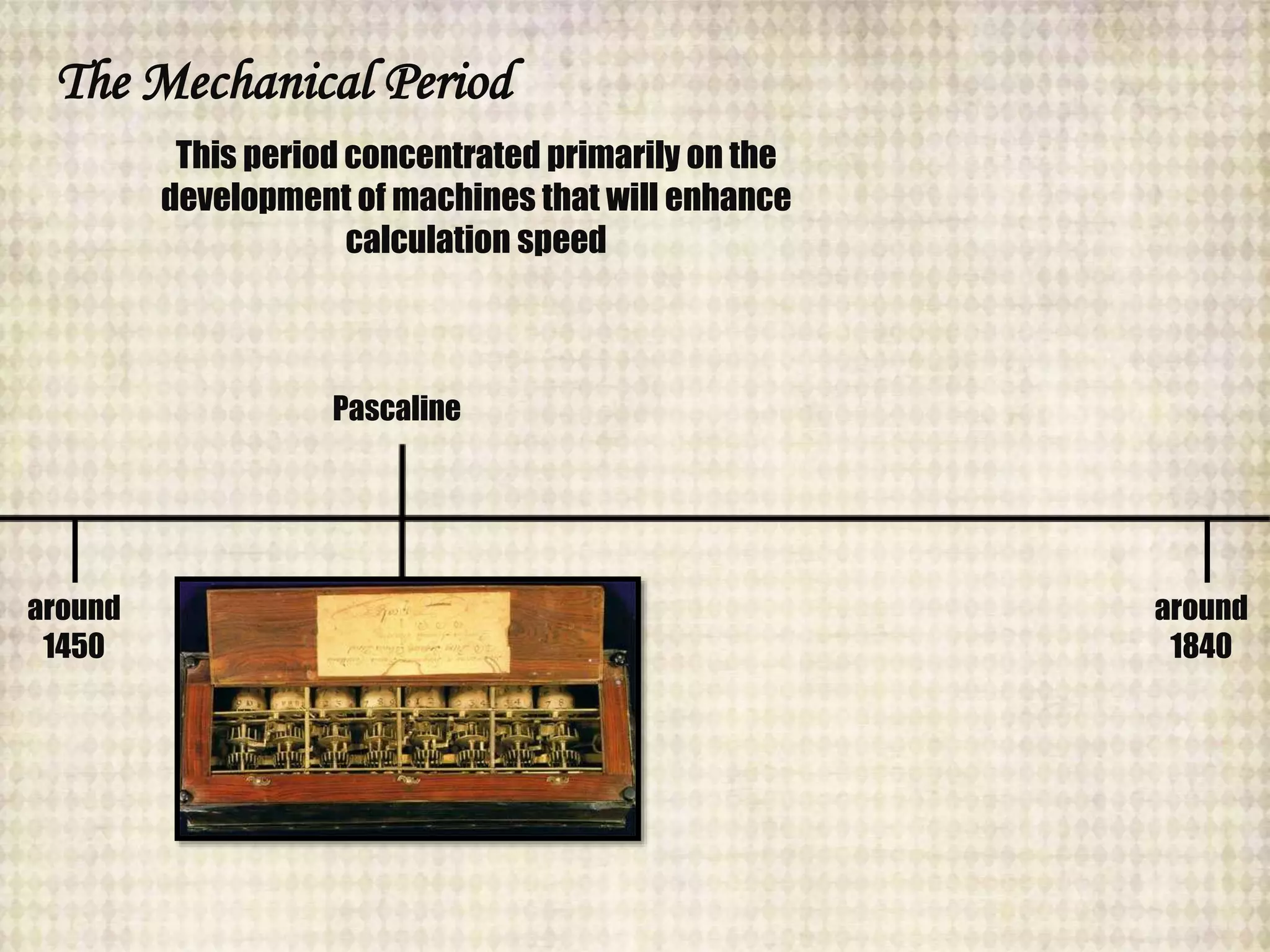
Pascaline
around
1450
This period concentrated primarily on the
development of machines that will enhance
calculation speed
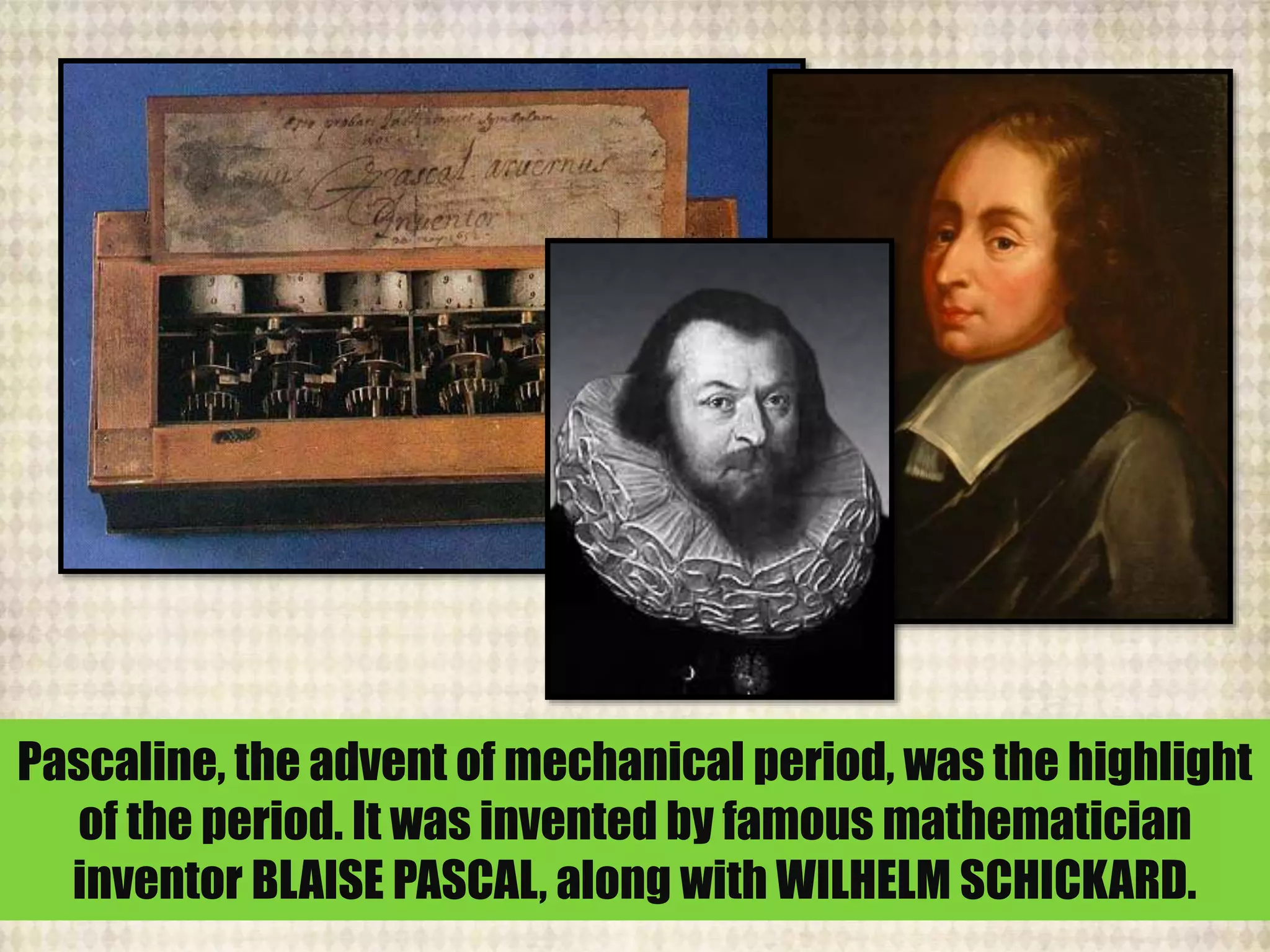
Pascaline, the advent of mechanical period, was the highlight
of the period. It was invented by famous mathematician
inventor BLAISE PASCAL, along with WILHELM SCHICKARD.
The Mechanical Period
around
1840
Pascaline
around
1450
This period concentrated primarily on the
development of machines that will enhance
calculation speed
Analytical
Engine
The ANALYTICAL ENGINE, first invented by CHARLES BABBAGE in
1873, contained features that became part of the blueprint in
the creation of succeeding computers.
ANALYTICAL
ENGINE is
considered the
first
programmable
mechanical
computer.
The invention of Analytical Engine earned Babbage the title
“Father of the Computers”
The Mechanical Period
around
1840
Pascaline
around
1450
This period concentrated primarily on the
development of machines that will enhance
calculation speed
Analytical
Engine
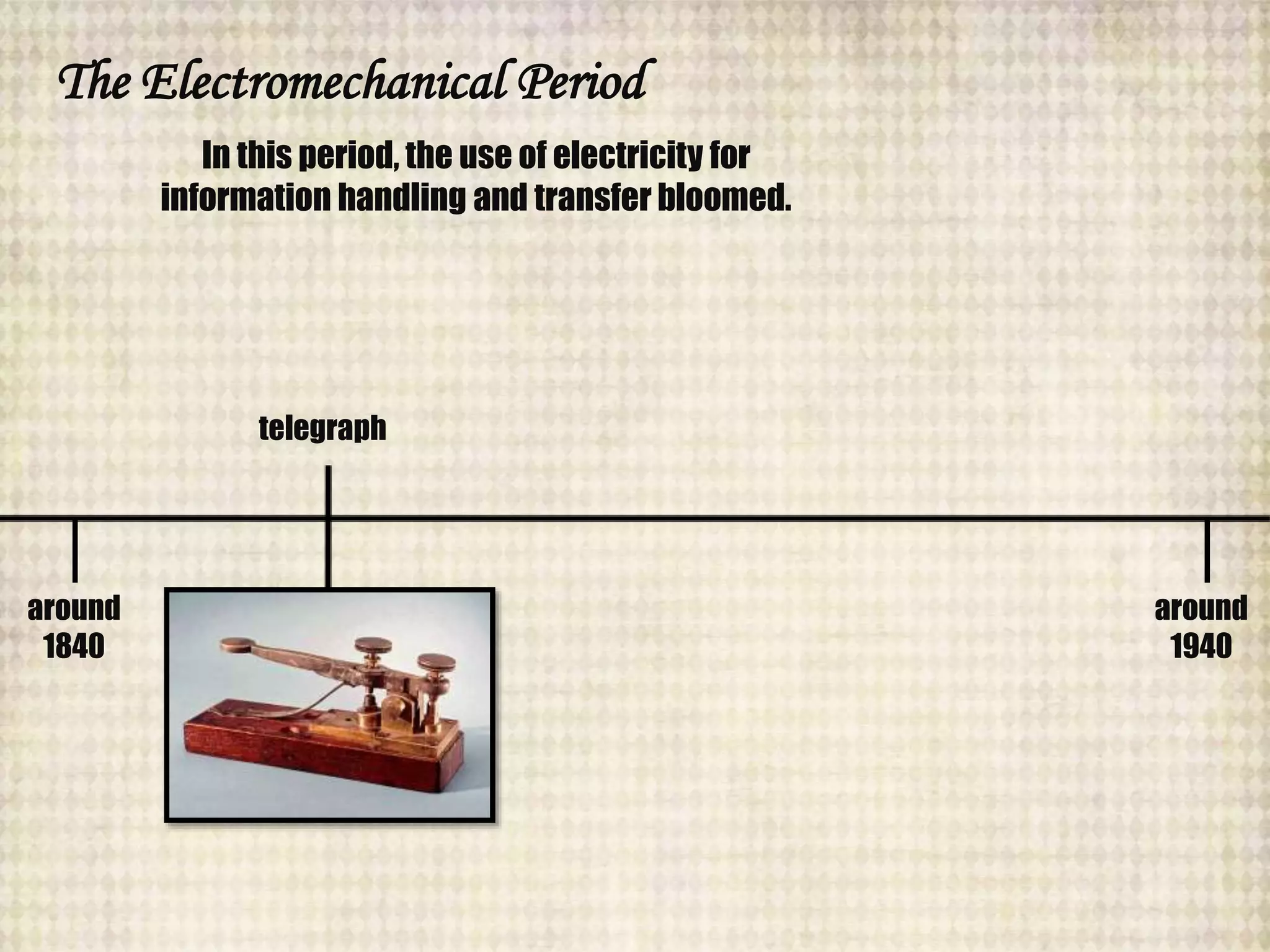
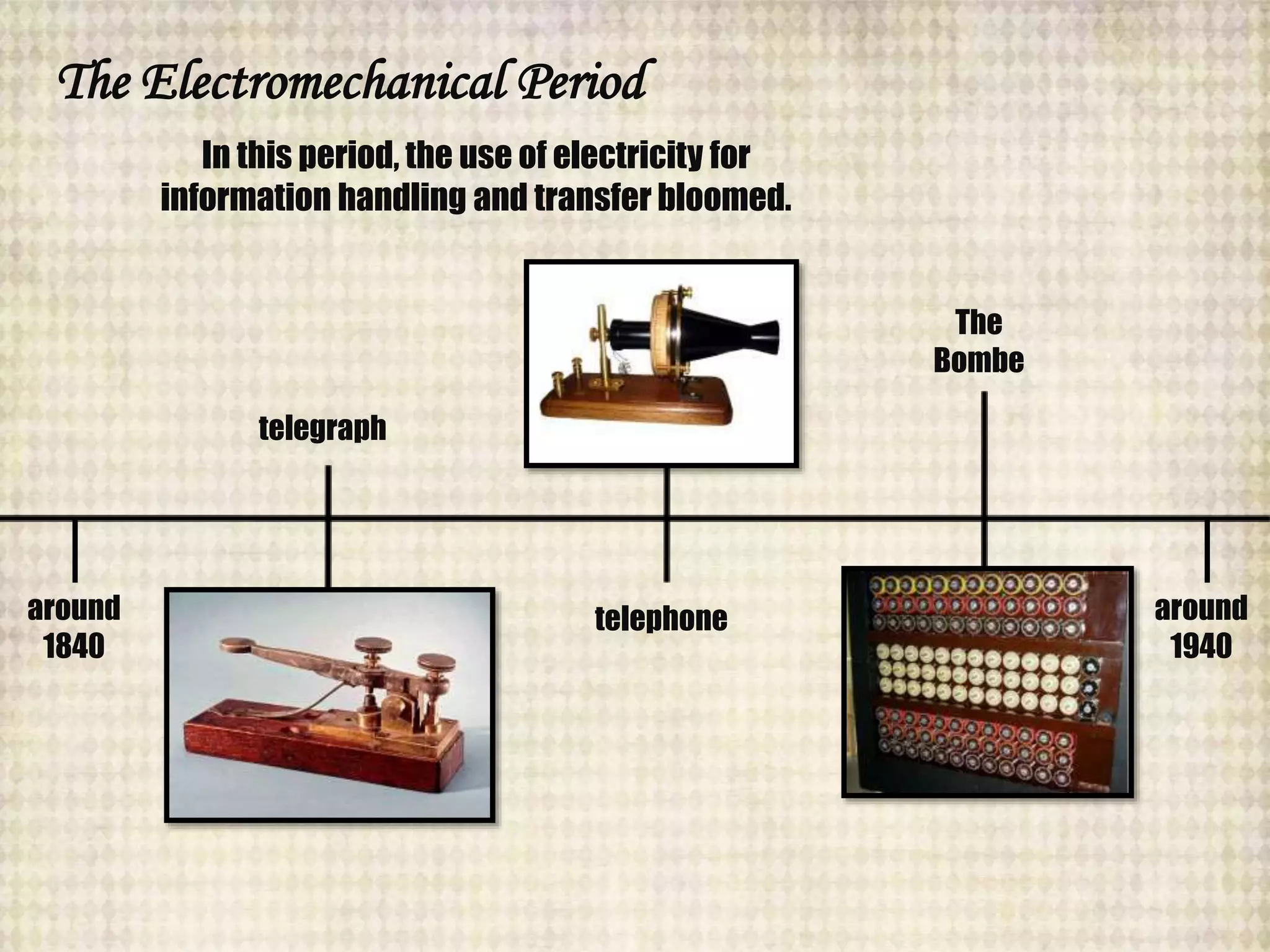
The Electromechanical Period
around
1940
around
1840
In this period, the use of electricity for
information handling and transfer bloomed.
telegraph
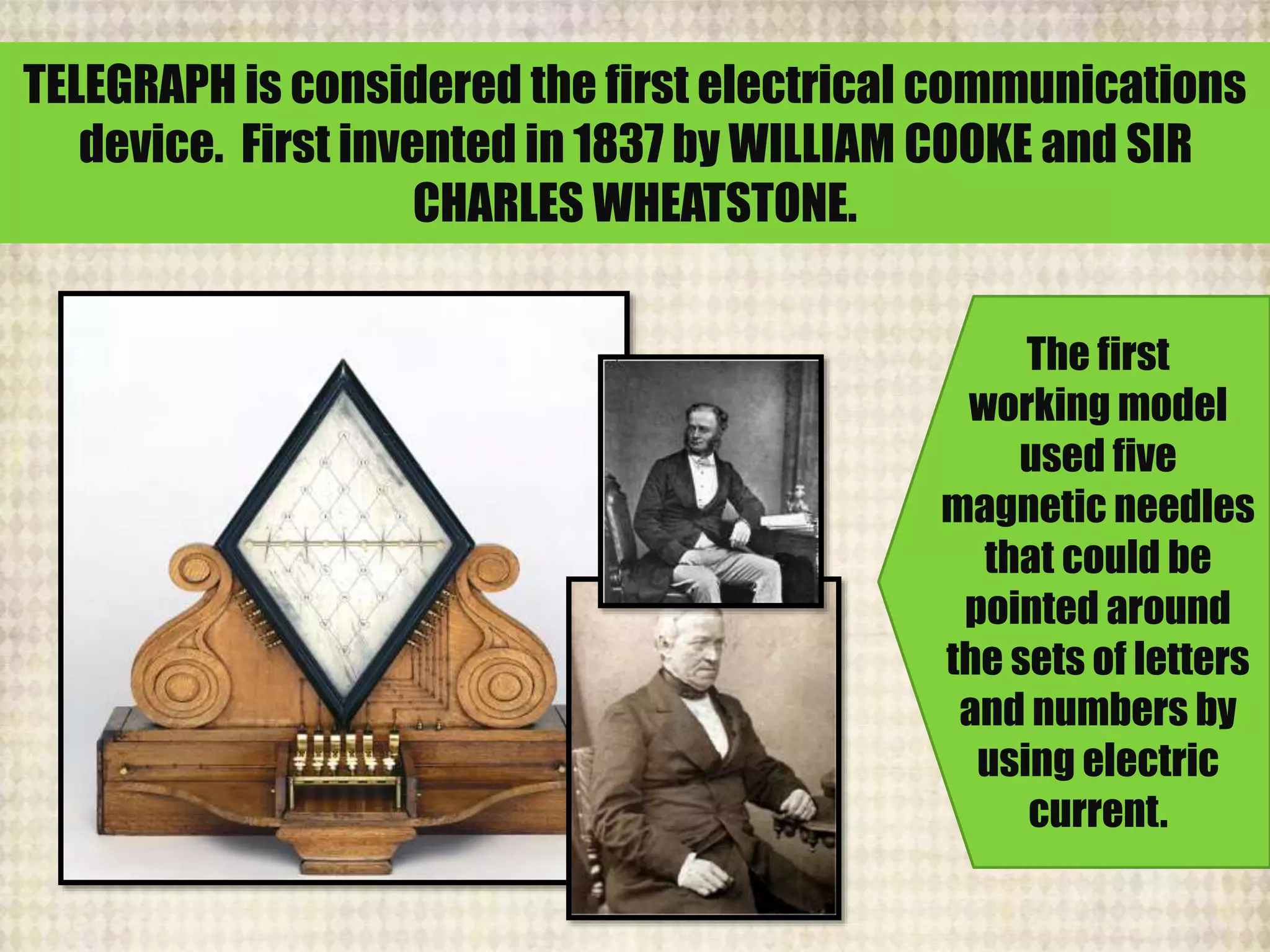
TELEGRAPH is considered the first electrical communications
device. First invented in 1837 by WILLIAM COOKE and SIR
CHARLES WHEATSTONE.
The first
working model
used five
magnetic needles
that could be
pointed around
the sets of letters
and numbers by
using electric
current.
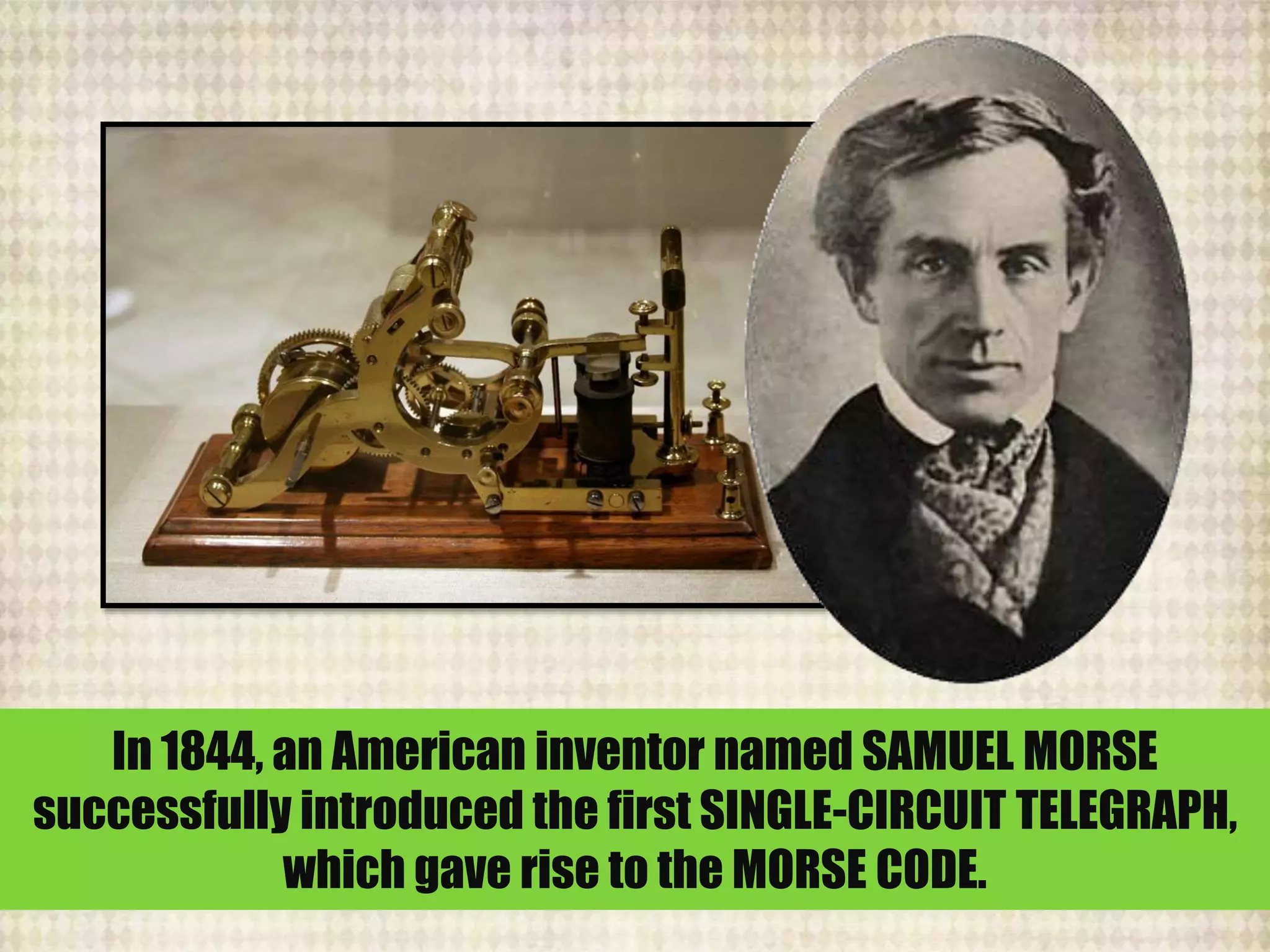
In 1844, an American inventor named SAMUEL MORSE
successfully introduced the first SINGLE-CIRCUIT TELEGRAPH,
which gave rise to the MORSE CODE.
The Electromechanical Period
around
1940
around
1840
In this period, the use of electricity for
information handling and transfer bloomed.
telegraph
telephone
In 1876, ALEXANDER GRAHAM BELL introduced the TELEPHONE.
The telephone converts sounds into electricity and enables
the telephone network to transmit over copper wires.
The Electromechanical Period
around
1940
around
1840
In this period, the use of electricity for
information handling and transfer bloomed.
telegraph
telephone
The
Bombe
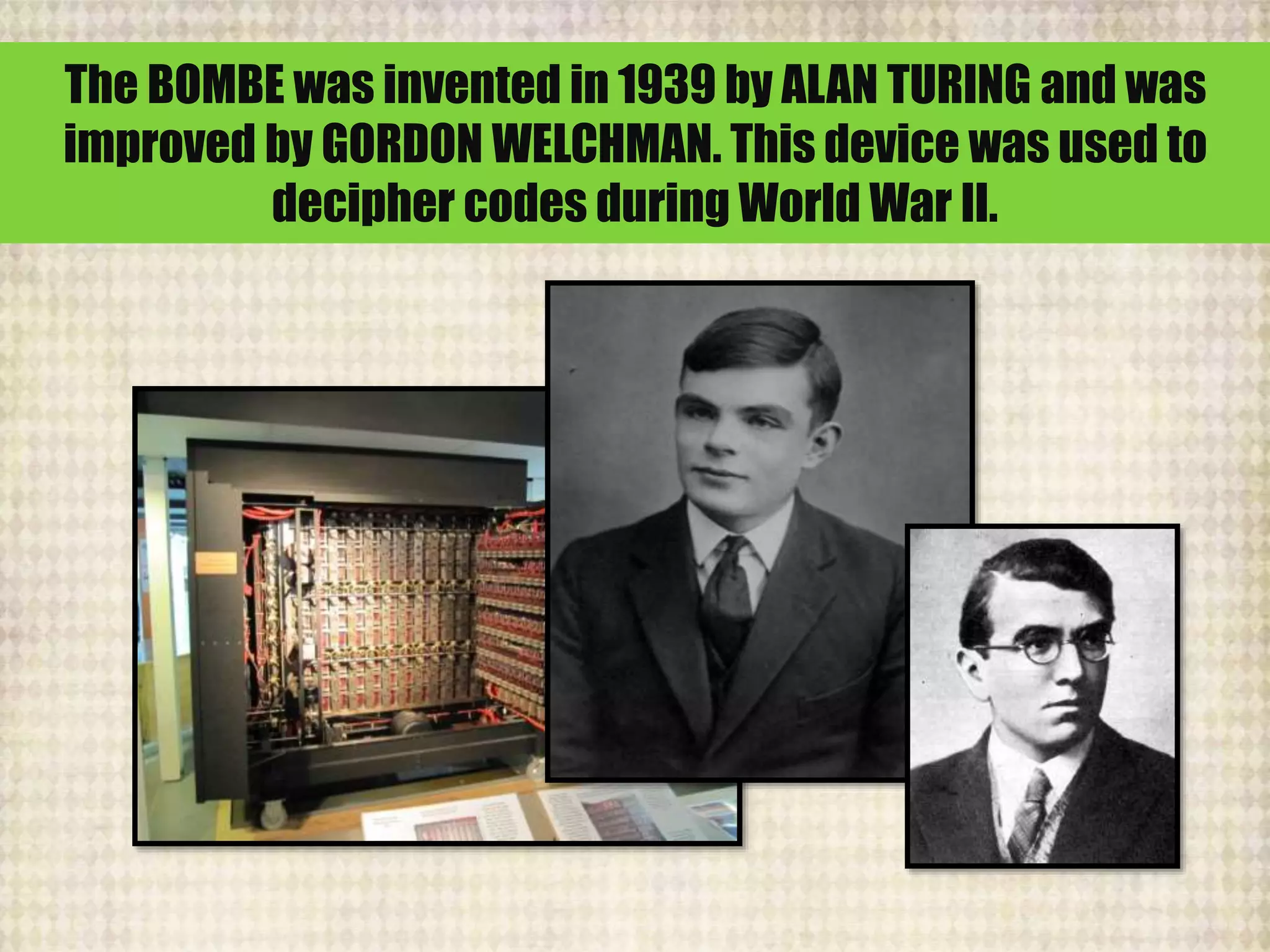
The BOMBE was invented in 1939 by ALAN TURING and was
improved by GORDON WELCHMAN. This device was used to
decipher codes during World War II.
The Electromechanical Period
around
1940
around
1840
In this period, the use of electricity for
information handling and transfer bloomed.
telegraph
telephone
The
Bombe
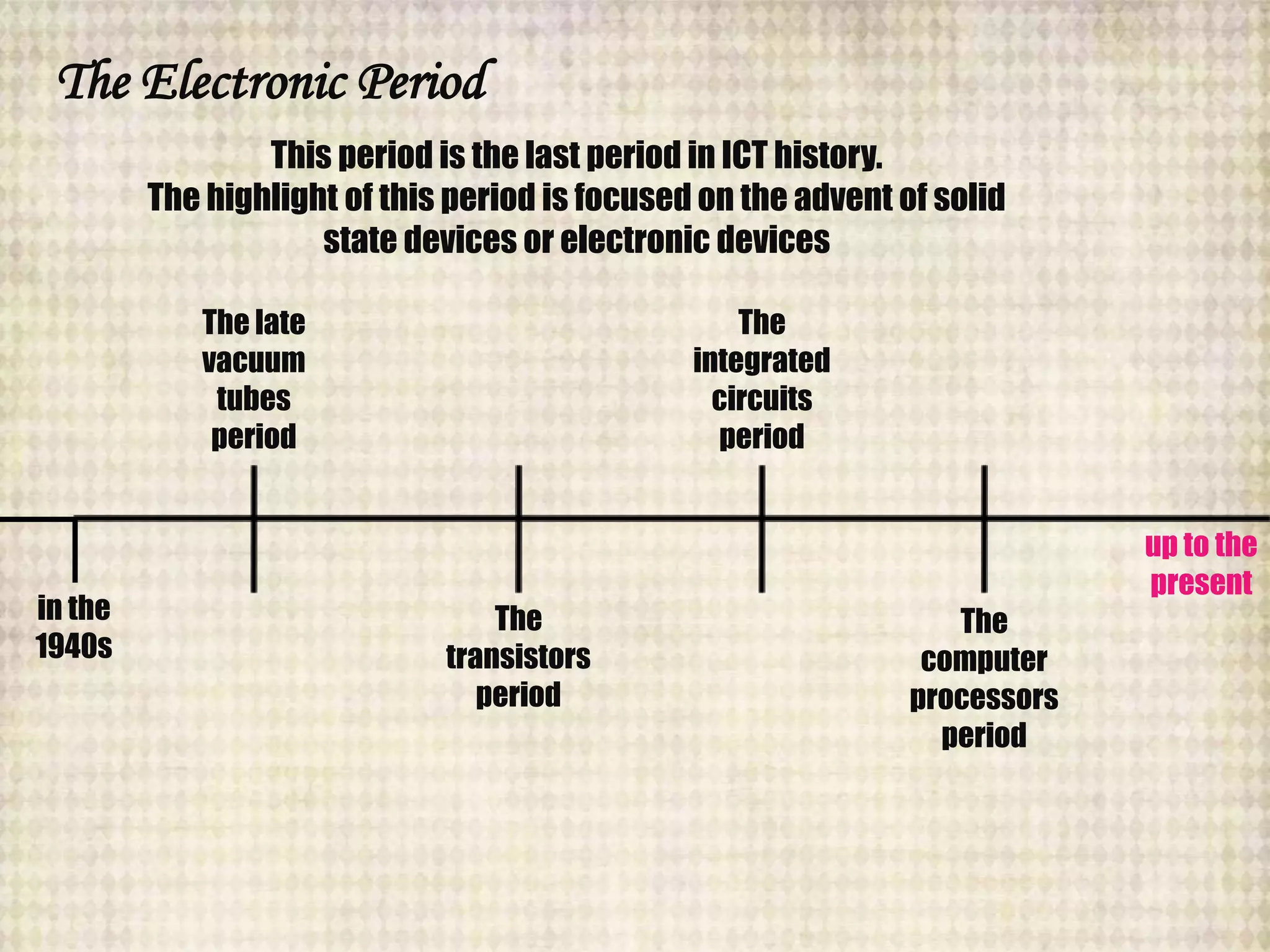
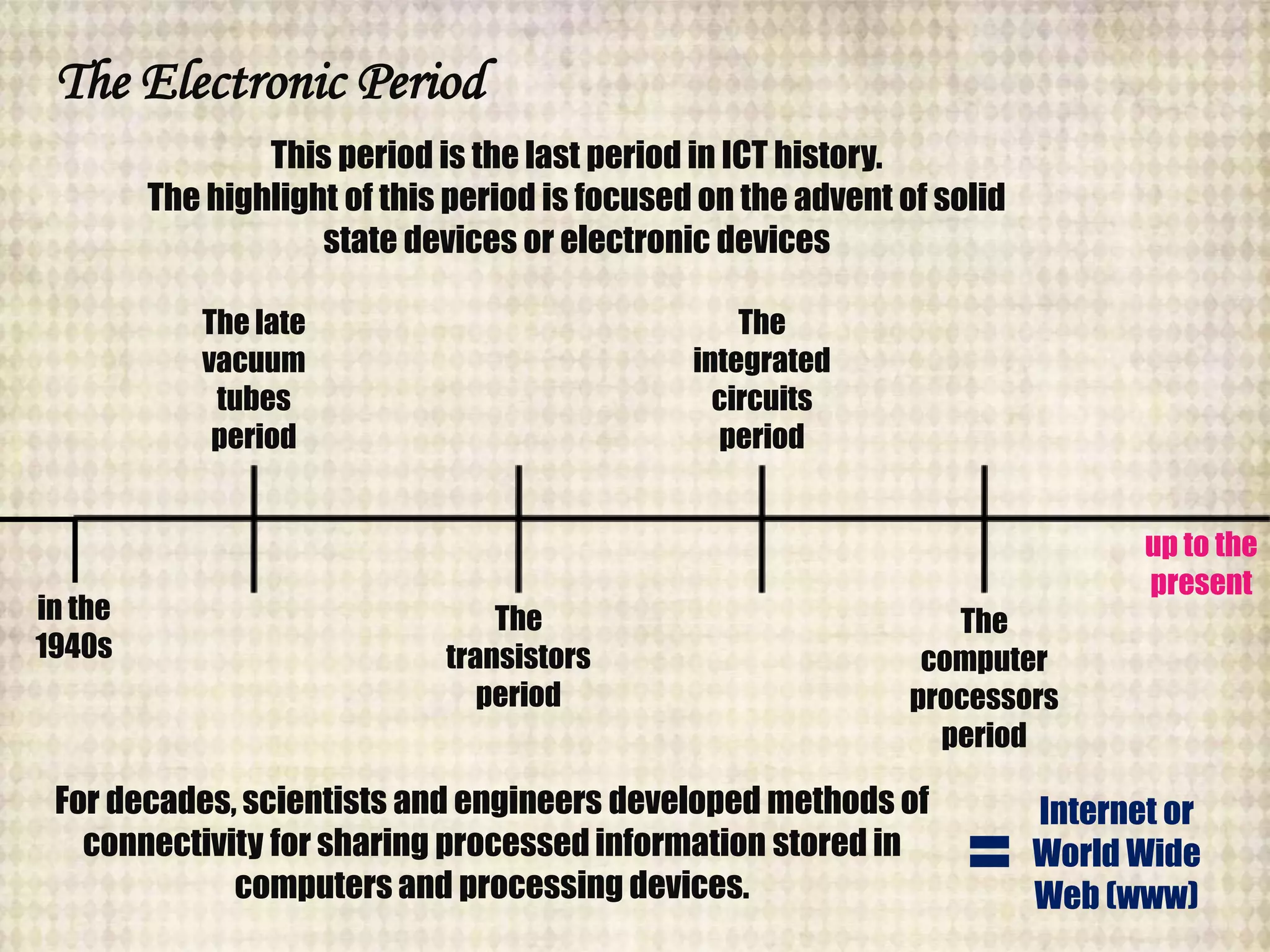
The Electronic Period
up to the
present
in the
1940s
This period is the last period in ICT history.
The highlight of this period is focused on the advent of solid
state devices or electronic devices
The late
vacuum
tubes
period
The
transistors
period
The
integrated
circuits
period
The
computer
processors
period
the late vacuum tubes period
The dawn of the Electronic Numerical Integrator and
Computer (ENIAC), the first electronic and general purpose
computer, marked a revolutionary period in computing.
ENIAC
was a big
machine that
occupied an
area of 167
square
meters.
The transistors period
In 1947, the TRANSISTOR was invented. It is an electronic
device with properties and functions similar to vacuum
tubes, but it is lightweight and faster.
The TRANSISTOR is the foundation of every electronic device today. In
fact, you can find a transistor for every electronic device.
The transistor may be one-third
of the total size of the vacuum
tube, but it transmits information
more effectively
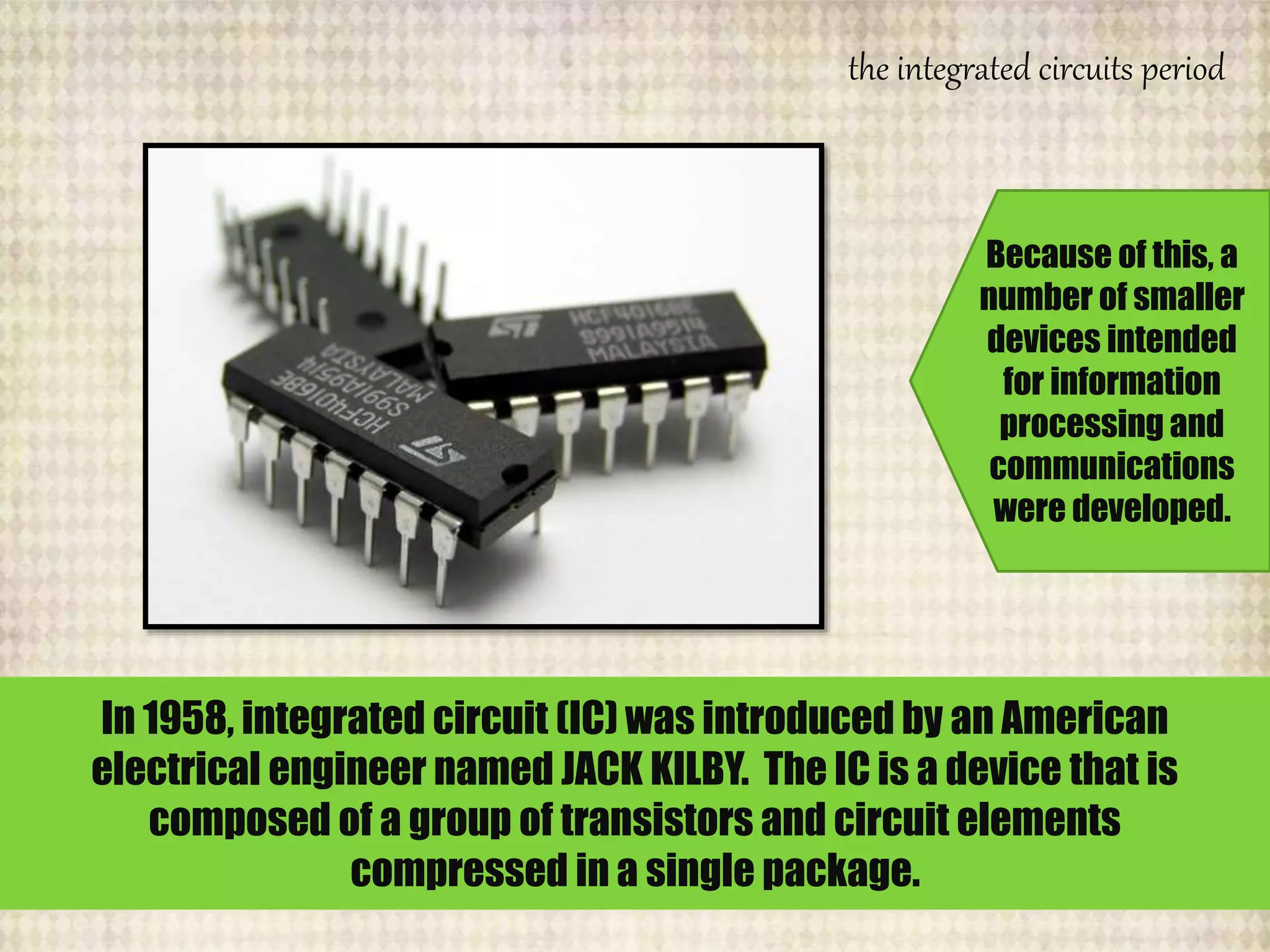
the integrated circuits period
In 1958, integrated circuit (IC) was introduced by an American
electrical engineer named JACK KILBY. The IC is a device that is
composed of a group of transistors and circuit elements
compressed in a single package.
Because of this, a
number of smaller
devices intended
for information
processing and
communications
were developed.
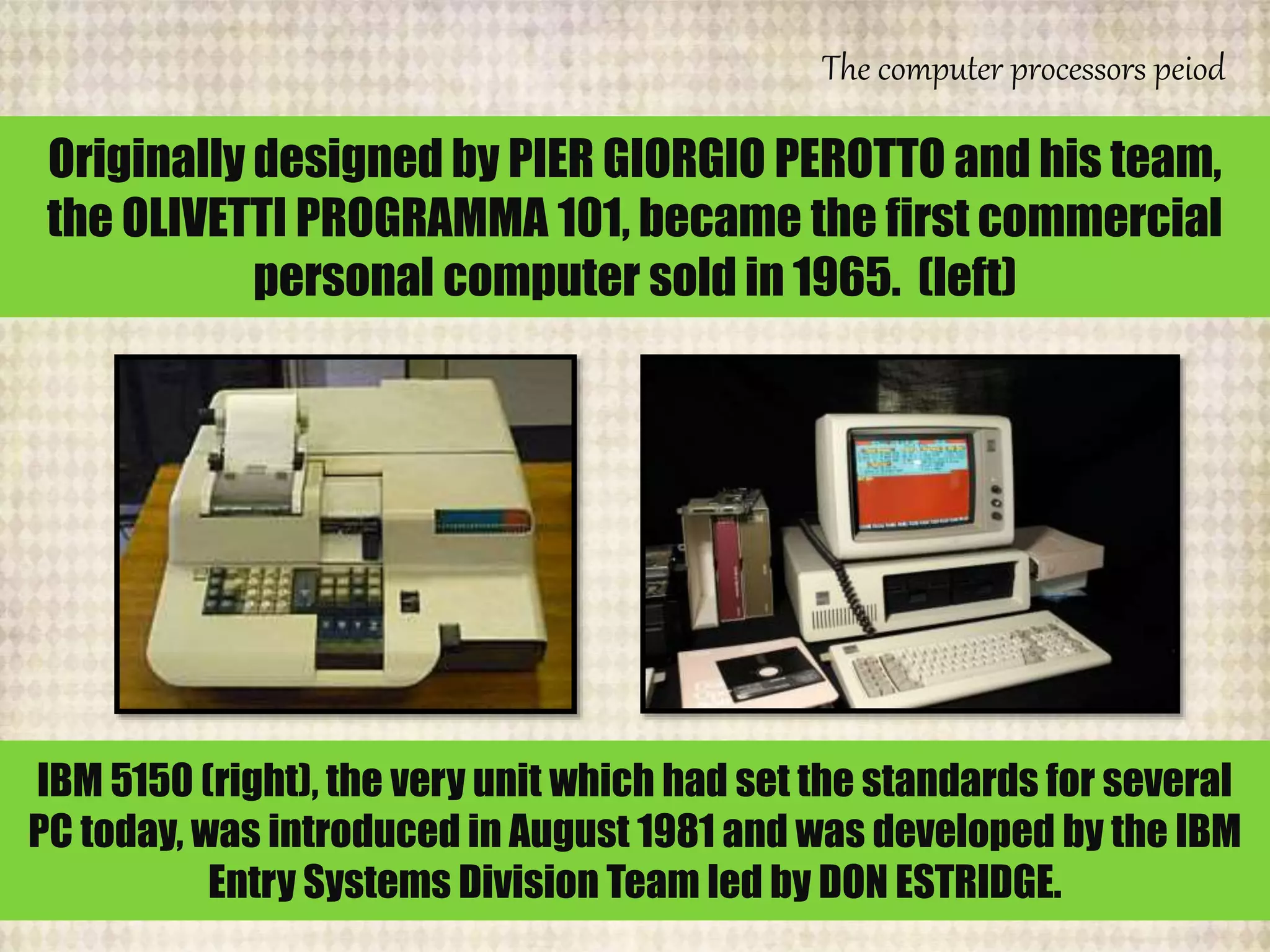
The computer processors peiod
Originally designed by PIER GIORGIO PEROTTO and his team,
the OLIVETTI PROGRAMMA 101, became the first commercial
personal computer sold in 1965. (left)
IBM 5150 (right), the very unit which had set the standards for several
PC today, was introduced in August 1981 and was developed by the IBM
Entry Systems Division Team led by DON ESTRIDGE.
The Electronic Period
up to the
present
in the
1940s
This period is the last period in ICT history.
The highlight of this period is focused on the advent of solid
state devices or electronic devices
The late
vacuum
tubes
period
The
transistors
period
The
integrated
circuits
period
The
computer
processors
period
For decades, scientists and engineers developed methods of
connectivity for sharing processed information stored in
computers and processing devices.
Internet or
World Wide
Web (www)
Through the years,
the World Wide Web
evolved because of
man’s rising needs
and continuous
usage.
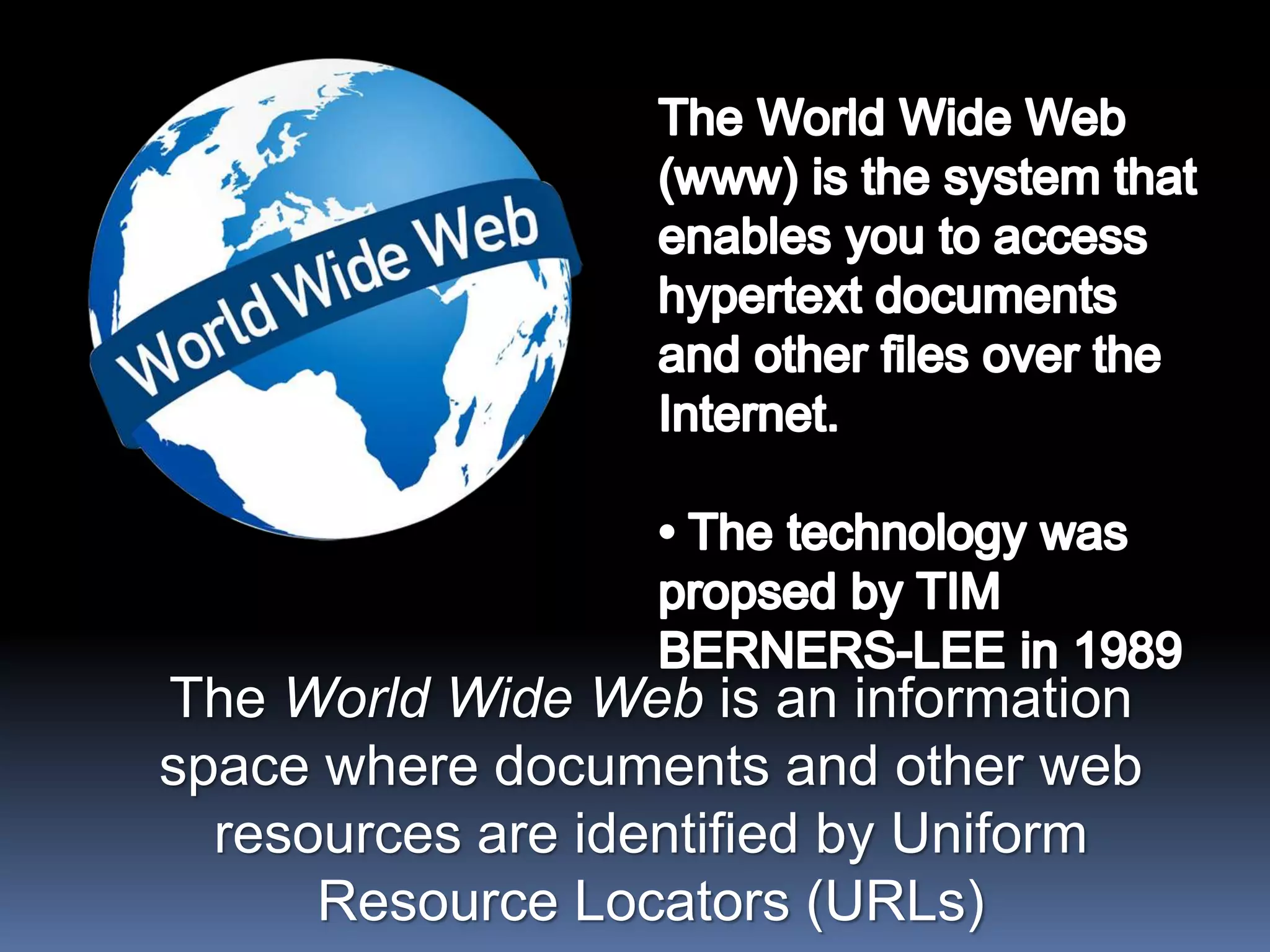
The World Wide Web is an information
space where documents and other web
resources are identified by Uniform
Resource Locators (URLs)
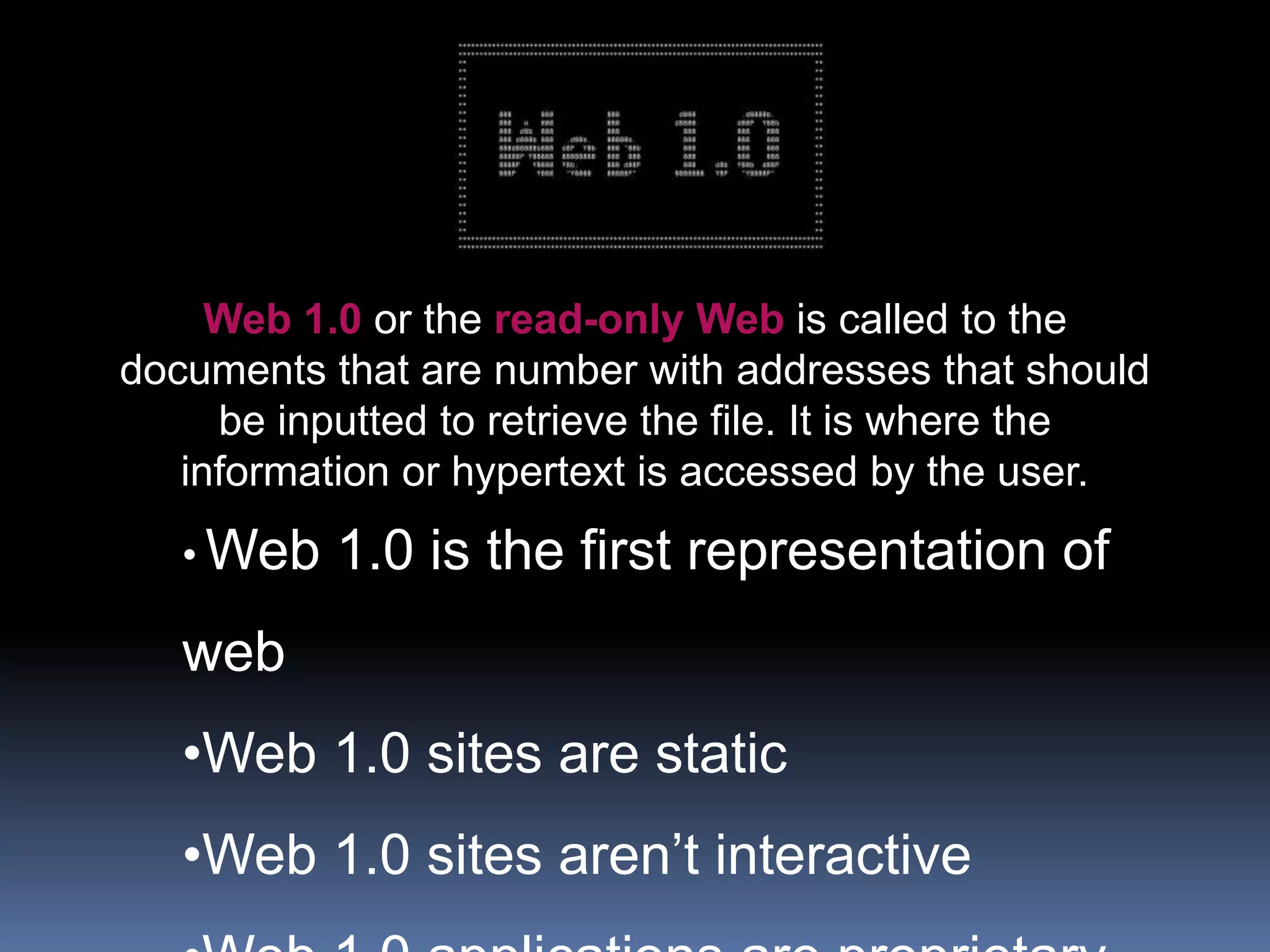
Web 1.0 or the read-only Web is called to the
documents that are number with addresses that should
be inputted to retrieve the file. It is where the
information or hypertext is accessed by the user.
• Web 1.0 is the first representation of
web
•Web 1.0 sites are static
•Web 1.0 sites aren’t interactive
Web 2.0 or the read-and-write Web started with the
need to interact with Web pages. The Web 2.0
enabled users or viewers to edit the content of the
files they were accessing.
• Web 2.0 enables users to contribute, collaborate and edit
site content
•Web 2.0 sends the trend toward users connecting
from wherever they may be
•Web 2.0 is the integration of multiple forms of call and
multimedia functions controlled by an individual user for both
business and social purposes
Web 2.0
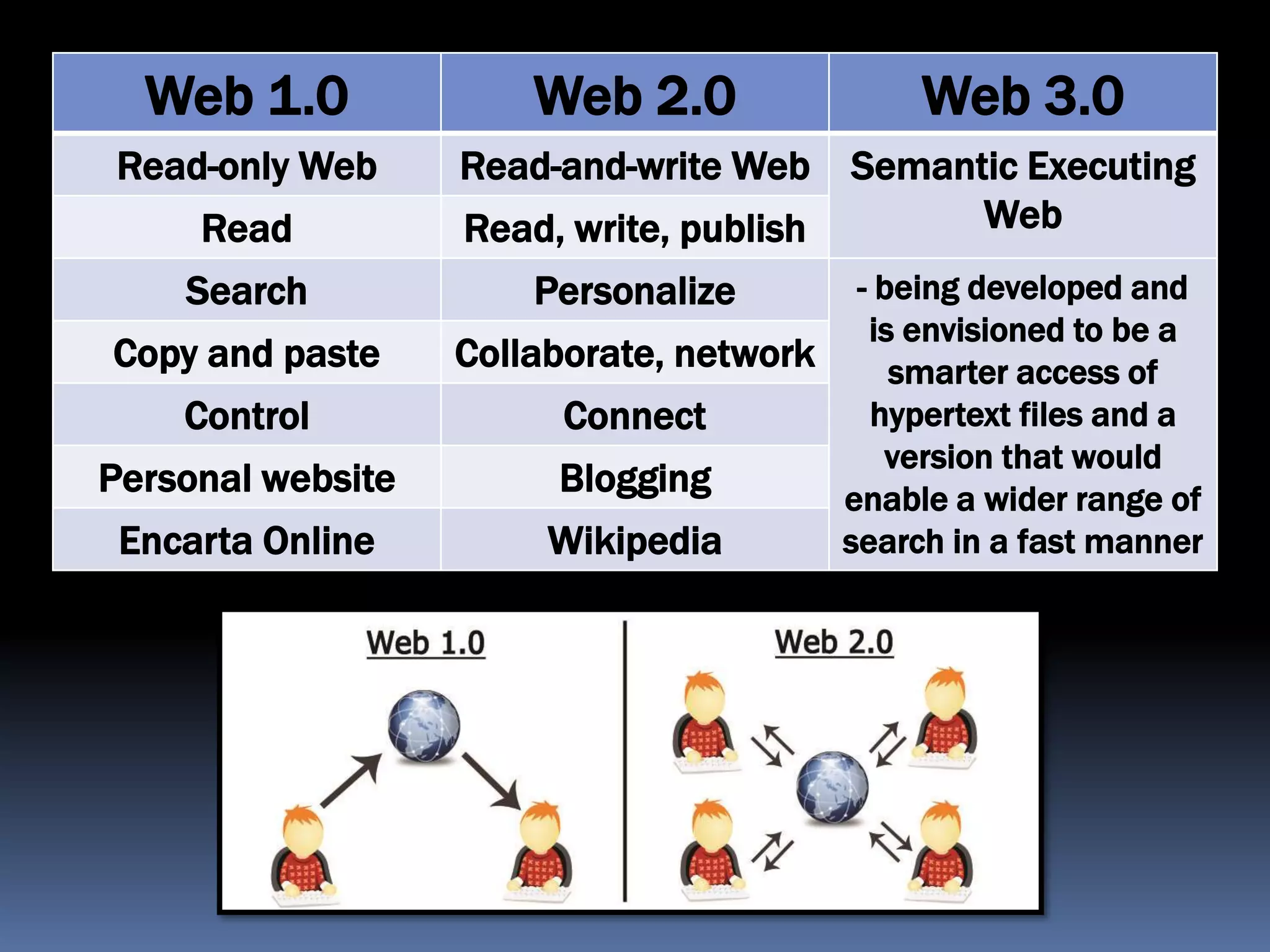
Web 1.0 Web 2.0 Web 3.0
Read-only Web Read-and-write Web Semantic Executing
WebRead Read, write, publish
Search Personalize - being developed and
is envisioned to be a
smarter access of
hypertext files and a
version that would
enable a wider range of
search in a fast manner
Copy and paste Collaborate, network
Control Connect
Personal website Blogging
Encarta Online Wikipedia
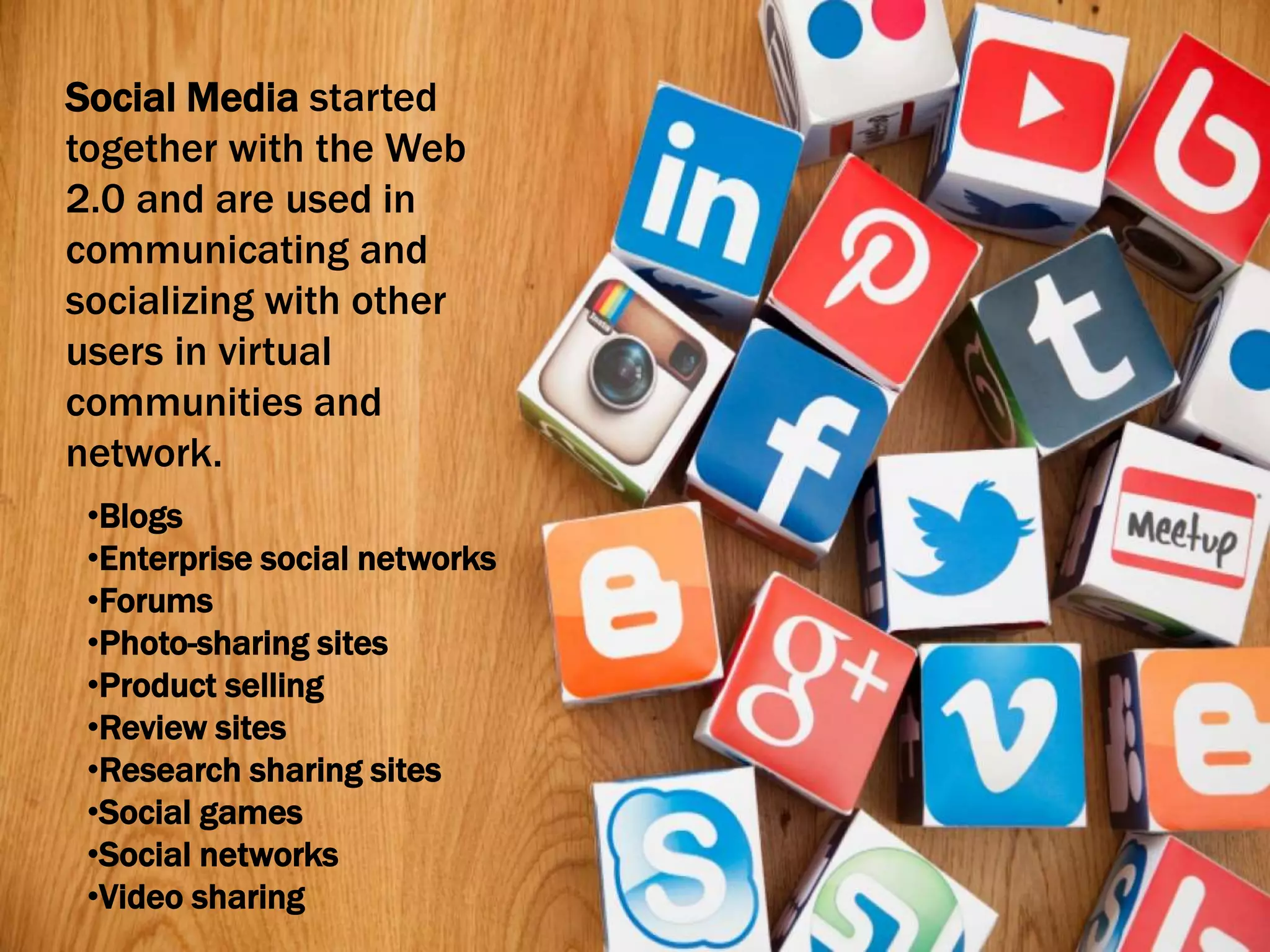
Social Media started
together with the Web
2.0 and are used in
communicating and
socializing with other
users in virtual
communities and
network.
•Blogs
•Enterprise social networks
•Forums
•Photo-sharing sites
•Product selling
•Review sites
•Research sharing sites
•Social games
•Social networks
•Video sharing
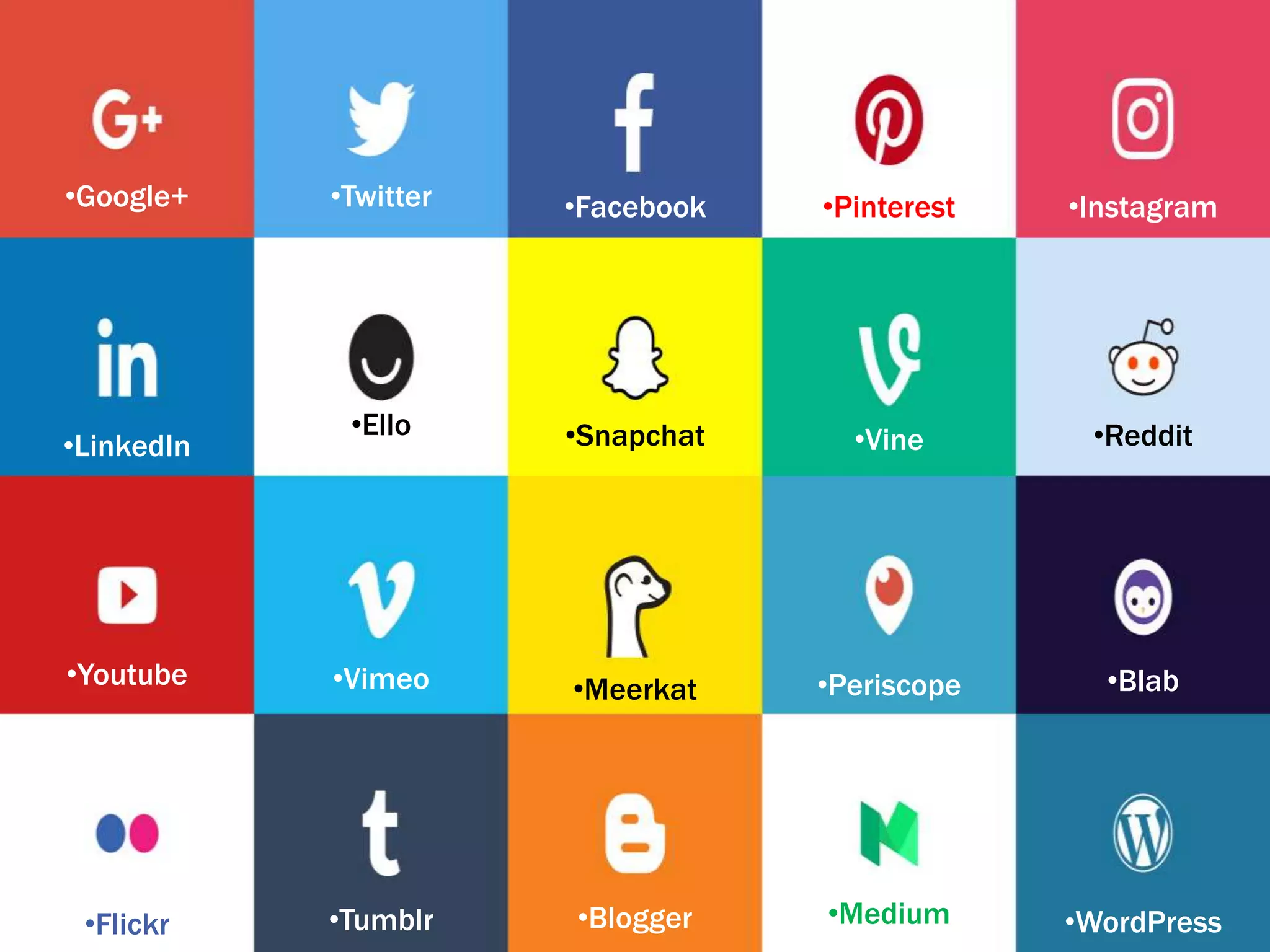
•Google+
•LinkedIn
•Youtube
•Flickr
•Twitter
•Ello
•Vimeo
•Tumblr
•Facebook
•Snapchat
•Meerkat
•Blogger
•Pinterest
•Vine
•Periscope
•Medium
•Instagram
•Reddit
•Blab
•WordPress
VIRAL!!!!!!
VIRALITY
It is defined as the rate of reposting or sharing of
photos, pieces of information, or ideas published in
one’s social media profile or page.
It is the measurement of the effectiveness of a
social media application.
PTAT is a trailing seven-day Facebook metric
that measures how many people are
“talking” (creating stories) about your page.
Research and Information Seeking
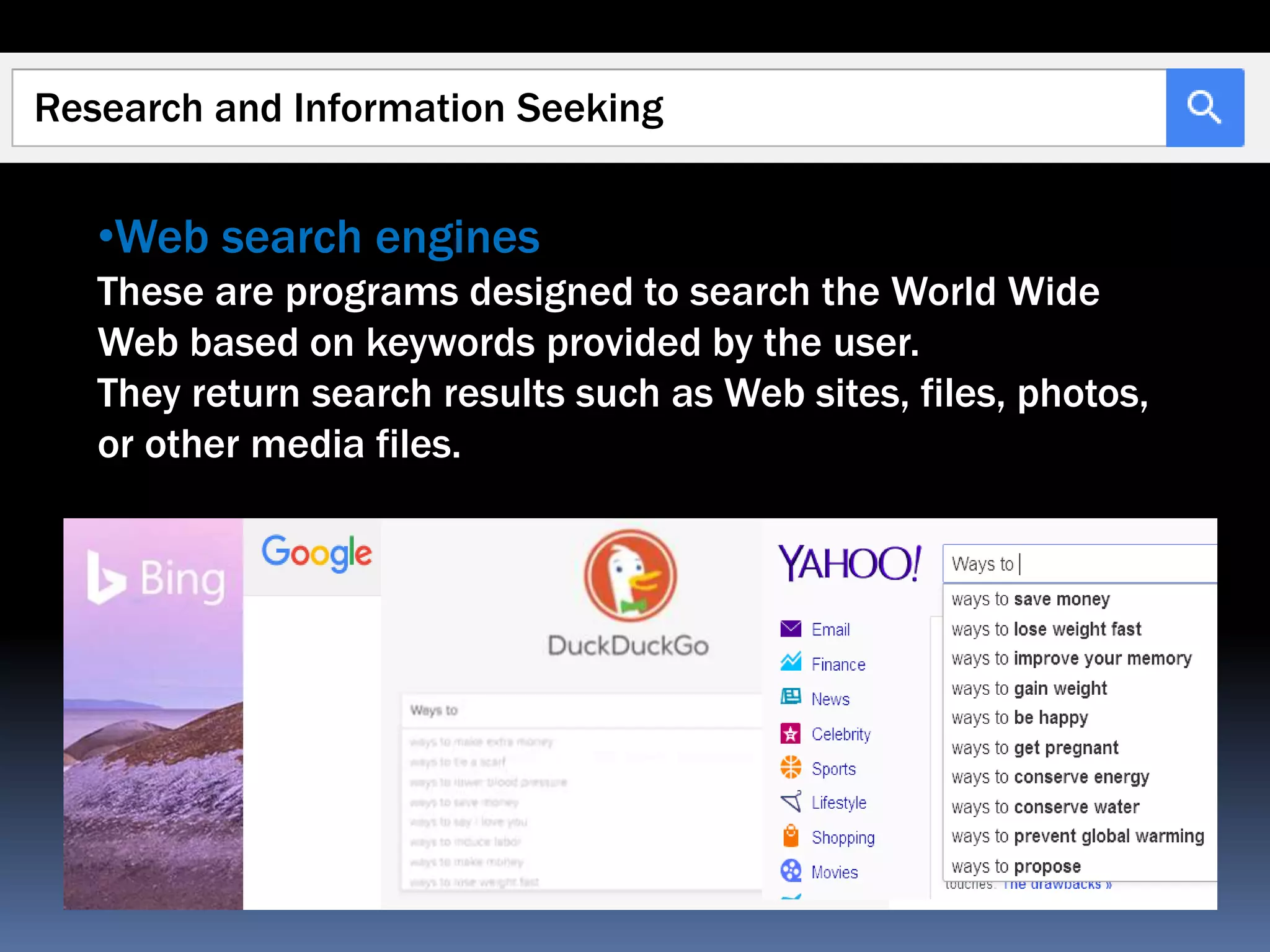
•Web search engines
These are programs designed to search the World Wide
Web based on keywords provided by the user.
They return search results such as Web sites, files, photos,
or other media files.
Research and Information Seeking
•Research indexing sites
These are Web sites dedicated to compile and index
researches done by academic researchers, engineers ,
social scientists, and so on.
Research and Information Seeking
•Massive Online Open Course (MOOC) sites or
tutorial sites
These are Web sites dedicated to teach and inform users
focused on different areas.
The delivery of information is similar to a classroom lecture
setup, wherein lectures and assignments are delivered and
submitted online.
Research and Information Seeking
•Employment Web sites
These are Web sites that enable companies to post job
vacancies and also accommodate job seekers by providing
a resume-submission facility.
Research and Information Seeking
•Electronic commerce (e-commerce)
This is a technology that uses electronic means to trade
products and currencies.
It also includes any technology that introduces ease in
business management and customer service
Authenticity Verification of Information from the Web
Published author’s name
Publishing the name of the one who wrote the article or information is
one sign that the information is valid, credible, and legitimate.
Most of the
authors
who are
Intentionally
writing false
articles will
likely omit
writing their
names to avoid
responsibility.
Source: http://www.codeproject.com/Articles/1001577/How-to-Design-Dynamically-Appearing-Rows-in-A-UITa
Authenticity Verification of Information from the Web
Credible Web sites
Error-free articles are more likely published by credible Web sites. These
are Web sites of big international or local companies involved in the field
you are searching for.
Authenticity Verification of Information from the Web
Rating, number of viewers, and number of shares
A credible article is more likely to receive a high rating or a normally high
number of
stars from
reviewers.
Another way
is to visit the
comment
section of
the article.
Authenticity Verification of Information from the Web
Reference and related articles
Most of the credible articles include a list of references or articles related
to the published one.
“netizen” refers to the person who is a member
or a part of the online community.
“netiquette” is a coined or portmanteau term
of network and etiquette.
It is a set of ideal rules and conduct that a
netizen should observe in communicating and/or
publishing information and materials over
World Wide Web and in ICT in general.
Think before you
click.
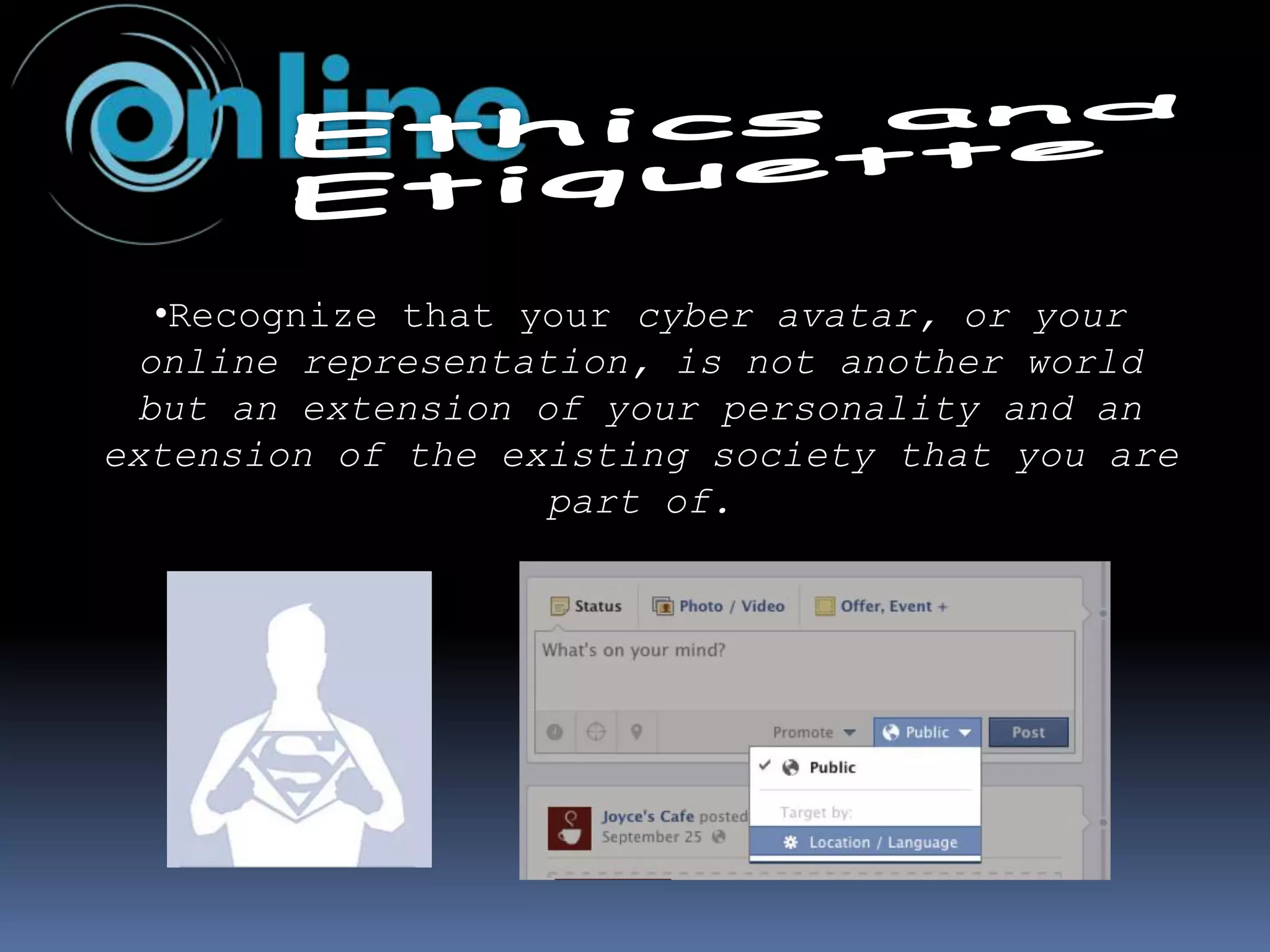
•Recognize that your cyber avatar, or your
online representation, is not another world
but an extension of your personality and an
extension of the existing society that you are
part of.
•You should apple the values and conduct
learned since childhood in the online
extension of our society.
•Keep in mind that there are laws existing in
our society and on the web.
•The World Wide Web enables participation of
people from different countries with different
cultures and religions.
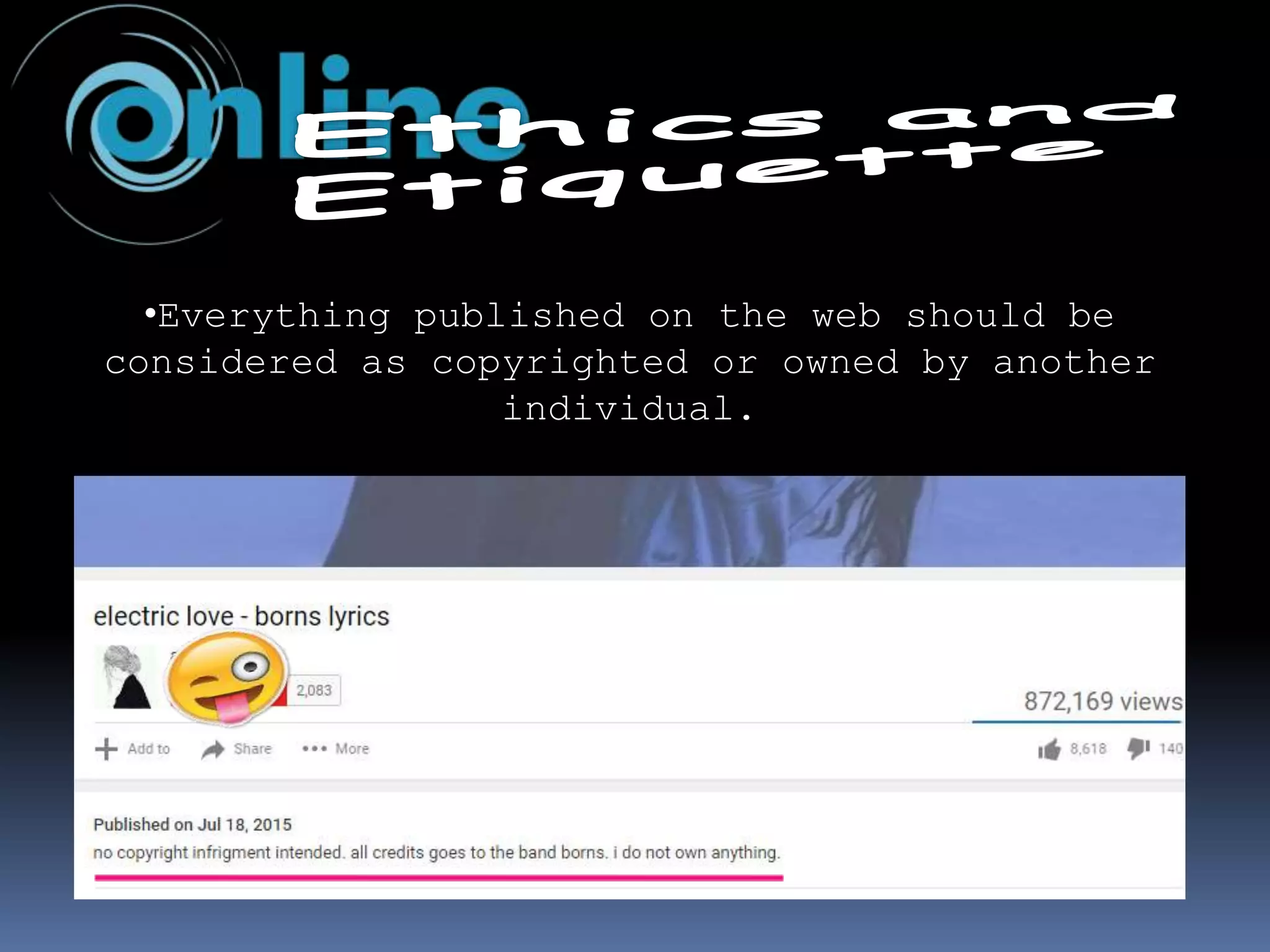
•Everything published on the web should be
considered as copyrighted or owned by another
individual.
•In sending correspondence in either e-mail or
chat, be careful in selecting words to
communicate.
Send
Spam refers to the
transmission of unsolicited
messages from various origins
using electronic messaging
systems such as e-mail and
chat messengers.
Phishing is
defined as a
software or a
program used
by an attacker
to obtain
personal
information.
Malware is a
short term for
malicious
software, which
is a computer
software set by
attackers to
inflict chaos on
a computer’s
operation and
processes.
Republic Act
10627
“Anti-Bullying Act
of 2013”
Republic Act
10175
“Cybercrime
Prevention Act of
2012”
Prepared by: Jess Henson
I do not own the
rights to the
information, as
well as the
pictures used. This
is just for an
educational
purpose. I hope I
have helped a lot
of students like
me.

ICT Today

  • 1.
  • 2.
  • 4.
  • 5.
    4 main periodsthat divide the era of ICT
  • 6.
    around 3000 BCE The PremechanicalPeriod around 1 450 CE 3100 BCE words, and pictograms curved in rocks
  • 7.
    These gave riseto our modern day alphabet. A Sumerian pictogram dating shows the earliest form of communication among humans.
  • 8.
    around 3000 BCE The PremechanicalPeriod around 1 450 CE 3100 BCE words, and pictograms curved in rocks paper was produced This is when early humans realized that stone tablets are too heavy.
  • 9.
    Paper was producedfrom papyrus plants, storing information was revolutionized. BOOKS compiled records written on pieces of paper and was bound together LIBRARY Area where a great number of books are compiled and stored. LIBRARIES were considered the first data centers in history.
  • 10.
    around 3000 BCE The PremechanicalPeriod around 1 450 CE 3100 BCE; words, and pictograms curved in rocks paper was produced This is when early humans realized that stone tablets are too heavy. In the last stages of this period; numerical systems
  • 11.
    The most popular devicecreated in premechanical period is said to have come from China – the ABACUS. The abacus, considered to be the first counting device, was introduced in the 2nd century BCE. It is manually operated device similar to the modern calculator.
  • 12.
    around 3000 BCE The PremechanicalPeriod around 1 450 CE 3100 BCE; words, and pictograms curved in rocks paper was produced This is when early humans realized that stone tablets are too heavy. In the last stages of this period; numerical systems
  • 13.
    The Mechanical Period around 1840 Pascaline around 1450 Thisperiod concentrated primarily on the development of machines that will enhance calculation speed
  • 14.
    Pascaline, the adventof mechanical period, was the highlight of the period. It was invented by famous mathematician inventor BLAISE PASCAL, along with WILHELM SCHICKARD.
  • 15.
    The Mechanical Period around 1840 Pascaline around 1450 Thisperiod concentrated primarily on the development of machines that will enhance calculation speed Analytical Engine
  • 16.
    The ANALYTICAL ENGINE,first invented by CHARLES BABBAGE in 1873, contained features that became part of the blueprint in the creation of succeeding computers. ANALYTICAL ENGINE is considered the first programmable mechanical computer. The invention of Analytical Engine earned Babbage the title “Father of the Computers”
  • 17.
    The Mechanical Period around 1840 Pascaline around 1450 Thisperiod concentrated primarily on the development of machines that will enhance calculation speed Analytical Engine
  • 18.
    The Electromechanical Period around 1940 around 1840 Inthis period, the use of electricity for information handling and transfer bloomed. telegraph
  • 19.
    TELEGRAPH is consideredthe first electrical communications device. First invented in 1837 by WILLIAM COOKE and SIR CHARLES WHEATSTONE. The first working model used five magnetic needles that could be pointed around the sets of letters and numbers by using electric current.
  • 20.
    In 1844, anAmerican inventor named SAMUEL MORSE successfully introduced the first SINGLE-CIRCUIT TELEGRAPH, which gave rise to the MORSE CODE.
  • 21.
    The Electromechanical Period around 1940 around 1840 Inthis period, the use of electricity for information handling and transfer bloomed. telegraph telephone
  • 22.
    In 1876, ALEXANDERGRAHAM BELL introduced the TELEPHONE. The telephone converts sounds into electricity and enables the telephone network to transmit over copper wires.
  • 23.
    The Electromechanical Period around 1940 around 1840 Inthis period, the use of electricity for information handling and transfer bloomed. telegraph telephone The Bombe
  • 24.
    The BOMBE wasinvented in 1939 by ALAN TURING and was improved by GORDON WELCHMAN. This device was used to decipher codes during World War II.
  • 25.
    The Electromechanical Period around 1940 around 1840 Inthis period, the use of electricity for information handling and transfer bloomed. telegraph telephone The Bombe
  • 26.
    The Electronic Period upto the present in the 1940s This period is the last period in ICT history. The highlight of this period is focused on the advent of solid state devices or electronic devices The late vacuum tubes period The transistors period The integrated circuits period The computer processors period
  • 27.
    the late vacuumtubes period The dawn of the Electronic Numerical Integrator and Computer (ENIAC), the first electronic and general purpose computer, marked a revolutionary period in computing. ENIAC was a big machine that occupied an area of 167 square meters.
  • 28.
    The transistors period In1947, the TRANSISTOR was invented. It is an electronic device with properties and functions similar to vacuum tubes, but it is lightweight and faster. The TRANSISTOR is the foundation of every electronic device today. In fact, you can find a transistor for every electronic device. The transistor may be one-third of the total size of the vacuum tube, but it transmits information more effectively
  • 29.
    the integrated circuitsperiod In 1958, integrated circuit (IC) was introduced by an American electrical engineer named JACK KILBY. The IC is a device that is composed of a group of transistors and circuit elements compressed in a single package. Because of this, a number of smaller devices intended for information processing and communications were developed.
  • 30.
    The computer processorspeiod Originally designed by PIER GIORGIO PEROTTO and his team, the OLIVETTI PROGRAMMA 101, became the first commercial personal computer sold in 1965. (left) IBM 5150 (right), the very unit which had set the standards for several PC today, was introduced in August 1981 and was developed by the IBM Entry Systems Division Team led by DON ESTRIDGE.
  • 31.
    The Electronic Period upto the present in the 1940s This period is the last period in ICT history. The highlight of this period is focused on the advent of solid state devices or electronic devices The late vacuum tubes period The transistors period The integrated circuits period The computer processors period For decades, scientists and engineers developed methods of connectivity for sharing processed information stored in computers and processing devices. Internet or World Wide Web (www)
  • 32.
    Through the years, theWorld Wide Web evolved because of man’s rising needs and continuous usage.
  • 33.
    The World WideWeb is an information space where documents and other web resources are identified by Uniform Resource Locators (URLs)
  • 34.
    Web 1.0 orthe read-only Web is called to the documents that are number with addresses that should be inputted to retrieve the file. It is where the information or hypertext is accessed by the user. • Web 1.0 is the first representation of web •Web 1.0 sites are static •Web 1.0 sites aren’t interactive
  • 35.
    Web 2.0 orthe read-and-write Web started with the need to interact with Web pages. The Web 2.0 enabled users or viewers to edit the content of the files they were accessing. • Web 2.0 enables users to contribute, collaborate and edit site content •Web 2.0 sends the trend toward users connecting from wherever they may be •Web 2.0 is the integration of multiple forms of call and multimedia functions controlled by an individual user for both business and social purposes Web 2.0
  • 36.
    Web 1.0 Web2.0 Web 3.0 Read-only Web Read-and-write Web Semantic Executing WebRead Read, write, publish Search Personalize - being developed and is envisioned to be a smarter access of hypertext files and a version that would enable a wider range of search in a fast manner Copy and paste Collaborate, network Control Connect Personal website Blogging Encarta Online Wikipedia
  • 38.
    Social Media started togetherwith the Web 2.0 and are used in communicating and socializing with other users in virtual communities and network. •Blogs •Enterprise social networks •Forums •Photo-sharing sites •Product selling •Review sites •Research sharing sites •Social games •Social networks •Video sharing
  • 39.
  • 40.
  • 41.
    VIRALITY It is definedas the rate of reposting or sharing of photos, pieces of information, or ideas published in one’s social media profile or page. It is the measurement of the effectiveness of a social media application. PTAT is a trailing seven-day Facebook metric that measures how many people are “talking” (creating stories) about your page.
  • 42.
    Research and InformationSeeking •Web search engines These are programs designed to search the World Wide Web based on keywords provided by the user. They return search results such as Web sites, files, photos, or other media files.
  • 43.
    Research and InformationSeeking •Research indexing sites These are Web sites dedicated to compile and index researches done by academic researchers, engineers , social scientists, and so on.
  • 44.
    Research and InformationSeeking •Massive Online Open Course (MOOC) sites or tutorial sites These are Web sites dedicated to teach and inform users focused on different areas. The delivery of information is similar to a classroom lecture setup, wherein lectures and assignments are delivered and submitted online.
  • 45.
    Research and InformationSeeking •Employment Web sites These are Web sites that enable companies to post job vacancies and also accommodate job seekers by providing a resume-submission facility.
  • 46.
    Research and InformationSeeking •Electronic commerce (e-commerce) This is a technology that uses electronic means to trade products and currencies. It also includes any technology that introduces ease in business management and customer service
  • 47.
    Authenticity Verification ofInformation from the Web Published author’s name Publishing the name of the one who wrote the article or information is one sign that the information is valid, credible, and legitimate. Most of the authors who are Intentionally writing false articles will likely omit writing their names to avoid responsibility. Source: http://www.codeproject.com/Articles/1001577/How-to-Design-Dynamically-Appearing-Rows-in-A-UITa
  • 48.
    Authenticity Verification ofInformation from the Web Credible Web sites Error-free articles are more likely published by credible Web sites. These are Web sites of big international or local companies involved in the field you are searching for.
  • 49.
    Authenticity Verification ofInformation from the Web Rating, number of viewers, and number of shares A credible article is more likely to receive a high rating or a normally high number of stars from reviewers. Another way is to visit the comment section of the article.
  • 50.
    Authenticity Verification ofInformation from the Web Reference and related articles Most of the credible articles include a list of references or articles related to the published one.
  • 51.
    “netizen” refers tothe person who is a member or a part of the online community. “netiquette” is a coined or portmanteau term of network and etiquette. It is a set of ideal rules and conduct that a netizen should observe in communicating and/or publishing information and materials over World Wide Web and in ICT in general. Think before you click.
  • 52.
    •Recognize that yourcyber avatar, or your online representation, is not another world but an extension of your personality and an extension of the existing society that you are part of.
  • 53.
    •You should applethe values and conduct learned since childhood in the online extension of our society.
  • 54.
    •Keep in mindthat there are laws existing in our society and on the web.
  • 55.
    •The World WideWeb enables participation of people from different countries with different cultures and religions.
  • 56.
    •Everything published onthe web should be considered as copyrighted or owned by another individual.
  • 57.
    •In sending correspondencein either e-mail or chat, be careful in selecting words to communicate. Send
  • 59.
    Spam refers tothe transmission of unsolicited messages from various origins using electronic messaging systems such as e-mail and chat messengers.
  • 60.
    Phishing is defined asa software or a program used by an attacker to obtain personal information.
  • 61.
    Malware is a shortterm for malicious software, which is a computer software set by attackers to inflict chaos on a computer’s operation and processes.
  • 63.
  • 64.
  • 65.
    Prepared by: JessHenson I do not own the rights to the information, as well as the pictures used. This is just for an educational purpose. I hope I have helped a lot of students like me.