Empowerment Technology
L E S S O N 1
I N T R O D U C T I O N T O I C T
Lesson 1 –
ICT and its
Current State
After going through
this lesson, you are
expected to:
1.1. identify what is ICT;
2.2. explain and give how ICT affects
their everyday lives and its current
state
What’s In
• This lesson will introduce the concept of
Information Communication Technology. This
lesson includes what ICT means, its concept
and current state of technology. It will also
discuss the difference between the Web and
Internet. It will also outline important
technological milestone in the evolution of
web technology and how it contributed to the
way we share and transmit information today
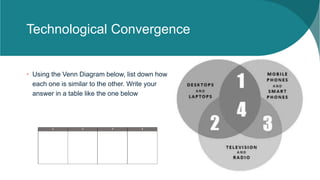
Technological Convergence
• Using the Venn Diagram below, list down how
each one is similar to the other. Write your
answer in a table like the one below
What is ICT?
What is ICT
• Information Communication Technology (ICT) is an
umbrella term referring to communication hardware
or software that allows the access, storage,
transmission and manipulation of information. In
terms of Hardware, ICT specifically encompasses
radio, television, communication devices (smart and
non-smart phones), desktops computers, laptops
and network hardware and technologies. ICT is
also comprised of software, applications and
platforms that allows information to be accessed,
stored, transmitted and manipulated.
What is ICT
• ICT is used across by many industries
and disciplines and in some, it is a
crucial element for them. ICT is now a
part of many people’s lives, for better or
for worst. Ultimately, this technology
depends on your behavior as an end
user, thus learning how to use ICT
properly and responsibly is a must
World Wide Web (WWW) vs Internet
• People colloquially refer the world wide web (‘web’ for short)
as the internet or vice versa interchangeably, but there are key
differences between the two.
• The Internet by definition is the actual interconnection of computers
and other networks, while the web refers to the system that enables
people to access information over the internet. The internet is the
hardware aspect because it relates to computer networks,
connections and infrastructures. The web on the other hand, refers to
the software aspect asit relates to the Protocols or HTTP (Hyper Text
Transfer Protocol. HTTP are the system or procedures that enables
the transfer of information in the internet) web services, applications
and platforms.
Web Versions
• The web has three distinctive versions
namely: Web 1.0, Web 2.0 and Web 3.0.
Some people think that the indicated
web versions are updates across a
particular point of history. The versions
of the web are categorized based on
functionality and features that it
represents.
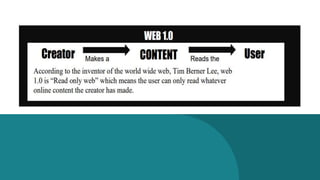
WEB 1.0
• When the World Wide Web was invented, most web
pages were static. Static (also known as flat page or
stationary page) in the sense that the page is “as is”
and cannot be manipulated by the user. The content
is also the same for all users. This is referred to as
Web 1.0.
WEB 2.0: Dynamic Web Pages
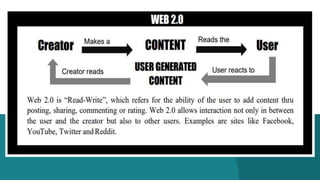
• Web 2.0 allows users to interact with the page: instead
of just reading a page, the user may be able to
comment or create a user account. Web 2.0 also allows
users to use web browsers instead of just using their
operating system. Browsers can now be used for their
user interface, application software (or web
applications), and even for file storage.
• Most websites that we visit today are Web 2.0.
Features of Web 2.0
1. Folksonomy. It allows users to categorize and
classify/arrange information using freely chosen keywords
(e.g., tagging). Popular social networking sites such as Twitter,
Instagram, Facebook, etc. use tags that start with the pound
sign (#). This is also referred to as hashtag.
2. Rich User Experience. Content is dynamic and is responsive
to user’s input. An example would be a website that shows
local content. In the case of social networking sites, when
logged on, your account is used to modify what you see in
their website.
Features of Web 2.0
3. Long Tail. Services are offered on demand rather than on a one-time purchase. In
certain cases, time-based pricing is better than file-size-based pricing or vice
versa. This is synonymous to subscribing to a data plan that charges you for the
amount of time you spent in the Internet, or a data plan that charges you for the
amount of bandwidth you used.
4. User Participation. The owner of the website is not the only one who is able to
put content. Others are able to place a content of their own by means of comment,
reviews, and evaluation. Some websites allow readers to comment on an article,
participate in a poll, or review a specific product (e.g., Amazon.com, online stores).
Features of Web 2.0
5. Software as a Service. Users will subscribe to a software only when needed
rather than purchasing them. This is a cheaper option if you do not always need to
use a software. For instance, Google Docs is a free web-based application that
allows the user to create and edit word processing and spreadsheet documents
online. When you need a software, like a Word Processor, you can purchase it for
a one-time huge amount and install it in your computer and it is yours forever.
Software as a service allows you to “rent” a software for a minimal fee.
6. Mass Participation. It is a diverse information sharing through universal web
access. Since most users can use the Internet, Web 2.0’s content is based on
people from various cultures.
Web 3.0 and the Semantic Web
• The Semantic Web is a movement led by the World
Wide Web Consortium (W3C).
• The W3C standard encourages web developers to
include semantic content in their web pages.
• According to the W3C, “The Semantic Web provides
a common framework that allows data to be shared
and reused across application, enterprise, and
community boundaries.”
• The aim of Web 3.0 is to have machines (or servers)
understand the user’s preferences to be able to
deliver web content specifically targeting the user.
Several problems of Web 3.0
1. Compatibility - HTML files and current web browsers could not support Web 3.0.
2. Security - The user’s security is also in question since the machine is saving his or her
preferences.
3. Vastness - The World Wide Web already contains billions of web pages.
4. Vagueness - Certain words are imprecise. The words “old” and “small” would depend on the
user.
5. Logic - Since machines use logic, there are certain limitations for a computer to be able to
predict what the user is referring to at a given time.
Trends in ICT
Current State of ICT
• ICT is following certain trends as it is
developing in this time and age. This
trend dictates the idea and design of how
ICT delivers information to people. The
following are emerging technologies,
principles or concepts in ICT.
Convergent Technologies
• This is when multiple different devices
combine into a single gadget because of
technological advancement. One example
of this is smartphone, where it is capable
of doing the functions of a television,
radio, computer, telephone, camera and
GPS as a single device
Trends in ICT
• Convergence
• Technological convergence is the synergy of
technological advancements to work on a similar goal or
task.
• Social Media
• Social media is a website, application, or online channels
that enable web users to create, co-create, discuss,
modify, and exchange user-generated content.
Social Media
• – These are software, applications
or platforms that allow users to
communicate in an online social
communities or network. Social
media allows people to
communicate faster through a
larger number of people
Trends in ICT
1. Social Networks. These are sites that allow you to connect with other people with the
same interests or background.
2. Bookmarking Sites. These are sites that allow you to store and manage links to
various websites and resources.
3. Social News. These are sites that allow users to post their own news items or links to
other news sources.
4. Media Sharing. These are sites that allow you to upload and share media content like
images, music, and video.
5. Microblogging. These are sites that focus on short updates from the user.
6. Blogs and Forums. These websites allow users to post their content.
Mobile Technologies
• This is a term for devices that are
easily carried and allows fast
means of communication. These
devices from the past were
originally big and bulk, but due to
the technological advancement,
they become smaller and more
compact.
Trends in ICT
• Mobile Technologies
• The popularity of smartphones and tablets has taken a major rise
over the years. This is largely because of the devices’ capability to
do tasks that were originally found in personal computers.
• Kinds of operating systems:
a. iOS
b. Android
c. Blackberry OS
d. Windows Phone OS
e. Symbian
f. WebOS
g. Windows Mobile
Trends in ICT
• Assistive Media
• Assistive media is a nonprofit service designed to help people
who have visual and reading impairments. A database of
audio recordings is used to read to the user.
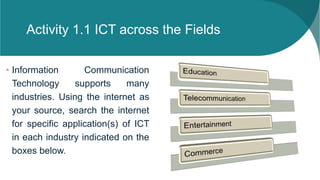
Activity 1.1 ICT across the Fields
• Information Communication
Technology supports many
industries. Using the internet as
your source, search the internet
for specific application(s) of ICT
in each industry indicated on the
boxes below.

Empowerment Technology Lesson 1.pptx

  • 1.
    Empowerment Technology L ES S O N 1 I N T R O D U C T I O N T O I C T
  • 2.
    Lesson 1 – ICTand its Current State After going through this lesson, you are expected to: 1.1. identify what is ICT; 2.2. explain and give how ICT affects their everyday lives and its current state
  • 3.
    What’s In • Thislesson will introduce the concept of Information Communication Technology. This lesson includes what ICT means, its concept and current state of technology. It will also discuss the difference between the Web and Internet. It will also outline important technological milestone in the evolution of web technology and how it contributed to the way we share and transmit information today
  • 4.
    Technological Convergence • Usingthe Venn Diagram below, list down how each one is similar to the other. Write your answer in a table like the one below
  • 5.
  • 6.
    What is ICT •Information Communication Technology (ICT) is an umbrella term referring to communication hardware or software that allows the access, storage, transmission and manipulation of information. In terms of Hardware, ICT specifically encompasses radio, television, communication devices (smart and non-smart phones), desktops computers, laptops and network hardware and technologies. ICT is also comprised of software, applications and platforms that allows information to be accessed, stored, transmitted and manipulated.
  • 7.
    What is ICT •ICT is used across by many industries and disciplines and in some, it is a crucial element for them. ICT is now a part of many people’s lives, for better or for worst. Ultimately, this technology depends on your behavior as an end user, thus learning how to use ICT properly and responsibly is a must
  • 8.
    World Wide Web(WWW) vs Internet • People colloquially refer the world wide web (‘web’ for short) as the internet or vice versa interchangeably, but there are key differences between the two. • The Internet by definition is the actual interconnection of computers and other networks, while the web refers to the system that enables people to access information over the internet. The internet is the hardware aspect because it relates to computer networks, connections and infrastructures. The web on the other hand, refers to the software aspect asit relates to the Protocols or HTTP (Hyper Text Transfer Protocol. HTTP are the system or procedures that enables the transfer of information in the internet) web services, applications and platforms.
  • 9.
    Web Versions • Theweb has three distinctive versions namely: Web 1.0, Web 2.0 and Web 3.0. Some people think that the indicated web versions are updates across a particular point of history. The versions of the web are categorized based on functionality and features that it represents.
  • 11.
    WEB 1.0 • Whenthe World Wide Web was invented, most web pages were static. Static (also known as flat page or stationary page) in the sense that the page is “as is” and cannot be manipulated by the user. The content is also the same for all users. This is referred to as Web 1.0.
  • 13.
    WEB 2.0: DynamicWeb Pages • Web 2.0 allows users to interact with the page: instead of just reading a page, the user may be able to comment or create a user account. Web 2.0 also allows users to use web browsers instead of just using their operating system. Browsers can now be used for their user interface, application software (or web applications), and even for file storage. • Most websites that we visit today are Web 2.0.
  • 14.
    Features of Web2.0 1. Folksonomy. It allows users to categorize and classify/arrange information using freely chosen keywords (e.g., tagging). Popular social networking sites such as Twitter, Instagram, Facebook, etc. use tags that start with the pound sign (#). This is also referred to as hashtag. 2. Rich User Experience. Content is dynamic and is responsive to user’s input. An example would be a website that shows local content. In the case of social networking sites, when logged on, your account is used to modify what you see in their website.
  • 15.
    Features of Web2.0 3. Long Tail. Services are offered on demand rather than on a one-time purchase. In certain cases, time-based pricing is better than file-size-based pricing or vice versa. This is synonymous to subscribing to a data plan that charges you for the amount of time you spent in the Internet, or a data plan that charges you for the amount of bandwidth you used. 4. User Participation. The owner of the website is not the only one who is able to put content. Others are able to place a content of their own by means of comment, reviews, and evaluation. Some websites allow readers to comment on an article, participate in a poll, or review a specific product (e.g., Amazon.com, online stores).
  • 16.
    Features of Web2.0 5. Software as a Service. Users will subscribe to a software only when needed rather than purchasing them. This is a cheaper option if you do not always need to use a software. For instance, Google Docs is a free web-based application that allows the user to create and edit word processing and spreadsheet documents online. When you need a software, like a Word Processor, you can purchase it for a one-time huge amount and install it in your computer and it is yours forever. Software as a service allows you to “rent” a software for a minimal fee. 6. Mass Participation. It is a diverse information sharing through universal web access. Since most users can use the Internet, Web 2.0’s content is based on people from various cultures.
  • 18.
    Web 3.0 andthe Semantic Web • The Semantic Web is a movement led by the World Wide Web Consortium (W3C). • The W3C standard encourages web developers to include semantic content in their web pages.
  • 19.
    • According tothe W3C, “The Semantic Web provides a common framework that allows data to be shared and reused across application, enterprise, and community boundaries.” • The aim of Web 3.0 is to have machines (or servers) understand the user’s preferences to be able to deliver web content specifically targeting the user.
  • 20.
    Several problems ofWeb 3.0 1. Compatibility - HTML files and current web browsers could not support Web 3.0. 2. Security - The user’s security is also in question since the machine is saving his or her preferences. 3. Vastness - The World Wide Web already contains billions of web pages. 4. Vagueness - Certain words are imprecise. The words “old” and “small” would depend on the user. 5. Logic - Since machines use logic, there are certain limitations for a computer to be able to predict what the user is referring to at a given time.
  • 21.
  • 22.
    Current State ofICT • ICT is following certain trends as it is developing in this time and age. This trend dictates the idea and design of how ICT delivers information to people. The following are emerging technologies, principles or concepts in ICT.
  • 23.
    Convergent Technologies • Thisis when multiple different devices combine into a single gadget because of technological advancement. One example of this is smartphone, where it is capable of doing the functions of a television, radio, computer, telephone, camera and GPS as a single device
  • 24.
    Trends in ICT •Convergence • Technological convergence is the synergy of technological advancements to work on a similar goal or task. • Social Media • Social media is a website, application, or online channels that enable web users to create, co-create, discuss, modify, and exchange user-generated content.
  • 25.
    Social Media • –These are software, applications or platforms that allow users to communicate in an online social communities or network. Social media allows people to communicate faster through a larger number of people
  • 26.
    Trends in ICT 1.Social Networks. These are sites that allow you to connect with other people with the same interests or background. 2. Bookmarking Sites. These are sites that allow you to store and manage links to various websites and resources. 3. Social News. These are sites that allow users to post their own news items or links to other news sources. 4. Media Sharing. These are sites that allow you to upload and share media content like images, music, and video. 5. Microblogging. These are sites that focus on short updates from the user. 6. Blogs and Forums. These websites allow users to post their content.
  • 27.
    Mobile Technologies • Thisis a term for devices that are easily carried and allows fast means of communication. These devices from the past were originally big and bulk, but due to the technological advancement, they become smaller and more compact.
  • 28.
    Trends in ICT •Mobile Technologies • The popularity of smartphones and tablets has taken a major rise over the years. This is largely because of the devices’ capability to do tasks that were originally found in personal computers. • Kinds of operating systems: a. iOS b. Android c. Blackberry OS d. Windows Phone OS e. Symbian f. WebOS g. Windows Mobile
  • 29.
    Trends in ICT •Assistive Media • Assistive media is a nonprofit service designed to help people who have visual and reading impairments. A database of audio recordings is used to read to the user.
  • 30.
    Activity 1.1 ICTacross the Fields • Information Communication Technology supports many industries. Using the internet as your source, search the internet for specific application(s) of ICT in each industry indicated on the boxes below.