WEB DESIGN
PRINCIPLE AND
ELEMENTS
Presented by: Nicah Thea D. Bajenting
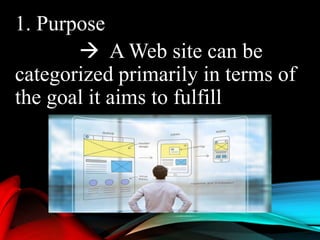
1. Purpose
 A Web site can be
categorized primarily in terms of
the goal it aims to fulfill
2. Communication
 When we visit a Web site,
the primary objective is to absorb as
much valuable information as
possible in the shortest amount of
time.
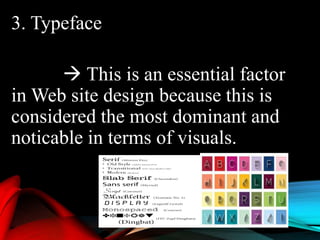
3. Typeface
 This is an essential factor
in Web site design because this is
considered the most dominant and
noticable in terms of visuals.
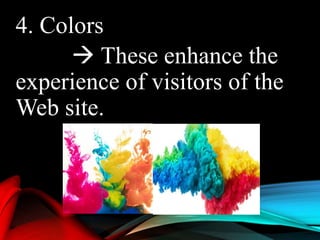
4. Colors
 These enhance the
experience of visitors of the
Web site.
5. Images
 Delivers a complete
message that the Web site
wishes to communicate the
audience.
6. Navigation
 Refers to the
facility that the audience can
use to go through the Website
and its subpages.
7. Layouts
 Refers to the
physical arrangement of the
content and elements on a
Web site.
7. LAYOUTS
a. Grid
 Can be useful
through enabling the user to
create sections or groups of
related information.
7. LAYOUTS
b. F-Pattern
 Based on the
studies, human vision
floes like the letter F.
7. LAYOUTS
c. Mobile
 The popularity of using
devices in viewing Web content
is increasing because of the
portability and convenience
brought about by mobile devices
to their users.
8. Load Time
 Another basis for the
success of a Web site will load or
appear onto the viewers’ display
device.

Web Design Principle and Elements