Pneumonia Cases
Dr. Sameh Ahmad Muhamad abdelghany
Lecturer Of Clinical Pharmacology
Mansura Faculty of medicine
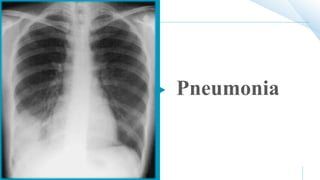
Pneumonia
CAS(1)
CHIEF COMPLAINT
4
 Cough and fever for four days.
HISTORY
5
 Mr. Alcot is a 68 year old man who developed a tough, productive cough four
days prior to being seen by a physician. The sputum is thick and yellow with
streaks of blood. He developed a fever, shaking, chills and malaise along with
the cough. One day ago he developed pain in his right chest that intensifies
with inspiration. The patient lost 7 kilograms over the past few months but
claims he did not lose his appetite. "I just thought I had the flu." Past history
reveals that he had a chronic smoker's cough for "10 or 15 years" which he
describes as being mild, non-productive and occurring most often in the early
morning. He smoked 2 packs of cigarettes per day for the past 50 years.
PHYSICAL EXAMINATION
6
 The patient is an elderly man who appears tired weak and underweight. His
complexion is pale. He coughs continuously. Sitting in a chair, he leans to his right
side, holding his right chest with his left arm. Vital signs are as follows: blood pressure
152/90, apical heart rate 112/minute and regular, respiratory rate 24/minute and
somewhat labored, temperature 39.2 ° Celsius. Both lungs are resonant by percussion
with one exception: the right mid-anterior and right mid-lateral lung fields are dull.
Auscultation reveals bilateral diminished vesicular breath sounds. Bronchial breath
sounds, rhonchi and late inspiratory crackles (are heard) in the area of the right mid-
anterior and right mid-lateral lung fields. The remainder of the lung fields is clear.
Percussion and auscultation of the heart reveals no significant abnormality.
LABORATORY
7
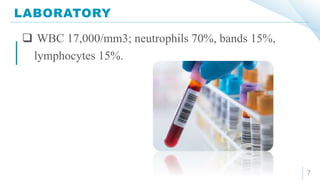
 WBC 17,000/mm3; neutrophils 70%, bands 15%,
lymphocytes 15%.
COURSE OF ILLNESS
8
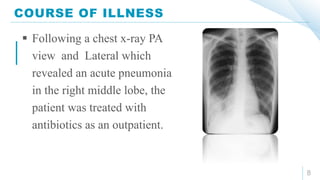
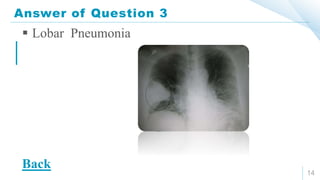
 Following a chest x-ray PA
view and Lateral which
revealed an acute pneumonia
in the right middle lobe, the
patient was treated with
antibiotics as an outpatient.
COURSE OF ILLNESS
9
 During the 10 days of treatment the patient's fever abated
and he felt somewhat better. A post-treatment (follow up)
chest x-ray reveals a right hilar mass. Sputum cytology
demonstrates atypical cells.
Questions
10
 Q1:Identify the problems from the history?
 Q2:Identify and explain the significance of physical findings?
 Q3:Review the lab findings. What is your diagnosis?
 Q4:What do you understand by the terms "hospital acquired"
and "community acquired " pneumonia.? Which type of
pneumonia does our patient have?
 Q5:What organisms are likely to be causing his
pneumonia?
Questions
11
 Q6: How is the specific diagnosis established?
 Q7: What antimicrobial agents would you prescribe for this
patient? Would you use or avoid penicillin, and why?
 Q8:What is the duration of treatment?
Answer of Question 1
12
 Acute febrile illness
 Cough with Yellow sputum, with streaking of blood
 Pain in chest
 Shaking chills
 weight loss
 Chronic bronchitis
 Smoker
 Hypertension
Back
Answer of Question 2
13
 BP, Temp, Respiratory rate
 Labored breathing
 Supraclavicular node
 Dullness with bronchial breathing over right mid anterior
lung field.
Back
Answer of Question 3
14
 Lobar Pneumonia
Back
Answer of Question 4
15
 Oropharyngeal colonization is different in the community
and hospital setting.
 This makes a difference in the etiology of pneumonia.
 This patient has community acquired pneumonia.
Back
Answer of Question 5
16
 The patient has community-acquired pneumonia.
 The most common organisms are
1. Streptococcus pneumoniae (30%)
2. Hemophilus influenzae (10%)
3. Mycoplasma pneumoniae (10%)
4. Chlamydia pneumoniae (8%)
5. influenza virus (7%)
6. Legionella species (3%)
7. gram negative Enterobacteriaceae (3%)
8. Chlamydia psittaci (1%)
Back
Answer of Question 6
17
 Gram stain: The diagnosis is suggested by the
demonstration of large numbers of PMN’s and gram-
positive diplococci in a gram stained sputum specimen.
 Sputum culture: The diagnosis is confirmed by
identification of Streptococcus pneumoniae in sputum
culture.
Back
Answer of Question 7
18
 Penicillin has been the standard drug to treat pneumonococcal
pneumonia. Procaine penicillin G, amoxicillin, cefazolin, and
erythromycin are effective.
 Trimethoprim-sulfamethoxazole should be avoided as up to 20%
isolated from day care centers are resistant.
 In penicillin – allergic patients, erythromycin is an alternative.
 The emergence of penicillin resistant strains is of great concern .
Where the incidence of resistance of high, Ceftriaxone or
erythromycin are the agents of choice.
Back
Answer of Question 8
19
 The length of treatment will vary with the severity of illness and the
presence of underlying disease.
 Generally, 7-10 days of antibiotic should be sufficient.
 Pneumococci are no longer detected in the sputum within several hours
of the first dose of penicillin.
 Dramatic symptomatic improvement in 24 hours
 The lack of lung destruction and complete resolution of pathologic
changes on recovery, coupled with the dramatic response to penicillin,
allow for a relatively short duration of treatment.
Back
CAS(2)
Scenario
21
A 15 year old female with a history of hay fever develops fever,
headache and malaise for 4 days followed by a nonproductive
cough and scratchy throat. Despite chicken soup and orange juice,
the cough and fever persist, and her mother drags her to your
office. On examination, her temperature is 38.3° celsius, pulse 90
beats/min, BP 110/70, respiratory rate 20 beats/min Physical
examination is unremarkable except for scattered rales over the
left lower lung, and small bullae in her left tympanic membrane.
Chest x-ray reveals a patchy left lower lobe infiltrate. At your
request, she makes a great effort but is unable to produce sputum.
Questions
22
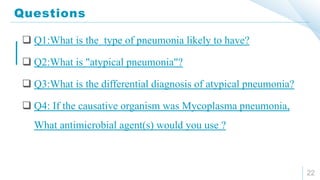
 Q1:What is the type of pneumonia likely to have?
 Q2:What is "atypical pneumonia"?
 Q3:What is the differential diagnosis of atypical pneumonia?
 Q4: If the causative organism was Mycoplasma pneumonia,
What antimicrobial agent(s) would you use ?
Answer of Question 1
23
 Atypical pneumonia.
Back
Answer of Question 2
24
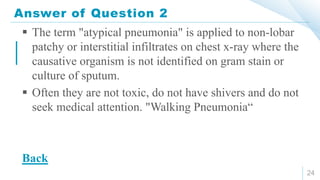
 The term "atypical pneumonia" is applied to non-lobar
patchy or interstitial infiltrates on chest x-ray where the
causative organism is not identified on gram stain or
culture of sputum.
 Often they are not toxic, do not have shivers and do not
seek medical attention. "Walking Pneumonia“
Back
Answer of Question 3
25
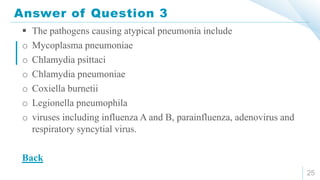
 The pathogens causing atypical pneumonia include
o Mycoplasma pneumoniae
o Chlamydia psittaci
o Chlamydia pneumoniae
o Coxiella burnetii
o Legionella pneumophila
o viruses including influenza A and B, parainfluenza, adenovirus and
respiratory syncytial virus.
Back
Answer of Question 4
26
 Erythromycin and tetracycline are equally effective in treatment of M.
pneumoniae infection. They shorten the course of infection but do not
eliminate the carrier state.
 Clarithromycin and azithromycin are also effective but much more
expensive.
 Quinolones such as ciprofloxacin have in vitro efficacy against
mycoplasma, but are expensive and contra-indicated in children.
 Since mycoplasmas lack a cell wall, beta-lactam antibiotics are
ineffective for treatment.
 Therapy is generally continued for 2-3 weeks, as relapses can occur in
up to 10% cases
Back
CAS(3)
Scenario
28
A 35 year alcoholic male with a history of seizures is admitted
with a three week history of fever, generalized weakness, poor
appetite, and cough productive of green, foul - smelling sputum.
On physical examination, the temperature is 37.9 celsius degrees.
Pulse is 96 beats per minute, respiratory rate is 20 breaths per
minute, and BP is 120/80 mm. There are many missing teeth with
gingivitis and dental caries. He has rales and decreased breath
sounds over the right base. Chest x-ray shows consolidation in the
superior segment of the right lower lobe.
Questions
29
 Q1: What type of infection is suggested by his fowl smelling
sputum?
 Q2: What organisms could be responsible for this patient's
pneumonia?
 Q3: How would you treat this patient?
 Q4: What organisms might be the cause of a hospital acquired
aspiration pneumonia?
Answer of Question 1
30
 Anaerobic infection.
Back
Answer of Question 2
31
 Peptostreptococcus sp.
 Bacteroides sp. (B. melanogenicus, B. intermedius)
 Fusobacterium sp.
Back
Answer of Question 3
32
 Antibiotic therapy is the key treatment for anaerobic pulmonary infections.
 Drug of choice: Clindamycin
 Alternative agents: Penicillin, Ampicillin/sulbactam, or
Amoxicillin/clavulanic acid
 Duration of therapy will depend on radiographic clearance, and may range
as long as 2-4 months.
 Postural drainage is an important component of therapy.
Back
Answer of Question 4
33
 Patients with nosocomial aspiration pneumonia are more likely to have a
mixed aerobic-anaerobic infection, in which the aerobic component
(gram-negative bacilli) predominates.
 Aerobic organisms: Klebsiella , Enterobacter , Serratia , E. coli ,
Pseudomonas aeruginosa, Staphylococcus aureus ,
 Anaerobic organisms: Peptostreptococcus sp. , Bacteroides sp. (B.
melanogenicus, B. intermedius) , Fusobacterium sp.
 Antibiotics
o Drug of choice: Clindamycin + aminoglycoside
o Alternative agents: Ticarcillin/clavulanate, or Imipenem, or Piperacillin, or
Mezlocillin
Back
T H A N K Y O U !
A N Y Q U E S T I O N S ?

Pneumonia cases

  • 1.
    Pneumonia Cases Dr. SamehAhmad Muhamad abdelghany Lecturer Of Clinical Pharmacology Mansura Faculty of medicine
  • 2.
  • 3.
  • 4.
    CHIEF COMPLAINT 4  Coughand fever for four days.
  • 5.
    HISTORY 5  Mr. Alcotis a 68 year old man who developed a tough, productive cough four days prior to being seen by a physician. The sputum is thick and yellow with streaks of blood. He developed a fever, shaking, chills and malaise along with the cough. One day ago he developed pain in his right chest that intensifies with inspiration. The patient lost 7 kilograms over the past few months but claims he did not lose his appetite. "I just thought I had the flu." Past history reveals that he had a chronic smoker's cough for "10 or 15 years" which he describes as being mild, non-productive and occurring most often in the early morning. He smoked 2 packs of cigarettes per day for the past 50 years.
  • 6.
    PHYSICAL EXAMINATION 6  Thepatient is an elderly man who appears tired weak and underweight. His complexion is pale. He coughs continuously. Sitting in a chair, he leans to his right side, holding his right chest with his left arm. Vital signs are as follows: blood pressure 152/90, apical heart rate 112/minute and regular, respiratory rate 24/minute and somewhat labored, temperature 39.2 ° Celsius. Both lungs are resonant by percussion with one exception: the right mid-anterior and right mid-lateral lung fields are dull. Auscultation reveals bilateral diminished vesicular breath sounds. Bronchial breath sounds, rhonchi and late inspiratory crackles (are heard) in the area of the right mid- anterior and right mid-lateral lung fields. The remainder of the lung fields is clear. Percussion and auscultation of the heart reveals no significant abnormality.
  • 7.
    LABORATORY 7  WBC 17,000/mm3;neutrophils 70%, bands 15%, lymphocytes 15%.
  • 8.
    COURSE OF ILLNESS 8 Following a chest x-ray PA view and Lateral which revealed an acute pneumonia in the right middle lobe, the patient was treated with antibiotics as an outpatient.
  • 9.
    COURSE OF ILLNESS 9 During the 10 days of treatment the patient's fever abated and he felt somewhat better. A post-treatment (follow up) chest x-ray reveals a right hilar mass. Sputum cytology demonstrates atypical cells.
  • 10.
    Questions 10  Q1:Identify theproblems from the history?  Q2:Identify and explain the significance of physical findings?  Q3:Review the lab findings. What is your diagnosis?  Q4:What do you understand by the terms "hospital acquired" and "community acquired " pneumonia.? Which type of pneumonia does our patient have?  Q5:What organisms are likely to be causing his pneumonia?
  • 11.
    Questions 11  Q6: Howis the specific diagnosis established?  Q7: What antimicrobial agents would you prescribe for this patient? Would you use or avoid penicillin, and why?  Q8:What is the duration of treatment?
  • 12.
    Answer of Question1 12  Acute febrile illness  Cough with Yellow sputum, with streaking of blood  Pain in chest  Shaking chills  weight loss  Chronic bronchitis  Smoker  Hypertension Back
  • 13.
    Answer of Question2 13  BP, Temp, Respiratory rate  Labored breathing  Supraclavicular node  Dullness with bronchial breathing over right mid anterior lung field. Back
  • 14.
    Answer of Question3 14  Lobar Pneumonia Back
  • 15.
    Answer of Question4 15  Oropharyngeal colonization is different in the community and hospital setting.  This makes a difference in the etiology of pneumonia.  This patient has community acquired pneumonia. Back
  • 16.
    Answer of Question5 16  The patient has community-acquired pneumonia.  The most common organisms are 1. Streptococcus pneumoniae (30%) 2. Hemophilus influenzae (10%) 3. Mycoplasma pneumoniae (10%) 4. Chlamydia pneumoniae (8%) 5. influenza virus (7%) 6. Legionella species (3%) 7. gram negative Enterobacteriaceae (3%) 8. Chlamydia psittaci (1%) Back
  • 17.
    Answer of Question6 17  Gram stain: The diagnosis is suggested by the demonstration of large numbers of PMN’s and gram- positive diplococci in a gram stained sputum specimen.  Sputum culture: The diagnosis is confirmed by identification of Streptococcus pneumoniae in sputum culture. Back
  • 18.
    Answer of Question7 18  Penicillin has been the standard drug to treat pneumonococcal pneumonia. Procaine penicillin G, amoxicillin, cefazolin, and erythromycin are effective.  Trimethoprim-sulfamethoxazole should be avoided as up to 20% isolated from day care centers are resistant.  In penicillin – allergic patients, erythromycin is an alternative.  The emergence of penicillin resistant strains is of great concern . Where the incidence of resistance of high, Ceftriaxone or erythromycin are the agents of choice. Back
  • 19.
    Answer of Question8 19  The length of treatment will vary with the severity of illness and the presence of underlying disease.  Generally, 7-10 days of antibiotic should be sufficient.  Pneumococci are no longer detected in the sputum within several hours of the first dose of penicillin.  Dramatic symptomatic improvement in 24 hours  The lack of lung destruction and complete resolution of pathologic changes on recovery, coupled with the dramatic response to penicillin, allow for a relatively short duration of treatment. Back
  • 20.
  • 21.
    Scenario 21 A 15 yearold female with a history of hay fever develops fever, headache and malaise for 4 days followed by a nonproductive cough and scratchy throat. Despite chicken soup and orange juice, the cough and fever persist, and her mother drags her to your office. On examination, her temperature is 38.3° celsius, pulse 90 beats/min, BP 110/70, respiratory rate 20 beats/min Physical examination is unremarkable except for scattered rales over the left lower lung, and small bullae in her left tympanic membrane. Chest x-ray reveals a patchy left lower lobe infiltrate. At your request, she makes a great effort but is unable to produce sputum.
  • 22.
    Questions 22  Q1:What isthe type of pneumonia likely to have?  Q2:What is "atypical pneumonia"?  Q3:What is the differential diagnosis of atypical pneumonia?  Q4: If the causative organism was Mycoplasma pneumonia, What antimicrobial agent(s) would you use ?
  • 23.
    Answer of Question1 23  Atypical pneumonia. Back
  • 24.
    Answer of Question2 24  The term "atypical pneumonia" is applied to non-lobar patchy or interstitial infiltrates on chest x-ray where the causative organism is not identified on gram stain or culture of sputum.  Often they are not toxic, do not have shivers and do not seek medical attention. "Walking Pneumonia“ Back
  • 25.
    Answer of Question3 25  The pathogens causing atypical pneumonia include o Mycoplasma pneumoniae o Chlamydia psittaci o Chlamydia pneumoniae o Coxiella burnetii o Legionella pneumophila o viruses including influenza A and B, parainfluenza, adenovirus and respiratory syncytial virus. Back
  • 26.
    Answer of Question4 26  Erythromycin and tetracycline are equally effective in treatment of M. pneumoniae infection. They shorten the course of infection but do not eliminate the carrier state.  Clarithromycin and azithromycin are also effective but much more expensive.  Quinolones such as ciprofloxacin have in vitro efficacy against mycoplasma, but are expensive and contra-indicated in children.  Since mycoplasmas lack a cell wall, beta-lactam antibiotics are ineffective for treatment.  Therapy is generally continued for 2-3 weeks, as relapses can occur in up to 10% cases Back
  • 27.
  • 28.
    Scenario 28 A 35 yearalcoholic male with a history of seizures is admitted with a three week history of fever, generalized weakness, poor appetite, and cough productive of green, foul - smelling sputum. On physical examination, the temperature is 37.9 celsius degrees. Pulse is 96 beats per minute, respiratory rate is 20 breaths per minute, and BP is 120/80 mm. There are many missing teeth with gingivitis and dental caries. He has rales and decreased breath sounds over the right base. Chest x-ray shows consolidation in the superior segment of the right lower lobe.
  • 29.
    Questions 29  Q1: Whattype of infection is suggested by his fowl smelling sputum?  Q2: What organisms could be responsible for this patient's pneumonia?  Q3: How would you treat this patient?  Q4: What organisms might be the cause of a hospital acquired aspiration pneumonia?
  • 30.
    Answer of Question1 30  Anaerobic infection. Back
  • 31.
    Answer of Question2 31  Peptostreptococcus sp.  Bacteroides sp. (B. melanogenicus, B. intermedius)  Fusobacterium sp. Back
  • 32.
    Answer of Question3 32  Antibiotic therapy is the key treatment for anaerobic pulmonary infections.  Drug of choice: Clindamycin  Alternative agents: Penicillin, Ampicillin/sulbactam, or Amoxicillin/clavulanic acid  Duration of therapy will depend on radiographic clearance, and may range as long as 2-4 months.  Postural drainage is an important component of therapy. Back
  • 33.
    Answer of Question4 33  Patients with nosocomial aspiration pneumonia are more likely to have a mixed aerobic-anaerobic infection, in which the aerobic component (gram-negative bacilli) predominates.  Aerobic organisms: Klebsiella , Enterobacter , Serratia , E. coli , Pseudomonas aeruginosa, Staphylococcus aureus ,  Anaerobic organisms: Peptostreptococcus sp. , Bacteroides sp. (B. melanogenicus, B. intermedius) , Fusobacterium sp.  Antibiotics o Drug of choice: Clindamycin + aminoglycoside o Alternative agents: Ticarcillin/clavulanate, or Imipenem, or Piperacillin, or Mezlocillin Back
  • 34.
    T H AN K Y O U ! A N Y Q U E S T I O N S ?

Editor's Notes