This project aims to explore and compare the different techniques used in the formulation of diazepam microspheres, focusing on their principles, processes, and potential applications in modern drug delivery systems
Hospital Pharmacy
Sanskar CityCollege of Pharmacy,
T h a k u r t o l a , R a j n a n d g a o n , ( C .G . )
A presentation on survey report on
Presented by:
Name:- Aarti Toppo
Roll. No:-312504121062
Enroll. No:-CB2215
B.Pharm, 7th
Sem.
Supervised by:
Mr. Parasmani Sahu
Asst. Professor
SCCP, Rajnandgaon
(C.G.)
2.
Hospital Pharmacy
Definition: Branchof pharmaceutical sciences that
deals with the pharmacy profession and the role of
pharmacist inside the hospital.
3.
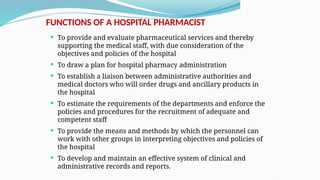
FUNCTIONS OF AHOSPITAL PHARMACIST
To provide and evaluate pharmaceutical services and thereby
supporting the medical staff, with due consideration of the
objectives and policies of the hospital
To draw a plan for hospital pharmacy administration
To establish a liaison between administrative authorities and
medical doctors who will order drugs and ancillary products in
the hospital
To estimate the requirements of the departments and enforce the
policies and procedures for the recruitment of adequate and
competent staff
To provide the means and methods by which the personnel can
work with other groups in interpreting objectives and policies of
the hospital
To develop and maintain an effective system of clinical and
administrative records and reports.
4.
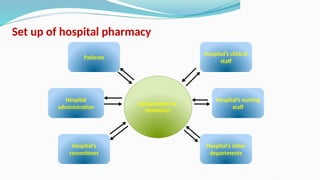
Set up ofhospital pharmacy
DEPARTMENT OF
PHARMACY
Hospital’s
committees
Hospital
administration
Patients
Hospital’s clinical
staff
Hospital’s other
departments
Hospital’s nursing
staff
5.
Functions and responsibilitiesof the HOD of
pharmacy and his staff
HOD have to ensure that pharmacists functioning in different
areas carry out their assigned functions and duties efficiently
and is aware of his responsibilities towards its staff and to the
hospital administration
6.
Pharmacy as aKnowledge system
Pharmacy can be defined as the knowledge system that offers a health
service through knowledge obtained from drugs and their effects either
physiological, chemical, physical or behavioural.
Pharmacy knowledge is distributed to physicians, pharmacists and other
health care professionals as well as to the general public.
Knowledge of drug products , their benefits and side effects will contribute to
the health of individuals and the welfare of the society.
7.
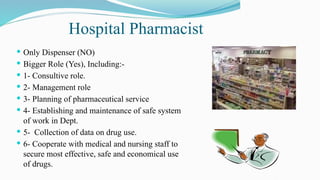
Hospital Pharmacist
OnlyDispenser (NO)
Bigger Role (Yes), Including:-
1- Consultive role.
2- Management role
3- Planning of pharmaceutical service
4- Establishing and maintenance of safe system
of work in Dept.
5- Collection of data on drug use.
6- Cooperate with medical and nursing staff to
secure most effective, safe and economical use
of drugs.
8.
Role of hospitalpharmacist (continued)
7- Preparation of IV admixtures
8- Sterile prescription compounding
9- Coordination of unit-dose operation
10- Patient profile monitoring
11- Supervision of medication technicians
12- patient drug interviews
13- daily clinical rounds
14- provision of drug information
9.
Goal
Integration withthe health care team of the hospital
Integration and cooperation with other hospital
pharmacists
To fulfil the best health care service that could be offered
to the patients
10.
Abilities required forhospital pharmacist
A wide knowledge of drugs and their actions
Ability to conduct and develop a manufacturing program
Accurate knowledge of drug control procedure
Ability to conduct and share in research
Ability to conduct teaching and in-service programs
Ability to manage and administer a hospital pharmacy
Ability to develop patient-oriented services
Ability to develop minimum skills in each pharmaceutical
area be capable of becoming an expert in any one of them.
Ability to establish and direct a drug information center
11.
Structure of thehospital pharmacy staff
A. Director of the pharmacy
Responsibilities include:
1- Maintains an adequate drug supply
2- Participates through the pharmacy and therapeutics committee in
developing and updating of a current hospital formulary (a drug list
selected by the committee and approved by the medical staff).
3- Establishes specifications for the procurement of drugs.
4- participates in orientation and continuing education of all persons
responsible for preparation or administration of sterile parenteral
medications and fluids.
5- responsible for the preparation, sterilization and labelling of parenteral
medications and solutions (e.g. Large volume parentrals LVP)
manufactured in the hospital.
12.
Structure of thehospital pharmacy staff
Responsibilities of the director (continued)
6- Responsible for any pharmaceuticals manufactured
within the hospital .
7- Responsible for emergency drugs and antidotes
throughout the hospital.
8- Keeps detailed records of controlled drugs within
hospital.
9- Attends all meetings of the pharmacy and therapeutics
committee s and implement their decisions
10- maintains confidentiality of information relating to
patients and medical staff.
13.
Structure of hospitalpharmacy staff
B- associate or assistant director of pharmacy
Helps the director of the pharmacy in the operation of the
pharmacy.
C- Staff pharmacists
Responsible for physician order review and filling, unit dose cart
checking, parenteral admixture and clinical duties including
monitoring drug-drug interactions and adverse drug effects.
D- Clinical Pharmacists
Play major role in therapeutic drug monitoring and evaluating
drug therapy.
14.
Pharmacy and TherapeuticsCommittee
(PTC)
Definition:
An advisory group of the medical staff which serves as the
organizational line of communication between the medical
staff and pharmacy department.
It is composed of physicians, pharmacists and other health
care professionals selected by the medical staff.
Purpose:
(advisory and educational)
15.
Organisation of thePharmacy and Therapeutics
Committee
1. It should be composed of at least three physicians, a
pharmacist and a representative of the nursing staff. The
members are either appointed or elected. The hospital
administrator should be a member in the committee.
2. A chairman is appointed from physicians and the pharmacist
is usually designated secretary.
3. The committee should meet regularly at least 6 times per
year and when necessary.
4. The committee should invite to the meetings skilled and
knowledgeable persons to contribute to judgments.
16.
Organization of PTC
5.An agenda or supplementary materials should be prepared by
the secretary and sent to all members before meeting.
6. Recommendations of the committee should be presented
to staff for adoption or recommendation.
7. Relation with other hospital committees concerned with
drug use.
17.
Function of PTC
Advisory to medical staff
Develop hospital drug formulary and minimize
duplication of drugs
Establish suitable education programs for staff
Study problems of drug distribution and administration of
medication
Review adverse drug reactions in hospital
Direct drug use review programs
Advice for rational use of drugs in the hospital
Make recommendations to drugs to be stocked
18.
Hospital Formulary
Definition:a program of objective evaluation, selection and
use of medicinal agents in the hospital.
Prepared by the Pharmacy and Therapeutics Committee
Contents of the formulary:
1.Section on prescription writing
2.Section covering the use of drugs
3.Tables of metric weights apothecary and household
equivalents
4.Tables on common laboratory values
5.Section on calculation of dosage for children based on body
weight and surface area
6.Pharmacological index
19.
Hospital formulary
Drugsare listed in the formulary by generic names
followed by information on strength, form, toxicology and
use.
The formulary should be updated regularly with new
drugs products, new uses, or dosing regimens
Both generic and brand names of drugs are used in the
formulary index to facilitate location of drugs.
20.
Facilities required forpharmacy department
Pharmacy location, communication-transport
Pharmacy area
Storage area
Parenteral admixture
Area for consultation
Drug info. Resources
Library and filing equipment
Locked spaces for narcotics, controlled drugs and alcohol
Refrigerator for thermo-labile products
Bookkeeping supplies and related materials and equipment
necessary for proper administration of department
Office for the director of pharmaceutical services
21.
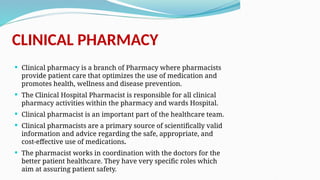
CLINICAL PHARMACY
Clinicalpharmacy is a branch of Pharmacy where pharmacists
provide patient care that optimizes the use of medication and
promotes health, wellness and disease prevention.
The Clinical Hospital Pharmacist is responsible for all clinical
pharmacy activities within the pharmacy and wards Hospital.
Clinical pharmacist is an important part of the healthcare team.
Clinical pharmacists are a primary source of scientifically valid
information and advice regarding the safe, appropriate, and
cost-effective use of medications.
The pharmacist works in coordination with the doctors for the
better patient healthcare. They have very specific roles which
aim at assuring patient safety.
22.
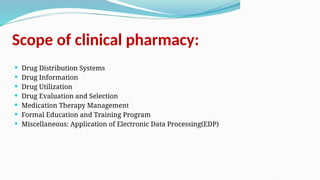
Scope of clinicalpharmacy:
Drug Distribution Systems
Drug Information
Drug Utilization
Drug Evaluation and Selection
Medication Therapy Management
Formal Education and Training Program
Miscellaneous: Application of Electronic Data Processing(EDP)
23.
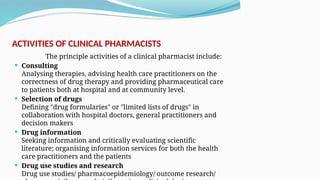
ACTIVITIES OF CLINICALPHARMACISTS
The principle activities of a clinical pharmacist include:
Consulting
Analysing therapies, advising health care practitioners on the
correctness of drug therapy and providing pharmaceutical care
to patients both at hospital and at community level.
Selection of drugs
Defining "drug formularies" or "limited lists of drugs" in
collaboration with hospital doctors, general practitioners and
decision makers
Drug information
Seeking information and critically evaluating scientific
literature; organising information services for both the health
care practitioners and the patients
Drug use studies and research
Drug use studies/ pharmacoepidemiology/ outcome research/
24.
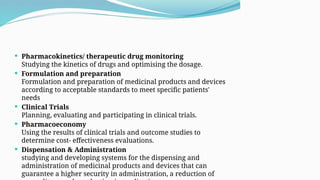
Pharmacokinetics/ therapeuticdrug monitoring
Studying the kinetics of drugs and optimising the dosage.
Formulation and preparation
Formulation and preparation of medicinal products and devices
according to acceptable standards to meet specific patients'
needs
Clinical Trials
Planning, evaluating and participating in clinical trials.
Pharmacoeconomy
Using the results of clinical trials and outcome studies to
determine cost- effectiveness evaluations.
Dispensation & Administration
studying and developing systems for the dispensing and
administration of medicinal products and devices that can
guarantee a higher security in administration, a reduction of
 Most read