Residence and
Tax Liability
Dr. P. Ravichandran
M.Com., M.B.A., M.A (Astrology)., M.Phil., Ph.D.,
D.C.P., D.L.L & A.L., P.G.D.C.A., P.G.D.P.M & I.R.,
S.B.K. College, Aruppukottai – 626101.
 9443424090 & 9080030090
 e-mail id.- prcapk@gmail.com
Person
Legal Status Residential
Status
1. Individual
2. Firm
3. Companies
4. Institution
5. Local Authorities
6. H.U.F.
7. A.O.P.
8. B.O.I.
 After determining the legal status of an Assessee
u/s. 2 (31) the Residential Status of an Assessee is
to be determined.
1. Determined of every PREVIOUS YEAR:
Residential Status is determined for every
previous year. It depends on the number of days
a person is in India during the concerned
previous year.
2. Different terms of Citizenship
An Individual may be a Citizen of Britain, but a
resident in India. In the same way a Citizen of
India may be a non-resident of India.
3. Residential Status is important in deciding whether
Foreign Income of a person is Taxable (or) not.
Residential Status: SEC. 6 (1)
 Tax incidence of an assessee depends on his
residential status.
 For instance, whether an income, accrued to an
individual outside India, is taxable in India
depends upon the residential status of the
individual in India.
 Similarly, whether an income earned by a foreign
national in India (or) outside India is taxable in
India, depends on the residential status of the
individual, rather than on the citizenship.
Therefore, the determination of the residential
status of a person is very significant in order to
find out his tax liability.
Residential Status
Basic Conditions
Stayed in India
182 days (or) more
in the PY (2017-18)
60 days (or) more
in the PY (2017-18)
365 days (or) more
in the 4 PPYs4 PPYs
2016-17
2015-16
2014-15
2013-14
(OR)
AND
Additional Conditions
Stayed in India
At least 2 out of
10 PPYs
730 days (or) more
in the 7 PPYs
Resident in India AND
(This means that the assessee must have satisfied at least one
of the basic condition for 2 years out of 10 PPYs)
Additional conditions [Sec. 6(6)(a)]
 To test as to when a resident individual is
ordinary resident in India (or) not
7PPYs = 2016-17 to 2010-11
Conditions to be satisfied
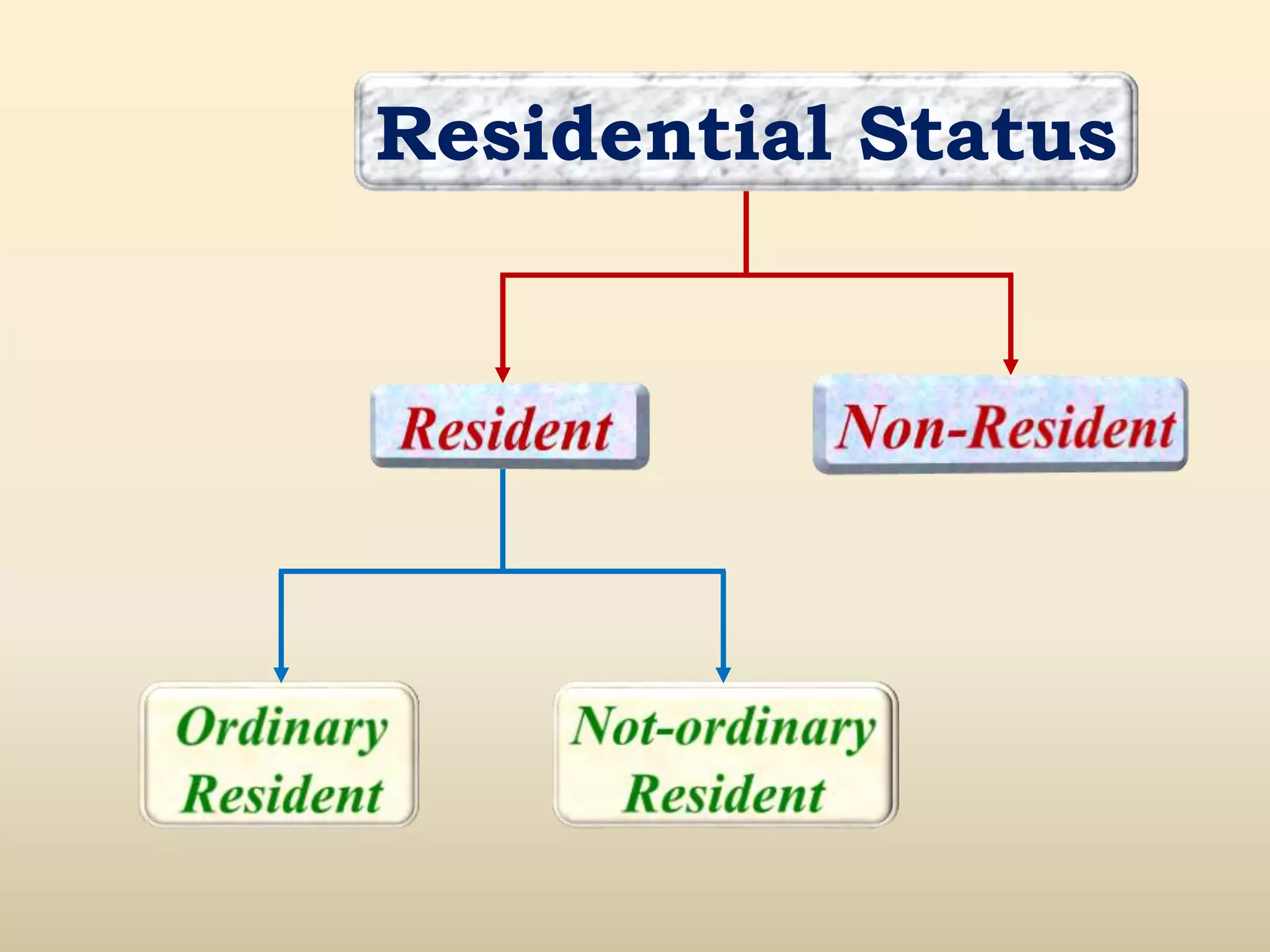
 Resident – Satisfies any one of the basic condition.
 Ordinary Resident – Satisfies any one of the basic
condition and both the additional conditions.
 Not ordinary Resident – Satisfies any one of the
basic condition but does not satisfies one (or)
none of the additional conditions.
 Non-Resident – Does not satisfies any of the
basic conditions.
Residential status in nutshell
Status Basic
condition
Additional
conditions
Resident (R)
Ordinary Resident (OR)
Not Ordinary Resident
(NOR)
Non-Resident (NR)
= Does not satisfies
= Not to consider

 

 = Satisfies
Residential Status of HUF
The residential status of HUF depends upon the control
and management of its affairs.
Resident HUF: If the control and management of the affairs of
HUF is situated wholly or partly in India then HUF is said to
be Resident in India.
Non- Resident HUF: If the control and management of the
affairs of HUF is situated wholly outside India then HUF is
said to be Non- Resident in India.
Not Ordinarily Resident HUF: A resident HUF is said to be
‘Not Ordinarily Resident’ in India if Karta or manager
thereof, satisfies any of the additional conditions u/s 6(6).
Residential Status of Company
According to section 6(3) an Indian
Company is always Resident in India.
A foreign Company will be resident in
India if Control (or) Management of its
affairs is wholly situated in India.
Residential Status of Firm (or) AOP
 Residential Status of a firm or AOP or other person
depends upon control and management of its
affairs.
 Resident: If the control and management of the affairs
of a firm or AOP or other person is situated wholly
or partly in India then such a firm or AOP or other
person is said to be resident in India.
 Non-Resident: If the control and management of the
affairs of a firm or AOP or other person is situated
outside India then such a firm or AOP or other
person is said to be non-resident in India.
Incidence of tax
(Scope of Total Income)
The tax is levied on total income of a person.
The total income is based upon the residential status
of an assessee.
The incidence of tax is –
 highest on Ordinary Resident (OR),
 little lower on Not Ordinary Resident (NOR) and
 lowest on Non-Resident (NR) assessees.
The scope of total income varies on the basis of status.
Scope of income = Indian Income + Foreign Income
 Income earned in India;
 Income accrues and arises in India;
 Income received (or) deemed to be received in India;
 Income payable in India. ( i.e., Income may have been
earned in foreign country but it is payable in India)
 Income earned (or) accrued in India but it is received
(or) payable outside India.
Indian Income
Foreign Income
 Income earned (or) accrued outside India and also
received outside India;
Any income which is not earned (or) accrued or arises
in India.
Ordinary Resident [OR] = Indian income +
Foreign income
 Not Ordinary Resident [NOR]= Indian income
+ One particular type of foreign income
(i.e., business in foreign but controlled from India).
 Non-Resident [NR]= Indian income only
Scope of income to Residents
Rules for determining the scope of total
income and incidence of tax:
Type of Income Ordinary
Resident
Not
Ordinary
Resident
Non
Resident
1. Income received (or) deemed to be received in
India, whether earned in India (or) outside India.
2. Income accrued (or) deemed to accrue in India,
whether received in India (or) outside India.
3. Income received outside India from a business
(or) profession controlled from India.
4. Income received outside India from a business (or)
profession controlled from outside India.
5. Income received outside India from any other
source apart from business.
6. Income earned outside India in earlier years
brought to India in previous year
(Past untaxed profit).
= Not Taxable


 




= Taxable

Residential status

  • 1.
    Residence and Tax Liability Dr.P. Ravichandran M.Com., M.B.A., M.A (Astrology)., M.Phil., Ph.D., D.C.P., D.L.L & A.L., P.G.D.C.A., P.G.D.P.M & I.R., S.B.K. College, Aruppukottai – 626101.  9443424090 & 9080030090  e-mail id.- prcapk@gmail.com
  • 2.
    Person Legal Status Residential Status 1.Individual 2. Firm 3. Companies 4. Institution 5. Local Authorities 6. H.U.F. 7. A.O.P. 8. B.O.I.
  • 3.
     After determiningthe legal status of an Assessee u/s. 2 (31) the Residential Status of an Assessee is to be determined. 1. Determined of every PREVIOUS YEAR: Residential Status is determined for every previous year. It depends on the number of days a person is in India during the concerned previous year. 2. Different terms of Citizenship An Individual may be a Citizen of Britain, but a resident in India. In the same way a Citizen of India may be a non-resident of India. 3. Residential Status is important in deciding whether Foreign Income of a person is Taxable (or) not. Residential Status: SEC. 6 (1)
  • 4.
     Tax incidenceof an assessee depends on his residential status.  For instance, whether an income, accrued to an individual outside India, is taxable in India depends upon the residential status of the individual in India.  Similarly, whether an income earned by a foreign national in India (or) outside India is taxable in India, depends on the residential status of the individual, rather than on the citizenship. Therefore, the determination of the residential status of a person is very significant in order to find out his tax liability.
  • 5.
  • 6.
    Basic Conditions Stayed inIndia 182 days (or) more in the PY (2017-18) 60 days (or) more in the PY (2017-18) 365 days (or) more in the 4 PPYs4 PPYs 2016-17 2015-16 2014-15 2013-14 (OR) AND
  • 7.
    Additional Conditions Stayed inIndia At least 2 out of 10 PPYs 730 days (or) more in the 7 PPYs Resident in India AND (This means that the assessee must have satisfied at least one of the basic condition for 2 years out of 10 PPYs) Additional conditions [Sec. 6(6)(a)]  To test as to when a resident individual is ordinary resident in India (or) not 7PPYs = 2016-17 to 2010-11
  • 8.
    Conditions to besatisfied  Resident – Satisfies any one of the basic condition.  Ordinary Resident – Satisfies any one of the basic condition and both the additional conditions.  Not ordinary Resident – Satisfies any one of the basic condition but does not satisfies one (or) none of the additional conditions.  Non-Resident – Does not satisfies any of the basic conditions.
  • 9.
    Residential status innutshell Status Basic condition Additional conditions Resident (R) Ordinary Resident (OR) Not Ordinary Resident (NOR) Non-Resident (NR) = Does not satisfies = Not to consider      = Satisfies
  • 10.
    Residential Status ofHUF The residential status of HUF depends upon the control and management of its affairs. Resident HUF: If the control and management of the affairs of HUF is situated wholly or partly in India then HUF is said to be Resident in India. Non- Resident HUF: If the control and management of the affairs of HUF is situated wholly outside India then HUF is said to be Non- Resident in India. Not Ordinarily Resident HUF: A resident HUF is said to be ‘Not Ordinarily Resident’ in India if Karta or manager thereof, satisfies any of the additional conditions u/s 6(6).
  • 11.
    Residential Status ofCompany According to section 6(3) an Indian Company is always Resident in India. A foreign Company will be resident in India if Control (or) Management of its affairs is wholly situated in India.
  • 12.
    Residential Status ofFirm (or) AOP  Residential Status of a firm or AOP or other person depends upon control and management of its affairs.  Resident: If the control and management of the affairs of a firm or AOP or other person is situated wholly or partly in India then such a firm or AOP or other person is said to be resident in India.  Non-Resident: If the control and management of the affairs of a firm or AOP or other person is situated outside India then such a firm or AOP or other person is said to be non-resident in India.
  • 13.
    Incidence of tax (Scopeof Total Income) The tax is levied on total income of a person. The total income is based upon the residential status of an assessee. The incidence of tax is –  highest on Ordinary Resident (OR),  little lower on Not Ordinary Resident (NOR) and  lowest on Non-Resident (NR) assessees. The scope of total income varies on the basis of status. Scope of income = Indian Income + Foreign Income
  • 14.
     Income earnedin India;  Income accrues and arises in India;  Income received (or) deemed to be received in India;  Income payable in India. ( i.e., Income may have been earned in foreign country but it is payable in India)  Income earned (or) accrued in India but it is received (or) payable outside India. Indian Income Foreign Income  Income earned (or) accrued outside India and also received outside India; Any income which is not earned (or) accrued or arises in India.
  • 15.
    Ordinary Resident [OR]= Indian income + Foreign income  Not Ordinary Resident [NOR]= Indian income + One particular type of foreign income (i.e., business in foreign but controlled from India).  Non-Resident [NR]= Indian income only Scope of income to Residents
  • 16.
    Rules for determiningthe scope of total income and incidence of tax: Type of Income Ordinary Resident Not Ordinary Resident Non Resident 1. Income received (or) deemed to be received in India, whether earned in India (or) outside India. 2. Income accrued (or) deemed to accrue in India, whether received in India (or) outside India. 3. Income received outside India from a business (or) profession controlled from India. 4. Income received outside India from a business (or) profession controlled from outside India. 5. Income received outside India from any other source apart from business. 6. Income earned outside India in earlier years brought to India in previous year (Past untaxed profit). = Not Taxable         = Taxable