2021
Convertibility
of Indian
Rupee
Classroom Deliberations
CA Dr. Prithvi Ranjan Parhi
1
CA DR Prithvi Ranjan Parhi
703- INTERNATIONAL TRADE AND BUSINESS
MODULE- I
International Trade: Concept, Importance, Benefits of International Trade, international
Marking vs. Domestic Marking (differences).
Theory of International Trade: theory of comparative Cost, factor proportion Theory.
MODULE-II
Multinational corporations (MNCs): Definition, Role of MNCs in International marking.
International Trade barriers: Meaning, tariff and non-Tariff Barriers, Impact of Non-tariff
barriers.
MODULE-III
Organizational and Agreements: WTO (Functions, Principle, agreements), IMF
(Purposes, Facilities Provided by IMF), World Bank (Purpose, Principle, Policies).
MODULE-IV
Foreign Trade of India: Organizational Setup (Autonomous Bodies, Attached and
subordinate offices), Major Export and Imports, Concept of Export House, EXIM Policy
(2002-2007) of India (Features and Objectives of the Policy).
MODULE-V
Foreign Exchange market: Concept, Functions, Methods of international Payment,
concept of Balance of Payment, Concept of Fixed and Flexible Exchange Rate and
Convertibility of Rupee.
CA DR Prithvi Ranjan Parhi 2
Is INR fully convertible?
• Indian rupee is a partially convertible currency.
• Although there is a lot of freedom to exchange
local and foreign currency at market rates, the
Indian rupee is a partially convertible currency,
meaning the exchange of higher amounts is
restricted and still needs approval.
CA DR Prithvi Ranjan Parhi 3
Convertibility of a currency
• Currency convertibility is the ease with which a country's
currency can be converted into gold or another currency.
Convertibility is extremely important for international
commerce.
• When a currency is inconvertible, it poses a risk and barrier to
trade with foreigners who have no need for the domestic
currency.
• Government restrictions can often result in a currency with a
low convertibility.
• For example, a government with low reserves of hard foreign
currency often restrict currency convertibility because the
government would not be in a position to intervene in the
foreign exchange market (i.e. revalue, devalue) to support their
own currency if and when necessary.
4
CA DR Prithvi Ranjan Parhi
Convertibility of Rupee
• Currency convertibility is of two types:
1.Current Account Convertibility
2.Capital Account Convertibility
• Current account convertibility allows free inflows
and outflows for all purposes other than for capital
purposes.
• Capital purpose means dealing the investments in
foreign currency and obtaining loans in foreign
currency, acquiring any plant and machinery from
abroad by making payments in foreign exchange.
5
CA DR Prithvi Ranjan Parhi
Convertibility of Rupee(Indian Experience)
• After the BoP crisis of 1990-91 and change in the central Government, the
Liberalised Exchange Rate Management System (LERMS) was
introduced as a first measure towards making foreign exchange a free
commodity.
• Thus, when LERMs was introduced, there were two exchange rates in India:
Official Rate for select items of exports and imports Market Rate for all
others.
• The Government said that now onwards, anyone who deals in current
account means international trade of goods and services will be able to
convert them to Indian Rupees as follows: 40 % of the receipts at Official
rate 60% of the receipts at Market Rate.
• This means that only part of the current account receipts were made
convertible at market rates and that is why it was called Partial
Convertibility of Rupee on Current Account.
6
CA DR Prithvi Ranjan Parhi
Convertibility of Rupee(Indian Experience)
• Encouraged with the success of the LERMS, the
government introduced the full convertibility of
Rupee in Trade account (means only
merchandise trade no service trade)from March
1993 onwards.
• With this the dual exchange rate system got
automatically abolished and LERMS was now
based upon the open market exchange.
7
CA DR Prithvi Ranjan Parhi
Convertibility of Rupee(Indian Experience)
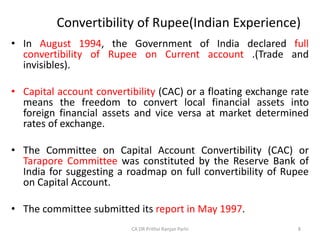
• In August 1994, the Government of India declared full
convertibility of Rupee on Current account .(Trade and
invisibles).
• Capital account convertibility (CAC) or a floating exchange rate
means the freedom to convert local financial assets into
foreign financial assets and vice versa at market determined
rates of exchange.
• The Committee on Capital Account Convertibility (CAC) or
Tarapore Committee was constituted by the Reserve Bank of
India for suggesting a roadmap on full convertibility of Rupee
on Capital Account.
• The committee submitted its report in May 1997.
8
CA DR Prithvi Ranjan Parhi
Convertibility of Rupee (Indian Experience)
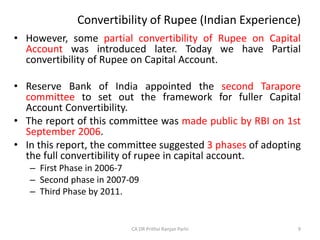
• However, some partial convertibility of Rupee on Capital
Account was introduced later. Today we have Partial
convertibility of Rupee on Capital Account.
• Reserve Bank of India appointed the second Tarapore
committee to set out the framework for fuller Capital
Account Convertibility.
• The report of this committee was made public by RBI on 1st
September 2006.
• In this report, the committee suggested 3 phases of adopting
the full convertibility of rupee in capital account.
– First Phase in 2006-7
– Second phase in 2007-09
– Third Phase by 2011.
9
CA DR Prithvi Ranjan Parhi
Convertibility of Rupee(Indian Experience)
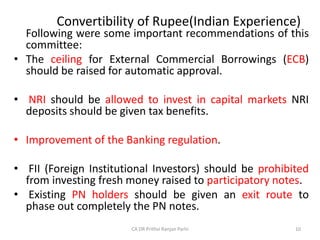
Following were some important recommendations of this
committee:
• The ceiling for External Commercial Borrowings (ECB)
should be raised for automatic approval.
• NRI should be allowed to invest in capital markets NRI
deposits should be given tax benefits.
• Improvement of the Banking regulation.
• FII (Foreign Institutional Investors) should be prohibited
from investing fresh money raised to participatory notes.
• Existing PN holders should be given an exit route to
phase out completely the PN notes.
10
CA DR Prithvi Ranjan Parhi
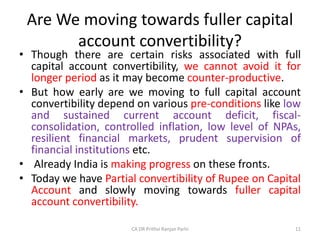
Are We moving towards fuller capital
account convertibility?
• Though there are certain risks associated with full
capital account convertibility, we cannot avoid it for
longer period as it may become counter-productive.
• But how early are we moving to full capital account
convertibility depend on various pre-conditions like low
and sustained current account deficit, fiscal-
consolidation, controlled inflation, low level of NPAs,
resilient financial markets, prudent supervision of
financial institutions etc.
• Already India is making progress on these fronts.
• Today we have Partial convertibility of Rupee on Capital
Account and slowly moving towards fuller capital
account convertibility.
11
CA DR Prithvi Ranjan Parhi
Advantages of Currency Convertibility:
1. Encouragement to exports: ...
2. Encouragement to import substitution: ...
3. Incentive to send remittances from abroad: ...
4. A self – balancing mechanism: ...
5. Specialisation in accordance with
comparative advantage: ...
6. Integration of World Economy:
CA DR Prithvi Ranjan Parhi 12
Thank You
13
CA DR Prithvi Ranjan Parhi

Convertibility of INR

  • 1.
    2021 Convertibility of Indian Rupee Classroom Deliberations CADr. Prithvi Ranjan Parhi 1 CA DR Prithvi Ranjan Parhi
  • 2.
    703- INTERNATIONAL TRADEAND BUSINESS MODULE- I International Trade: Concept, Importance, Benefits of International Trade, international Marking vs. Domestic Marking (differences). Theory of International Trade: theory of comparative Cost, factor proportion Theory. MODULE-II Multinational corporations (MNCs): Definition, Role of MNCs in International marking. International Trade barriers: Meaning, tariff and non-Tariff Barriers, Impact of Non-tariff barriers. MODULE-III Organizational and Agreements: WTO (Functions, Principle, agreements), IMF (Purposes, Facilities Provided by IMF), World Bank (Purpose, Principle, Policies). MODULE-IV Foreign Trade of India: Organizational Setup (Autonomous Bodies, Attached and subordinate offices), Major Export and Imports, Concept of Export House, EXIM Policy (2002-2007) of India (Features and Objectives of the Policy). MODULE-V Foreign Exchange market: Concept, Functions, Methods of international Payment, concept of Balance of Payment, Concept of Fixed and Flexible Exchange Rate and Convertibility of Rupee. CA DR Prithvi Ranjan Parhi 2
  • 3.
    Is INR fullyconvertible? • Indian rupee is a partially convertible currency. • Although there is a lot of freedom to exchange local and foreign currency at market rates, the Indian rupee is a partially convertible currency, meaning the exchange of higher amounts is restricted and still needs approval. CA DR Prithvi Ranjan Parhi 3
  • 4.
    Convertibility of acurrency • Currency convertibility is the ease with which a country's currency can be converted into gold or another currency. Convertibility is extremely important for international commerce. • When a currency is inconvertible, it poses a risk and barrier to trade with foreigners who have no need for the domestic currency. • Government restrictions can often result in a currency with a low convertibility. • For example, a government with low reserves of hard foreign currency often restrict currency convertibility because the government would not be in a position to intervene in the foreign exchange market (i.e. revalue, devalue) to support their own currency if and when necessary. 4 CA DR Prithvi Ranjan Parhi
  • 5.
    Convertibility of Rupee •Currency convertibility is of two types: 1.Current Account Convertibility 2.Capital Account Convertibility • Current account convertibility allows free inflows and outflows for all purposes other than for capital purposes. • Capital purpose means dealing the investments in foreign currency and obtaining loans in foreign currency, acquiring any plant and machinery from abroad by making payments in foreign exchange. 5 CA DR Prithvi Ranjan Parhi
  • 6.
    Convertibility of Rupee(IndianExperience) • After the BoP crisis of 1990-91 and change in the central Government, the Liberalised Exchange Rate Management System (LERMS) was introduced as a first measure towards making foreign exchange a free commodity. • Thus, when LERMs was introduced, there were two exchange rates in India: Official Rate for select items of exports and imports Market Rate for all others. • The Government said that now onwards, anyone who deals in current account means international trade of goods and services will be able to convert them to Indian Rupees as follows: 40 % of the receipts at Official rate 60% of the receipts at Market Rate. • This means that only part of the current account receipts were made convertible at market rates and that is why it was called Partial Convertibility of Rupee on Current Account. 6 CA DR Prithvi Ranjan Parhi
  • 7.
    Convertibility of Rupee(IndianExperience) • Encouraged with the success of the LERMS, the government introduced the full convertibility of Rupee in Trade account (means only merchandise trade no service trade)from March 1993 onwards. • With this the dual exchange rate system got automatically abolished and LERMS was now based upon the open market exchange. 7 CA DR Prithvi Ranjan Parhi
  • 8.
    Convertibility of Rupee(IndianExperience) • In August 1994, the Government of India declared full convertibility of Rupee on Current account .(Trade and invisibles). • Capital account convertibility (CAC) or a floating exchange rate means the freedom to convert local financial assets into foreign financial assets and vice versa at market determined rates of exchange. • The Committee on Capital Account Convertibility (CAC) or Tarapore Committee was constituted by the Reserve Bank of India for suggesting a roadmap on full convertibility of Rupee on Capital Account. • The committee submitted its report in May 1997. 8 CA DR Prithvi Ranjan Parhi
  • 9.
    Convertibility of Rupee(Indian Experience) • However, some partial convertibility of Rupee on Capital Account was introduced later. Today we have Partial convertibility of Rupee on Capital Account. • Reserve Bank of India appointed the second Tarapore committee to set out the framework for fuller Capital Account Convertibility. • The report of this committee was made public by RBI on 1st September 2006. • In this report, the committee suggested 3 phases of adopting the full convertibility of rupee in capital account. – First Phase in 2006-7 – Second phase in 2007-09 – Third Phase by 2011. 9 CA DR Prithvi Ranjan Parhi
  • 10.
    Convertibility of Rupee(IndianExperience) Following were some important recommendations of this committee: • The ceiling for External Commercial Borrowings (ECB) should be raised for automatic approval. • NRI should be allowed to invest in capital markets NRI deposits should be given tax benefits. • Improvement of the Banking regulation. • FII (Foreign Institutional Investors) should be prohibited from investing fresh money raised to participatory notes. • Existing PN holders should be given an exit route to phase out completely the PN notes. 10 CA DR Prithvi Ranjan Parhi
  • 11.
    Are We movingtowards fuller capital account convertibility? • Though there are certain risks associated with full capital account convertibility, we cannot avoid it for longer period as it may become counter-productive. • But how early are we moving to full capital account convertibility depend on various pre-conditions like low and sustained current account deficit, fiscal- consolidation, controlled inflation, low level of NPAs, resilient financial markets, prudent supervision of financial institutions etc. • Already India is making progress on these fronts. • Today we have Partial convertibility of Rupee on Capital Account and slowly moving towards fuller capital account convertibility. 11 CA DR Prithvi Ranjan Parhi
  • 12.
    Advantages of CurrencyConvertibility: 1. Encouragement to exports: ... 2. Encouragement to import substitution: ... 3. Incentive to send remittances from abroad: ... 4. A self – balancing mechanism: ... 5. Specialisation in accordance with comparative advantage: ... 6. Integration of World Economy: CA DR Prithvi Ranjan Parhi 12
  • 13.
    Thank You 13 CA DRPrithvi Ranjan Parhi