Lecture#2
 Course Title: Introduction to Grammar
Course Code:ENG-101
Topic: Noun and its types
 Instructor Ayesha khalik
Nouns
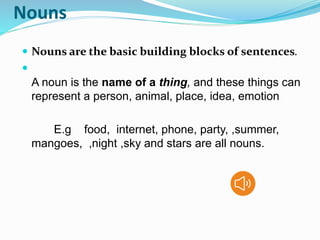
 Nouns are the basic building blocks of sentences.

A noun is the name of a thing, and these things can
represent a person, animal, place, idea, emotion
E.g food, internet, phone, party, ,summer,
mangoes, ,night ,sky and stars are all nouns.
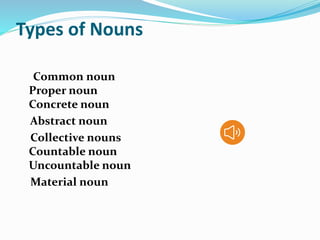
Types of Nouns
Common noun
Proper noun
Concrete noun
Abstract noun
Collective nouns
Countable noun
Uncountable noun
Material noun
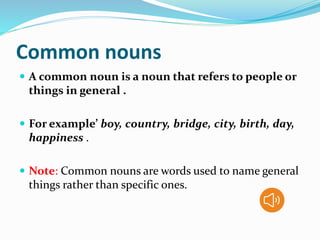
Common nouns
 A common noun is a noun that refers to people or
things in general .
 For example’ boy, country, bridge, city, birth, day,
happiness .
 Note: Common nouns are words used to name general
things rather than specific ones.
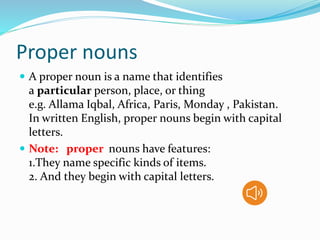
Proper nouns
 A proper noun is a name that identifies
a particular person, place, or thing
e.g. Allama Iqbal, Africa, Paris, Monday , Pakistan.
In written English, proper nouns begin with capital
letters.
 Note: proper nouns have features:
1.They name specific kinds of items.
2. And they begin with capital letters.
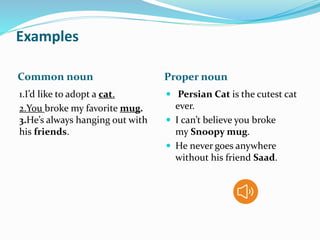
Examples
Common noun Proper noun
1.I’d like to adopt a cat.
2.You broke my favorite mug.
3.He’s always hanging out with
his friends.
 Persian Cat is the cutest cat
ever.
 I can’t believe you broke
my Snoopy mug.
 He never goes anywhere
without his friend Saad.
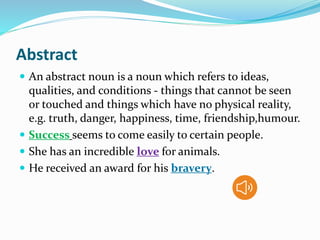
Abstract
 An abstract noun is a noun which refers to ideas,
qualities, and conditions - things that cannot be seen
or touched and things which have no physical reality,
e.g. truth, danger, happiness, time, friendship,humour.
 Success seems to come easily to certain people.
 She has an incredible love for animals.
 He received an award for his bravery.
Concrete Nouns
 A concrete noun is a noun which refers to people and
to things that exist physically and can be seen,
touched, smelled, heard, or tasted. Examples
include Parrot, building, coffee, tree, rain, beach, .In
other words we can say
 Please remember to buy books.
 Have a seat in that chair.
Collective Noun
 Collective nouns refer to groups of people or things,
e.g. audience, family, government, team, jury. In
American English, most collective nouns are treated as
singular, with a singular verb . It can be either singular
or plural, but is usually used as a singular. Examples:
There’s a pack of wolves outside.
 Watch out for that swarm of bees.
 Last night I saw a pride of lions.
Our class graduates two years from now.
Countable and Uncountable
Nouns
Countable Nouns Uncountable Nouns
 countable nouns are
individual people, animals,
places, things, or ideas which
can be counted.
Notice that singular verbs are
used with singular countable
nouns, while plural verbs are
used with plural countable
nouns
 Anything that cannot be
counted is an uncountable
noun.
Uncountable nouns are not
individual objects, so they
cannot be counted. Notice
they are always singular and
one must always use
singular verbs with
uncountable nouns.
Examples
Uncountable Nouns Countable Nouns
 I need some drinking water.
 Have some juice, please
 I need some more milk.
 Bring me a glass of water.
Your book is on the
kitchen table.
How many candles are on
that birthday cake?
Material Noun
 A material noun is a noun that deals with matter or
metal.
 E.g wood ,iron, copper ,gold,silver,etc
 Gold is a precious metal
 Wood floats in water
 Iron sinks in water
 Note; Do not insert ‘The’ before material noun when
used in general sense.
Conclusion
 Noun means name ,therefore ,is the name of
person,place,object,idea etc.it is used as a subject or
object in a sentence .The subject of a sentence causes
an action whereas the object in a sentence is affected
by the action .

introduction to grammar

  • 1.
    Lecture#2  Course Title:Introduction to Grammar Course Code:ENG-101 Topic: Noun and its types  Instructor Ayesha khalik
  • 2.
    Nouns  Nouns arethe basic building blocks of sentences.  A noun is the name of a thing, and these things can represent a person, animal, place, idea, emotion E.g food, internet, phone, party, ,summer, mangoes, ,night ,sky and stars are all nouns.
  • 3.
    Types of Nouns Commonnoun Proper noun Concrete noun Abstract noun Collective nouns Countable noun Uncountable noun Material noun
  • 4.
    Common nouns  Acommon noun is a noun that refers to people or things in general .  For example’ boy, country, bridge, city, birth, day, happiness .  Note: Common nouns are words used to name general things rather than specific ones.
  • 5.
    Proper nouns  Aproper noun is a name that identifies a particular person, place, or thing e.g. Allama Iqbal, Africa, Paris, Monday , Pakistan. In written English, proper nouns begin with capital letters.  Note: proper nouns have features: 1.They name specific kinds of items. 2. And they begin with capital letters.
  • 6.
    Examples Common noun Propernoun 1.I’d like to adopt a cat. 2.You broke my favorite mug. 3.He’s always hanging out with his friends.  Persian Cat is the cutest cat ever.  I can’t believe you broke my Snoopy mug.  He never goes anywhere without his friend Saad.
  • 7.
    Abstract  An abstractnoun is a noun which refers to ideas, qualities, and conditions - things that cannot be seen or touched and things which have no physical reality, e.g. truth, danger, happiness, time, friendship,humour.  Success seems to come easily to certain people.  She has an incredible love for animals.  He received an award for his bravery.
  • 8.
    Concrete Nouns  Aconcrete noun is a noun which refers to people and to things that exist physically and can be seen, touched, smelled, heard, or tasted. Examples include Parrot, building, coffee, tree, rain, beach, .In other words we can say  Please remember to buy books.  Have a seat in that chair.
  • 9.
    Collective Noun  Collectivenouns refer to groups of people or things, e.g. audience, family, government, team, jury. In American English, most collective nouns are treated as singular, with a singular verb . It can be either singular or plural, but is usually used as a singular. Examples: There’s a pack of wolves outside.  Watch out for that swarm of bees.  Last night I saw a pride of lions. Our class graduates two years from now.
  • 10.
    Countable and Uncountable Nouns CountableNouns Uncountable Nouns  countable nouns are individual people, animals, places, things, or ideas which can be counted. Notice that singular verbs are used with singular countable nouns, while plural verbs are used with plural countable nouns  Anything that cannot be counted is an uncountable noun. Uncountable nouns are not individual objects, so they cannot be counted. Notice they are always singular and one must always use singular verbs with uncountable nouns.
  • 11.
    Examples Uncountable Nouns CountableNouns  I need some drinking water.  Have some juice, please  I need some more milk.  Bring me a glass of water. Your book is on the kitchen table. How many candles are on that birthday cake?
  • 12.
    Material Noun  Amaterial noun is a noun that deals with matter or metal.  E.g wood ,iron, copper ,gold,silver,etc  Gold is a precious metal  Wood floats in water  Iron sinks in water  Note; Do not insert ‘The’ before material noun when used in general sense.
  • 13.
    Conclusion  Noun meansname ,therefore ,is the name of person,place,object,idea etc.it is used as a subject or object in a sentence .The subject of a sentence causes an action whereas the object in a sentence is affected by the action .