NOUNS
Submitted By,
SHAGASHRA V S
I - B.Ed (English)
NOUNS
A noun is a word that functions as the
name of a specific object or set of
objects, such as
• living creatures
• Places
• Actions
• Qualities
• states of existence or
• ideas.
DIFFERENT TYPES OF NOUN
• Proper Noun
• Common Noun
• Abstract Noun
• Concrete Noun
• Countable Noun
• Non-countable Noun
• Collective Noun
• Compound Noun
PROPER NOUN
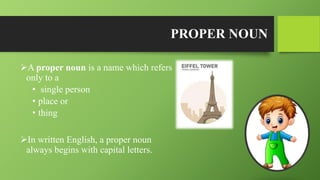
A proper noun is a name which refers
only to a
• single person
• place or
• thing
In written English, a proper noun
always begins with capital letters.
EXAMPLES OF PROPER NOUN
1. William Shakespeare was a playwright ( name of a specific person )
2. I will be visiting New York next month ( name of a specific place )
3. Max was born in South Africa ( name of a specific person & name of a
specific place )
COMMON NOUN
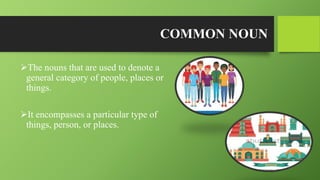
The nouns that are used to denote a
general category of people, places or
things.
It encompasses a particular type of
things, person, or places.
EXAMPLES OF COMMON NOUN
1. I want to be a writer
2. Let us go to the city
3. I think that is a planet, not a star
4. Would you like a cookie?
ABSTRACT NOUN
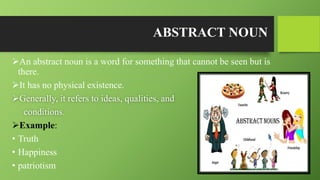
An abstract noun is a word for something that cannot be seen but is
there.
It has no physical existence.
Generally, it refers to ideas, qualities, and
conditions.
Example:
• Truth
• Happiness
• patriotism
EXAMPLES OF ABSTRACT NOUN
1. Truthfulness is a virtue that is rare nowadays.
2. Dishonesty, treachery, infidelity, brutality, pessimism, etc.
are some of the vices.
3. Honesty depends mostly on truthfulness and integrity.
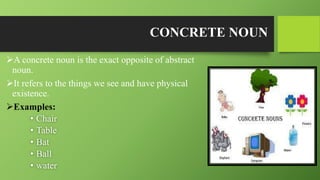
CONCRETE NOUN
A concrete noun is the exact opposite of abstract
noun.
It refers to the things we see and have physical
existence.
Examples:
• Chair
• Table
• Bat
• Ball
• water
EXAMPLES OF CONCRETE NOUN
1. Santi likes to drink coffee
2. Yellow flowers in the red vase are looking very attractive.
3. I enjoy the sunset at the bank of Ganga river in Varanasi.
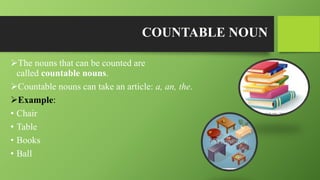
COUNTABLE NOUN
The nouns that can be counted are
called countable nouns.
Countable nouns can take an article: a, an, the.
Example:
• Chair
• Table
• Books
• Ball
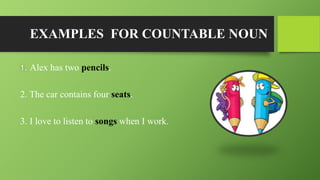
EXAMPLES FOR COUNTABLE NOUN
1. Alex has two pencils.
2. The car contains four seats.
3. I love to listen to songs when I work.
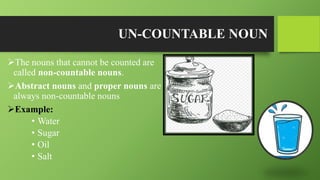
UN-COUNTABLE NOUN
The nouns that cannot be counted are
called non-countable nouns.
Abstract nouns and proper nouns are
always non-countable nouns
Example:
• Water
• Sugar
• Oil
• Salt
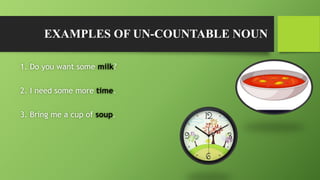
EXAMPLES OF UN-COUNTABLE NOUN
1. Do you want some milk?
2. I need some more time.
3. Bring me a cup of soup.
COLLECTIVE NOUN
A collective noun is a word for a group of
things, people, or animals, etc.
Collective nouns can be both plural and
singular.
Example:
• Family
• Team
• Jury
• Cattle
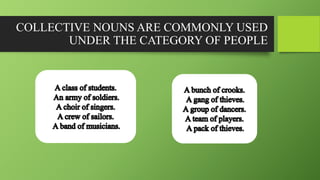
COLLECTIVE NOUNS ARE COMMONLY USED
UNDER THE CATEGORY OF PEOPLE
COLLECTIVE NOUNS USED UNDER THE
CATEGORY OF PEOPLE
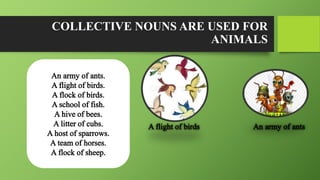
COLLECTIVE NOUNS ARE USED FOR
ANIMALS
COMPOUND NOUN
Sometimes two or three nouns appear together, or even with other parts
of speech, and create idiomatic compound nouns.
Refer to a noun that is made with two or more words. It can be written in
three ways.
Example:
• Six-pack
• Five-year-old and son-in-law
• Snowball
• mailbox
EXAMPLES OF COMPOUND NOUN
1. I love watching fireflies on warm summer nights.
2. Let’s watch the full moon come up over the mountain.
3. Let’s be sure to stay somewhere with a swimming pool.
THANK YOU

Nouns grammar

  • 1.
    NOUNS Submitted By, SHAGASHRA VS I - B.Ed (English)
  • 2.
    NOUNS A noun isa word that functions as the name of a specific object or set of objects, such as • living creatures • Places • Actions • Qualities • states of existence or • ideas.
  • 3.
    DIFFERENT TYPES OFNOUN • Proper Noun • Common Noun • Abstract Noun • Concrete Noun • Countable Noun • Non-countable Noun • Collective Noun • Compound Noun
  • 4.
    PROPER NOUN A propernoun is a name which refers only to a • single person • place or • thing In written English, a proper noun always begins with capital letters.
  • 5.
    EXAMPLES OF PROPERNOUN 1. William Shakespeare was a playwright ( name of a specific person ) 2. I will be visiting New York next month ( name of a specific place ) 3. Max was born in South Africa ( name of a specific person & name of a specific place )
  • 6.
    COMMON NOUN The nounsthat are used to denote a general category of people, places or things. It encompasses a particular type of things, person, or places.
  • 7.
    EXAMPLES OF COMMONNOUN 1. I want to be a writer 2. Let us go to the city 3. I think that is a planet, not a star 4. Would you like a cookie?
  • 8.
    ABSTRACT NOUN An abstractnoun is a word for something that cannot be seen but is there. It has no physical existence. Generally, it refers to ideas, qualities, and conditions. Example: • Truth • Happiness • patriotism
  • 9.
    EXAMPLES OF ABSTRACTNOUN 1. Truthfulness is a virtue that is rare nowadays. 2. Dishonesty, treachery, infidelity, brutality, pessimism, etc. are some of the vices. 3. Honesty depends mostly on truthfulness and integrity.
  • 10.
    CONCRETE NOUN A concretenoun is the exact opposite of abstract noun. It refers to the things we see and have physical existence. Examples: • Chair • Table • Bat • Ball • water
  • 11.
    EXAMPLES OF CONCRETENOUN 1. Santi likes to drink coffee 2. Yellow flowers in the red vase are looking very attractive. 3. I enjoy the sunset at the bank of Ganga river in Varanasi.
  • 12.
    COUNTABLE NOUN The nounsthat can be counted are called countable nouns. Countable nouns can take an article: a, an, the. Example: • Chair • Table • Books • Ball
  • 13.
    EXAMPLES FOR COUNTABLENOUN 1. Alex has two pencils. 2. The car contains four seats. 3. I love to listen to songs when I work.
  • 14.
    UN-COUNTABLE NOUN The nounsthat cannot be counted are called non-countable nouns. Abstract nouns and proper nouns are always non-countable nouns Example: • Water • Sugar • Oil • Salt
  • 15.
    EXAMPLES OF UN-COUNTABLENOUN 1. Do you want some milk? 2. I need some more time. 3. Bring me a cup of soup.
  • 16.
    COLLECTIVE NOUN A collectivenoun is a word for a group of things, people, or animals, etc. Collective nouns can be both plural and singular. Example: • Family • Team • Jury • Cattle
  • 17.
    COLLECTIVE NOUNS ARECOMMONLY USED UNDER THE CATEGORY OF PEOPLE
  • 18.
    COLLECTIVE NOUNS USEDUNDER THE CATEGORY OF PEOPLE
  • 19.
    COLLECTIVE NOUNS AREUSED FOR ANIMALS
  • 20.
    COMPOUND NOUN Sometimes twoor three nouns appear together, or even with other parts of speech, and create idiomatic compound nouns. Refer to a noun that is made with two or more words. It can be written in three ways. Example: • Six-pack • Five-year-old and son-in-law • Snowball • mailbox
  • 21.
    EXAMPLES OF COMPOUNDNOUN 1. I love watching fireflies on warm summer nights. 2. Let’s watch the full moon come up over the mountain. 3. Let’s be sure to stay somewhere with a swimming pool.
  • 22.

Editor's Notes