Nouns
What is a noun?What is a noun?
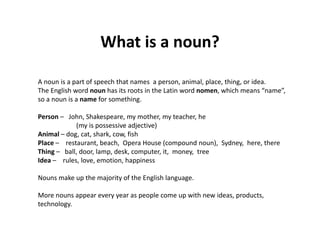
A noun is a part of speech that names  a person, animal, place, thing, or idea. 
The English word noun has its roots in the Latin word nomen, which means “name”, 
so a noun is a name for something. 
Person – John, Shakespeare, my mother, my teacher, he      
(my is possessive adjective)
Animal – dog, cat, shark, cow, fish
Place – restaurant, beach,  Opera House (compound noun),  Sydney,  here, there
Thing – ball, door, lamp, desk, computer, it,  money,  tree
Idea – rules, love, emotion, happiness
Nouns make up the majority of the English language.  
More nouns appear every year as people come up with new ideas, products, 
h ltechnology. 
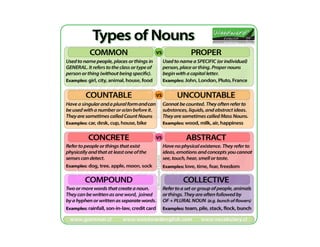
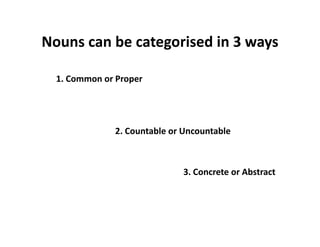
Nouns can be categorised in 3 waysNouns can be categorised in 3 ways
1 C P1. Common or Proper
2. Countable or Uncountable
3 C t Ab t t3. Concrete or Abstract
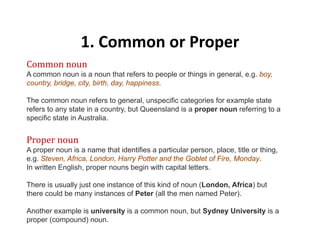
1. Common or Proper1. Common or Proper
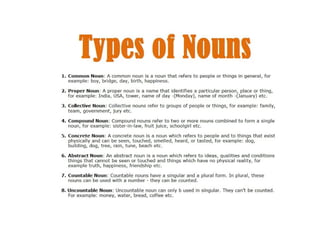
Common noun
A common noun is a noun that refers to people or things in general, e.g. boy,co o ou s a ou a e e s o peop e o gs ge e a , e g boy,
country, bridge, city, birth, day, happiness.
The common noun refers to general, unspecific categories for example state
refers to any state in a country but Queensland is a proper noun referring to arefers to any state in a country, but Queensland is a proper noun referring to a
specific state in Australia.
Proper nounProper noun
A proper noun is a name that identifies a particular person, place, title or thing,
e.g. Steven, Africa, London, Harry Potter and the Goblet of Fire, Monday.
In written English, proper nouns begin with capital letters.g , p p g p
There is usually just one instance of this kind of noun (London, Africa) but
there could be many instances of Peter (all the men named Peter).
Another example is university is a common noun, but Sydney University is a
proper (compound) noun.
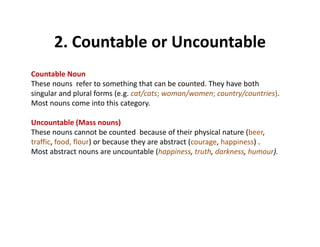
2. Countable or Uncountable2. Countable or Uncountable
Countable Noun 
These nouns  refer to something that can be counted. They have both 
singular and plural forms (e.g. cat/cats; woman/women; country/countries). 
Most nouns come into this category.
Uncountable (Mass nouns)
These nouns cannot be counted  because of their physical nature (beer, 
ff f d fl ) b h b ( h )traffic, food, flour) or because they are abstract (courage, happiness) .   
Most abstract nouns are uncountable (happiness, truth, darkness, humour).
2. Countable or Uncountable continued2. Countable or Uncountable continued 
Some mass nouns can not take plural forms, for example, stuff and clutter. p , p ,
There is a lot of stuff in my room. You don’t say I have a lot of stuffs. 
Substances, liquids and powders are entities that are often described as mass 
nouns such as wood, sand, water, beer, milk and flour. 
Some uncountable nouns can be made countable by using another word to 
i di t tit b ttl f t l f ilk l f f b d k t f flindicate a quantity:   bottle of water, glass of milk, loaf of bread, packet of flour. 
A good test to see if a word is countable or not is to precede with a number, for 
example “2 cats” makes sense (cat is countable) but “2 software” orexample  2 cats  makes sense (cat is countable), but  2 software  or
“2 softwares” does not make sense:
More examples: slang (is a collection of words) and feedback (comments madeMore examples: slang (is a  collection of words) and feedback (comments made 
by people).
2. Countable or Uncountable continued2. Countable or Uncountable continued 
• Uncountable nouns are often treated asUncountable nouns are often treated as 
countable if we are talking about different 
kinds of material liquid etc: Most washingkinds of material, liquid etc: Most washing 
powders are not very kind to your hands.. 
Although powder is an uncountable nounAlthough powder is an uncountable noun, 
here we are talking about different kinds of 
the materialthe material.
2. Countable or Uncountable continued2. Countable or Uncountable continued 
• Some uncountable nouns are plural. They have no 
singular forms with the same meaning, and cannot be 
used with numbers. Common examples are: groceries, 
arms, remains, goods, customs, clothes, thanks, g
regards, police etc.
– The police are searching for a white man in his twenties.
– Have you bought the groceries? (NOT Have you bought theHave you bought the groceries? (NOT Have you bought the 
grocery?)
– Many thanks for your help.
• Some uncountable nouns can be used in the plural as• Some uncountable nouns can be used in the plural as 
well as single, depending on the meaning or context of 
the word.
2. Countable or Uncountable continued 
• Would you like some coffee?y ff
– uncountable because it's referring to the drink in 
general
• He ordered a coffee• He ordered a coffee.
– countable, because it's referring to a cup of coffee
• There's no truth in the rumours.There s no truth in the rumours.
– uncountable, because it refers to the quality or state 
of being true
Th f d t l t th b t h t• The fundamental truths about human nature.
– countable, because it's referring to facts or beliefs 
that are true
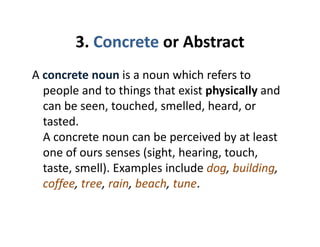
3. Concrete or Abstract3. Concrete or Abstract
A concrete noun is a noun which refers toA concrete noun is a noun which refers to 
people and to things that exist physically and 
can be seen touched smelled heard orcan be seen, touched, smelled, heard, or 
tasted. 
A concrete noun can be perceived by at leastA concrete noun can be perceived by at least 
one of ours senses (sight, hearing, touch, 
taste smell) Examples include dog buildingtaste, smell). Examples include dog, building, 
coffee, tree, rain, beach, tune.
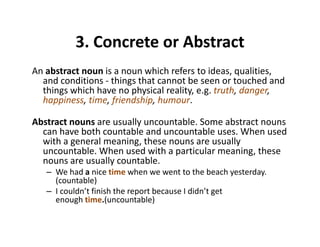
3. Concrete or Abstract3. Concrete or Abstract
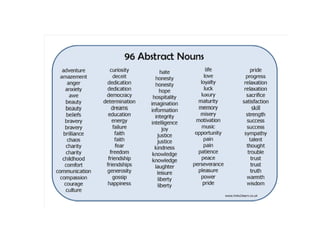
An abstract noun is a noun which refers to ideas, qualities, 
and conditions ‐ things that cannot be seen or touched and 
things which have no physical reality, e.g. truth, danger, 
happiness, time, friendship, humour.
Abstract nouns are usually uncountable. Some abstract nouns 
can have both countable and uncountable uses. When used 
ith l i th llwith a general meaning, these nouns are usually 
uncountable. When used with a particular meaning, these 
nouns are usually countable.
W h d i ti h t t th b h t d– We had a nice time when we went to the beach yesterday. 
(countable)
– I couldn’t finish the report because I didn’t get 
enough time.(uncountable)enough time.(uncountable)
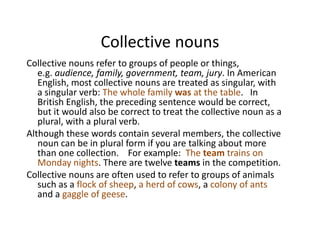
Collective nounsCollective nouns
Collective nouns refer to groups of people or things, 
e.g. audience, family, government, team, jury. In American g , f y, g , , j y
English, most collective nouns are treated as singular, with 
a singular verb: The whole family was at the table.   In 
British English, the preceding sentence would be correct, 
but it would also be correct to treat the collective noun as a 
plural, with a plural verb.
Although these words contain several members, the collective 
noun can be in plural form if you are talking about more 
than one collection.    For example:  The team trains on 
Monday nights. There are twelve teams in the competition.
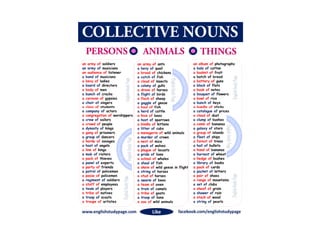
Collective nouns are often used to refer to groups of animals 
such as a flock of sheep, a herd of cows, a colony of ants 
and a gaggle of geese. 
Compound NounsCompound Nouns
A compound noun contains two or more words which p
join together to make a single noun. This is a 
common way of making new names for things. 
Compound nouns can be words written:Compound nouns can be words written:
• together (closed form) such 
as softball and toothpaste
• hyphenated (hyphenated form) such as
six‐pack and son‐in‐law
d ( f ) h• separate words (open form) such as
post office and upper class that go together by 
meaning.g
PronounsPronouns
• Personal pronouns are types of nouns that take the place of 
nouns when referring to people, places or things. The 
personal pronouns in English are I, you, he, she, it, and 
they.
– Amy works at a flower shop. She works at a flower shop.
– The Greeks invented democracy. They invented democracy.
• These pronouns take on other forms depending on what 
type of function they are performing in a sentence. For 
example, when used to signify possession of another noun, 
pronouns take on their possessive form such as mine, ours, 
h d th ihers, and theirs.
• That pizza belongs to Marley. That pizza is hers.
Pronouns (part 2)Pronouns (part 2)
• When used as the object of a prepositionWhen used as the object of a preposition, 
pronouns take on their objective case. 
Examples include him her me us and themExamples include him, her, me, us, and them.
– Hand the money over to Jennifer. Hand the money 
over to her.over to her.
– The police are on to John and Ray. The police are 
on to them.o o e
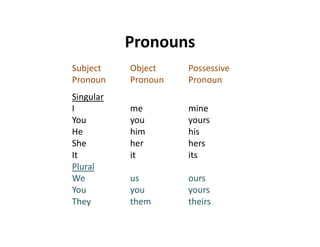
PronounsPronouns
Subject  Object Possessive
P P PPronoun Pronoun Pronoun
Singular
I me mineI me mine
You you yours
He him his
She her hers
It it its
Plural
We us ours
You you yours
They them theirsThey them theirs

Nouns - for English Learners

  • 1.
  • 2.
    What is anoun?What is a noun? A noun is a part of speech that names  a person, animal, place, thing, or idea.  The English word noun has its roots in the Latin word nomen, which means “name”,  so a noun is a name for something.  Person – John, Shakespeare, my mother, my teacher, he       (my is possessive adjective) Animal – dog, cat, shark, cow, fish Place – restaurant, beach,  Opera House (compound noun),  Sydney,  here, there Thing – ball, door, lamp, desk, computer, it,  money,  tree Idea – rules, love, emotion, happiness Nouns make up the majority of the English language.   More nouns appear every year as people come up with new ideas, products,  h ltechnology. 
  • 6.
    Nouns can becategorised in 3 waysNouns can be categorised in 3 ways 1 C P1. Common or Proper 2. Countable or Uncountable 3 C t Ab t t3. Concrete or Abstract
  • 7.
    1. Common orProper1. Common or Proper Common noun A common noun is a noun that refers to people or things in general, e.g. boy,co o ou s a ou a e e s o peop e o gs ge e a , e g boy, country, bridge, city, birth, day, happiness. The common noun refers to general, unspecific categories for example state refers to any state in a country but Queensland is a proper noun referring to arefers to any state in a country, but Queensland is a proper noun referring to a specific state in Australia. Proper nounProper noun A proper noun is a name that identifies a particular person, place, title or thing, e.g. Steven, Africa, London, Harry Potter and the Goblet of Fire, Monday. In written English, proper nouns begin with capital letters.g , p p g p There is usually just one instance of this kind of noun (London, Africa) but there could be many instances of Peter (all the men named Peter). Another example is university is a common noun, but Sydney University is a proper (compound) noun.
  • 8.
    2. Countable orUncountable2. Countable or Uncountable Countable Noun  These nouns  refer to something that can be counted. They have both  singular and plural forms (e.g. cat/cats; woman/women; country/countries).  Most nouns come into this category. Uncountable (Mass nouns) These nouns cannot be counted  because of their physical nature (beer,  ff f d fl ) b h b ( h )traffic, food, flour) or because they are abstract (courage, happiness) .    Most abstract nouns are uncountable (happiness, truth, darkness, humour).
  • 9.
    2. Countable orUncountable continued2. Countable or Uncountable continued  Some mass nouns can not take plural forms, for example, stuff and clutter. p , p , There is a lot of stuff in my room. You don’t say I have a lot of stuffs.  Substances, liquids and powders are entities that are often described as mass  nouns such as wood, sand, water, beer, milk and flour.  Some uncountable nouns can be made countable by using another word to  i di t tit b ttl f t l f ilk l f f b d k t f flindicate a quantity:   bottle of water, glass of milk, loaf of bread, packet of flour.  A good test to see if a word is countable or not is to precede with a number, for  example “2 cats” makes sense (cat is countable) but “2 software” orexample  2 cats  makes sense (cat is countable), but  2 software  or “2 softwares” does not make sense: More examples: slang (is a collection of words) and feedback (comments madeMore examples: slang (is a  collection of words) and feedback (comments made  by people).
  • 10.
    2. Countable orUncountable continued2. Countable or Uncountable continued  • Uncountable nouns are often treated asUncountable nouns are often treated as  countable if we are talking about different  kinds of material liquid etc: Most washingkinds of material, liquid etc: Most washing  powders are not very kind to your hands..  Although powder is an uncountable nounAlthough powder is an uncountable noun,  here we are talking about different kinds of  the materialthe material.
  • 11.
    2. Countable orUncountable continued2. Countable or Uncountable continued  • Some uncountable nouns are plural. They have no  singular forms with the same meaning, and cannot be  used with numbers. Common examples are: groceries,  arms, remains, goods, customs, clothes, thanks, g regards, police etc. – The police are searching for a white man in his twenties. – Have you bought the groceries? (NOT Have you bought theHave you bought the groceries? (NOT Have you bought the  grocery?) – Many thanks for your help. • Some uncountable nouns can be used in the plural as• Some uncountable nouns can be used in the plural as  well as single, depending on the meaning or context of  the word.
  • 12.
    2. Countable or Uncountable continued  • Would you like some coffee?yff – uncountable because it's referring to the drink in  general • He ordered a coffee• He ordered a coffee. – countable, because it's referring to a cup of coffee • There's no truth in the rumours.There s no truth in the rumours. – uncountable, because it refers to the quality or state  of being true Th f d t l t th b t h t• The fundamental truths about human nature. – countable, because it's referring to facts or beliefs  that are true
  • 13.
    3. Concrete orAbstract3. Concrete or Abstract A concrete noun is a noun which refers toA concrete noun is a noun which refers to  people and to things that exist physically and  can be seen touched smelled heard orcan be seen, touched, smelled, heard, or  tasted.  A concrete noun can be perceived by at leastA concrete noun can be perceived by at least  one of ours senses (sight, hearing, touch,  taste smell) Examples include dog buildingtaste, smell). Examples include dog, building,  coffee, tree, rain, beach, tune.
  • 14.
    3. Concrete orAbstract3. Concrete or Abstract An abstract noun is a noun which refers to ideas, qualities,  and conditions ‐ things that cannot be seen or touched and  things which have no physical reality, e.g. truth, danger,  happiness, time, friendship, humour. Abstract nouns are usually uncountable. Some abstract nouns  can have both countable and uncountable uses. When used  ith l i th llwith a general meaning, these nouns are usually  uncountable. When used with a particular meaning, these  nouns are usually countable. W h d i ti h t t th b h t d– We had a nice time when we went to the beach yesterday.  (countable) – I couldn’t finish the report because I didn’t get  enough time.(uncountable)enough time.(uncountable)
  • 16.
    Collective nounsCollective nouns Collective nouns refer to groups of people or things,  e.g. audience, family, government, team, jury. In American g, f y, g , , j y English, most collective nouns are treated as singular, with  a singular verb: The whole family was at the table.   In  British English, the preceding sentence would be correct,  but it would also be correct to treat the collective noun as a  plural, with a plural verb. Although these words contain several members, the collective  noun can be in plural form if you are talking about more  than one collection.    For example:  The team trains on  Monday nights. There are twelve teams in the competition. Collective nouns are often used to refer to groups of animals  such as a flock of sheep, a herd of cows, a colony of ants  and a gaggle of geese. 
  • 19.
    Compound NounsCompound Nouns A compound nouncontains two or more words which p join together to make a single noun. This is a  common way of making new names for things.  Compound nouns can be words written:Compound nouns can be words written: • together (closed form) such  as softball and toothpaste • hyphenated (hyphenated form) such as six‐pack and son‐in‐law d ( f ) h• separate words (open form) such as post office and upper class that go together by  meaning.g
  • 20.
    PronounsPronouns • Personal pronouns are types of nouns that take the place of  nouns when referring to people, places or things. The  personal pronouns in English are I, you, he, she, it, and  they. – Amy works at a flower shop. Sheworks at a flower shop. – The Greeks invented democracy. They invented democracy. • These pronouns take on other forms depending on what  type of function they are performing in a sentence. For  example, when used to signify possession of another noun,  pronouns take on their possessive form such as mine, ours,  h d th ihers, and theirs. • That pizza belongs to Marley. That pizza is hers.
  • 21.
    Pronouns (part 2)Pronouns (part 2) •When used as the object of a prepositionWhen used as the object of a preposition,  pronouns take on their objective case.  Examples include him her me us and themExamples include him, her, me, us, and them. – Hand the money over to Jennifer. Hand the money  over to her.over to her. – The police are on to John and Ray. The police are  on to them.o o e
  • 22.
    PronounsPronouns Subject  Object Possessive PP PPronoun Pronoun Pronoun Singular I me mineI me mine You you yours He him his She her hers It it its Plural We us ours You you yours They them theirsThey them theirs