









ENGLISH FAL:
NOUNS
SYDNEY M. MTHETHWA
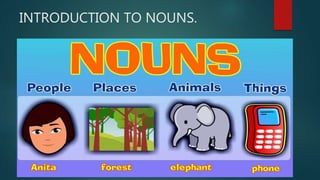
INTRODUCTION TO NOUNS.
WHAT ARE NOUNS ?
 According to Oxford dictionary a
noun refers to a part of speech that
names a person, animals, place,
thing, idea, action or quality.
 In simple terms, nouns are building
blocks of sentences, nouns can be
classified into groups : common or
proper and many others.
 A noun is a word that functions as the
name of a specific object or set of
objects, such as living creatures,
places, actions, qualities, states of
existence, or ideas. However, noun is
not a semantic category, so that it
cannot be characterized in terms of
its meaning.
NOUN DEFINITION CONTINUED…
 Nouns can represent a person, animal, place, idea, emotion – almost any
thing that you can think of. Dog, Sam, love, phone, Chicago, courage and
spaceship are all nouns.
 The more nouns you know in a language, the better you will be able to
communicate your ideas. Here, we’ll take a closer look at what makes a
noun a noun, and we’ll provide some examples of how nouns are used.
Noun examples in the following sentences are in black for easy identification.
 The boy and girl were holding hands as they crossed the bridge on the
way to town.
 I love watching my cat play with the pink yarn.
 It is raining! Everyone, grab your umbrella and rain hat and watch out for
the puddles!
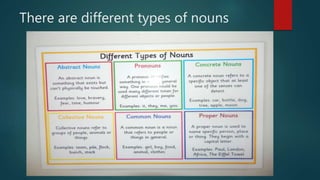
There are different types of nouns
PROPER NOUNS
 Proper nouns have two distinct features: They name specific one-of-a-kind items, and they
begin with capital letters, no matter where they occur within a sentence. Here, we’ll take a
closer look at proper nouns, provide proper noun examples, and help you learn how to use
a proper noun the right way.
 It is easy to use proper nouns, once you know what they are. Simply place them in your
sentences as you would common nouns, ensuring that you capitalize them. Here are some
examples to help you get started.
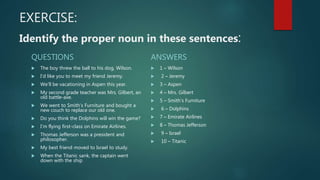
EXERCISE:
Identify the proper noun in these sentences:
QUESTIONS
 The boy threw the ball to his dog, Wilson.
 I’d like you to meet my friend Jeremy.
 We’ll be vacationing in Aspen this year.
 My second grade teacher was Mrs. Gilbert, an
old battle-axe.
 We went to Smith’s Furniture and bought a
new couch to replace our old one.
 Do you think the Dolphins will win the game?
 I’m flying first-class on Emirate Airlines.
 Thomas Jefferson was a president and
philosopher.
 My best friend moved to Israel to study.
 When the Titanic sank, the captain went
down with the ship
ANSWERS
 1 – Wilson
 2 – Jeremy
 3 – Aspen
 4 – Mrs. Gilbert
 5 – Smith’s Furniture
 6 – Dolphins
 7 – Emirate Airlines
 8 – Thomas Jefferson
 9 – Israel
 10 – Titanic
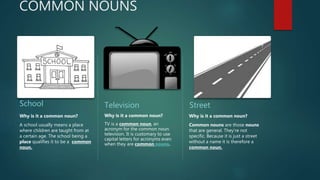
COMMON NOUNS
School
Why is it a common noun?
A school usually means a place
where children are taught from at
a certain age. The school being a
place qualifies it to be a common
noun.
Television
Why is it a common noun?
TV is a common noun, an
acronym for the common noun
television. It is customary to use
capital letters for acronyms even
when they are common nouns.
Street
Why is it a common noun?
Common nouns are those nouns
that are general. They're not
specific. Because it is just a street
without a name it is therefore a
common noun.
EXAMPLES CONTINUED…
 At some point, everyone has the same question: What is a common noun? Here, we will take a look
at common nouns and provide some common noun examples so you can easily recognize common
nouns when you see them.
 In the following sentences, proper noun examples are compared with common nouns. Notice
that the proper nouns are specific and unique, while the common nouns are much more
general in nature.
 Common noun: I want to be a writer. Proper noun: Agatha Christie wrote many books.
 Common noun: I’d like to adopt a cat. Proper noun: Cleopatra is the cutest kitten ever.
 Common noun: Would you like a cookie? Proper noun: I’m craving Oreos.
 Common noun: Let’s go to the city. Proper noun: Let’s go to San Francisco.
 Common noun: My teacher starts work before sunup. Proper noun: Mr. Bell seems to understand
what students need.
 Common noun: I think that’s a planet, not a star. Proper noun: I can see Jupiter tonight.
COLLECTIVE NOUNS
Collective
nouns
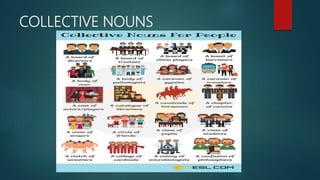
 Collective nouns are names for a collection or a number of people or
things. Words like group, herd, and array are collective noun examples.
Here, we’ll take a closer look at collective nouns, and provide even more
examples, placing them in context so you can gain a greater
understanding of how they work.
 Herd– A group of herbivore animals
 Pack– A group of canine animals such as wolves or dogs; also used to
describe playing cards and packages containing multiple objects
 Flock– A group of birds; also used to discuss small hooved animals such
as sheep or goats
 Swarm– A group of insects
 Shoal– A group of fish
 Group – A very general term used to describe people, places, things,
and animals
 Crowd – Usually used to describe a group of people
 Gang – Usually used to describe a group of criminals; also used to
describe a group of workers, particularly sailors or dock workers
More on collective nouns
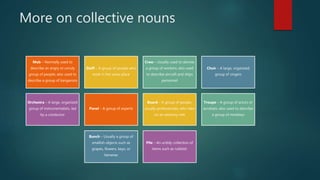
Mob – Normally used to
describe an angry or unruly
group of people; also used to
describe a group of kangaroos
Staff – A group of people who
work in the same place
Crew – Usually used to denote
a group of workers; also used
to describe aircraft and ships
personnel
Choir – A large, organized
group of singers
Orchestra – A large, organized
group of instrumentalists, led
by a conductor
Panel – A group of experts
Board – A group of people,
usually professionals, who take
on an advisory role
Troupe – A group of actors or
acrobats; also used to describe
a group of monkeys
Bunch – Usually a group of
smallish objects such as
grapes, flowers, keys, or
bananas
Pile – An untidy collection of
items such as rubbish
ABSTRACT
NOUNS
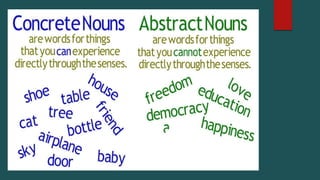
 Abstract nouns are words that name things that are
not concrete. Your five physical senses cannot
detect an abstract noun – you can’t see it, smell it,
taste it, hear it, or touch it. In essence, an abstract
noun is a quality, a concept, an idea, or maybe
even an event.
 Abstract nouns and concrete nouns are usually
defined in terms of one another. Something that is
abstract exists only in the mind, while something
that is concrete can be interacted with in a physical
way. Qualities, relationships, theories, conditions,
and states of being are some examples of the types
of things abstract nouns define.
FEELINGS STATES EMOTIONS QUALITIES CONCEPTS IDEAS EVENTS
Anxiety Being Anger Beauty Charity Beliefs Adventure
Confusion Chaos Despair Beauty Comfort Motivation Birthday
Fear Freedom Happiness Brilliance Culture Curiosity Career
Pain Liberty Hate Courage Deceit Democracy Childhood
Pleasure Luxury Indifference Dedication Energy Friendship Death
Satisfaction Misery Joy Generosity Faith Perseverance Vacation
CONCRETE
NOUNS
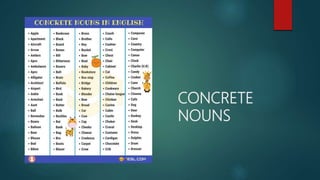
CONCRETE NOUN
 Concrete nouns refers to a noun
denoting something material and
non-abstract, as chair, house, or
automobile.
 The displayed image exemplifies a
concrete noun
SINGULAR NOUNS
The following sentences contain singular nouns examples.
 The boy had a baseball in his hand.
 My horse prefers to wear an English saddle.
 That cat never seems to tire of jumping in and out of the box.
 You stole my idea and didn’t give me any credit.
 Your mom is going to be upset about that broken lamp.
 It’s not difficult to grow a tree as long as you give it plenty of water.
 I can’t believe you let your dog stick his head out the window while you
drive.
PLURAL
NOUNS
The following sentences contain plural noun examples.
 The boys were throwing baseballs back and forth
between bases.
 Our horses are much happier wearing lightweight
English saddles.
 Those cats never seem to tire of chasing one another
in and out of those boxes.
 You stole my ideas and didn’t give me any credit.
 Our moms are going to be upset that we stayed out
all night going to parties.
 It’s not too difficult to grow trees as long as you
provide them with plenty of water.
 I can’t believe you allow your dogs to climb all over
the seats while you are driving.
SINGULAR-
PLURAL
NOUNS
EXERCISES
Transform each of the following words into plurals:
 Day
 Tax
 Taxi
 Lady
 Mountain
Answers 1-5:
 Days
 Taxes
 Taxis
 Ladies
 Mountains
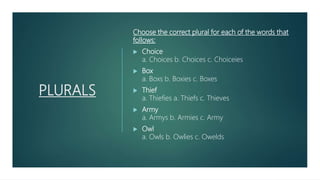
PLURALS
Choose the correct plural for each of the words that
follows:
 Choice
a. Choices b. Choices c. Choiceies
 Box
a. Boxs b. Boxies c. Boxes
 Thief
a. Thiefies a. Thiefs c. Thieves
 Army
a. Armys b. Armies c. Army
 Owl
a. Owls b. Owlies c. Owelds
ANSWERS:
PLURALS
 – a
 – c
 – c
 – b
 – a
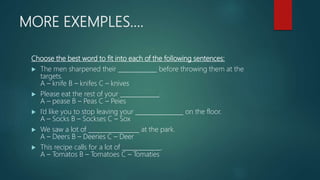
MORE EXEMPLES….
Choose the best word to fit into each of the following sentences:
 The men sharpened their _____________ before throwing them at the
targets.
A – knife B – knifes C – knives
 Please eat the rest of your _____________.
A – pease B – Peas C – Peies
 I’d like you to stop leaving your ________________ on the floor.
A – Socks B – Sockses C – Sox
 We saw a lot of _________________ at the park.
A – Deers B – Deeries C – Deer
 This recipe calls for a lot of _____________.
A – Tomatos B – Tomatoes C – Tomaties
ANSWERS  – C
 – B
 – A
 – C
 – B
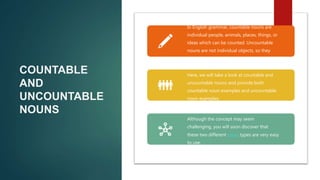
COUNTABLE
AND
UNCOUNTABLE
NOUNS
In English grammar, countable nouns are
individual people, animals, places, things, or
ideas which can be counted. Uncountable
nouns are not individual objects, so they
cannot be counted.
Here, we will take a look at countable and
uncountable nouns and provide both
countable noun examples and uncountable
noun examples.
Although the concept may seem
challenging, you will soon discover that
these two different noun types are very easy
to use.
COUNTABLE ANDUNCOUNTABLE NOUNS

NOUNS

  • 1.
  • 2.
  • 3.
    WHAT ARE NOUNS?  According to Oxford dictionary a noun refers to a part of speech that names a person, animals, place, thing, idea, action or quality.  In simple terms, nouns are building blocks of sentences, nouns can be classified into groups : common or proper and many others.  A noun is a word that functions as the name of a specific object or set of objects, such as living creatures, places, actions, qualities, states of existence, or ideas. However, noun is not a semantic category, so that it cannot be characterized in terms of its meaning.
  • 4.
    NOUN DEFINITION CONTINUED… Nouns can represent a person, animal, place, idea, emotion – almost any thing that you can think of. Dog, Sam, love, phone, Chicago, courage and spaceship are all nouns.  The more nouns you know in a language, the better you will be able to communicate your ideas. Here, we’ll take a closer look at what makes a noun a noun, and we’ll provide some examples of how nouns are used. Noun examples in the following sentences are in black for easy identification.  The boy and girl were holding hands as they crossed the bridge on the way to town.  I love watching my cat play with the pink yarn.  It is raining! Everyone, grab your umbrella and rain hat and watch out for the puddles!
  • 5.
    There are differenttypes of nouns
  • 6.
    PROPER NOUNS  Propernouns have two distinct features: They name specific one-of-a-kind items, and they begin with capital letters, no matter where they occur within a sentence. Here, we’ll take a closer look at proper nouns, provide proper noun examples, and help you learn how to use a proper noun the right way.  It is easy to use proper nouns, once you know what they are. Simply place them in your sentences as you would common nouns, ensuring that you capitalize them. Here are some examples to help you get started.
  • 7.
    EXERCISE: Identify the propernoun in these sentences: QUESTIONS  The boy threw the ball to his dog, Wilson.  I’d like you to meet my friend Jeremy.  We’ll be vacationing in Aspen this year.  My second grade teacher was Mrs. Gilbert, an old battle-axe.  We went to Smith’s Furniture and bought a new couch to replace our old one.  Do you think the Dolphins will win the game?  I’m flying first-class on Emirate Airlines.  Thomas Jefferson was a president and philosopher.  My best friend moved to Israel to study.  When the Titanic sank, the captain went down with the ship ANSWERS  1 – Wilson  2 – Jeremy  3 – Aspen  4 – Mrs. Gilbert  5 – Smith’s Furniture  6 – Dolphins  7 – Emirate Airlines  8 – Thomas Jefferson  9 – Israel  10 – Titanic
  • 8.
    COMMON NOUNS School Why isit a common noun? A school usually means a place where children are taught from at a certain age. The school being a place qualifies it to be a common noun. Television Why is it a common noun? TV is a common noun, an acronym for the common noun television. It is customary to use capital letters for acronyms even when they are common nouns. Street Why is it a common noun? Common nouns are those nouns that are general. They're not specific. Because it is just a street without a name it is therefore a common noun.
  • 9.
    EXAMPLES CONTINUED…  Atsome point, everyone has the same question: What is a common noun? Here, we will take a look at common nouns and provide some common noun examples so you can easily recognize common nouns when you see them.  In the following sentences, proper noun examples are compared with common nouns. Notice that the proper nouns are specific and unique, while the common nouns are much more general in nature.  Common noun: I want to be a writer. Proper noun: Agatha Christie wrote many books.  Common noun: I’d like to adopt a cat. Proper noun: Cleopatra is the cutest kitten ever.  Common noun: Would you like a cookie? Proper noun: I’m craving Oreos.  Common noun: Let’s go to the city. Proper noun: Let’s go to San Francisco.  Common noun: My teacher starts work before sunup. Proper noun: Mr. Bell seems to understand what students need.  Common noun: I think that’s a planet, not a star. Proper noun: I can see Jupiter tonight.
  • 10.
  • 11.
    Collective nouns  Collective nounsare names for a collection or a number of people or things. Words like group, herd, and array are collective noun examples. Here, we’ll take a closer look at collective nouns, and provide even more examples, placing them in context so you can gain a greater understanding of how they work.  Herd– A group of herbivore animals  Pack– A group of canine animals such as wolves or dogs; also used to describe playing cards and packages containing multiple objects  Flock– A group of birds; also used to discuss small hooved animals such as sheep or goats  Swarm– A group of insects  Shoal– A group of fish  Group – A very general term used to describe people, places, things, and animals  Crowd – Usually used to describe a group of people  Gang – Usually used to describe a group of criminals; also used to describe a group of workers, particularly sailors or dock workers
  • 12.
    More on collectivenouns Mob – Normally used to describe an angry or unruly group of people; also used to describe a group of kangaroos Staff – A group of people who work in the same place Crew – Usually used to denote a group of workers; also used to describe aircraft and ships personnel Choir – A large, organized group of singers Orchestra – A large, organized group of instrumentalists, led by a conductor Panel – A group of experts Board – A group of people, usually professionals, who take on an advisory role Troupe – A group of actors or acrobats; also used to describe a group of monkeys Bunch – Usually a group of smallish objects such as grapes, flowers, keys, or bananas Pile – An untidy collection of items such as rubbish
  • 13.
    ABSTRACT NOUNS  Abstract nounsare words that name things that are not concrete. Your five physical senses cannot detect an abstract noun – you can’t see it, smell it, taste it, hear it, or touch it. In essence, an abstract noun is a quality, a concept, an idea, or maybe even an event.  Abstract nouns and concrete nouns are usually defined in terms of one another. Something that is abstract exists only in the mind, while something that is concrete can be interacted with in a physical way. Qualities, relationships, theories, conditions, and states of being are some examples of the types of things abstract nouns define.
  • 14.
    FEELINGS STATES EMOTIONSQUALITIES CONCEPTS IDEAS EVENTS Anxiety Being Anger Beauty Charity Beliefs Adventure Confusion Chaos Despair Beauty Comfort Motivation Birthday Fear Freedom Happiness Brilliance Culture Curiosity Career Pain Liberty Hate Courage Deceit Democracy Childhood Pleasure Luxury Indifference Dedication Energy Friendship Death Satisfaction Misery Joy Generosity Faith Perseverance Vacation
  • 16.
  • 17.
    CONCRETE NOUN  Concretenouns refers to a noun denoting something material and non-abstract, as chair, house, or automobile.  The displayed image exemplifies a concrete noun
  • 18.
    SINGULAR NOUNS The followingsentences contain singular nouns examples.  The boy had a baseball in his hand.  My horse prefers to wear an English saddle.  That cat never seems to tire of jumping in and out of the box.  You stole my idea and didn’t give me any credit.  Your mom is going to be upset about that broken lamp.  It’s not difficult to grow a tree as long as you give it plenty of water.  I can’t believe you let your dog stick his head out the window while you drive.
  • 19.
    PLURAL NOUNS The following sentencescontain plural noun examples.  The boys were throwing baseballs back and forth between bases.  Our horses are much happier wearing lightweight English saddles.  Those cats never seem to tire of chasing one another in and out of those boxes.  You stole my ideas and didn’t give me any credit.  Our moms are going to be upset that we stayed out all night going to parties.  It’s not too difficult to grow trees as long as you provide them with plenty of water.  I can’t believe you allow your dogs to climb all over the seats while you are driving.
  • 20.
    SINGULAR- PLURAL NOUNS EXERCISES Transform each ofthe following words into plurals:  Day  Tax  Taxi  Lady  Mountain Answers 1-5:  Days  Taxes  Taxis  Ladies  Mountains
  • 21.
    PLURALS Choose the correctplural for each of the words that follows:  Choice a. Choices b. Choices c. Choiceies  Box a. Boxs b. Boxies c. Boxes  Thief a. Thiefies a. Thiefs c. Thieves  Army a. Armys b. Armies c. Army  Owl a. Owls b. Owlies c. Owelds
  • 22.
    ANSWERS: PLURALS  – a – c  – c  – b  – a
  • 23.
    MORE EXEMPLES…. Choose thebest word to fit into each of the following sentences:  The men sharpened their _____________ before throwing them at the targets. A – knife B – knifes C – knives  Please eat the rest of your _____________. A – pease B – Peas C – Peies  I’d like you to stop leaving your ________________ on the floor. A – Socks B – Sockses C – Sox  We saw a lot of _________________ at the park. A – Deers B – Deeries C – Deer  This recipe calls for a lot of _____________. A – Tomatos B – Tomatoes C – Tomaties
  • 24.
    ANSWERS  –C  – B  – A  – C  – B
  • 25.
    COUNTABLE AND UNCOUNTABLE NOUNS In English grammar,countable nouns are individual people, animals, places, things, or ideas which can be counted. Uncountable nouns are not individual objects, so they cannot be counted. Here, we will take a look at countable and uncountable nouns and provide both countable noun examples and uncountable noun examples. Although the concept may seem challenging, you will soon discover that these two different noun types are very easy to use.
  • 26.