SALIVARY GLANDS
AND
THEIR SECRETION
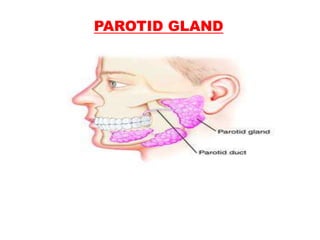
PAROTID GLAND
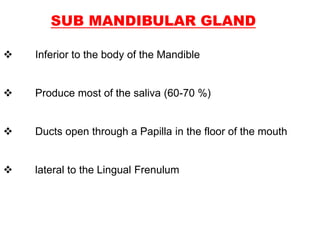
SUB MANDIBULAR GLAND
 Inferior to the body of the Mandible
 Produce most of the saliva (60-70 %)
 Ducts open through a Papilla in the floor of the mouth
 lateral to the Lingual Frenulum
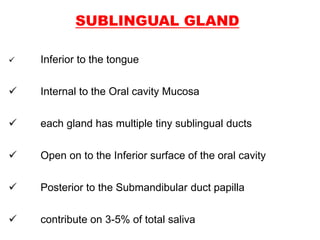
SUBLINGUAL GLAND
 Inferior to the tongue
 Internal to the Oral cavity Mucosa
 each gland has multiple tiny sublingual ducts
 Open on to the Inferior surface of the oral cavity
 Posterior to the Submandibular duct papilla
 contribute on 3-5% of total saliva
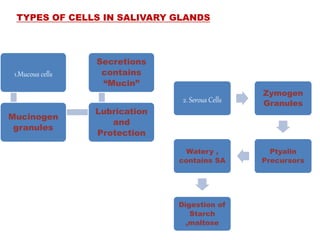
TYPES OF CELLS IN SALIVARY GLANDS
1.Mucous cells
Mucinogen
granules
Lubrication
and
Protection
Secretions
contains
“Mucin”
2. Serous Cells
Zymogen
Granules
Ptyalin
Precursors
Watery ,
contains SA
Digestion of
Starch
,maltose
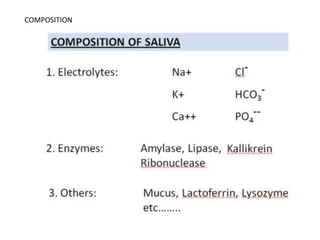
COMPOSITION
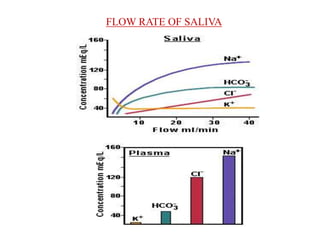
FLOW RATE OF SALIVA
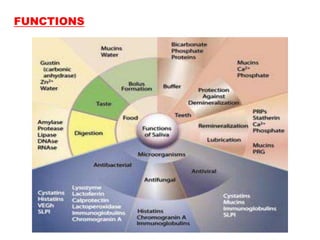
FUNCTIONS
MECHANISM OF FORMATION OF SALIVA
1. Primary secretion
2. Modification of saliva
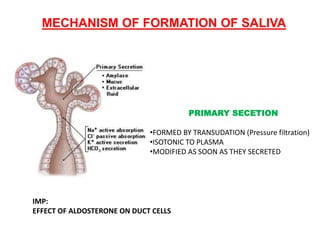
MECHANISM OF FORMATION OF SALIVA
PRIMARY SECETION
•FORMED BY TRANSUDATION (Pressure filtration)
•ISOTONIC TO PLASMA
•MODIFIED AS SOON AS THEY SECRETED
IMP:
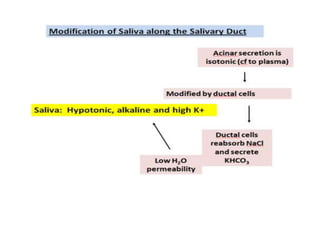
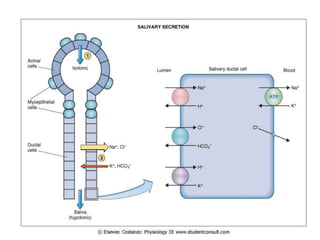
EFFECT OF ALDOSTERONE ON DUCT CELLS
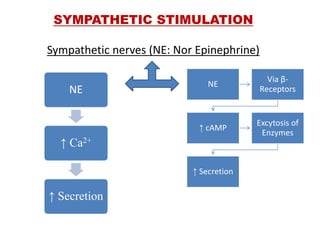
SYMPATHETIC STIMULATION
Sympathetic nerves (NE: Nor Epinephrine)
NE
Via β-
Receptors
↑ cAMP
Excytosis of
Enzymes
↑ Secretion
NE
↑ Ca2+
↑ Secretion
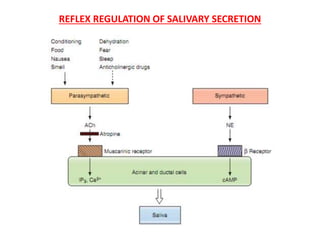
REFLEX REGULATION OF SALIVARY SECRETION
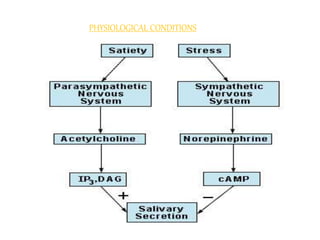
PHYSIOLOGICAL CONDITIONS
CEPHALIC PHASE SECRETION OF SALIVA BEFORE
ENTRY OF FOOD
CONDITIONAL REFLEX
BUCCAL PHASE PRESENCE OF FOOD IN THE
MOUTH [(+) BUCCAL
RECEPTORS]
UNCONDITIONAL REFLEX&
PARTIALLY REGULATED BY
APETITE CENTRE
OESOPHAGEAL PHASE PASSING OF FOOD THROUGH
OESOPHAGUS
STIMULATION OF SALIVARY
GLANDS
GASTRIC PHASE PRESENCE OF FOOD IN
STOMACH
IRRITANT FOODS IN
STOMACH (VOMITING)
INTESTINAL PHASE FOOD IN INTESTINE IRRITANT FOOD IN UPPER
INTESTINE
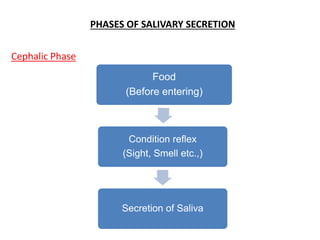
PHASES OF SALIVARY SECRETION
Cephalic Phase
Food
(Before entering)
Condition reflex
(Sight, Smell etc.,)
Secretion of Saliva
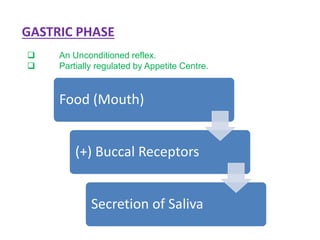
GASTRIC PHASE
Food (Mouth)
(+) Buccal Receptors
Secretion of Saliva
 An Unconditioned reflex.
 Partially regulated by Appetite Centre.
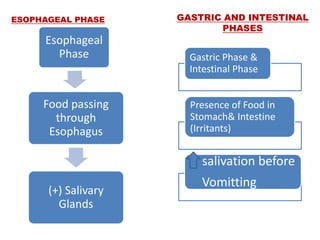
Esophageal
Phase
Food passing
through
Esophagus
(+) Salivary
Glands
Gastric Phase &
Intestinal Phase
Presence of Food in
Stomach& Intestine
(Irritants)
salivation before
Vomitting
ESOPHAGEAL PHASE GASTRIC AND INTESTINAL
PHASES
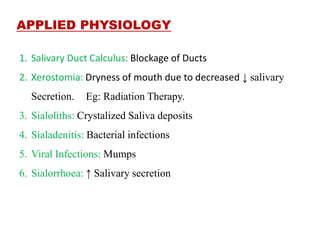
APPLIED PHYSIOLOGY
1. Salivary Duct Calculus: Blockage of Ducts
2. Xerostomia: Dryness of mouth due to decreased ↓ salivary
Secretion. Eg: Radiation Therapy.
3. Sialoliths: Crystalized Saliva deposits
4. Sialadenitis: Bacterial infections
5. Viral Infections: Mumps
6. Sialorrhoea: ↑ Salivary secretion

Salivary secretion

  • 1.
  • 3.
  • 4.
    SUB MANDIBULAR GLAND Inferior to the body of the Mandible  Produce most of the saliva (60-70 %)  Ducts open through a Papilla in the floor of the mouth  lateral to the Lingual Frenulum
  • 5.
    SUBLINGUAL GLAND  Inferiorto the tongue  Internal to the Oral cavity Mucosa  each gland has multiple tiny sublingual ducts  Open on to the Inferior surface of the oral cavity  Posterior to the Submandibular duct papilla  contribute on 3-5% of total saliva
  • 8.
    TYPES OF CELLSIN SALIVARY GLANDS 1.Mucous cells Mucinogen granules Lubrication and Protection Secretions contains “Mucin” 2. Serous Cells Zymogen Granules Ptyalin Precursors Watery , contains SA Digestion of Starch ,maltose
  • 10.
  • 11.
  • 12.
  • 13.
    MECHANISM OF FORMATIONOF SALIVA 1. Primary secretion 2. Modification of saliva
  • 14.
    MECHANISM OF FORMATIONOF SALIVA PRIMARY SECETION •FORMED BY TRANSUDATION (Pressure filtration) •ISOTONIC TO PLASMA •MODIFIED AS SOON AS THEY SECRETED IMP: EFFECT OF ALDOSTERONE ON DUCT CELLS
  • 17.
    SYMPATHETIC STIMULATION Sympathetic nerves(NE: Nor Epinephrine) NE Via β- Receptors ↑ cAMP Excytosis of Enzymes ↑ Secretion NE ↑ Ca2+ ↑ Secretion
  • 18.
    REFLEX REGULATION OFSALIVARY SECRETION
  • 19.
  • 20.
    CEPHALIC PHASE SECRETIONOF SALIVA BEFORE ENTRY OF FOOD CONDITIONAL REFLEX BUCCAL PHASE PRESENCE OF FOOD IN THE MOUTH [(+) BUCCAL RECEPTORS] UNCONDITIONAL REFLEX& PARTIALLY REGULATED BY APETITE CENTRE OESOPHAGEAL PHASE PASSING OF FOOD THROUGH OESOPHAGUS STIMULATION OF SALIVARY GLANDS GASTRIC PHASE PRESENCE OF FOOD IN STOMACH IRRITANT FOODS IN STOMACH (VOMITING) INTESTINAL PHASE FOOD IN INTESTINE IRRITANT FOOD IN UPPER INTESTINE PHASES OF SALIVARY SECRETION
  • 21.
    PHASES OF SALIVARYSECRETION Cephalic Phase Food (Before entering) Condition reflex (Sight, Smell etc.,) Secretion of Saliva
  • 22.
    GASTRIC PHASE Food (Mouth) (+)Buccal Receptors Secretion of Saliva  An Unconditioned reflex.  Partially regulated by Appetite Centre.
  • 23.
    Esophageal Phase Food passing through Esophagus (+) Salivary Glands GastricPhase & Intestinal Phase Presence of Food in Stomach& Intestine (Irritants) salivation before Vomitting ESOPHAGEAL PHASE GASTRIC AND INTESTINAL PHASES
  • 24.
    APPLIED PHYSIOLOGY 1. SalivaryDuct Calculus: Blockage of Ducts 2. Xerostomia: Dryness of mouth due to decreased ↓ salivary Secretion. Eg: Radiation Therapy. 3. Sialoliths: Crystalized Saliva deposits 4. Sialadenitis: Bacterial infections 5. Viral Infections: Mumps 6. Sialorrhoea: ↑ Salivary secretion