FINANCIAL FORECASTING
- is an essential component of
planning. It serves as a basis for
budgeting and for estimating future
financing requirements.
INTERNAL FINANCING –
- refers to cash flow generated by the
business enterprise’s normal operating
business.
EXTERNAL FINANCING –
- refers to capital provided by parties
outside the business enterprise, such as
investors and banks.
Steps in projecting a business
enterprise’s financing needs are:
1. Project the business enterprise’s sales.
2. Project additional variables, such as
expenses.
3. Estimate the level of investment in current
and plant assets
4. Calculate the business enterprise’s financing
needs.
PERCENT-OF-SALES METHOD
- The most widely used method for projecting
the business enterprise’s financing needs.
- This methods requires financial planners to
estimate future expenses, assets, and
liabilities as a percent of sales for that
period.
Present year retained earnings
= previous year retained earnings plus
projected net income less cash dividends paid.
External financing needed
= projected total assets less the sum of
projected total liabilities and projected equity
External funds needed
= required increase in assets less spontaneous
increase in liabilities less increase in retained
earnings.
BUDGET
-Represents a business enterprise’s annual
financial plan.
- A comprehensive (master) budget is a
formal statement of management’s
expectation for sales, expenses, volume, and
other financial transactions for the coming
period
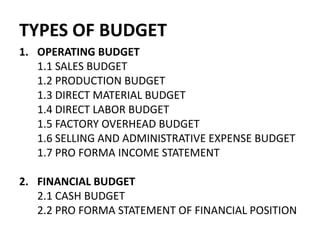
TYPES OF BUDGET
1. OPERATING BUDGET
1.1 SALES BUDGET
1.2 PRODUCTION BUDGET
1.3 DIRECT MATERIAL BUDGET
1.4 DIRECT LABOR BUDGET
1.5 FACTORY OVERHEAD BUDGET
1.6 SELLING AND ADMINISTRATIVE EXPENSE BUDGET
1.7 PRO FORMA INCOME STATEMENT
2. FINANCIAL BUDGET
2.1 CASH BUDGET
2.2 PRO FORMA STATEMENT OF FINANCIAL POSITION
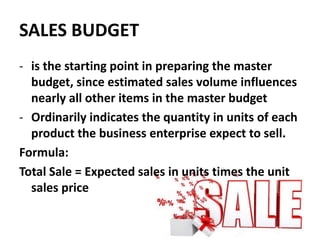
SALES BUDGET
- is the starting point in preparing the master
budget, since estimated sales volume influences
nearly all other items in the master budget
- Ordinarily indicates the quantity in units of each
product the business enterprise expect to sell.
Formula:
Total Sale = Expected sales in units times the unit
sales price
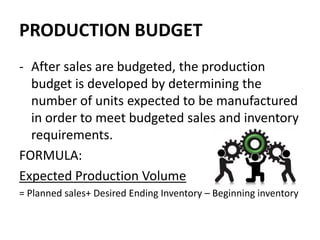
PRODUCTION BUDGET
- After sales are budgeted, the production
budget is developed by determining the
number of units expected to be manufactured
in order to meet budgeted sales and inventory
requirements.
FORMULA:
Expected Production Volume
= Planned sales+ Desired Ending Inventory – Beginning inventory
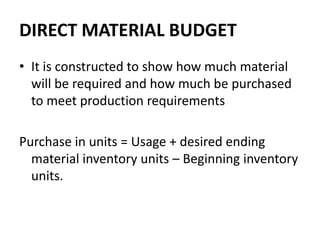
DIRECT MATERIAL BUDGET
• It is constructed to show how much material
will be required and how much be purchased
to meet production requirements
Purchase in units = Usage + desired ending
material inventory units – Beginning inventory
units.
DIRECT LABOR BUDGET
The production requirements in the production
budget provide the starting point for the
preparation of the direct labor budget.
To compute direct labor requirements, multiply
expected production volume for each period
by number of direct labor hours required to
produce a single unit. The result is then
multiplied by the direct labor cost per hour to
obtain budgeted total direct labor costs.
THE FACTORY OVERHEAD BUDGET
-It provides a schedule of all manufacturing
costs other than direct materials and direct
labor, such as depreciation, property taxes,
and factory rent.
THE ENDING INVENTORY BUDGET
- It provides the information required for the
construction of budgeted financial
statements.
- It help compute the cost of good sold on the
budgeted income statement and the peso
value of the ending materials and finished
goods inventory that appears on the
budgeted statement of financial position.
THE SELLING AND ADMINISTRATIVE
EXPENSE BUDGET
- It lists the operating expenses incurred in
selling the products and in managing the
business.
THE CASH BUDGET
- It helps managers anticipate the expected cash
inflow and outflow for a designated time
period, keep cash balances in reasonable
relationship to needs, and avoid both
unnecessarily idle cash and possible cash
shortages
4 Major Sections of Cash Budget
1. Receipts Section – including the beginning cash
balance, cash collections from customers, and other
receipts
2. Disbursement section – comprising all cash payments
that are planned during the budget period.
3. Cash Surplus or deficit section – which shows the
difference between the cash receipts section and the
cash disbursements section
4. The financing portion – which provides a detailed
account of the of the borrowings and repayments
expected during the budgeting period.
THE BUDGETED INCOME STATEMENT
- It summarizes projections for the various
components of revenue and expenses for the
budgeting period.
Formula:
Sales less variable costs less fixed costs.

Chapter 6 financial forecasting and budgeting

  • 2.
    FINANCIAL FORECASTING - isan essential component of planning. It serves as a basis for budgeting and for estimating future financing requirements.
  • 3.
    INTERNAL FINANCING – -refers to cash flow generated by the business enterprise’s normal operating business. EXTERNAL FINANCING – - refers to capital provided by parties outside the business enterprise, such as investors and banks.
  • 4.
    Steps in projectinga business enterprise’s financing needs are: 1. Project the business enterprise’s sales. 2. Project additional variables, such as expenses. 3. Estimate the level of investment in current and plant assets 4. Calculate the business enterprise’s financing needs.
  • 5.
    PERCENT-OF-SALES METHOD - Themost widely used method for projecting the business enterprise’s financing needs. - This methods requires financial planners to estimate future expenses, assets, and liabilities as a percent of sales for that period.
  • 6.
    Present year retainedearnings = previous year retained earnings plus projected net income less cash dividends paid. External financing needed = projected total assets less the sum of projected total liabilities and projected equity External funds needed = required increase in assets less spontaneous increase in liabilities less increase in retained earnings.
  • 7.
    BUDGET -Represents a businessenterprise’s annual financial plan. - A comprehensive (master) budget is a formal statement of management’s expectation for sales, expenses, volume, and other financial transactions for the coming period
  • 8.
    TYPES OF BUDGET 1.OPERATING BUDGET 1.1 SALES BUDGET 1.2 PRODUCTION BUDGET 1.3 DIRECT MATERIAL BUDGET 1.4 DIRECT LABOR BUDGET 1.5 FACTORY OVERHEAD BUDGET 1.6 SELLING AND ADMINISTRATIVE EXPENSE BUDGET 1.7 PRO FORMA INCOME STATEMENT 2. FINANCIAL BUDGET 2.1 CASH BUDGET 2.2 PRO FORMA STATEMENT OF FINANCIAL POSITION
  • 9.
    SALES BUDGET - isthe starting point in preparing the master budget, since estimated sales volume influences nearly all other items in the master budget - Ordinarily indicates the quantity in units of each product the business enterprise expect to sell. Formula: Total Sale = Expected sales in units times the unit sales price
  • 10.
    PRODUCTION BUDGET - Aftersales are budgeted, the production budget is developed by determining the number of units expected to be manufactured in order to meet budgeted sales and inventory requirements. FORMULA: Expected Production Volume = Planned sales+ Desired Ending Inventory – Beginning inventory
  • 11.
    DIRECT MATERIAL BUDGET •It is constructed to show how much material will be required and how much be purchased to meet production requirements Purchase in units = Usage + desired ending material inventory units – Beginning inventory units.
  • 12.
    DIRECT LABOR BUDGET Theproduction requirements in the production budget provide the starting point for the preparation of the direct labor budget. To compute direct labor requirements, multiply expected production volume for each period by number of direct labor hours required to produce a single unit. The result is then multiplied by the direct labor cost per hour to obtain budgeted total direct labor costs.
  • 13.
    THE FACTORY OVERHEADBUDGET -It provides a schedule of all manufacturing costs other than direct materials and direct labor, such as depreciation, property taxes, and factory rent.
  • 14.
    THE ENDING INVENTORYBUDGET - It provides the information required for the construction of budgeted financial statements. - It help compute the cost of good sold on the budgeted income statement and the peso value of the ending materials and finished goods inventory that appears on the budgeted statement of financial position.
  • 15.
    THE SELLING ANDADMINISTRATIVE EXPENSE BUDGET - It lists the operating expenses incurred in selling the products and in managing the business.
  • 16.
    THE CASH BUDGET -It helps managers anticipate the expected cash inflow and outflow for a designated time period, keep cash balances in reasonable relationship to needs, and avoid both unnecessarily idle cash and possible cash shortages
  • 17.
    4 Major Sectionsof Cash Budget 1. Receipts Section – including the beginning cash balance, cash collections from customers, and other receipts 2. Disbursement section – comprising all cash payments that are planned during the budget period. 3. Cash Surplus or deficit section – which shows the difference between the cash receipts section and the cash disbursements section 4. The financing portion – which provides a detailed account of the of the borrowings and repayments expected during the budgeting period.
  • 18.
    THE BUDGETED INCOMESTATEMENT - It summarizes projections for the various components of revenue and expenses for the budgeting period. Formula: Sales less variable costs less fixed costs.