DISASTER MANAGEMENT
Name-Arjun singh
Class- 9
Sec-B
Roll no-09
Definition of disaster management
What disaster management?
Disaster management is how
we deal with the human,
material, economic or
environmental impacts of
said disaster, it is the process
of how we “prepare for,
respond to and learn from the
effects of major failures”.
Though often caused by
nature, disasters can have
human origins.
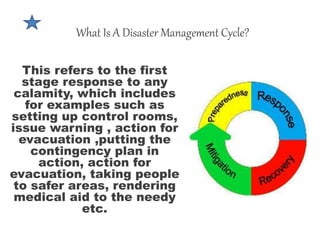
What Is A Disaster Management Cycle?
This refers to the first
stage response to any
calamity, which includes
for examples such as
setting up control rooms,
issue warning , action for
evacuation ,putting the
contingency plan in
action, action for
evacuation, taking people
to safer areas, rendering
medical aid to the needy
etc.
What is vulnerability and risk?
Vulnerability describes the characteristics and
circumstances of a community, system or asset that make it
susceptible to the damaging effects of a hazard. There are
many aspects of vulnerability, arising from various physical,
social, economic, and environmental factors.
Examples may include:
1)poor design and construction of buildings,
2)inadequate protection of assets,
Risk (or more specifically, disaster risk) is the potential
disaster losses (in terms of lives, health status, livelihoods,
assets and services) which could occur to a particular
community or a society over some specified future time
period.
It considers the probability of harmful consequences, or
expected losses (deaths, injuries, property, livelihoods,
economic activity disrupted or environmentally damaged)
resulting from interactions between natural or human induced
hazards and vulnerable conditions.
Differentiate Between Hazard And Disaster?
Hazard
Hazard is an event
that has potential for
causing injury/ loss of
life or damage to
property/environment.
Disaster
Disaster is an event that
occurs
suddenly/unexpectedly in
most cases and disrupts
the normal course of life in
affected area. It results in
loss or damage to life,
property or environment.
Physical, Chemical And Biological Hazards.
Physical Hazards
A physical hazard is an
agent, factor or
circumstance that can
cause harm with
contact. They can be
classified as type of
occupational hazard or
environmental hazard.
Physical hazards include
ergonomic hazards,
radiation, heat and cold
stress, vibration hazards,
and noise hazards.
Chemical Hazards
A chemical hazard is a
substance that has the
potential to cause harm
to life or health.
Chemicals are widely
used in the home and in
many other places.
Exposure to chemicals
can cause acute or long-
term detrimental health
effects.
Biological hazards
A biological hazard, or
biohazard, is a biological
substance that poses a threat
to the health of living
organisms, primarily humans.
This could include a sample of
a microorganism, virus or
toxin that can adversely affect
human health. A biohazard
could also be a substance
harmful to other animals.
Types of disasters
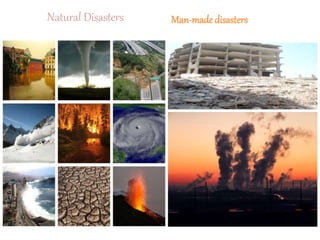
1)Natural Disasters-Natural Disasters are catastrophic events that
result from any of the Earth's natural phenomena.
Eg:-Floods, earthquakes, storms.
What causes natural Disasters?
Natural disasters are caused due to different reasons like soil
erosion, seismic activity, tectonic movements, air pressure, and
ocean currents etc.
2)Man-Made Disasters-Man-made disasters have an element of
human intent, negligence, or error involving a failure of a man-made
system, as opposed to natural disasters resulting from natural
hazards.
Eg:-chemical spills ,nuclear blast, hazardous material spills
What causes man-made Disasters?
Examples include war , Human-instigated disasters are the
consequence of technological or human hazards. social unrest,
stampedes, fires, transport accidents.
Natural Disasters Man-made disasters
Prevention And Mitigation From Fire (High Rise Building)
Prevention: High-rise buildings should have Smoke
Detectors, Sprinklers, First Aid Fire Fighting
system, PA system, Adequate water supply, Fire
pumps, Fire escape routes, Fireman Lift, Service
shaft enclosures, compact mentation, approved
electrical system, refuse area etc.
Mitigation: Never use elevators. Always use
emergency stairs. Use wet blanket to cover
yourself. Use wet handkerchief as a mask.
Open all doors and windows(if possible). Lay
down to prevent smoke. DON’T TAKE RISK.
What a emergency Kit should have in a disaster
Emergency kit is very important during
disaster you should have first aid and many
more things.
First aid kit is very important and you should
always have some extra medicines, Band-Aids,
antibiotic ointment, hand sanitizers, etc. in
your emergency kit. Tools: You should always
carry tools like candles, scissors, flashlight,
extra batteries, a knife, etc.
THANK YOU!

class 9 ARJUN SINGH DISASTER MANAGEMENT.pptx

  • 1.
  • 2.
    Definition of disastermanagement What disaster management? Disaster management is how we deal with the human, material, economic or environmental impacts of said disaster, it is the process of how we “prepare for, respond to and learn from the effects of major failures”. Though often caused by nature, disasters can have human origins.
  • 3.
    What Is ADisaster Management Cycle? This refers to the first stage response to any calamity, which includes for examples such as setting up control rooms, issue warning , action for evacuation ,putting the contingency plan in action, action for evacuation, taking people to safer areas, rendering medical aid to the needy etc.
  • 4.
    What is vulnerabilityand risk? Vulnerability describes the characteristics and circumstances of a community, system or asset that make it susceptible to the damaging effects of a hazard. There are many aspects of vulnerability, arising from various physical, social, economic, and environmental factors. Examples may include: 1)poor design and construction of buildings, 2)inadequate protection of assets, Risk (or more specifically, disaster risk) is the potential disaster losses (in terms of lives, health status, livelihoods, assets and services) which could occur to a particular community or a society over some specified future time period. It considers the probability of harmful consequences, or expected losses (deaths, injuries, property, livelihoods, economic activity disrupted or environmentally damaged) resulting from interactions between natural or human induced hazards and vulnerable conditions.
  • 5.
    Differentiate Between HazardAnd Disaster? Hazard Hazard is an event that has potential for causing injury/ loss of life or damage to property/environment. Disaster Disaster is an event that occurs suddenly/unexpectedly in most cases and disrupts the normal course of life in affected area. It results in loss or damage to life, property or environment.
  • 6.
    Physical, Chemical AndBiological Hazards. Physical Hazards A physical hazard is an agent, factor or circumstance that can cause harm with contact. They can be classified as type of occupational hazard or environmental hazard. Physical hazards include ergonomic hazards, radiation, heat and cold stress, vibration hazards, and noise hazards. Chemical Hazards A chemical hazard is a substance that has the potential to cause harm to life or health. Chemicals are widely used in the home and in many other places. Exposure to chemicals can cause acute or long- term detrimental health effects. Biological hazards A biological hazard, or biohazard, is a biological substance that poses a threat to the health of living organisms, primarily humans. This could include a sample of a microorganism, virus or toxin that can adversely affect human health. A biohazard could also be a substance harmful to other animals.
  • 7.
    Types of disasters 1)NaturalDisasters-Natural Disasters are catastrophic events that result from any of the Earth's natural phenomena. Eg:-Floods, earthquakes, storms. What causes natural Disasters? Natural disasters are caused due to different reasons like soil erosion, seismic activity, tectonic movements, air pressure, and ocean currents etc. 2)Man-Made Disasters-Man-made disasters have an element of human intent, negligence, or error involving a failure of a man-made system, as opposed to natural disasters resulting from natural hazards. Eg:-chemical spills ,nuclear blast, hazardous material spills What causes man-made Disasters? Examples include war , Human-instigated disasters are the consequence of technological or human hazards. social unrest, stampedes, fires, transport accidents.
  • 8.
  • 9.
    Prevention And MitigationFrom Fire (High Rise Building) Prevention: High-rise buildings should have Smoke Detectors, Sprinklers, First Aid Fire Fighting system, PA system, Adequate water supply, Fire pumps, Fire escape routes, Fireman Lift, Service shaft enclosures, compact mentation, approved electrical system, refuse area etc. Mitigation: Never use elevators. Always use emergency stairs. Use wet blanket to cover yourself. Use wet handkerchief as a mask. Open all doors and windows(if possible). Lay down to prevent smoke. DON’T TAKE RISK.
  • 10.
    What a emergencyKit should have in a disaster Emergency kit is very important during disaster you should have first aid and many more things. First aid kit is very important and you should always have some extra medicines, Band-Aids, antibiotic ointment, hand sanitizers, etc. in your emergency kit. Tools: You should always carry tools like candles, scissors, flashlight, extra batteries, a knife, etc.
  • 11.