Sustainable management of
Natural resources
- Jadeja Namrataba
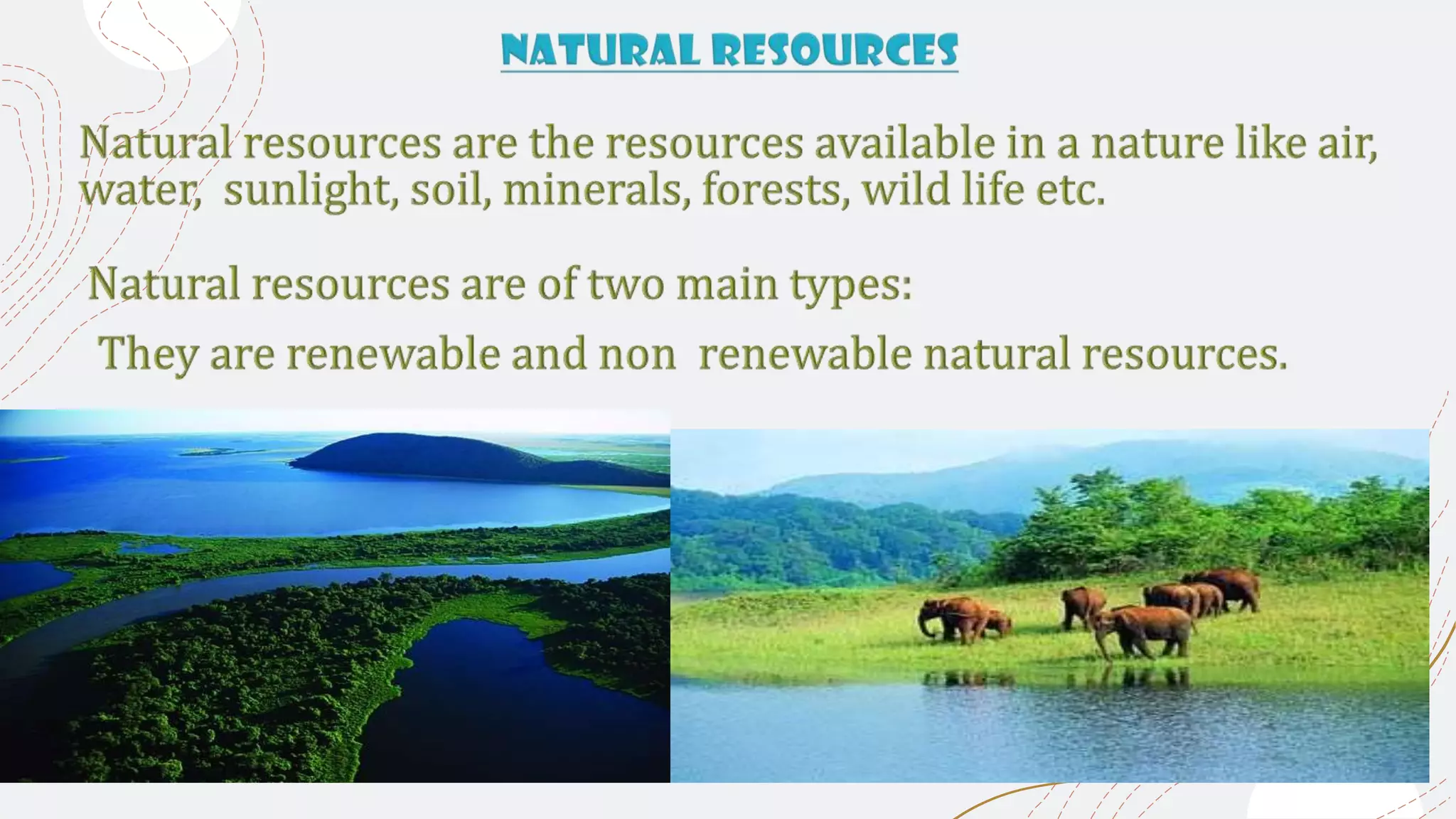
NATURAL RESOURCES
Renewable natural resources
Resources which can be replenished in a short period of time
like air, water, sunlight, forests etc.
Non renewable natural resources
Resources which cannot be replenished in a short period of
time like minerals (coal, petroleum, natural gas, metals etc.)
because they take millions of years to be formed.
Human activities produce a lot of waste materials which are
thrown away into the environment. These wastes cause
pollution of natural resources like air, water and soil.
The Ganga is the largest river in India with an extraordinaryreligious importance
for Hindus .It runs over 2500 km from Gangotri in the Himalayas to Ganga Sagar in
the Bay of Bengal. Along its banks are some of the world's oldest inhabited places
like Varanasi and Patna. It provides water to about 40% of India's population in 11
states. In modern times, In 1985 because the quality of the water in Ganga so
government started multicore project GANGA ACTION PLAN. Ganga in modern times,
it is known for being very polluted.
An estimated 2.9 billion liters or more of human sewage is discharged into
the Ganges daily.
The Ganges river basin is one of the most fertile and densely populated
regions in the world and covers an area of 1,080,000 km2.
The river flows through 29 cities with population over 100,000; 23 cities
with population between 50,000 and 100,000, and about 48 towns.
A large proportion of the waste in the Ganges is from this population
through domestic usage like bathing, laundry and public
defecation.
GANGA ACTION PLAN
Ganga Action Plan : Multi Crore Project came in 1985 to improve the
quality of Gang a Contamination of river water is indicated by the
presence of coliform fa group of bacteria found in human intestine) and
acidic water.
1993-94 Total Coliform(MPN/l00ml)
 Minimum found in Rishikesh 600-6s0 MPN/100ni1
 Minimum desired level 4S0MPN/100ml
 Maximum found in kannauj1400MPN/l00nil
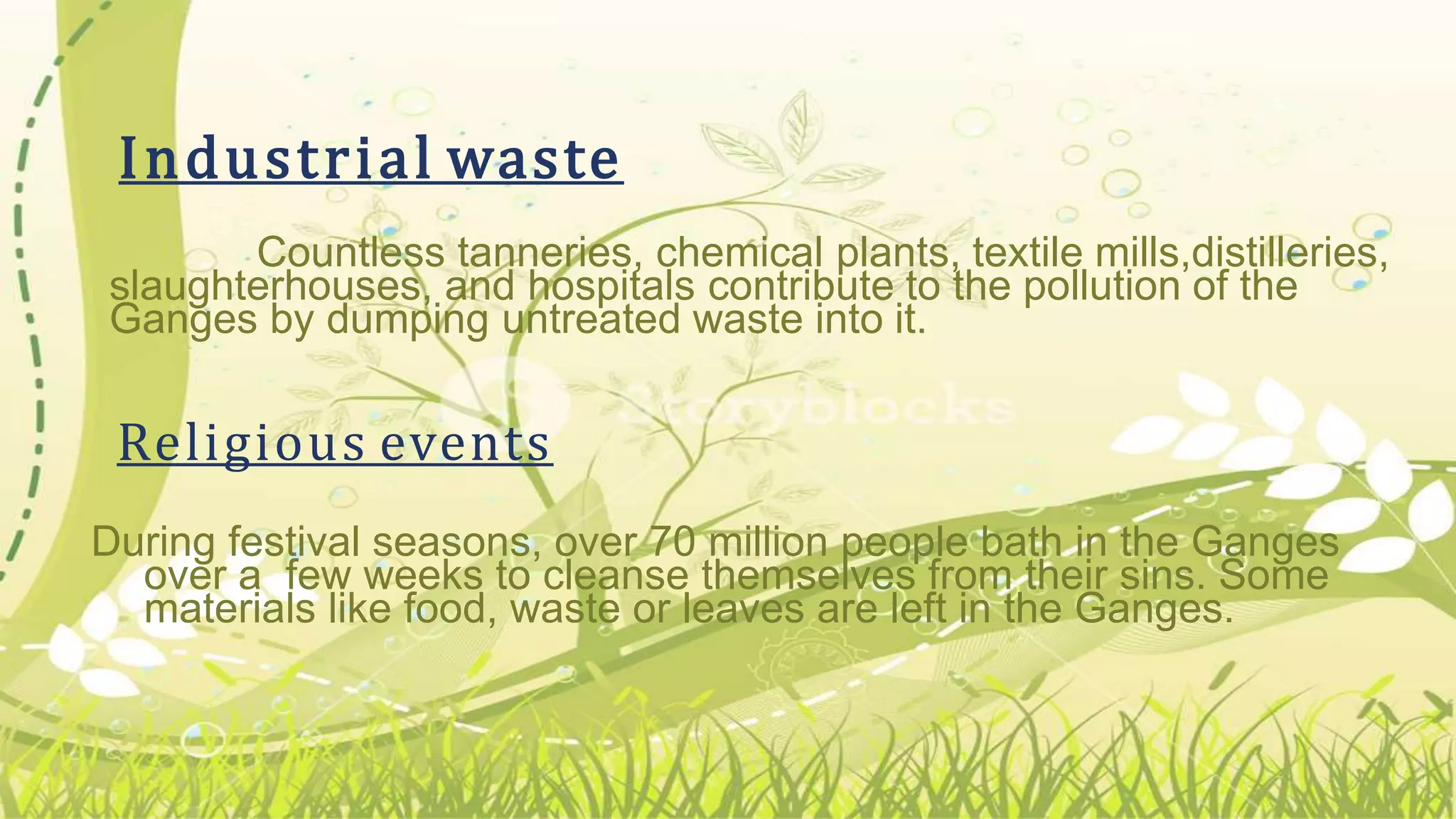
Countless tanneries, chemical plants, textile mills,distilleries,
slaughterhouses, and hospitals contribute to the pollution of the
Ganges by dumping untreated waste into it.
Religious events
During festival seasons, over 70 million people bath in the Ganges
over a few weeks to cleanse themselves from their sins. Some
materials like food, waste or leaves are left in the Ganges.
Industrial waste
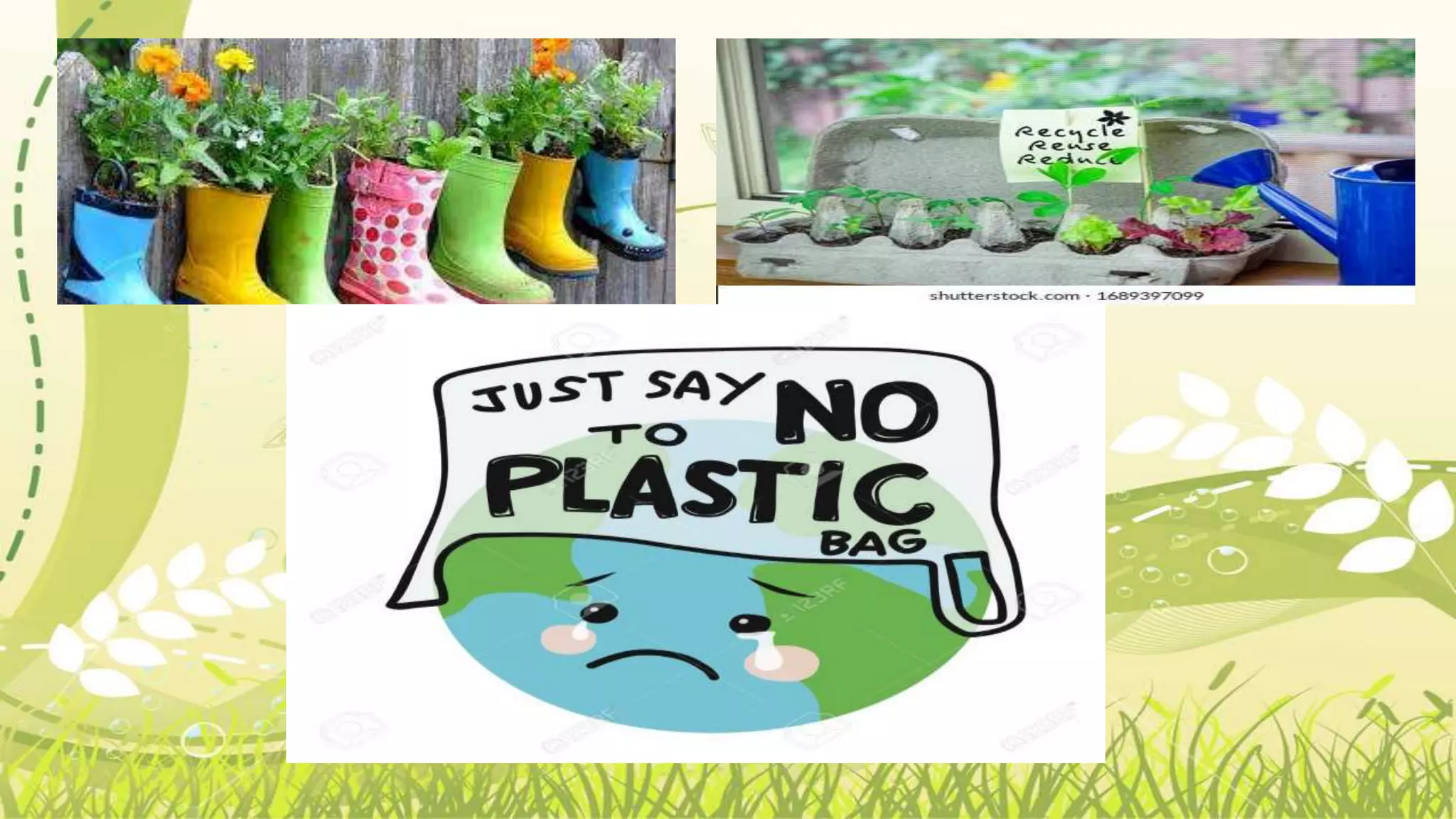
The five R’s to save the environment :-
The five R’s to save the environment are refuse ,Reduce, Recycle,
Reuse and repurpose .
i) Reduce :- means using less of natural resources and avoiding
wastage of natural resources.
ii) Recycle :- means the materials like paper, plastic, glass, metals
etc. used for making things can again be used for making new things
instead of synthesising or extracting new paper, plastic, glass or
metals.
iii) Reuse :- means using things again and again like the plastic bottles
in which we buy jams, pickles etc can be again used for storing things in the kitchen.
Iv) Refuse :- This is actually even better than recycling because the
process of recycling uses some energy. In the ‘reuse’ strategy, you simply
use things again and again. Instead of throwing away used envelopes,
you can reverse it and use it again. The plastic bottles in which you buy
various food-items like jam or pickle can be used for storing things in
the kitchen. What other items can we reuse?
v) Repurpose: -
This means when a product can no more be used for the original
purpose, think carefully and use it for some other useful purpose. For
example, cracked crockery, or cups with broken handles can be used to
grow small plants and as feeding vessels for birds.
Need for management of natural resources :-
All the things we use and consume are obtained from natural resources. Due to
increase in population, industrialisation and urbanisation the demand for natural
resources is increasing and their availability is limited . So there is a need for
proper management of natural resources.
The proper management of natural resources consists of :-
i) Judicious use of natural resources and avoiding wastage of natural resources.
ii) Long term planning for the use of natural resources so that it last not only for
the present but also for future generations.
iii) The exploitation of natural resources should not be for the benefit of a few
people but should be distributed equally for all.
iv) While extracting and using natural resources we should also plan for the safe
disposal of wastes so that no damage is caused to the environment.
Need for management of natural resources :-
The management of natural resources requires:
1. a long-term perspective so that these will last for the generations to
come and will not merely be exploited to the hilt for short term gains.
2. This management should also ensure equitable distribution of
resources so that all, and not just a handful of rich and powerful
people, benefit from the development of these resources.
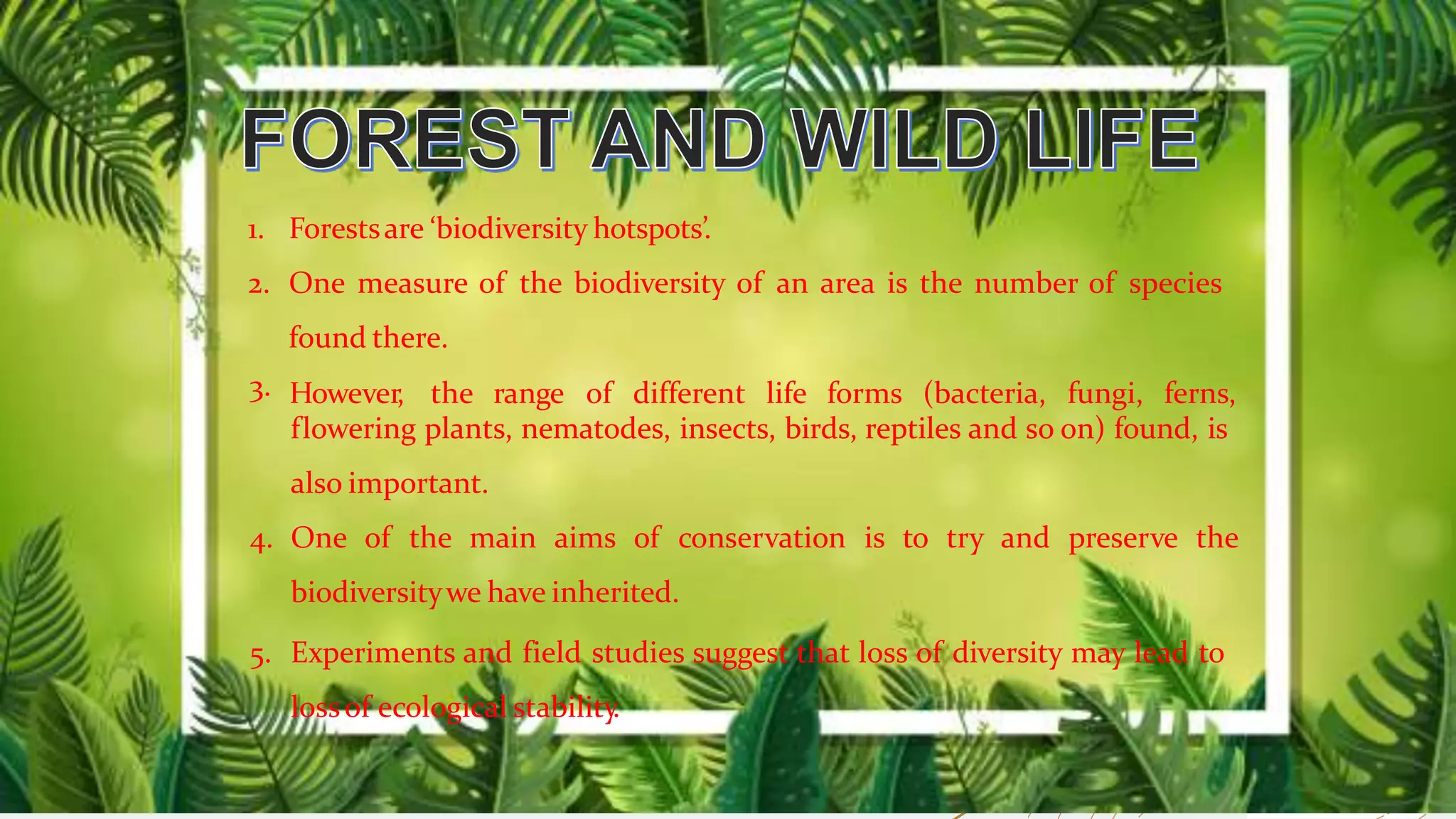
1. Forestsare ‘biodiversity hotspots’.
2. One measure of the biodiversity of an area is the number of species
found there.
3. However, the range of different life forms (bacteria, fungi, ferns,
flowering plants, nematodes, insects, birds, reptiles and so on) found, is
also important.
4. One of the main aims of conservation is to try and preserve the
biodiversitywe have inherited.
5. Experiments and field studies suggest that loss of diversity may lead to
lossof ecological stability.
Bacteria Fungi Ferns
Bird
Nematode Insects
Reptiles
Flowering plant
 Biodiversity :
A biodiversity hotspot is a biogeographic regionwith significant levels of biodiversity that is threatened
by human habitation.
Wild life and
Natureenthusiasts
Local People
(Forest Tribal)
Industrialists
The Forest
Department
Stakeholders
Local People (Forest Tribal):
1. Need large quantities of
firewood, timberand thatch.
2. Bamboo is used to make slats for
huts, baskets to collect and store
food etc.
3. Agricultural implements are made
of wood.
4. Theircattlegraze in the forests.
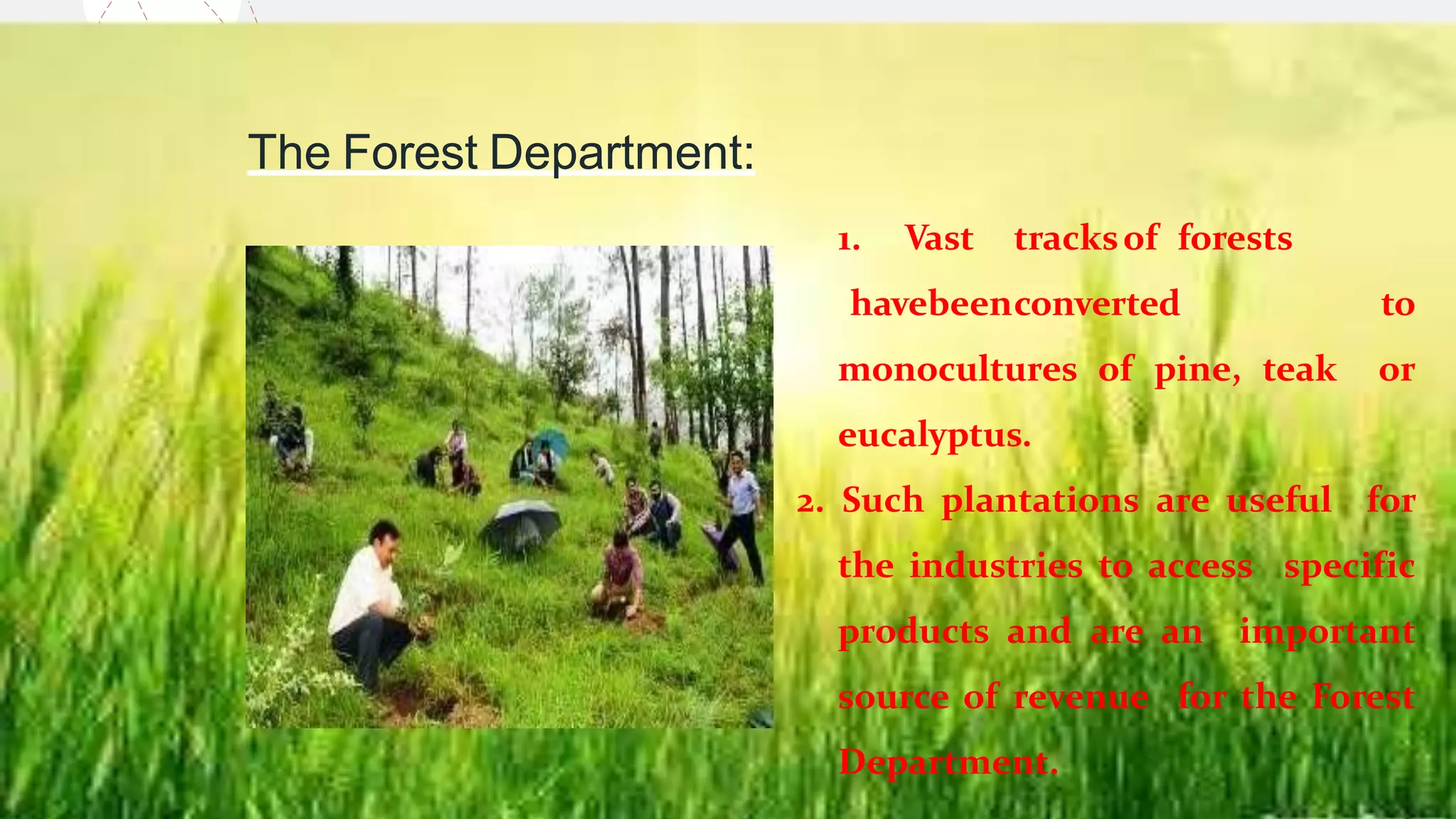
The Forest Department:
1. Vast tracksof forests
havebeenconverted to
monocultures of pine, teak or
eucalyptus.
2. Such plantations are useful for
the industries to access specific
products and are an important
source of revenue for the Forest
Department.
Industrialists:
 Forestsare the sourceof raw
materials for industriessuch as:
 Timber
 Paper
 Lac
 Sports equipment
+ 1. A group that is in no way dependent on the forests, but who
may have considerable say in their management.
2. The conservationists
initially
animals
taken up with
like lions,
were
large
tigers,
elephantsand rhinoceros.
3. They now recognise the need to
preserve biodiversity as a
whole.
 Weall use various forest produce. But our dependency on forest resources
varies. Someof us haveaccess toalternatives, some do not. When we
considertheconservationof forests, we need to look at the stakeholders
who are –
 thepeoplewho live in oraround forestsaredependenton forest produce
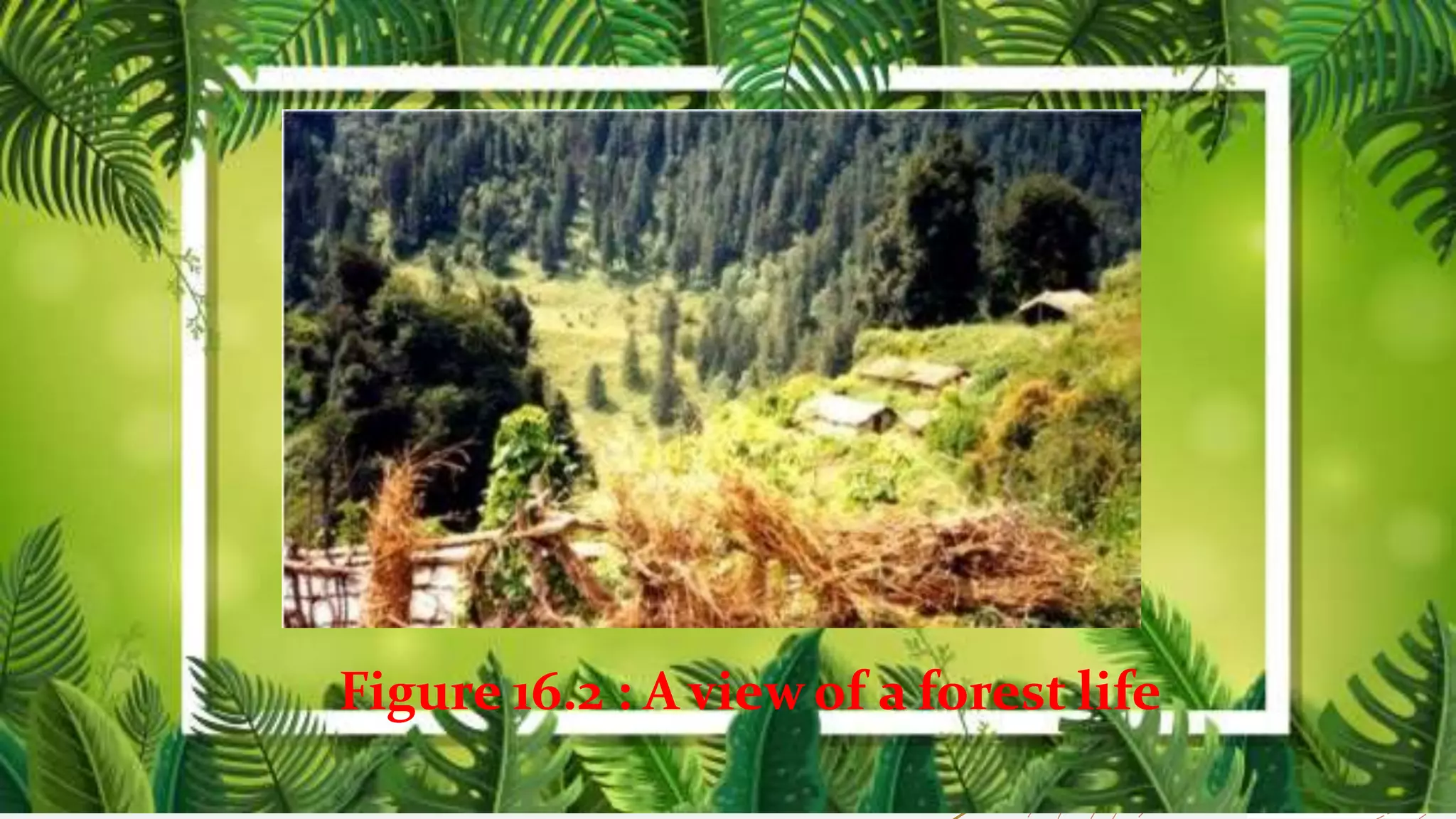
forvarious aspects of their life (see Fig. 16.2).
 the Forest Departmentof the Governmentwhich owns the land
and controls the resources from forests.
 the industrialists – from thosewho use ‘tendu’ leaves to make
bidis to theones with paper mills – who usevarious forestproduce,
butare notdependenton the forests in anyonearea.
 thewildlifeand natureenthusiasts whowant toconserve nature in its
 Let us take a look at what each of these groups needs/gets out of the forests.
 The local people need large quantities of firewood, small timber and
thatch.
 Bamboo is used to make slats for huts, and baskets for collecting and
storing food materials.
 Implements for agriculture, fishing and hunting are largely made of wood, also
forests are sites for fishing and hunting.
 In addition to the people gathering fruits, nuts and medicines from the forests,
their cattle also graze in forest areas or feed on the fodder which is collected
from forests.
 Doyou think such useof forestresourceswould lead to the
exhaustion of these resources?
 Do not forgetthat before the Britishcame
and took over mostof our forestareas, people had been living in these
forests forcenturies.
 They had developed practices to ensure that the resources were used in a
sustainable manner.
 After the British took control of the forests (which they exploited ruthlessly
for their own purposes), these people were forced to depend on much
smaller areas and forest resources started becoming over- exploited to some
extent.
 The Forest Department in independent India took overfrom the British but local
knowledge and local needs continued to be ignored in the management
practices.
 Thus vast tracts of forests have been converted to monocultures of pine,
teak oreucalyptus.
 In order to plant these trees, huge areas are first cleared of all vegetation.
 Thisdestroysa largeamountof biodiversity in thearea.
 Not only this, the varied needs of the local people – leaves for fodder, herbs for
medicines, fruits and nuts for food – can no longer be met fromsuch forests.
 Such plantations are useful for the industries to access specific products and are
an importantsourceof revenue forthe Forest Department.
Figure 16.2 : A viewof a forest life
 Doyou know how many industriesare based on forestproduce?
 A shortcountreveals timber, paper, lacand sportsequipment.
 Industrieswould considerthe forest as merely a sourceof raw material for
itsfactories.
 And huge interest-groups lobby the government for access to these raw materialsat
artificially lowrates.
 Since these industries have a greater reach than the local people, they are
not interested in thesustainabilityof the forest inoneparticulararea.
 Forexample, aftercutting down all the teak trees in onearea, theywill get
theirteak from a forest fartheraway.
 They do not have any stake in ensuring that one particular area should yield an optimal
amountof some produce forall generationstocome.
 What do you think will stop the local people in behaving in a similar manner?
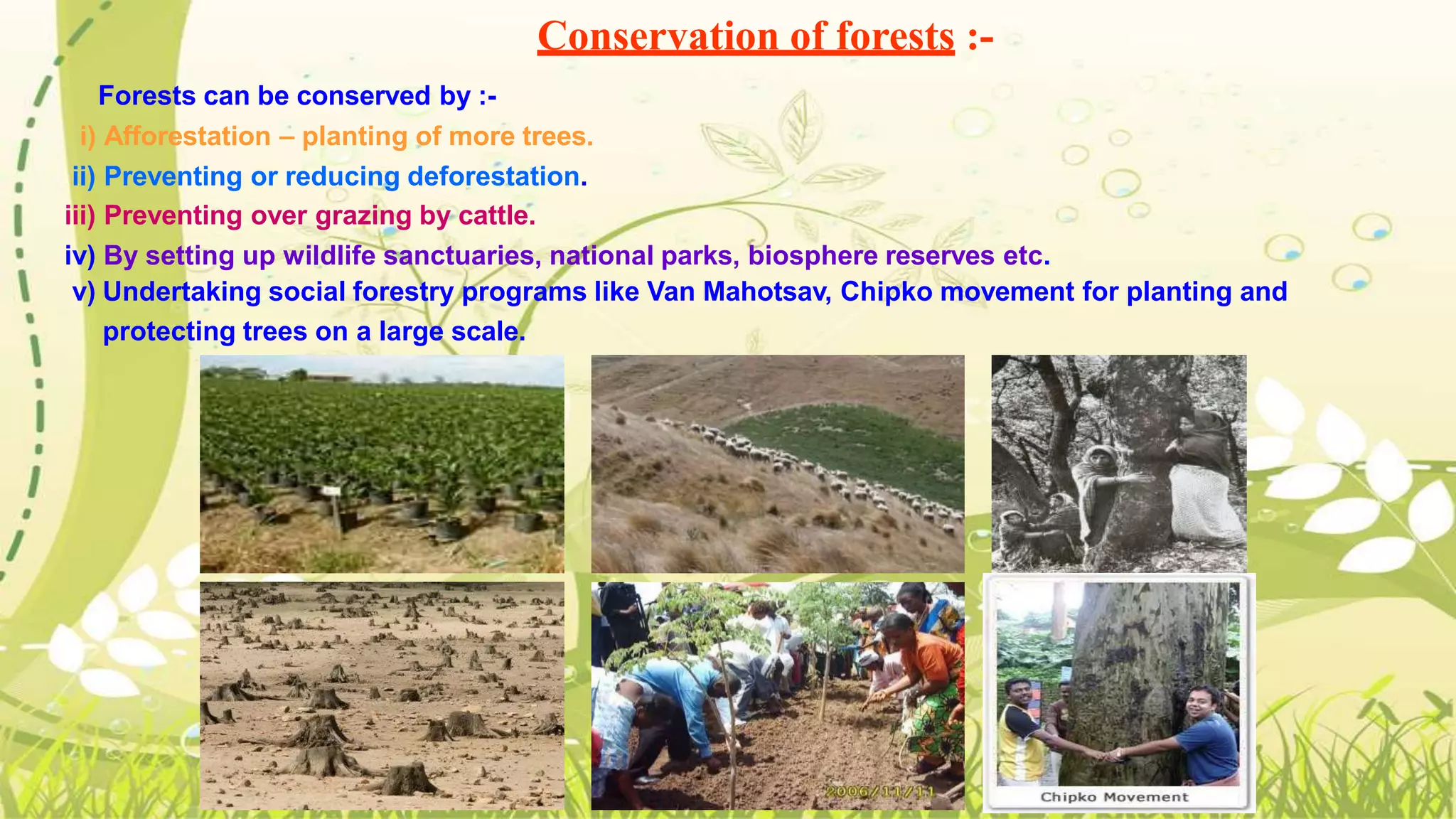
Conservation of forests :-
Forests can be conserved by :-
i) Afforestation – planting of more trees.
ii) Preventing or reducing deforestation.
iii) Preventing over grazing by cattle.
iv) By setting up wildlife sanctuaries, national parks, biosphere reserves etc.
v) Undertaking social forestry programs like Van Mahotsav, Chipko movement for planting and
protecting trees on a large scale.
•
•
•
•
•
•
Case study of peoples participation in
conservation of forest
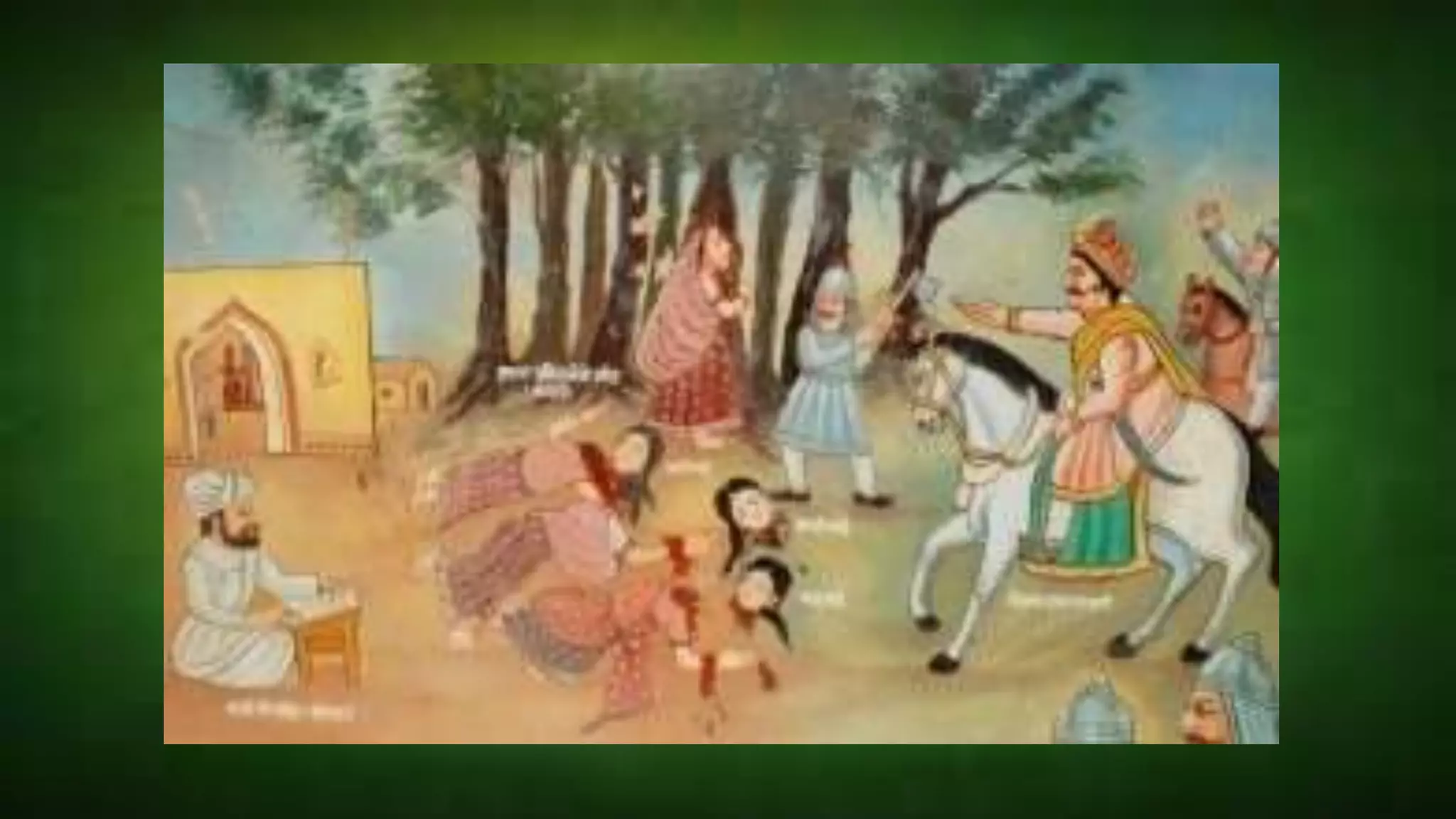
 In 1731 , the king of jodhapur in rajasthan asked one of his ministers to arrange
wood for constructing a new palace the ministers & workers went to forest near
avillage , inhabited by Bishnois, to cut down trees
 The Bishnoi community known for its peaceful co – existance with nature
 A Bishnoi women Amrita devi showed courage by hugging a tree & daring kings
men to cut her first before cutting the tree
 The tree mattered much more to her thanher own life
 The king’s men cut down the tree along with Amrita Devi.Her three daughters &
& hundreds of other Bishnois followed her & they lost their live saving trees
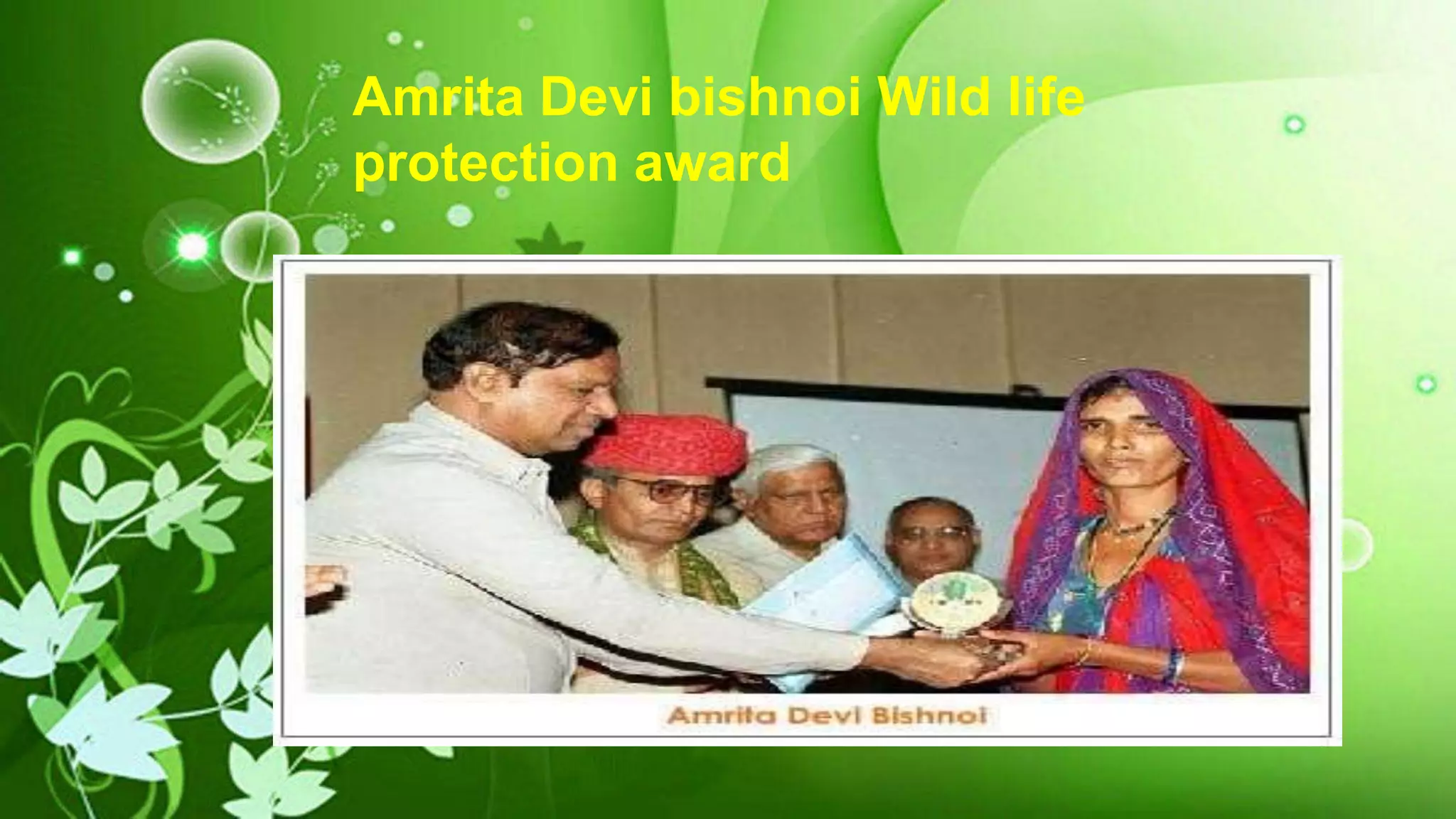
 The government of INDIA has recently instituted the Amrita Devi bishnoi Wild
life protection award for individuals or communities from rural area that have
shown extraordinary courage dedication in protecting wild life
Amrita Devi bishnoi Wild life
protection award
Chipko Andolan (Hug the trees movement)
People’s participation in the management of forests.
 Far-seeing forest officer, A.K. Banerjee in the Arabari forest range of
Midnapore district Mr.Banerjeee involved the villagers in the
protection of 1,272 hectares of badly degraded Sal forest.
 In return for help in protection, villagers were allowed fuel wood and
fodder collection on payment of a nominal fee and given employment
in both silviculture and harvesting operations, 25 per cent of the final
harvest was given to the village community.
 The result was the active and willing participation of the local
community. The Sal forests of Arabari underwent a remarkable
recovery by 1983; a previously worthless forest was valued Rs. 12.5
Wildlife :-
Importance of wildlife :-
i) Wildlife helps to preserve biodiversity.
ii) Wild life helps to maintain food chains and food web.
iii) We get useful products from wild life like food, medicines, leather, bones, honey, lac etc.
Conservation of wildlife :-
i) Preserving the natural habitats of animals.
ii) Banning poaching of animals.
iii) Protecting endangered species of animals.
iv) Setting up of wildlife sanctuaries, national parks, biosphere reserves etc.
Dams :-
Advantages of dams :-
i) Irrigation of crops.
ii)Producing electricity.
iii)Supplying water to towns and cities.
iv) To control floods.
.
Uses of water
•
+ Water is a basic necessity for all living things.
We use water for our daily needs, for agriculture,
transportation, construction of buildings, roads,
dams etc. Water is a natural habitat for aquatic
organisms.
+Human activities are affecting the availability of
water and causing pollution of water bodies
•
Disadvantages of dams
i)Social problems :- It displaces a large number of people
who have to be rehabilitated.
ii)Economic problems :- It is expensive and uses a huge
amount of public money.
iii)iii) Environmental problems :-
•
Reasons for the loss of underground
water availability
•
Rains in India are largely due to the monsoons.
This means that most of the rain falls in a few
months of the year.
Despite nature’s monsoon bounty, failure to sustain
water availability underground has resulted largely
from the
loss of vegetation cover
Diversion for high water demanding crops,
Pollution from industrial effluents and urban
wastes.
•
•
•
DAMS
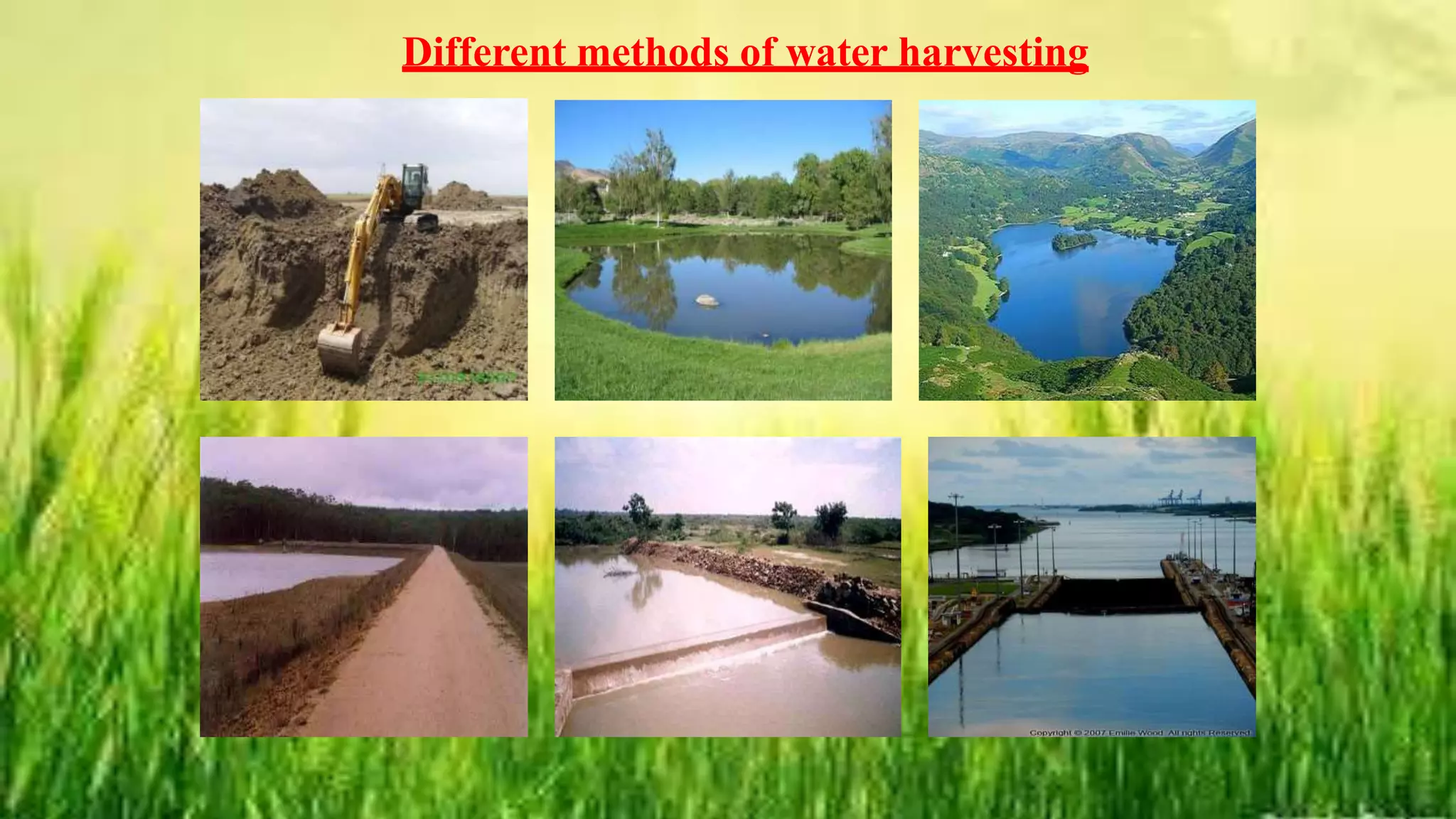
Water harvesting (Rain water harvesting) :-
Water harvesting is collecting and storing rain water for future use. The common methods of
water harvesting are :-
i) Digging pits, ponds, lakes etc.
ii) Building small earthen dams or concrete check dams.
iii) Construction of dykes.
iv) Construction of reservoirs.
v) Construction of rooftop collecting units in houses.
Advantages of underground water :-
i) It does not evaporate easily.
ii) It spreads out and recharges wells.
iii) It provides moisture for irrigation of crops.
iv) It does not get polluted easily.
v) It does not provide breeding ground for mosquitoes and houseflies.
•
 Irrigation methods like dams, tanks and canals have been used in
various parts of India since ancient times.
 These were generally local interventions managed by local people and
assured that the basic minimum requirements for both agriculture and
daily needs were met throughout the year.
•
 The use of this stored water was strictly regulated and the optimum
cropping patterns based on the water availability were arrived at on the
basis of decades/centuries of experience, the maintenance of these
irrigation systems was also a local affair
 The arrival of the British changed these systems as it
changed many other things.
 The conception of large scale projects – large dams and
canals traversing large distances were first conceived and
implemented by the British.
 These mega-projects led to the neglect of the local irrigation
methods, and the government also increasingly took over the
administration of these systems leading to the loss of control
over the local water sources by the local people.
Different methods of water harvesting
RAINWATER HARVESTING
Traditional water harvesting system — an ideal setting of the khadin system
Water harvesting systems
 Water harvesting is an age-old concept in India.
Khadins, tanks and nadis in Rajasthan, bandharas and
tals in Maharashtra,
 Bundhis in Madhya Pradesh and Uttar Pradesh Ahars
and pynes in Bihar
 kulhs in Himachal Pradesh
 Ponds in the Kandi belt of Jammu region Eris
(tanks) in Tamil Nadu
 surangams in Kerala,
 kattas in Karnataka are some of the ancient water
harvesting,
Coal and petroleum :-
Coal and petroleum are fossil fuels formed by the decomposition of dead plants and animals
inside the earth after several millions of years. They are non renewable sources of energy.
Petroleum reserves may last for about 40 years and coal reserves may last for about 200
years.
Coal and petroleum contain carbon, hydrogen, nitrogen and sulphur. When they are burnt,
they release carbon dioxide and oxides of nitrogen and sulphur.
Carbon dioxide is a green house gas which causes global warming.
Oxides of nitrogen and sulphur combines with moisture in the air and produces acid rain.
MELTING OF POLAR ICE RISE IN SEA LEVELS
simple choices can make a difference in our energy
consumption
• environment-friendliness of the following –
• (i) Taking a bus, using your personal vehicle or
walking/cycling.
• (ii) Using bulbs or fluorescent tubes in your homes.
• (iii) Using the lift or taking the stairs.
• (iv) Wearing an extra sweater or using a heating
device (heater or ‘sigri’) on cold days
Advantages of sustainablenatural
resource management
• .It is controlling the use of resources in such a way so as
to provide for its equitable and continuous availability
not only to the present generation without any harmful
impact on the environment.
Four advantages:
Equitable distribution, controlled
exploitation,minimum wastage,disposal of waste
sustainable management of natural resources

sustainable management of natural resources

  • 1.
    Sustainable management of Naturalresources - Jadeja Namrataba
  • 4.
  • 5.
    Renewable natural resources Renewablenatural resources Resources which can be replenished in a short period of time like air, water, sunlight, forests etc. Non renewable natural resources Resources which cannot be replenished in a short period of time like minerals (coal, petroleum, natural gas, metals etc.) because they take millions of years to be formed. Human activities produce a lot of waste materials which are thrown away into the environment. These wastes cause pollution of natural resources like air, water and soil.
  • 6.
    The Ganga isthe largest river in India with an extraordinaryreligious importance for Hindus .It runs over 2500 km from Gangotri in the Himalayas to Ganga Sagar in the Bay of Bengal. Along its banks are some of the world's oldest inhabited places like Varanasi and Patna. It provides water to about 40% of India's population in 11 states. In modern times, In 1985 because the quality of the water in Ganga so government started multicore project GANGA ACTION PLAN. Ganga in modern times, it is known for being very polluted.
  • 7.
    An estimated 2.9billion liters or more of human sewage is discharged into the Ganges daily. The Ganges river basin is one of the most fertile and densely populated regions in the world and covers an area of 1,080,000 km2. The river flows through 29 cities with population over 100,000; 23 cities with population between 50,000 and 100,000, and about 48 towns. A large proportion of the waste in the Ganges is from this population through domestic usage like bathing, laundry and public defecation.
  • 8.
    GANGA ACTION PLAN GangaAction Plan : Multi Crore Project came in 1985 to improve the quality of Gang a Contamination of river water is indicated by the presence of coliform fa group of bacteria found in human intestine) and acidic water. 1993-94 Total Coliform(MPN/l00ml)  Minimum found in Rishikesh 600-6s0 MPN/100ni1  Minimum desired level 4S0MPN/100ml  Maximum found in kannauj1400MPN/l00nil
  • 9.
    Countless tanneries, chemicalplants, textile mills,distilleries, slaughterhouses, and hospitals contribute to the pollution of the Ganges by dumping untreated waste into it. Religious events During festival seasons, over 70 million people bath in the Ganges over a few weeks to cleanse themselves from their sins. Some materials like food, waste or leaves are left in the Ganges. Industrial waste
  • 11.
    The five R’sto save the environment :- The five R’s to save the environment are refuse ,Reduce, Recycle, Reuse and repurpose . i) Reduce :- means using less of natural resources and avoiding wastage of natural resources. ii) Recycle :- means the materials like paper, plastic, glass, metals etc. used for making things can again be used for making new things instead of synthesising or extracting new paper, plastic, glass or metals. iii) Reuse :- means using things again and again like the plastic bottles in which we buy jams, pickles etc can be again used for storing things in the kitchen.
  • 12.
    Iv) Refuse :-This is actually even better than recycling because the process of recycling uses some energy. In the ‘reuse’ strategy, you simply use things again and again. Instead of throwing away used envelopes, you can reverse it and use it again. The plastic bottles in which you buy various food-items like jam or pickle can be used for storing things in the kitchen. What other items can we reuse? v) Repurpose: - This means when a product can no more be used for the original purpose, think carefully and use it for some other useful purpose. For example, cracked crockery, or cups with broken handles can be used to grow small plants and as feeding vessels for birds.
  • 14.
    Need for managementof natural resources :- All the things we use and consume are obtained from natural resources. Due to increase in population, industrialisation and urbanisation the demand for natural resources is increasing and their availability is limited . So there is a need for proper management of natural resources. The proper management of natural resources consists of :- i) Judicious use of natural resources and avoiding wastage of natural resources. ii) Long term planning for the use of natural resources so that it last not only for the present but also for future generations. iii) The exploitation of natural resources should not be for the benefit of a few people but should be distributed equally for all. iv) While extracting and using natural resources we should also plan for the safe disposal of wastes so that no damage is caused to the environment.
  • 15.
    Need for managementof natural resources :- The management of natural resources requires: 1. a long-term perspective so that these will last for the generations to come and will not merely be exploited to the hilt for short term gains. 2. This management should also ensure equitable distribution of resources so that all, and not just a handful of rich and powerful people, benefit from the development of these resources.
  • 16.
    1. Forestsare ‘biodiversityhotspots’. 2. One measure of the biodiversity of an area is the number of species found there. 3. However, the range of different life forms (bacteria, fungi, ferns, flowering plants, nematodes, insects, birds, reptiles and so on) found, is also important. 4. One of the main aims of conservation is to try and preserve the biodiversitywe have inherited. 5. Experiments and field studies suggest that loss of diversity may lead to lossof ecological stability.
  • 17.
    Bacteria Fungi Ferns Bird NematodeInsects Reptiles Flowering plant  Biodiversity : A biodiversity hotspot is a biogeographic regionwith significant levels of biodiversity that is threatened by human habitation.
  • 18.
    Wild life and Natureenthusiasts LocalPeople (Forest Tribal) Industrialists The Forest Department Stakeholders
  • 19.
    Local People (ForestTribal): 1. Need large quantities of firewood, timberand thatch. 2. Bamboo is used to make slats for huts, baskets to collect and store food etc. 3. Agricultural implements are made of wood. 4. Theircattlegraze in the forests.
  • 20.
    The Forest Department: 1.Vast tracksof forests havebeenconverted to monocultures of pine, teak or eucalyptus. 2. Such plantations are useful for the industries to access specific products and are an important source of revenue for the Forest Department.
  • 21.
    Industrialists:  Forestsare thesourceof raw materials for industriessuch as:  Timber  Paper  Lac  Sports equipment
  • 22.
    + 1. Agroup that is in no way dependent on the forests, but who may have considerable say in their management. 2. The conservationists initially animals taken up with like lions, were large tigers, elephantsand rhinoceros. 3. They now recognise the need to preserve biodiversity as a whole.
  • 23.
     Weall usevarious forest produce. But our dependency on forest resources varies. Someof us haveaccess toalternatives, some do not. When we considertheconservationof forests, we need to look at the stakeholders who are –  thepeoplewho live in oraround forestsaredependenton forest produce forvarious aspects of their life (see Fig. 16.2).  the Forest Departmentof the Governmentwhich owns the land and controls the resources from forests.  the industrialists – from thosewho use ‘tendu’ leaves to make bidis to theones with paper mills – who usevarious forestproduce, butare notdependenton the forests in anyonearea.  thewildlifeand natureenthusiasts whowant toconserve nature in its
  • 24.
     Let ustake a look at what each of these groups needs/gets out of the forests.  The local people need large quantities of firewood, small timber and thatch.  Bamboo is used to make slats for huts, and baskets for collecting and storing food materials.  Implements for agriculture, fishing and hunting are largely made of wood, also forests are sites for fishing and hunting.  In addition to the people gathering fruits, nuts and medicines from the forests, their cattle also graze in forest areas or feed on the fodder which is collected from forests.
  • 25.
     Doyou thinksuch useof forestresourceswould lead to the exhaustion of these resources?  Do not forgetthat before the Britishcame and took over mostof our forestareas, people had been living in these forests forcenturies.  They had developed practices to ensure that the resources were used in a sustainable manner.  After the British took control of the forests (which they exploited ruthlessly for their own purposes), these people were forced to depend on much smaller areas and forest resources started becoming over- exploited to some extent.
  • 26.
     The ForestDepartment in independent India took overfrom the British but local knowledge and local needs continued to be ignored in the management practices.  Thus vast tracts of forests have been converted to monocultures of pine, teak oreucalyptus.  In order to plant these trees, huge areas are first cleared of all vegetation.  Thisdestroysa largeamountof biodiversity in thearea.  Not only this, the varied needs of the local people – leaves for fodder, herbs for medicines, fruits and nuts for food – can no longer be met fromsuch forests.  Such plantations are useful for the industries to access specific products and are an importantsourceof revenue forthe Forest Department.
  • 27.
    Figure 16.2 :A viewof a forest life
  • 28.
     Doyou knowhow many industriesare based on forestproduce?  A shortcountreveals timber, paper, lacand sportsequipment.  Industrieswould considerthe forest as merely a sourceof raw material for itsfactories.  And huge interest-groups lobby the government for access to these raw materialsat artificially lowrates.  Since these industries have a greater reach than the local people, they are not interested in thesustainabilityof the forest inoneparticulararea.  Forexample, aftercutting down all the teak trees in onearea, theywill get theirteak from a forest fartheraway.  They do not have any stake in ensuring that one particular area should yield an optimal amountof some produce forall generationstocome.  What do you think will stop the local people in behaving in a similar manner?
  • 29.
    Conservation of forests:- Forests can be conserved by :- i) Afforestation – planting of more trees. ii) Preventing or reducing deforestation. iii) Preventing over grazing by cattle. iv) By setting up wildlife sanctuaries, national parks, biosphere reserves etc. v) Undertaking social forestry programs like Van Mahotsav, Chipko movement for planting and protecting trees on a large scale.
  • 30.
    • • • • • • Case study ofpeoples participation in conservation of forest  In 1731 , the king of jodhapur in rajasthan asked one of his ministers to arrange wood for constructing a new palace the ministers & workers went to forest near avillage , inhabited by Bishnois, to cut down trees  The Bishnoi community known for its peaceful co – existance with nature  A Bishnoi women Amrita devi showed courage by hugging a tree & daring kings men to cut her first before cutting the tree  The tree mattered much more to her thanher own life  The king’s men cut down the tree along with Amrita Devi.Her three daughters & & hundreds of other Bishnois followed her & they lost their live saving trees  The government of INDIA has recently instituted the Amrita Devi bishnoi Wild life protection award for individuals or communities from rural area that have shown extraordinary courage dedication in protecting wild life
  • 34.
    Amrita Devi bishnoiWild life protection award
  • 35.
    Chipko Andolan (Hugthe trees movement)
  • 38.
    People’s participation inthe management of forests.  Far-seeing forest officer, A.K. Banerjee in the Arabari forest range of Midnapore district Mr.Banerjeee involved the villagers in the protection of 1,272 hectares of badly degraded Sal forest.  In return for help in protection, villagers were allowed fuel wood and fodder collection on payment of a nominal fee and given employment in both silviculture and harvesting operations, 25 per cent of the final harvest was given to the village community.  The result was the active and willing participation of the local community. The Sal forests of Arabari underwent a remarkable recovery by 1983; a previously worthless forest was valued Rs. 12.5
  • 40.
    Wildlife :- Importance ofwildlife :- i) Wildlife helps to preserve biodiversity. ii) Wild life helps to maintain food chains and food web. iii) We get useful products from wild life like food, medicines, leather, bones, honey, lac etc. Conservation of wildlife :- i) Preserving the natural habitats of animals. ii) Banning poaching of animals. iii) Protecting endangered species of animals. iv) Setting up of wildlife sanctuaries, national parks, biosphere reserves etc.
  • 41.
    Dams :- Advantages ofdams :- i) Irrigation of crops. ii)Producing electricity. iii)Supplying water to towns and cities. iv) To control floods. .
  • 42.
    Uses of water • +Water is a basic necessity for all living things. We use water for our daily needs, for agriculture, transportation, construction of buildings, roads, dams etc. Water is a natural habitat for aquatic organisms. +Human activities are affecting the availability of water and causing pollution of water bodies •
  • 43.
    Disadvantages of dams i)Socialproblems :- It displaces a large number of people who have to be rehabilitated. ii)Economic problems :- It is expensive and uses a huge amount of public money. iii)iii) Environmental problems :- •
  • 44.
    Reasons for theloss of underground water availability • Rains in India are largely due to the monsoons. This means that most of the rain falls in a few months of the year. Despite nature’s monsoon bounty, failure to sustain water availability underground has resulted largely from the loss of vegetation cover Diversion for high water demanding crops, Pollution from industrial effluents and urban wastes. • • •
  • 45.
  • 46.
    Water harvesting (Rainwater harvesting) :- Water harvesting is collecting and storing rain water for future use. The common methods of water harvesting are :- i) Digging pits, ponds, lakes etc. ii) Building small earthen dams or concrete check dams. iii) Construction of dykes. iv) Construction of reservoirs. v) Construction of rooftop collecting units in houses. Advantages of underground water :- i) It does not evaporate easily. ii) It spreads out and recharges wells. iii) It provides moisture for irrigation of crops. iv) It does not get polluted easily. v) It does not provide breeding ground for mosquitoes and houseflies.
  • 47.
    •  Irrigation methodslike dams, tanks and canals have been used in various parts of India since ancient times.  These were generally local interventions managed by local people and assured that the basic minimum requirements for both agriculture and daily needs were met throughout the year. •  The use of this stored water was strictly regulated and the optimum cropping patterns based on the water availability were arrived at on the basis of decades/centuries of experience, the maintenance of these irrigation systems was also a local affair
  • 48.
     The arrivalof the British changed these systems as it changed many other things.  The conception of large scale projects – large dams and canals traversing large distances were first conceived and implemented by the British.  These mega-projects led to the neglect of the local irrigation methods, and the government also increasingly took over the administration of these systems leading to the loss of control over the local water sources by the local people.
  • 49.
    Different methods ofwater harvesting
  • 50.
  • 51.
    Traditional water harvestingsystem — an ideal setting of the khadin system
  • 52.
    Water harvesting systems Water harvesting is an age-old concept in India. Khadins, tanks and nadis in Rajasthan, bandharas and tals in Maharashtra,  Bundhis in Madhya Pradesh and Uttar Pradesh Ahars and pynes in Bihar  kulhs in Himachal Pradesh  Ponds in the Kandi belt of Jammu region Eris (tanks) in Tamil Nadu  surangams in Kerala,  kattas in Karnataka are some of the ancient water harvesting,
  • 53.
    Coal and petroleum:- Coal and petroleum are fossil fuels formed by the decomposition of dead plants and animals inside the earth after several millions of years. They are non renewable sources of energy. Petroleum reserves may last for about 40 years and coal reserves may last for about 200 years. Coal and petroleum contain carbon, hydrogen, nitrogen and sulphur. When they are burnt, they release carbon dioxide and oxides of nitrogen and sulphur. Carbon dioxide is a green house gas which causes global warming. Oxides of nitrogen and sulphur combines with moisture in the air and produces acid rain.
  • 55.
    MELTING OF POLARICE RISE IN SEA LEVELS
  • 56.
    simple choices canmake a difference in our energy consumption • environment-friendliness of the following – • (i) Taking a bus, using your personal vehicle or walking/cycling. • (ii) Using bulbs or fluorescent tubes in your homes. • (iii) Using the lift or taking the stairs. • (iv) Wearing an extra sweater or using a heating device (heater or ‘sigri’) on cold days
  • 57.
    Advantages of sustainablenatural resourcemanagement • .It is controlling the use of resources in such a way so as to provide for its equitable and continuous availability not only to the present generation without any harmful impact on the environment. Four advantages: Equitable distribution, controlled exploitation,minimum wastage,disposal of waste