Kendriya Vidyalaya Bhandara
Biology PowerPoint Presentation
OUR ENVIRONMENT
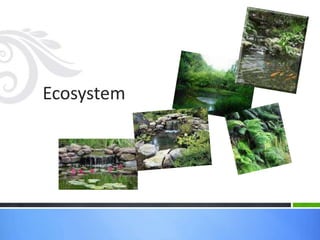
Ecosystem
What is an ecosystem?
• An ecosystem is a self-contained unit of living
things (plants, animals and decomposers), and
their non-living environment (soil, air and water).
• The examples of ecosystems are grassland
(meadow), a forest, a desert, a mountain, a pond,
a lake, a river and a sea.
• Most of the ecosystem in the world are natural
ecosystems but some of them are also man-made
ecosystems or artificial ecosystems.
• Artificial ecosystem includes crop-fields
(agriculture lands), parks and aquarium.
Ecosystems
The pond is an ecosystem.
Contents of the Presentation
And much more
Components
of an
Ecosystem
The
Functioning of
an Ecosystem
Producers,
Consumers
and
Decomposers
Components of an
Ecosystem
Abiotic and Biotic Components of an Ecosystem
• The abiotic components (or non-living
components) of an ecosystem include the
physical environment like soil, water and air
alongwith the inorganic substances like carbon
dioxide, nitrogen, oxygen, water, phosphorus,
sulphur, sodium, potassium, calcium and other
elements present in them.
• The physical factors or climate factors like light,
temperature, pressure and humidity are also
considered abiotic components of the ecosystem.
Abiotic Components
• The biotic components (or living components)
of an ecosystem is a community of organisms
(like plants and animals), which is made up of
many different inter-dependent populations.
• The biotic community (or living world) of an
ecosystem includes three types of organisms:
– Producer organisms (or Autotrophs)
– Consumer organisms (or Heterotrophs)
– Decomposers (or Saprotrophs)
Biotic Components
The Functioning of an
Ecosystem
Act as self-sufficient unit
Whatarethefunctionsof
Ecosystem? What does components do?
Ecosystem functions as a self-sufficient or independent unit in
nature. Ecosystem has both living and non-living components. All
these components make the ecosystem functions as follows: From
the nutrient pool of the earth (soil, water and air), carbon dioxide
and water are absorbed by the producer organism (green plants).
With the help of sunlight energy, the producer organisms convert
these inorganic substances into organic compounds like
carbohydrates which act as a food. Thus, producers trap the solar
energy and then provide the basic food or energy for all other
life forms in the ecosystem. The consumers (animals) derive their
energy needs, directly or indirectly, from the producers (plants).
When the producers (plants) and consumers (animals) die, then
the decomposer organisms act on their dead bodies to return the
various elements back to the nutrient pool (soil, water and air).
Thus, an ecosystem involves input of energy and matter which are
exchanged between living and non-living components in a cyclic
process.
Producers, Consumers and
Decomposers
Three types of organisms
Producers
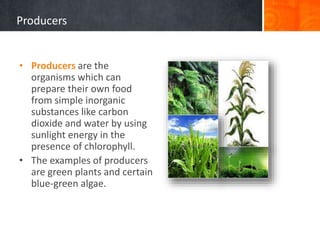
• Producers are the
organisms which can
prepare their own food
from simple inorganic
substances like carbon
dioxide and water by using
sunlight energy in the
presence of chlorophyll.
• The examples of producers
are green plants and certain
blue-green algae.
Consumers
• Those organisms which consume food
(eat food) prepared by producers are
called consumers.
• All the animals are consumers.
• If an animal eats grass or other green
plants or their products itself we say that
it gets the food from producers directly.
• If an animal eats the meat of another
animal (which eats grass), then we say
that it gets the food from producer
indirectly.
• Consumers can be further classified as
herbivores, carnivores and omnivores.
Cow, Buffalo, Goat, Sheep,
Horse, Deer, Camel, Ass, Ox,
Elephant, Monkey, Squirrel,
Rabbit and Hippopotamus are
herbivores.
Those animals which eat only
plants are called herbivores.
Herbivores are primary
consumers. The herbivores
may eat grasses, leaves,
grains, fruits or the bark of
trees.
Herbivores
Lion, Tiger, Frog, Vulture,
Kingfisher, Lizard, Wolf, Snake
and Hawk are Carnivores.
Those animals which eat only
other animals as food are
called carnivores. The
carnivores eat the meat (or
flesh) of other animals.
Carnivores
Carnivores eats only flesh of other animals
Carnivores
Carnivores
The small carnivores
which fed on
herbivores (primary
consumers) are called
secondary consumers.
The large carnivores
(or top carnivores)
which feed upon the
small carnivores
(secondary consumers)
are called tertiary
consumers.
Man (human beings), Dog,
Crow, Sparrow, Bear, Mynah
and Ant are omnivores.
Those animals which eat both,
plants and animals, are called
omnivores.
Omnivores
Omnivores
Man is called an omnivore because he eats both, plant food (such as grains,
pulses, fruits and vegetables) as well as meat of animals (such as goat, chicken
and fish).
Planktons
• Planktons are very minute or
microscopic organisms freely
floating don the surface of water
in a pond, lake, river or ocean.
• Planktons are of two types:
Phytoplankton and Zooplanktons.
– The microscopic aquatic plants
freely floating on the surface
of water are called
phytoplanktons. Eg: Algae
– The microscopic aquatic
animals freely floating on
water are called zooplanktons.
Eg: Protozoa
Phytoplanktons
The green layer floating on the surface of water in this lake is that of tiny free-floating plants called algae
which are phytoplanktons.
Tiny aquatic animals freely floating on water which are called zooplanktons
Decomposers
• The micro-organisms which break down the
complex organic compounds present in dead
organisms like dead plants and animals and
their products like faeces, urine, etc., into
simpler substances are called decomposers.
• The bacteria and fungi act as decomposers by
the secretions of their body surfaces which
decompose the organic matter present in dead
plants and animals into simpler substances and
liberate ammonia, carbon dioxide, etc.. The
bacteria which act as decomposers are called
putrefying bacteria.
• Decomposers help in the recycling of materials
in ecosystem. The decomposers are also known
as micro-consumers or Saprotrophs.
The decomposers help in decomposing
the dead bodies of plant s and animals,
and hence act as cleansing agents of
environment. It is only due the presence
of decomposers that the various
nutrient elements which were initially
taken by plants from the soil, air and
water are returned to the soil, air and
water, after the death of plants and
animals. The decomposers organisms
help in recycling the materials in the
ecosystem so that the process of life
may go on and on like an unending
chain.
Important of Decomposer
Name: Mrunal Mohadikar
Class: 10th ‘B’
Roll Number: 11
School: Kendriya Vidyalaya Bhandara
About Me
Share
to all
?
Want to do
Something More!
Watch and tell me your experience
» Watch some of the most terrific carnivores on
the planet on YouTube (http://www.youtube
.com/Top 10 Most Dangerous Carnivore
Animals In The World.flv/)
» Watch the video on
http://www.youtube.com/Top 10 Most
Dangerous carnivore Animals In The World.flv.
» You’ll never have to say, “Next slide, please”
again!
WATCH IT
 Google.com (For Images)
 Biology S.CHAND By Lakhmir Singh
and Manjit Kaur (For Information)
 YouTube.com (For Videoes)
 Microsoft Office 2010 especially
Microsoft PowerPoint 2010 (For
Presentation Template and
Animations)
Bibliography
Thanks
to all for the presentation
What’s Your Opinion about
it?
THANK YOU VERY
MUCH

Our Environment

  • 1.
    Kendriya Vidyalaya Bhandara BiologyPowerPoint Presentation OUR ENVIRONMENT
  • 2.
  • 3.
    What is anecosystem? • An ecosystem is a self-contained unit of living things (plants, animals and decomposers), and their non-living environment (soil, air and water). • The examples of ecosystems are grassland (meadow), a forest, a desert, a mountain, a pond, a lake, a river and a sea. • Most of the ecosystem in the world are natural ecosystems but some of them are also man-made ecosystems or artificial ecosystems. • Artificial ecosystem includes crop-fields (agriculture lands), parks and aquarium.
  • 4.
  • 5.
    Contents of thePresentation And much more Components of an Ecosystem The Functioning of an Ecosystem Producers, Consumers and Decomposers
  • 6.
    Components of an Ecosystem Abioticand Biotic Components of an Ecosystem
  • 7.
    • The abioticcomponents (or non-living components) of an ecosystem include the physical environment like soil, water and air alongwith the inorganic substances like carbon dioxide, nitrogen, oxygen, water, phosphorus, sulphur, sodium, potassium, calcium and other elements present in them. • The physical factors or climate factors like light, temperature, pressure and humidity are also considered abiotic components of the ecosystem. Abiotic Components
  • 8.
    • The bioticcomponents (or living components) of an ecosystem is a community of organisms (like plants and animals), which is made up of many different inter-dependent populations. • The biotic community (or living world) of an ecosystem includes three types of organisms: – Producer organisms (or Autotrophs) – Consumer organisms (or Heterotrophs) – Decomposers (or Saprotrophs) Biotic Components
  • 9.
    The Functioning ofan Ecosystem Act as self-sufficient unit
  • 10.
    Whatarethefunctionsof Ecosystem? What doescomponents do? Ecosystem functions as a self-sufficient or independent unit in nature. Ecosystem has both living and non-living components. All these components make the ecosystem functions as follows: From the nutrient pool of the earth (soil, water and air), carbon dioxide and water are absorbed by the producer organism (green plants). With the help of sunlight energy, the producer organisms convert these inorganic substances into organic compounds like carbohydrates which act as a food. Thus, producers trap the solar energy and then provide the basic food or energy for all other life forms in the ecosystem. The consumers (animals) derive their energy needs, directly or indirectly, from the producers (plants). When the producers (plants) and consumers (animals) die, then the decomposer organisms act on their dead bodies to return the various elements back to the nutrient pool (soil, water and air). Thus, an ecosystem involves input of energy and matter which are exchanged between living and non-living components in a cyclic process.
  • 11.
  • 12.
    Producers • Producers arethe organisms which can prepare their own food from simple inorganic substances like carbon dioxide and water by using sunlight energy in the presence of chlorophyll. • The examples of producers are green plants and certain blue-green algae.
  • 13.
    Consumers • Those organismswhich consume food (eat food) prepared by producers are called consumers. • All the animals are consumers. • If an animal eats grass or other green plants or their products itself we say that it gets the food from producers directly. • If an animal eats the meat of another animal (which eats grass), then we say that it gets the food from producer indirectly. • Consumers can be further classified as herbivores, carnivores and omnivores.
  • 14.
    Cow, Buffalo, Goat,Sheep, Horse, Deer, Camel, Ass, Ox, Elephant, Monkey, Squirrel, Rabbit and Hippopotamus are herbivores. Those animals which eat only plants are called herbivores. Herbivores are primary consumers. The herbivores may eat grasses, leaves, grains, fruits or the bark of trees. Herbivores
  • 15.
    Lion, Tiger, Frog,Vulture, Kingfisher, Lizard, Wolf, Snake and Hawk are Carnivores. Those animals which eat only other animals as food are called carnivores. The carnivores eat the meat (or flesh) of other animals. Carnivores
  • 16.
    Carnivores eats onlyflesh of other animals Carnivores
  • 17.
    Carnivores The small carnivores whichfed on herbivores (primary consumers) are called secondary consumers. The large carnivores (or top carnivores) which feed upon the small carnivores (secondary consumers) are called tertiary consumers.
  • 18.
    Man (human beings),Dog, Crow, Sparrow, Bear, Mynah and Ant are omnivores. Those animals which eat both, plants and animals, are called omnivores. Omnivores
  • 19.
    Omnivores Man is calledan omnivore because he eats both, plant food (such as grains, pulses, fruits and vegetables) as well as meat of animals (such as goat, chicken and fish).
  • 20.
    Planktons • Planktons arevery minute or microscopic organisms freely floating don the surface of water in a pond, lake, river or ocean. • Planktons are of two types: Phytoplankton and Zooplanktons. – The microscopic aquatic plants freely floating on the surface of water are called phytoplanktons. Eg: Algae – The microscopic aquatic animals freely floating on water are called zooplanktons. Eg: Protozoa
  • 21.
    Phytoplanktons The green layerfloating on the surface of water in this lake is that of tiny free-floating plants called algae which are phytoplanktons. Tiny aquatic animals freely floating on water which are called zooplanktons
  • 22.
    Decomposers • The micro-organismswhich break down the complex organic compounds present in dead organisms like dead plants and animals and their products like faeces, urine, etc., into simpler substances are called decomposers. • The bacteria and fungi act as decomposers by the secretions of their body surfaces which decompose the organic matter present in dead plants and animals into simpler substances and liberate ammonia, carbon dioxide, etc.. The bacteria which act as decomposers are called putrefying bacteria. • Decomposers help in the recycling of materials in ecosystem. The decomposers are also known as micro-consumers or Saprotrophs.
  • 23.
    The decomposers helpin decomposing the dead bodies of plant s and animals, and hence act as cleansing agents of environment. It is only due the presence of decomposers that the various nutrient elements which were initially taken by plants from the soil, air and water are returned to the soil, air and water, after the death of plants and animals. The decomposers organisms help in recycling the materials in the ecosystem so that the process of life may go on and on like an unending chain. Important of Decomposer
  • 24.
    Name: Mrunal Mohadikar Class:10th ‘B’ Roll Number: 11 School: Kendriya Vidyalaya Bhandara About Me Share to all
  • 25.
    ? Want to do SomethingMore! Watch and tell me your experience
  • 26.
    » Watch someof the most terrific carnivores on the planet on YouTube (http://www.youtube .com/Top 10 Most Dangerous Carnivore Animals In The World.flv/) » Watch the video on http://www.youtube.com/Top 10 Most Dangerous carnivore Animals In The World.flv. » You’ll never have to say, “Next slide, please” again! WATCH IT
  • 27.
     Google.com (ForImages)  Biology S.CHAND By Lakhmir Singh and Manjit Kaur (For Information)  YouTube.com (For Videoes)  Microsoft Office 2010 especially Microsoft PowerPoint 2010 (For Presentation Template and Animations) Bibliography Thanks to all for the presentation
  • 28.
    What’s Your Opinionabout it? THANK YOU VERY MUCH

Editor's Notes

  • #2 This presentation demonstrates the new capabilities of PowerPoint and it is best viewed in Slide Show. These slides are designed to give great ideas for the presentations!
  • #3 MADE BY: Mrunal Mohadikar 10th ’B’ Kendriya Vidyalaya Bhandara
  • #4 MADE BY: Mrunal Mohadikar 10th ’B’ Kendriya Vidyalaya Bhandara
  • #5 MADE BY: Mrunal Mohadikar 10th ’B’ Kendriya Vidyalaya Bhandara
  • #6 MADE BY: Mrunal Mohadikar 10th ’B’ Kendriya Vidyalaya Bhandara
  • #7 MADE BY: Mrunal Mohadikar 10th ’B’ Kendriya Vidyalaya Bhandara
  • #8 MADE BY: Mrunal Mohadikar 10th ’B’ Kendriya Vidyalaya Bhandara
  • #9 MADE BY: Mrunal Mohadikar 10th ’B’ Kendriya Vidyalaya Bhandara
  • #10 MADE BY: Mrunal Mohadikar 10th ’B’ Kendriya Vidyalaya Bhandara
  • #11 MADE BY: Mrunal Mohadikar 10th ’B’ Kendriya Vidyalaya Bhandara
  • #12 MADE BY: Mrunal Mohadikar 10th ’B’ Kendriya Vidyalaya Bhandara
  • #13 MADE BY: Mrunal Mohadikar 10th ’B’ Kendriya Vidyalaya Bhandara
  • #14 MADE BY: Mrunal Mohadikar 10th ’B’ Kendriya Vidyalaya Bhandara
  • #15 MADE BY: Mrunal Mohadikar 10th ’B’ Kendriya Vidyalaya Bhandara
  • #16 MADE BY: Mrunal Mohadikar 10th ’B’ Kendriya Vidyalaya Bhandara
  • #17 MADE BY: Mrunal Mohadikar 10th ’B’ Kendriya Vidyalaya Bhandara
  • #18 MADE BY: Mrunal Mohadikar 10th ’B’ Kendriya Vidyalaya Bhandara
  • #19 MADE BY: Mrunal Mohadikar 10th ’B’ Kendriya Vidyalaya Bhandara
  • #20 MADE BY: Mrunal Mohadikar 10th ’B’ Kendriya Vidyalaya Bhandara
  • #21 MADE BY: Mrunal Mohadikar 10th ’B’ Kendriya Vidyalaya Bhandara
  • #22 MADE BY: Mrunal Mohadikar 10th ’B’ Kendriya Vidyalaya Bhandara
  • #23 MADE BY: Mrunal Mohadikar 10th ’B’ Kendriya Vidyalaya Bhandara
  • #24 MADE BY: Mrunal Mohadikar 10th ’B’ Kendriya Vidyalaya Bhandara
  • #25 MADE BY: Mrunal Mohadikar 10th ’B’ Kendriya Vidyalaya Bhandara
  • #26 MADE BY: Mrunal Mohadikar 10th ’B’ Kendriya Vidyalaya Bhandara
  • #27 MADE BY: Mrunal Mohadikar 10th ’B’ Kendriya Vidyalaya Bhandara
  • #28 MADE BY: Mrunal Mohadikar 10th ’B’ Kendriya Vidyalaya Bhandara