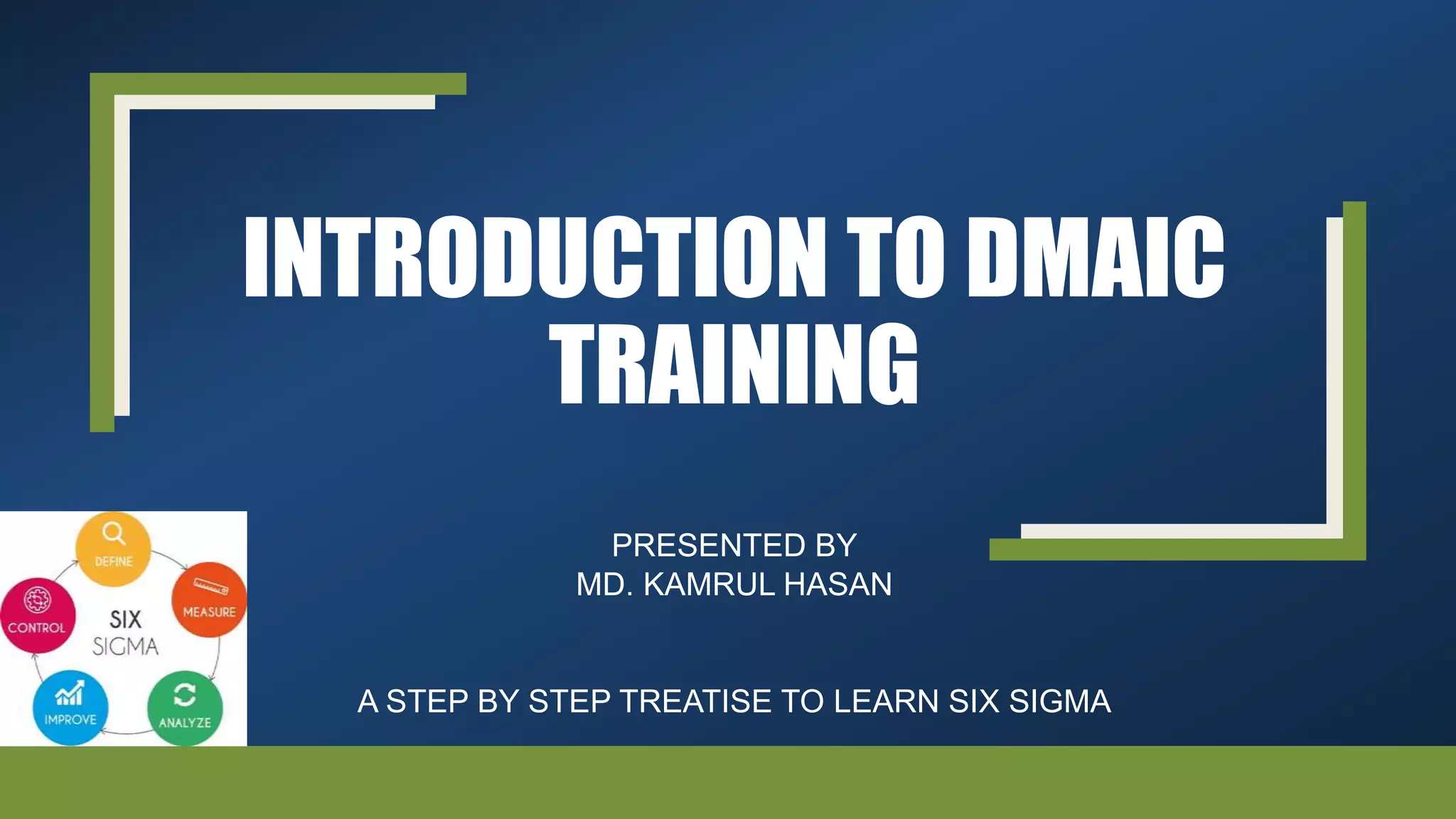
INTRODUCTION TO DMAIC
TRAINING
PRESENTED BY
MD. KAMRUL HASAN
A STEP BY STEP TREATISE TO LEARN SIX SIGMA
DMAIC PROCESS
• DMAIC is the combination of 5 major phase of process
Improvement. Each phase consist of set of tools & deliverables.
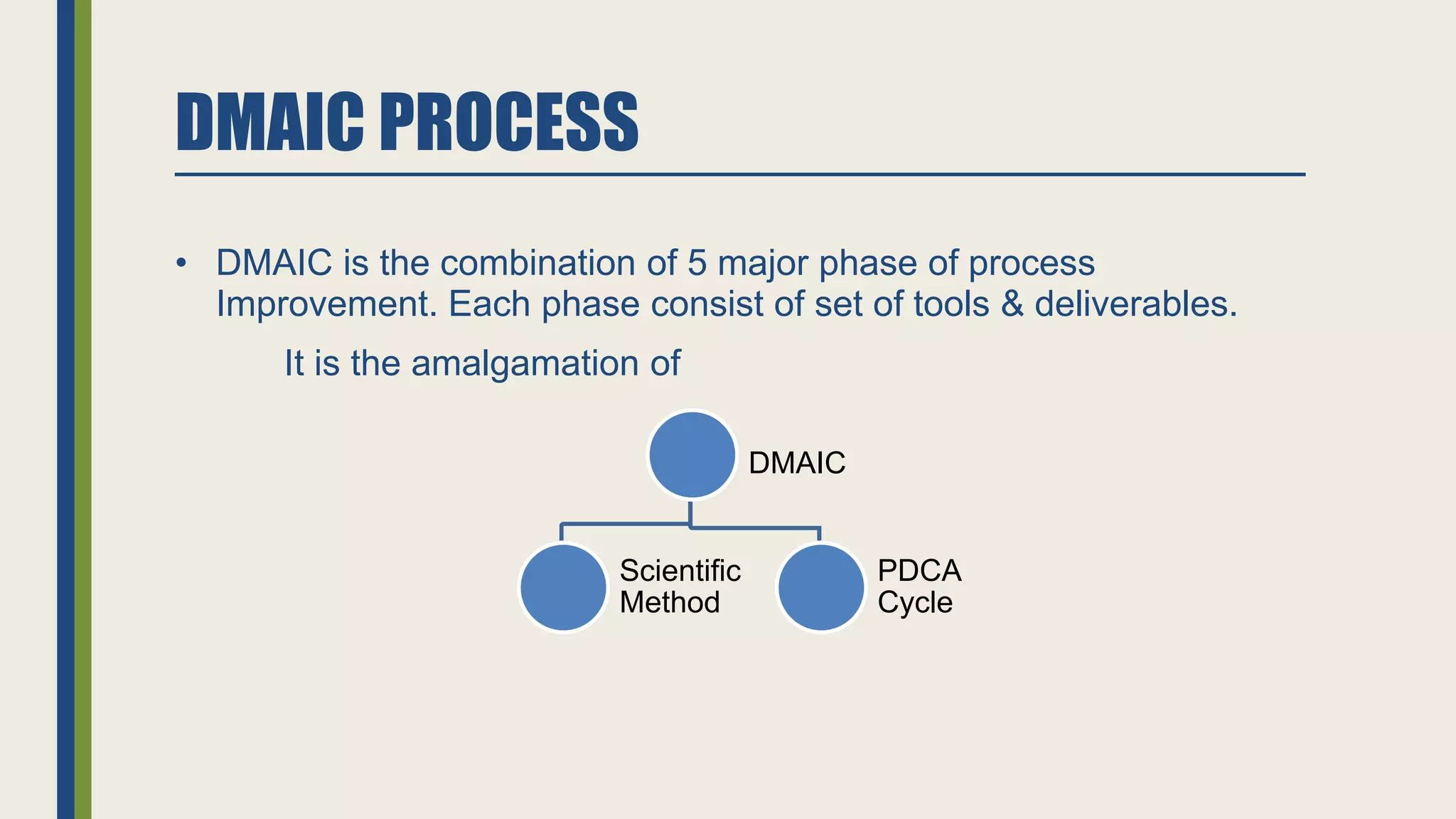
It is the amalgamation of
DMAIC
Scientific
Method
PDCA
Cycle
SCIENTIFIC METHOD
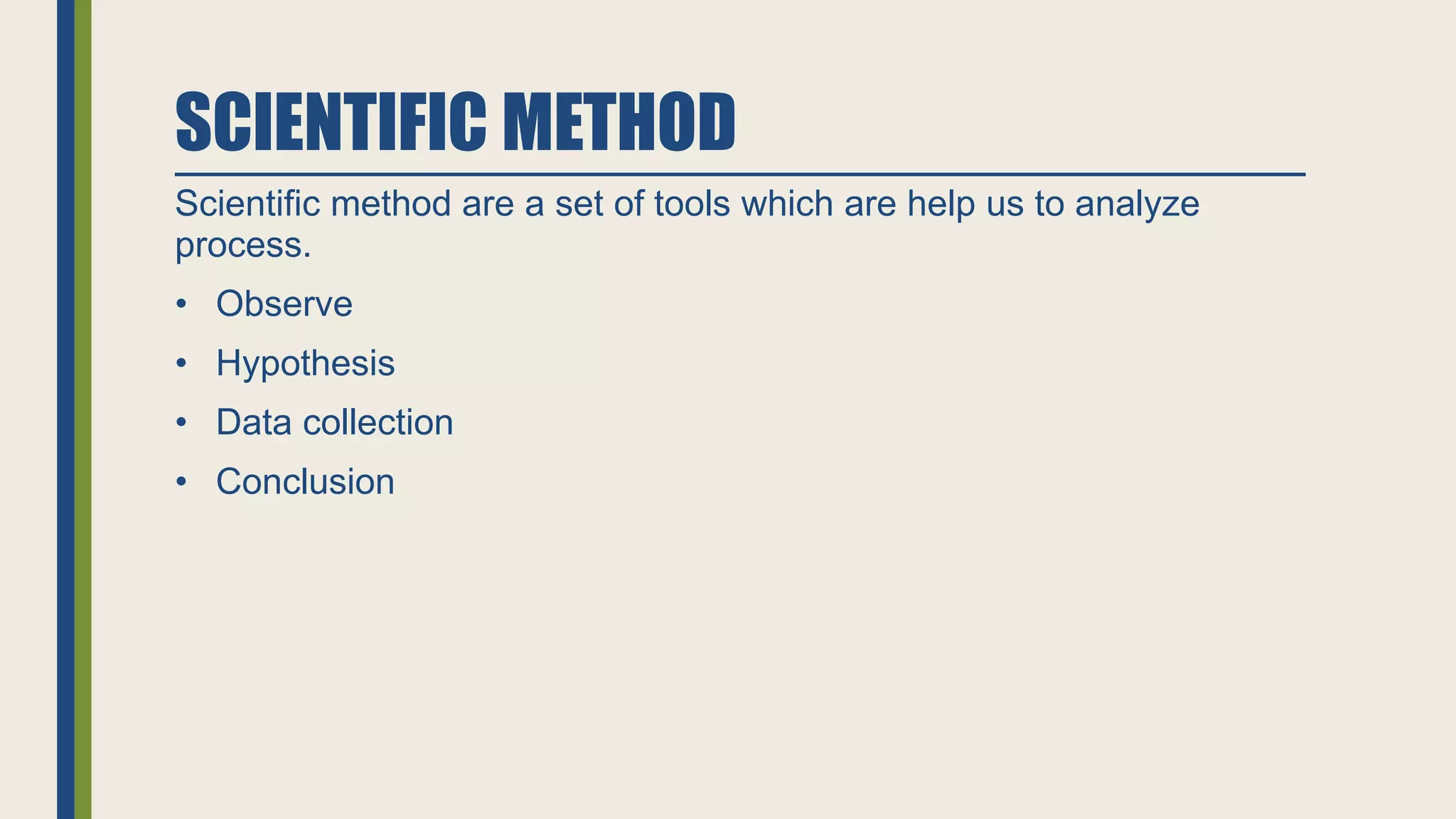
Scientific method are a set of tools which are help us to analyze
process.
• Observe
• Hypothesis
• Data collection
• Conclusion
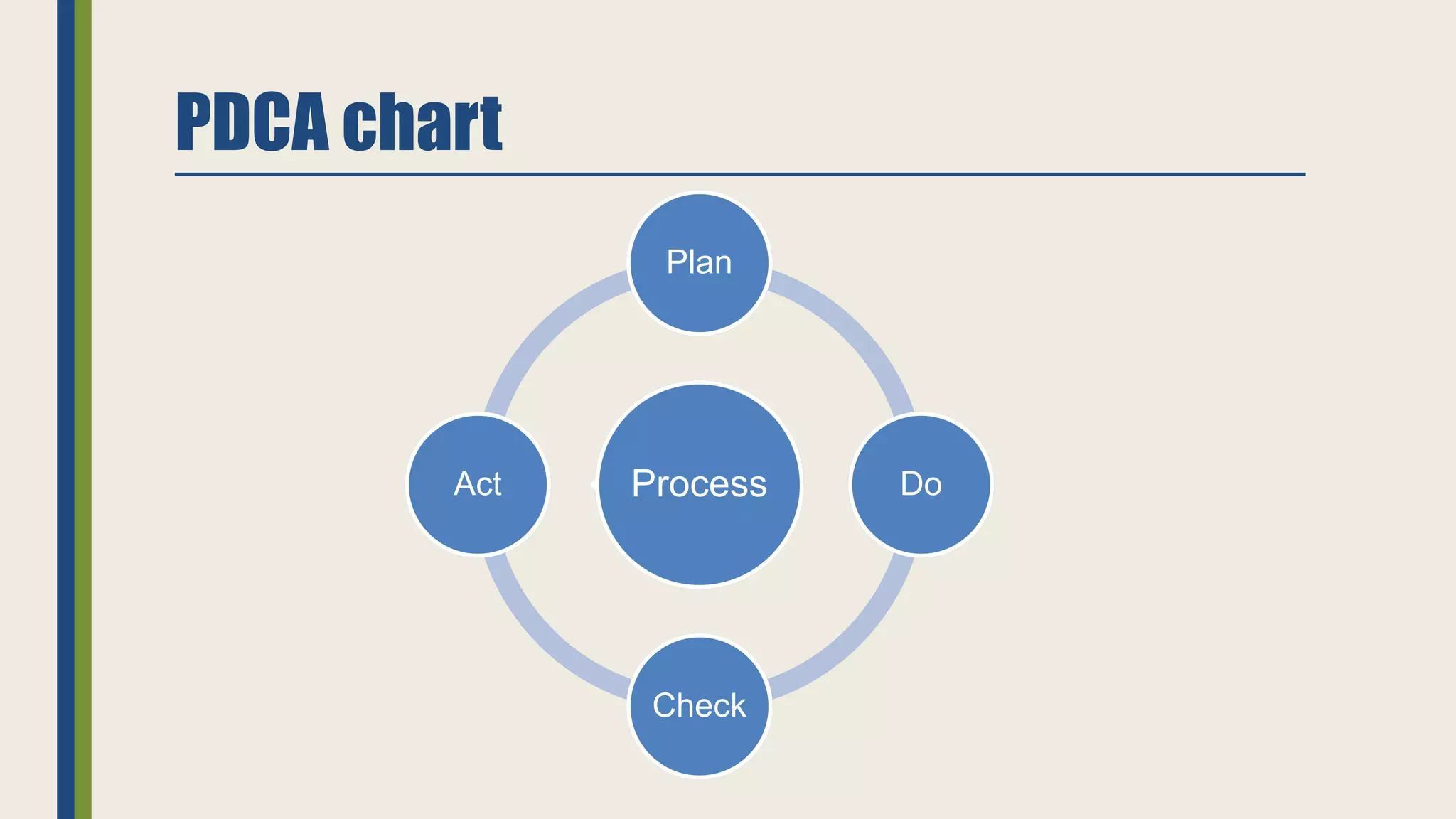
PDCA chart
Process
Plan
Do
Check
Act
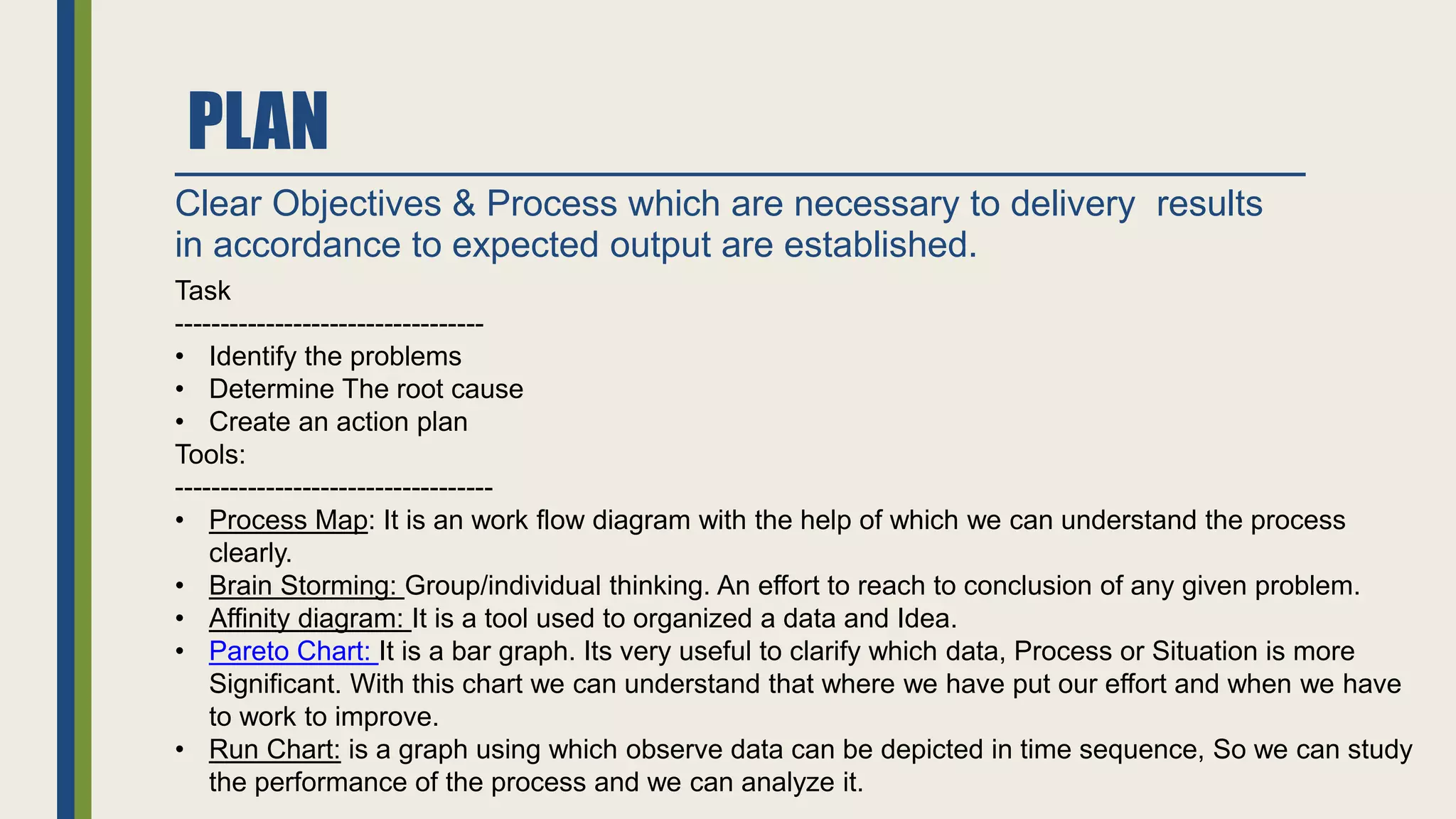
PLAN
Clear Objectives & Process which are necessary to delivery results
in accordance to expected output are established.
Task
----------------------------------
• Identify the problems
• Determine The root cause
• Create an action plan
Tools:
-----------------------------------
• Process Map: It is an work flow diagram with the help of which we can understand the process
clearly.
• Brain Storming: Group/individual thinking. An effort to reach to conclusion of any given problem.
• Affinity diagram: It is a tool used to organized a data and Idea.
• Pareto Chart: It is a bar graph. Its very useful to clarify which data, Process or Situation is more
Significant. With this chart we can understand that where we have put our effort and when we have
to work to improve.
• Run Chart: is a graph using which observe data can be depicted in time sequence, So we can study
the performance of the process and we can analyze it.
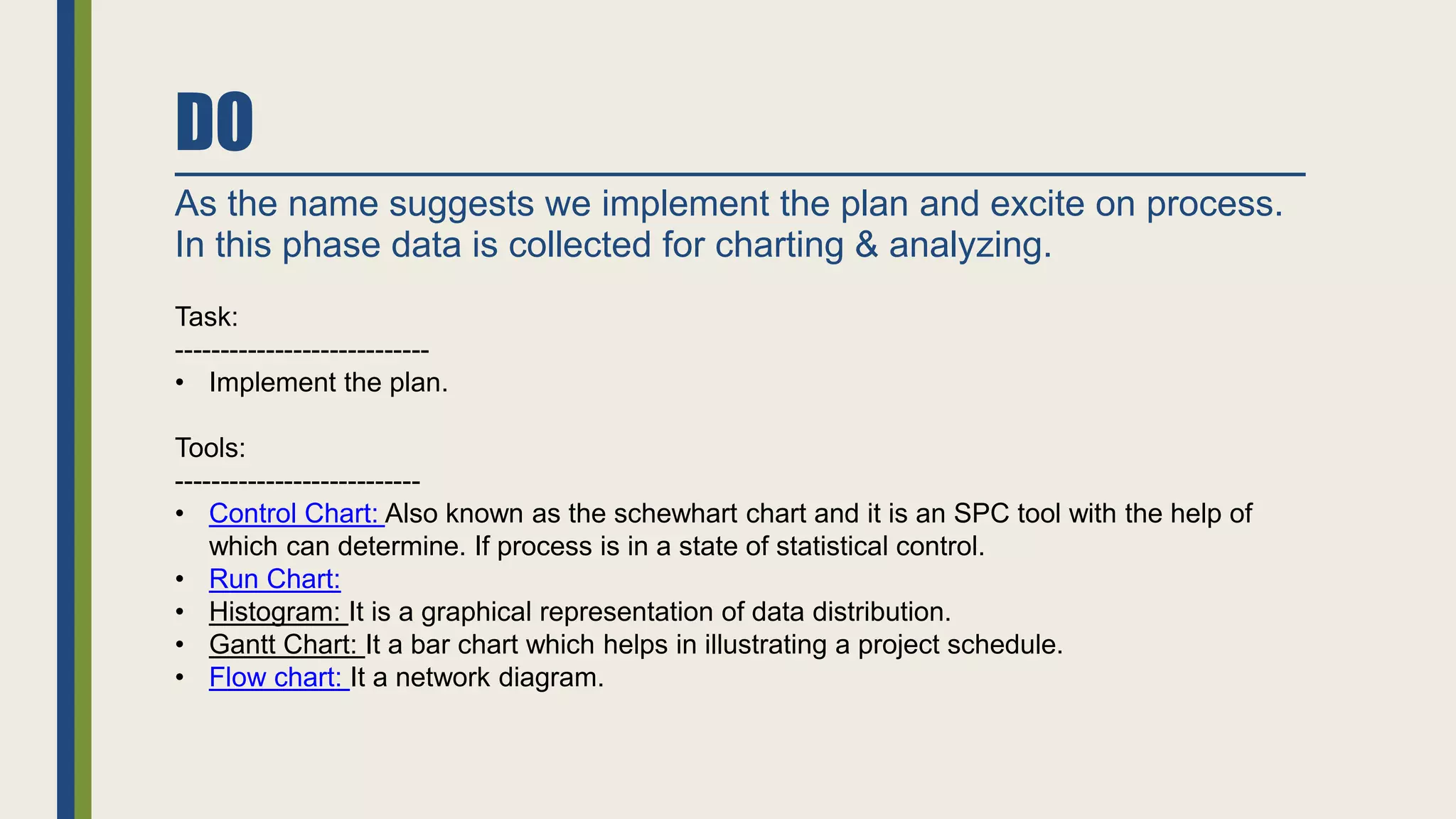
DO
As the name suggests we implement the plan and excite on process.
In this phase data is collected for charting & analyzing.
Task:
----------------------------
• Implement the plan.
Tools:
---------------------------
• Control Chart: Also known as the schewhart chart and it is an SPC tool with the help of
which can determine. If process is in a state of statistical control.
• Run Chart:
• Histogram: It is a graphical representation of data distribution.
• Gantt Chart: It a bar chart which helps in illustrating a project schedule.
• Flow chart: It a network diagram.
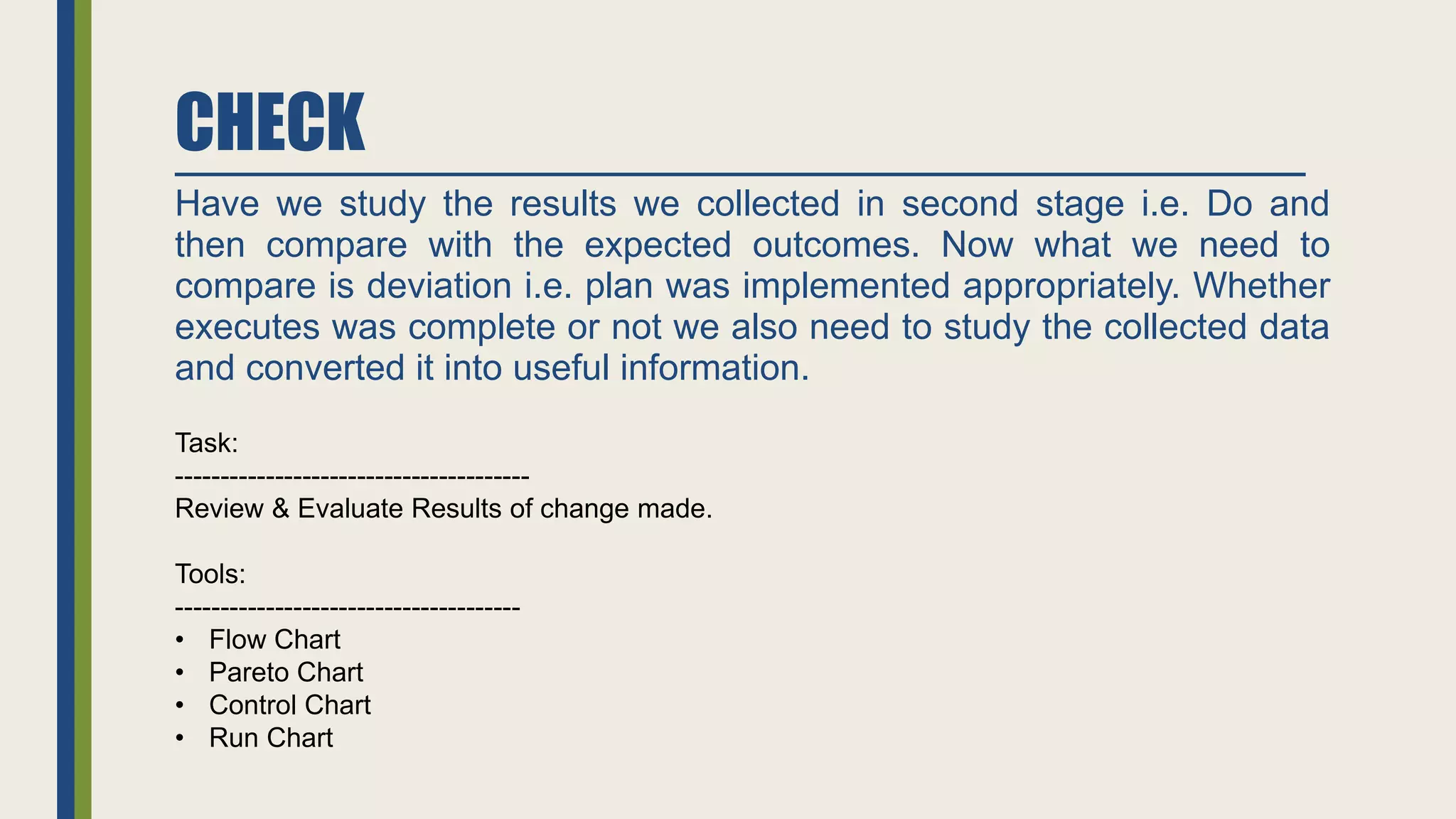
CHECK
Have we study the results we collected in second stage i.e. Do and
then compare with the expected outcomes. Now what we need to
compare is deviation i.e. plan was implemented appropriately. Whether
executes was complete or not we also need to study the collected data
and converted it into useful information.
Task:
---------------------------------------
Review & Evaluate Results of change made.
Tools:
--------------------------------------
• Flow Chart
• Pareto Chart
• Control Chart
• Run Chart
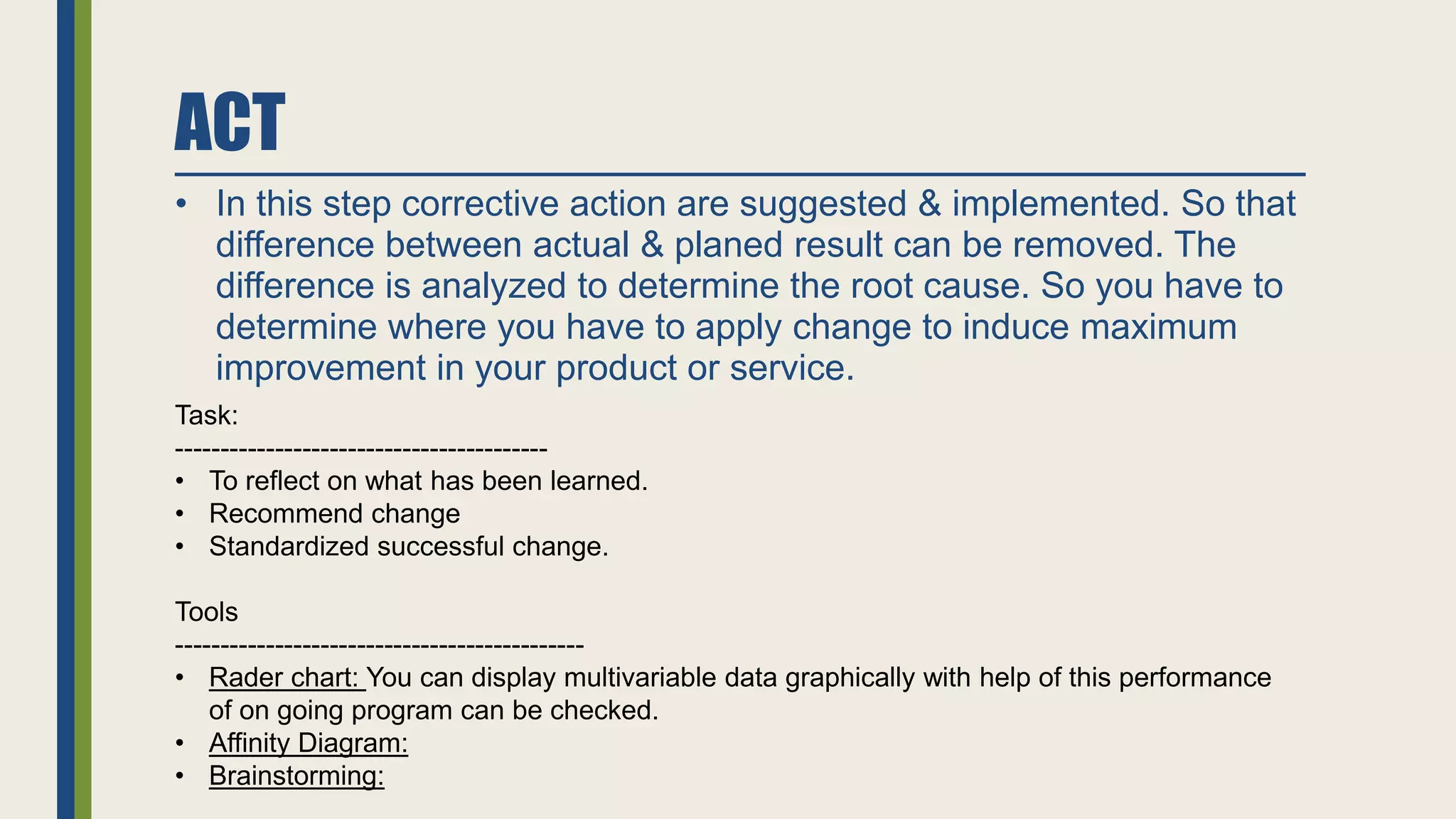
ACT
• In this step corrective action are suggested & implemented. So that
difference between actual & planed result can be removed. The
difference is analyzed to determine the root cause. So you have to
determine where you have to apply change to induce maximum
improvement in your product or service.
Task:
-----------------------------------------
• To reflect on what has been learned.
• Recommend change
• Standardized successful change.
Tools
---------------------------------------------
• Rader chart: You can display multivariable data graphically with help of this performance
of on going program can be checked.
• Affinity Diagram:
• Brainstorming:
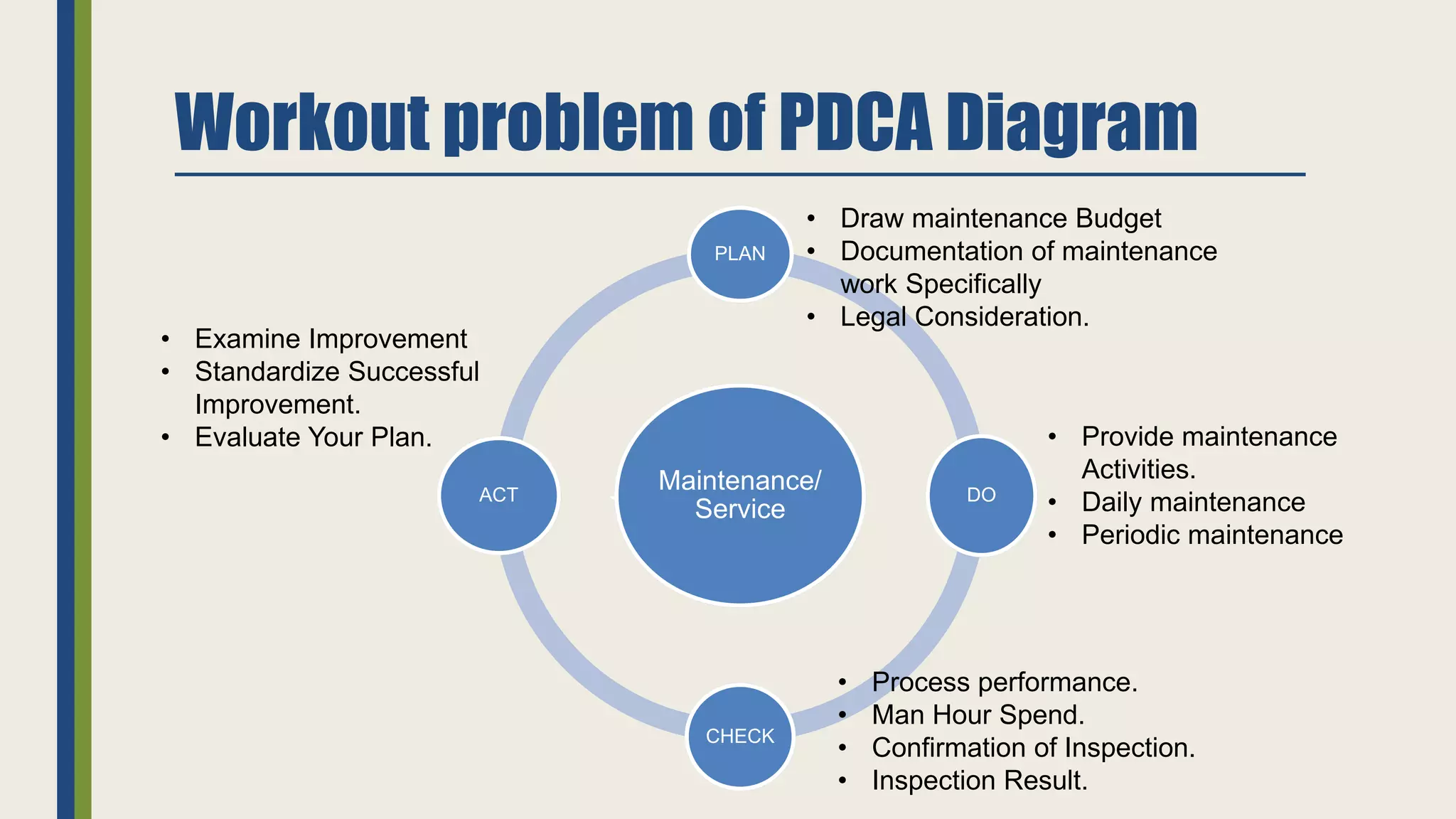
Workout problem of PDCA Diagram
Maintenance/
Service
PLAN
DO
CHECK
ACT
• Draw maintenance Budget
• Documentation of maintenance
work Specifically
• Legal Consideration.
• Provide maintenance
Activities.
• Daily maintenance
• Periodic maintenance
• Process performance.
• Man Hour Spend.
• Confirmation of Inspection.
• Inspection Result.
• Examine Improvement
• Standardize Successful
Improvement.
• Evaluate Your Plan.
DMAIC
• DMAIC refers to data driven improvement cycle used for
improving, Optimizing, Stabilizing business process & design.
• Define:
Basically we try to articulated in different phase.
• Business Problem
• Our Goal
• Potential Resources [which we can utilize].
• Project Scope.
So, What we Try to define:
• Problem [why we initial a project]
• Customer [What kinds of Product & Service are required by the customer].
• What are critical process output [i.e what is CTQ & VOC]
• Target business process.
• Scope of project.
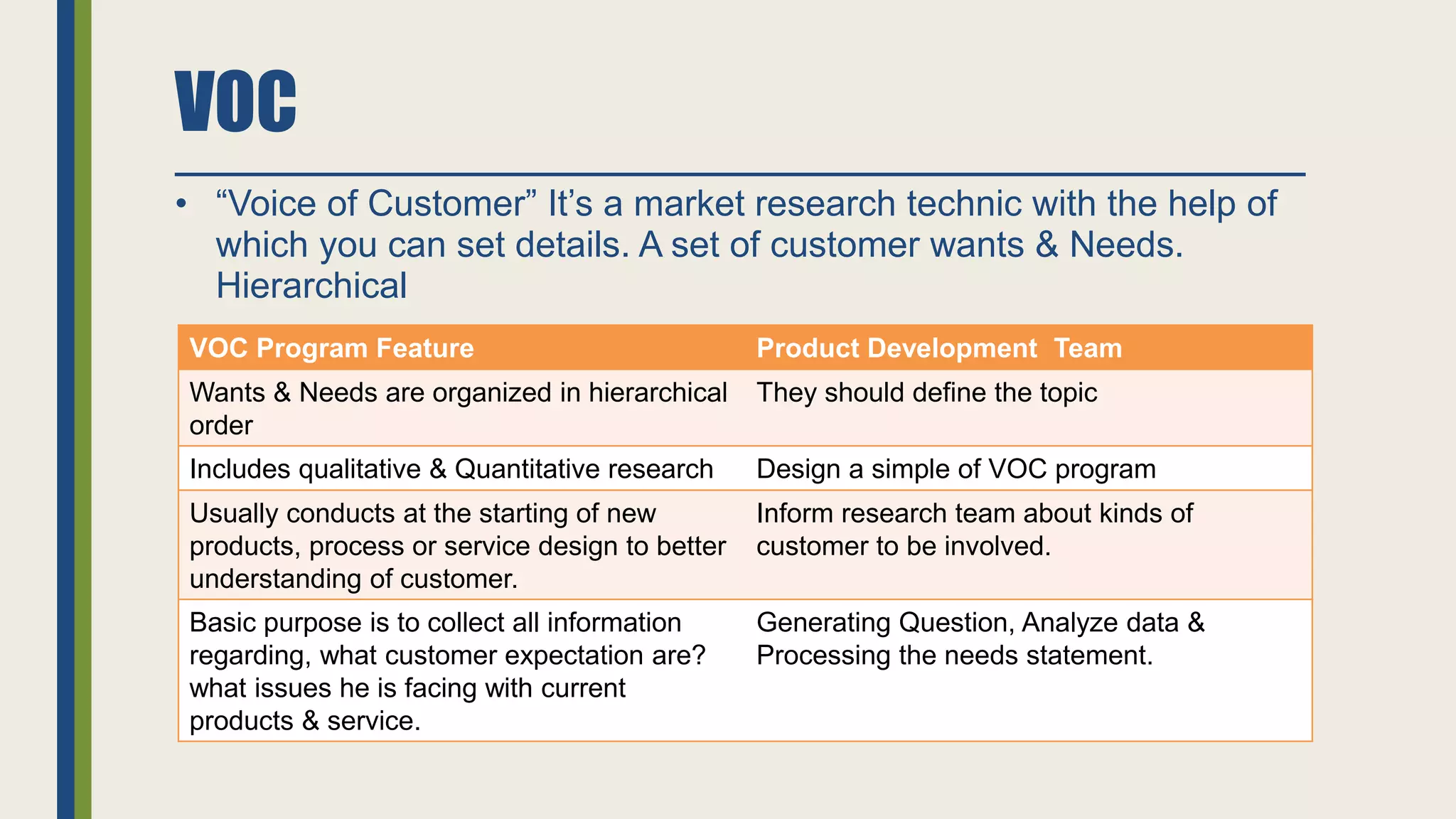
VOC
• “Voice of Customer” It’s a market research technic with the help of
which you can set details. A set of customer wants & Needs.
Hierarchical
VOC Program Feature Product Development Team
Wants & Needs are organized in hierarchical
order
They should define the topic
Includes qualitative & Quantitative research Design a simple of VOC program
Usually conducts at the starting of new
products, process or service design to better
understanding of customer.
Inform research team about kinds of
customer to be involved.
Basic purpose is to collect all information
regarding, what customer expectation are?
what issues he is facing with current
products & service.
Generating Question, Analyze data &
Processing the needs statement.
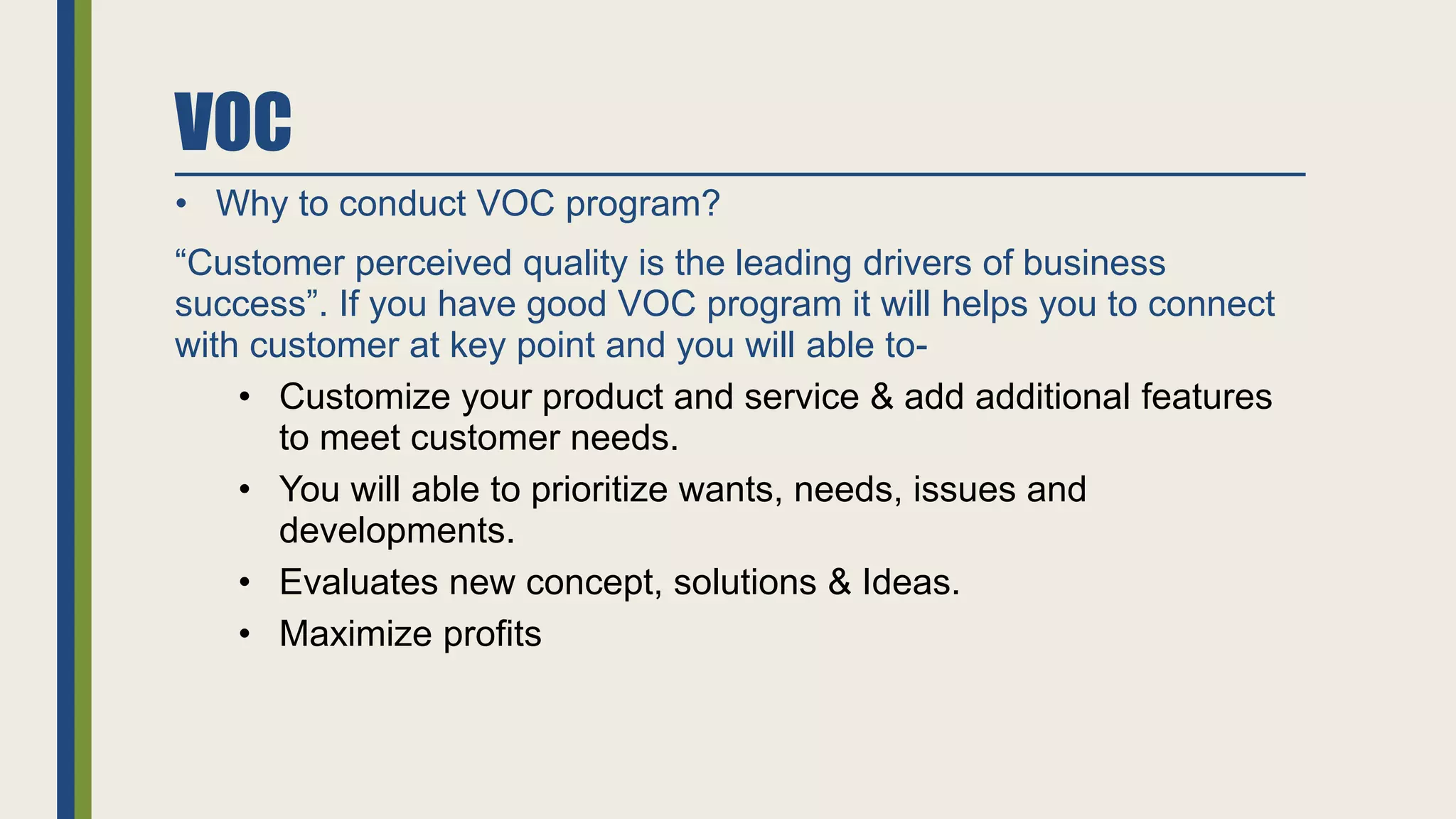
VOC
• Why to conduct VOC program?
“Customer perceived quality is the leading drivers of business
success”. If you have good VOC program it will helps you to connect
with customer at key point and you will able to-
• Customize your product and service & add additional features
to meet customer needs.
• You will able to prioritize wants, needs, issues and
developments.
• Evaluates new concept, solutions & Ideas.
• Maximize profits
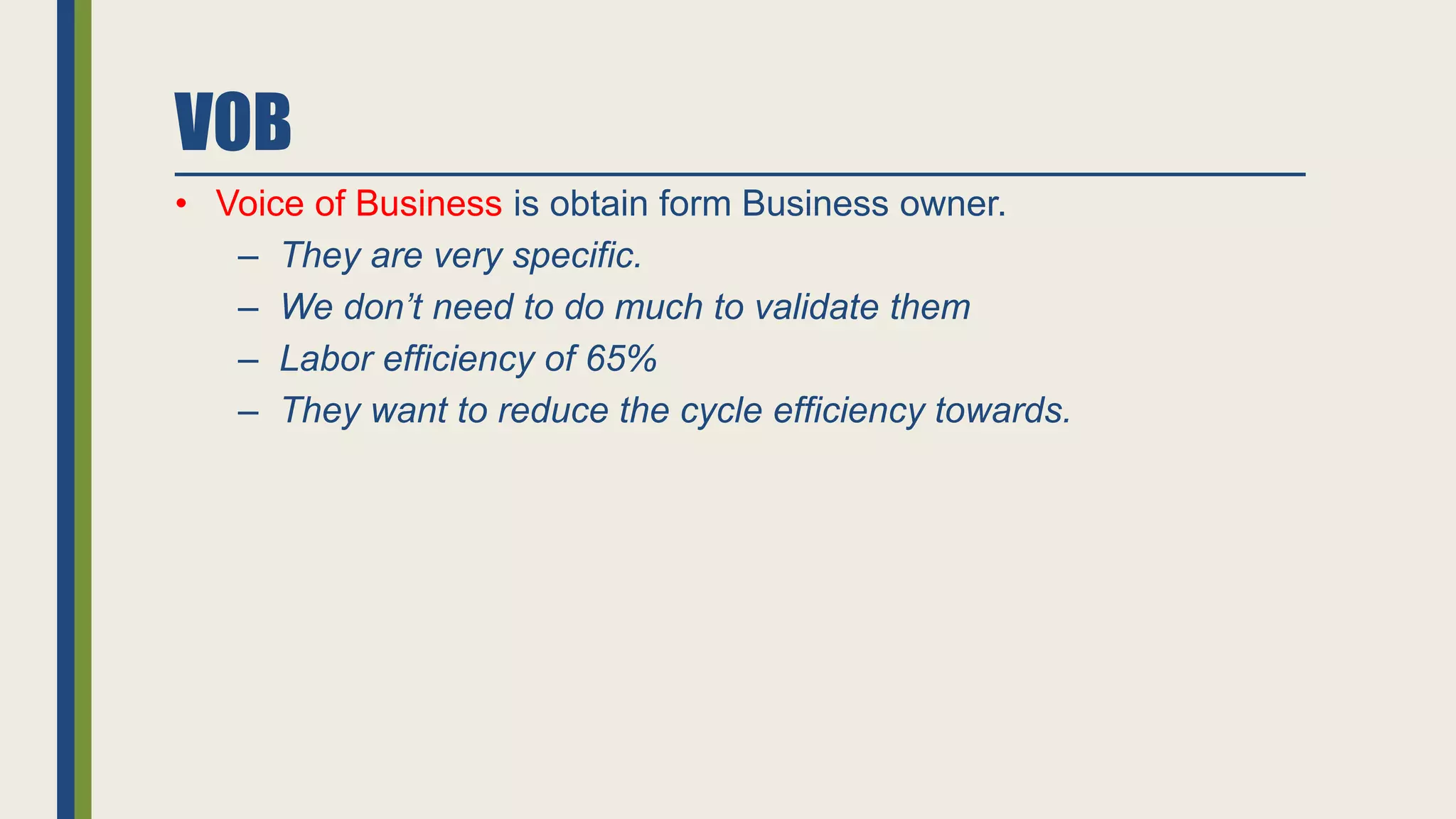
VOB
• Voice of Business is obtain form Business owner.
‒ They are very specific.
‒ We don’t need to do much to validate them
‒ Labor efficiency of 65%
‒ They want to reduce the cycle efficiency towards.
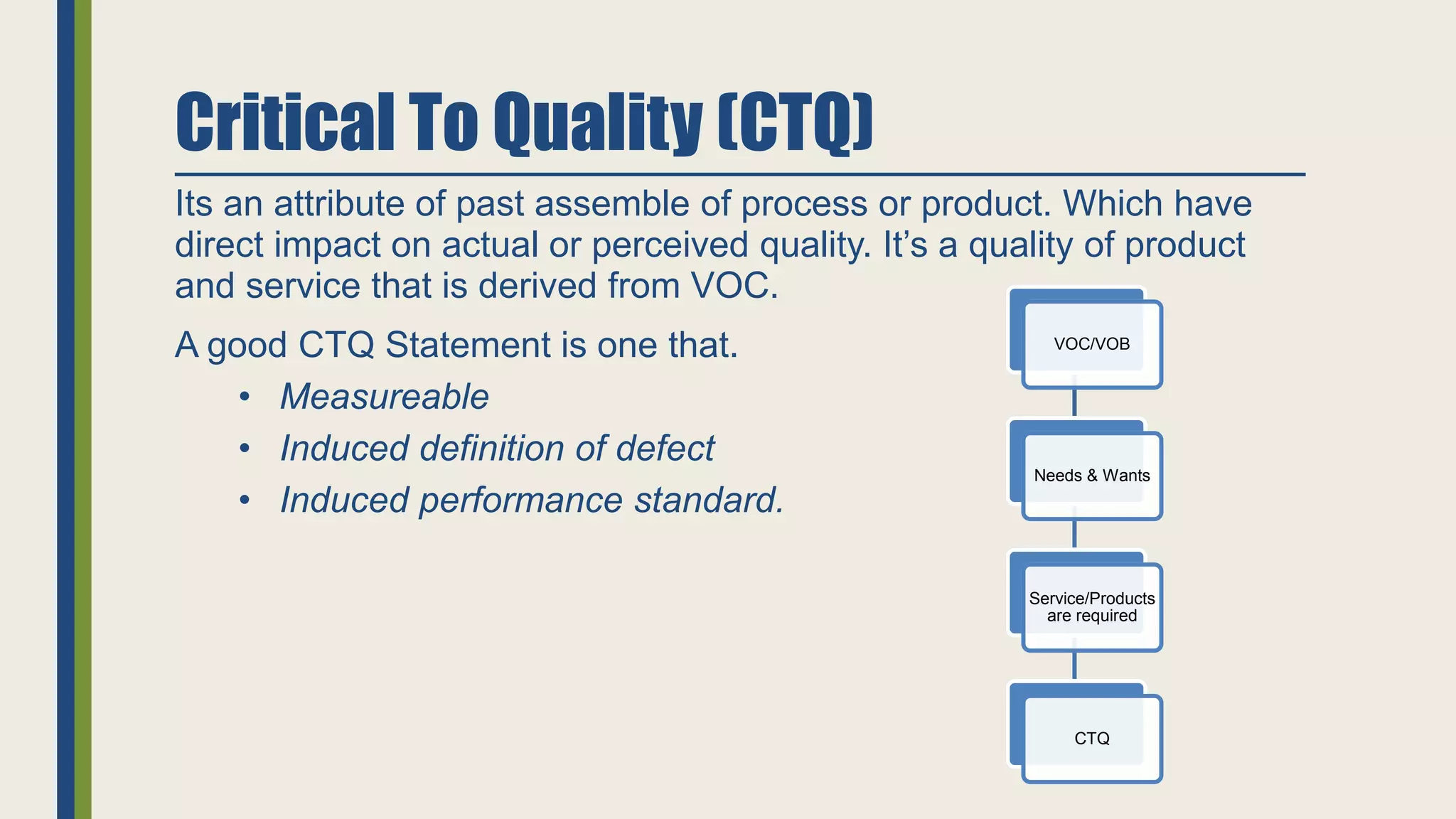
Critical To Quality (CTQ)
Its an attribute of past assemble of process or product. Which have
direct impact on actual or perceived quality. It’s a quality of product
and service that is derived from VOC.
A good CTQ Statement is one that.
• Measureable
• Induced definition of defect
• Induced performance standard.
VOC/VOB
Needs & Wants
Service/Products
are required
CTQ
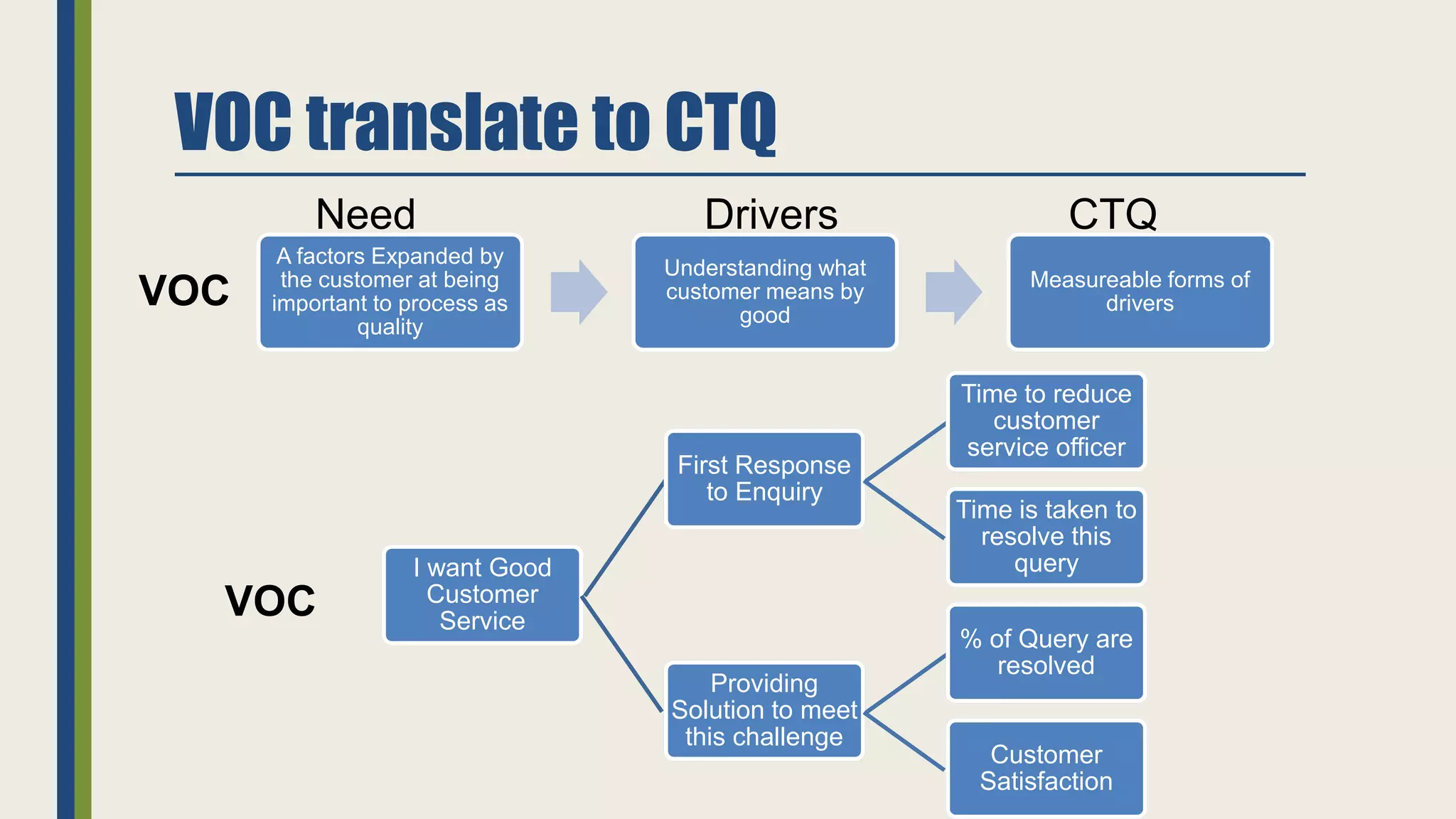
VOC translate to CTQ
A factors Expanded by
the customer at being
important to process as
quality
Understanding what
customer means by
good
Measureable forms of
driversVOC
I want Good
Customer
Service
First Response
to Enquiry
Time to reduce
customer
service officer
Time is taken to
resolve this
query
Providing
Solution to meet
this challenge
% of Query are
resolved
Customer
Satisfaction
VOC
Need Drivers CTQ
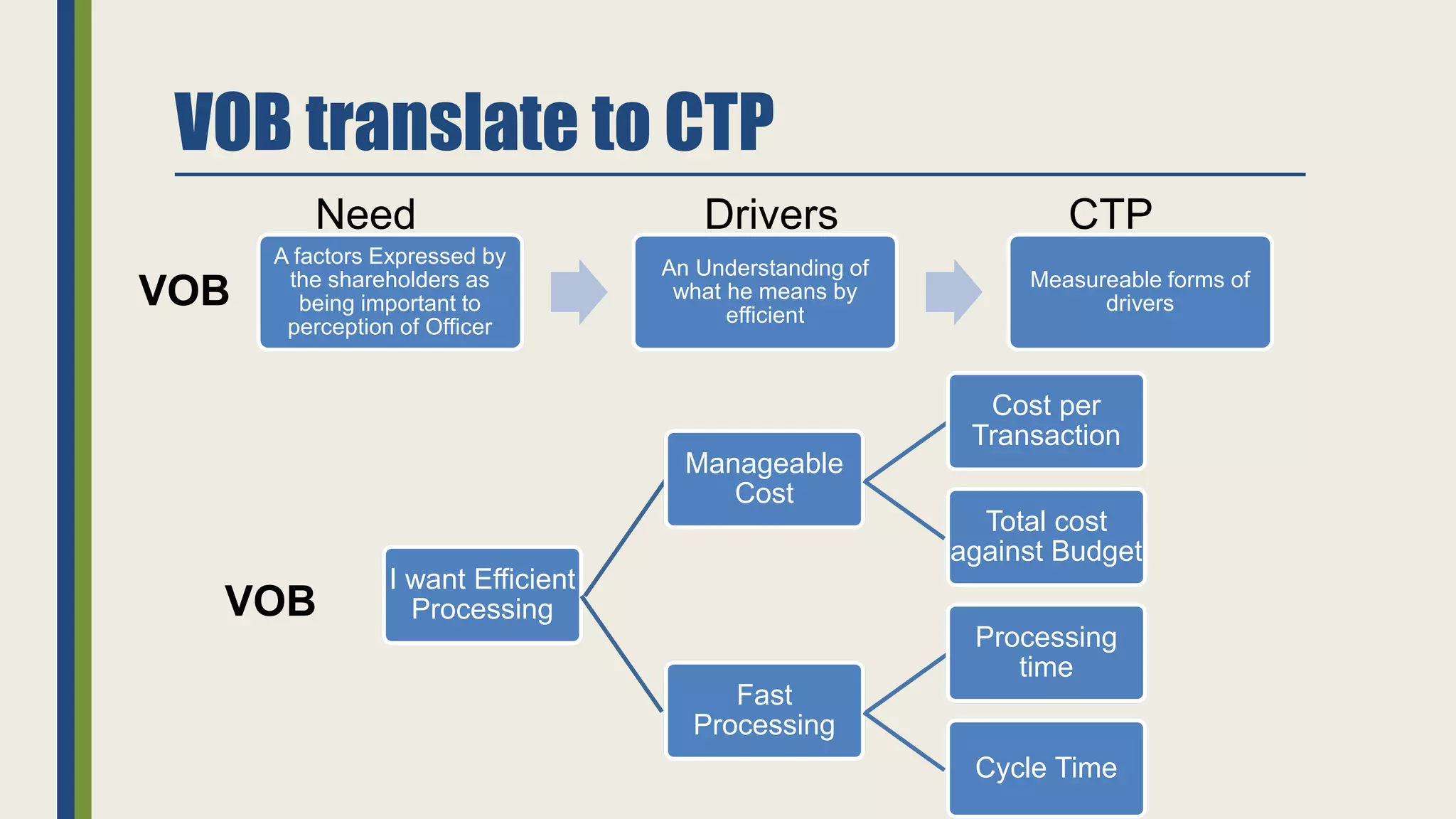
VOB translate to CTP
A factors Expressed by
the shareholders as
being important to
perception of Officer
An Understanding of
what he means by
efficient
Measureable forms of
driversVOB
I want Efficient
Processing
Manageable
Cost
Cost per
Transaction
Total cost
against Budget
Fast
Processing
Processing
time
Cycle Time
VOB
Need Drivers CTP
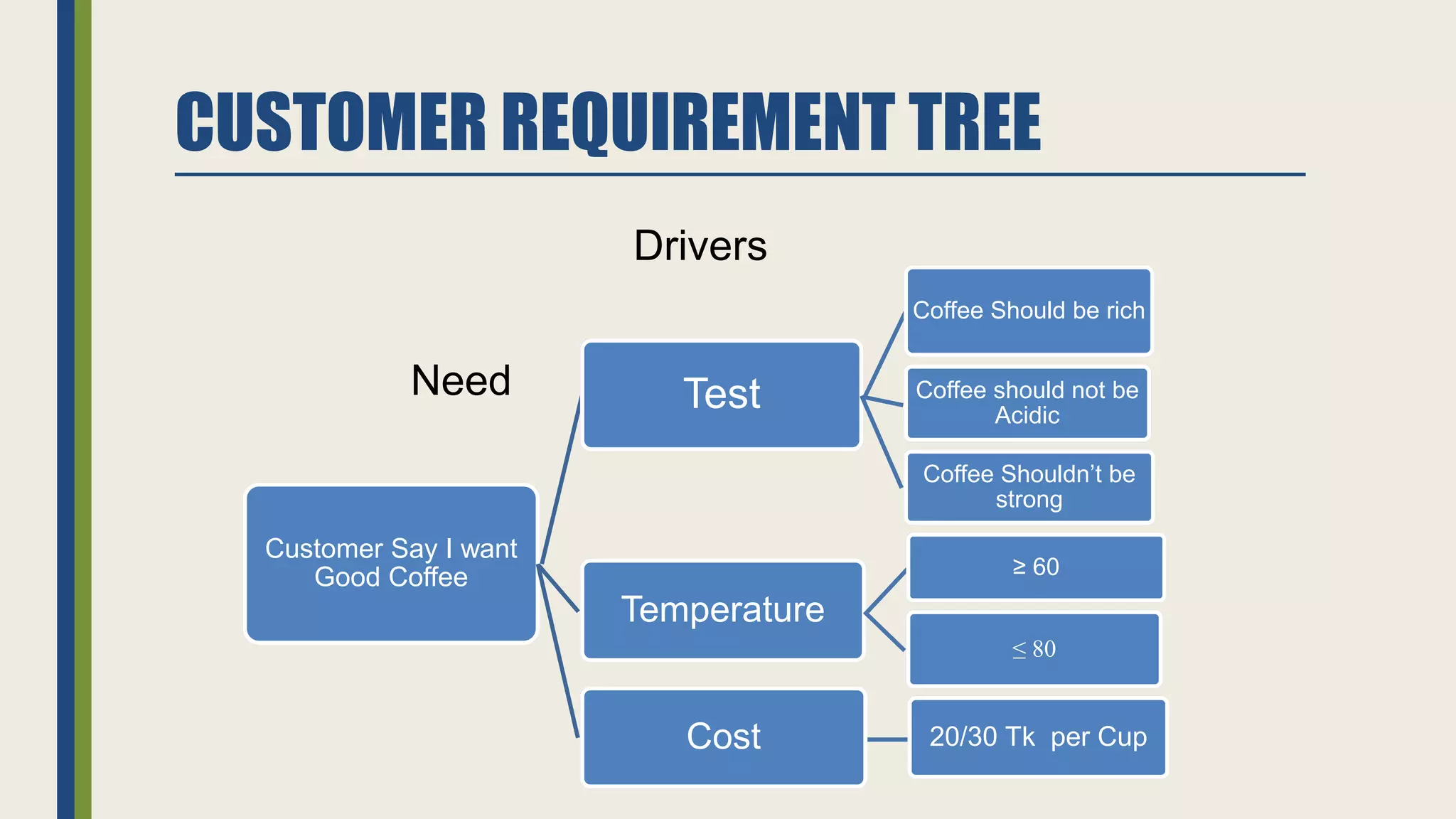
CUSTOMER REQUIREMENT TREE
Customer Say I want
Good Coffee
Test
Coffee Should be rich
Coffee should not be
Acidic
Coffee Shouldn’t be
strong
Temperature
≥ 60
≤ 80
Cost 20/30 Tk per Cup
Need
Drivers
MEASURE PHASE
• Existing system is measured, Valid & reliable metrics are
established and current process are monitored for progress
towards the goal.
» Purpose of this step is to objectively established present / current baseline as the
basis of improvement.
» In simple word, performance baseline from the measure phase will be used to
determine if the objective of six sigma project has been achieved.
How this done?
By comparing final performance metrics with baseline performance metrics.
Major consideration for this phase are?
» Identify the Gap between Current & required performance.
» Data collection: Data is collected to create a process performance baseline, so that
project metrics can be decided & output i.e. y can be sought.
» Measurement system is assessed for accuracy & precision.
» Establishing high level precision flow baseline.
ANALYZE
• System is analyzed to identify ways to eliminate gap between
current performance & the desired goals.
How this is done?
 Using statistical tools & data analysis
 Large number of process input “X” which can
be potential root cause of project problem are
identified using root causes analysis &
Fishbone diagram.
 When all possible root cause are figured, then
3-4 major causes are selected using tools
such multi voting & consensus tools.
 Data action plan is created & data is collected
to establish relative contribution of each root
cause to project metrics
 This process is repeated till team reaches a
valid root causes.
We focus on & Try to!
 List and prioritize potential causes of problem.
 Prioritize root cause on which team will work
in next step that is improve step.
 Team tries to identify process input “X” which
have an mentionable impact on output “Y”.
 Basically Data collected in measure phase is
understood to understand the magnitude of
contribution of each root cause “X” on process
output “Y”.
 This is done using statistical tools,
histrograme, Perato chart etc.
 Finally tailed process chart should be created
to pin point, where exactly the process root
causes lied & what are possible of
occurrence.
IMPROVE PHASE
Purpose of this step is to identify test & implement a solution to the
problem. Whether in part in a whole. In this step team tries to find
ways to do things better cheaper & faster.
For this?
-------------------------------
 Creative solution are identified to eliminate key
root causes so that process problem can be
prevented or fixed.
Tools which are to be used:
• Brainstorming
• Six thinking hate
• Random words
• DOE [design of experiment]
In nut shell:
--------------------------------
• Team should come up with innovative solutions.
• First focus on simplest or easiest solution.
• Solution should be Checked using a PDCA
cycle.
• Based on this results which we get from PDCA,
voidable risk should be anticipated.
• Detailed implemented plan should be created.
• Implemented plan should be deployed.
BRAINSTORMING
• As a relaxed, informed approach to problem solving with lateral
thinking.
Why Brainstorming?
Conventional group solving can’t be successful because of unhelpful
group behavior. It has been seen that structural analytical process to
problem solving can lead to limited & unimagined idea.
Where in brainstorming –
– Free and open environment.
– Encourage everyone to participate.
– Brings for diverse experience of the team which lades better
solution.
– Better team involvement.
BRAINSTORMING
Dung Brainstorming:
– Approach should always be open minded.
– Don’t be judgment other than quality of idea will go down and creativity will suffer.
a) Individual Brainstorming:
Positiveness are :
– You don’t have to worry about other peoples opinion.
– You can be move creative.
Negativenss are:
– You don’t have the experience of problem.
– Individual brainstorming is being when you need to solve
– Simple Problem
– Generate list of idea.
– Focus of problem issue.
BRAINSTORMING
• How to brainstorming effective?
Part-1: Create a road map.
a) Look at your goal [what do you want to achieve]
b) Try to understand the requirement.
c) Try to understand your limitations and what kinds of products it
should be & what you expected to develop.
d) List all your assumptions focus on you have a business or you
have to develop new product.
Try to assume
• What your customer wants
• Think about similar product that already exist in market.
e) Evaluate your source.
BRAINSTORMING
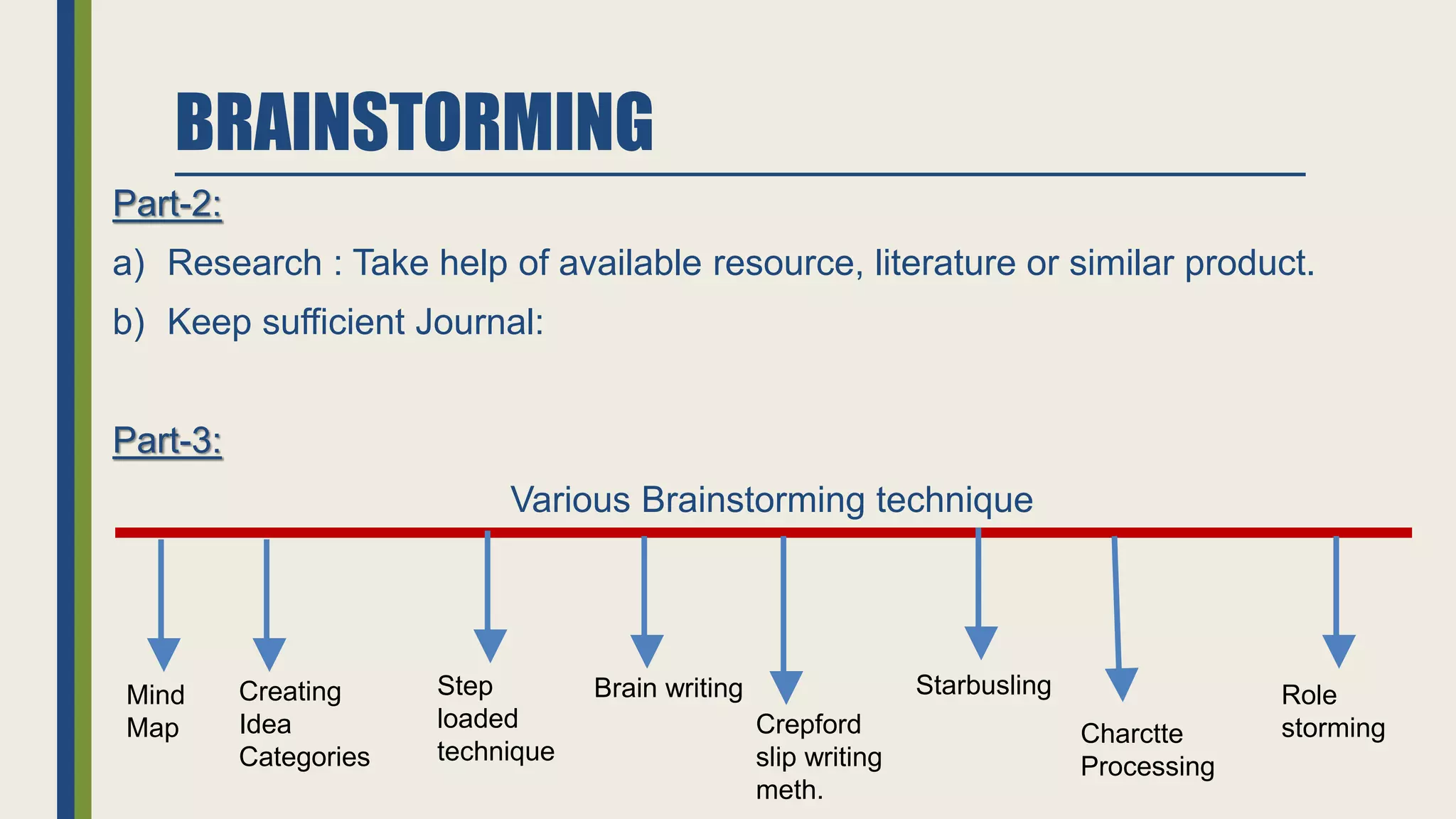
Part-2:
a) Research : Take help of available resource, literature or similar product.
b) Keep sufficient Journal:
Part-3:
Various Brainstorming technique
Mind
Map
Creating
Idea
Categories
Step
loaded
technique
Brain writing
Crepford
slip writing
meth.
Starbusling
Charctte
Processing
Role
storming
SIX THINKING HATS
• This was developed by Edward de Bono, it’s a very important &
powerful decision making technic and is used to look into decisions
from no of important perspective and will help you get a rounded
view of situation.
Using this technique a problem can be solved using all approach and technique styles:
So what you will decide will be mix of-
• Ambition
• Skilling implementation
• Public sensitivity
• Creativity
• Good contingency planning.
This technique can be used by-
• Individually
• Group
So when used in group it helps preventing confrontations that usually happen when people with
different thinking styles come together.
SIX THINKING HATS
Six thinking Hats Are:
• White Hat:
» Focus on data & information you have
» Look for gaps in your knowledge's [ then either you try to fill them or take account of them.]
» Analyze past trends
» Extrapolate from historical data.
• Red Hat
» This is a kind of thinking when you Look at problems using inclusion, gut reaction / emotionally try to think
how other people will react emotionally & try to understand their response.
• Black Hat
» Look at all the bad points of decision consciously & defensively
» Try to find out why your points may not work.
» Highlight the weak point of your plan. So that you can either eliminate them or develop contingency plan in
case they fail
» In this way you can make your plan tougher & more reveling.
CONTROL PHASE
The purpose of this step is to control the new system & this is done
by institutionalizing the improved system. The basic purpose is to
sustain gains & monitor improvement to ensure continued & sustain
success.
For this control plan is-
‒ Created
‒ Documented
‒ Updated
Control charts are developed to assess stability of improvement-
‒ To guide continued monitoring of process
‒ Response plan is developed.
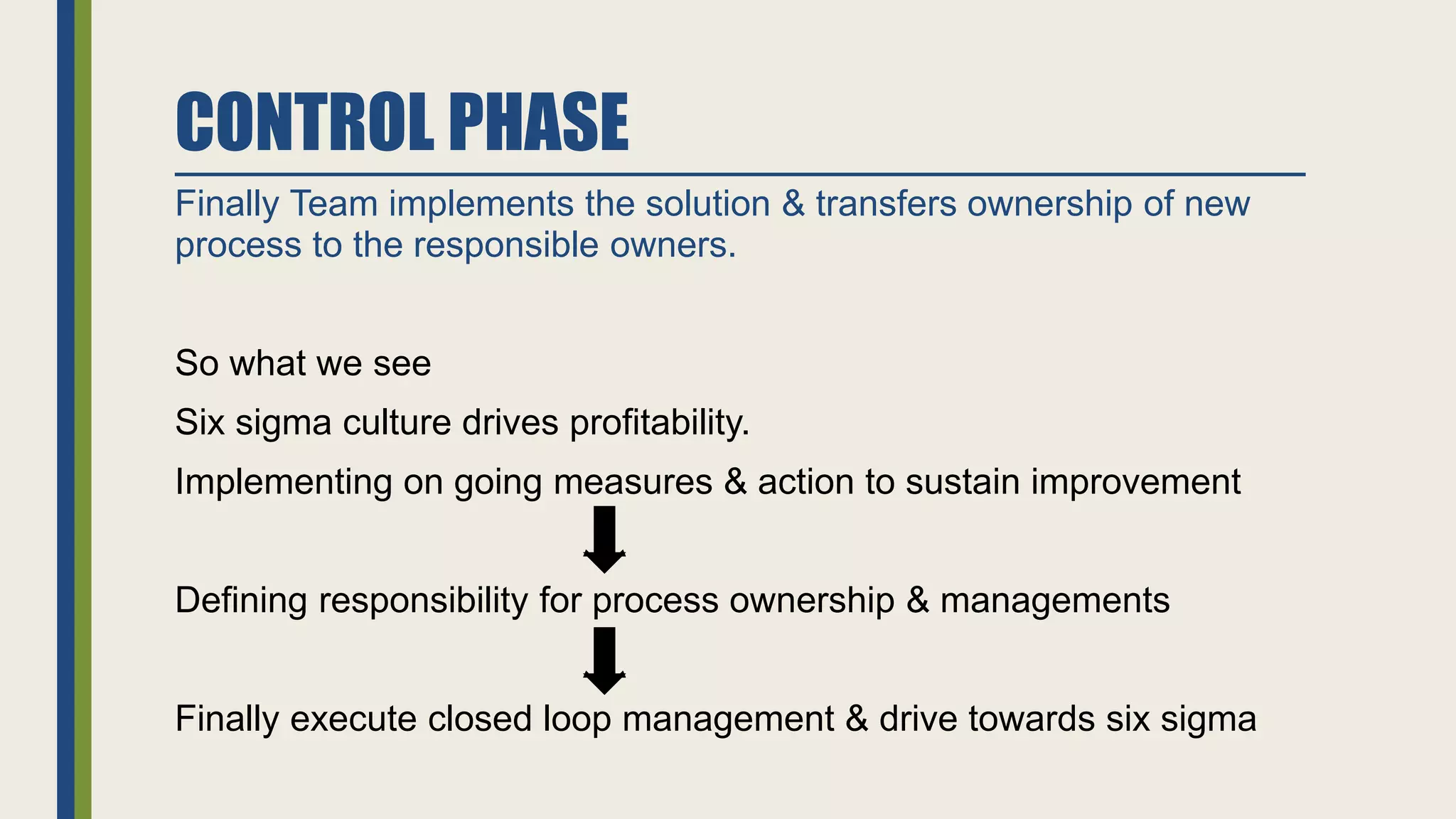
CONTROL PHASE
Finally Team implements the solution & transfers ownership of new
process to the responsible owners.
So what we see
Six sigma culture drives profitability.
Implementing on going measures & action to sustain improvement
Defining responsibility for process ownership & managements
Finally execute closed loop management & drive towards six sigma

Introduction to DMAIC Training

  • 1.
    INTRODUCTION TO DMAIC TRAINING PRESENTEDBY MD. KAMRUL HASAN A STEP BY STEP TREATISE TO LEARN SIX SIGMA
  • 2.
    DMAIC PROCESS • DMAICis the combination of 5 major phase of process Improvement. Each phase consist of set of tools & deliverables. It is the amalgamation of DMAIC Scientific Method PDCA Cycle
  • 3.
    SCIENTIFIC METHOD Scientific methodare a set of tools which are help us to analyze process. • Observe • Hypothesis • Data collection • Conclusion
  • 4.
  • 5.
    PLAN Clear Objectives &Process which are necessary to delivery results in accordance to expected output are established. Task ---------------------------------- • Identify the problems • Determine The root cause • Create an action plan Tools: ----------------------------------- • Process Map: It is an work flow diagram with the help of which we can understand the process clearly. • Brain Storming: Group/individual thinking. An effort to reach to conclusion of any given problem. • Affinity diagram: It is a tool used to organized a data and Idea. • Pareto Chart: It is a bar graph. Its very useful to clarify which data, Process or Situation is more Significant. With this chart we can understand that where we have put our effort and when we have to work to improve. • Run Chart: is a graph using which observe data can be depicted in time sequence, So we can study the performance of the process and we can analyze it.
  • 6.
    DO As the namesuggests we implement the plan and excite on process. In this phase data is collected for charting & analyzing. Task: ---------------------------- • Implement the plan. Tools: --------------------------- • Control Chart: Also known as the schewhart chart and it is an SPC tool with the help of which can determine. If process is in a state of statistical control. • Run Chart: • Histogram: It is a graphical representation of data distribution. • Gantt Chart: It a bar chart which helps in illustrating a project schedule. • Flow chart: It a network diagram.
  • 7.
    CHECK Have we studythe results we collected in second stage i.e. Do and then compare with the expected outcomes. Now what we need to compare is deviation i.e. plan was implemented appropriately. Whether executes was complete or not we also need to study the collected data and converted it into useful information. Task: --------------------------------------- Review & Evaluate Results of change made. Tools: -------------------------------------- • Flow Chart • Pareto Chart • Control Chart • Run Chart
  • 8.
    ACT • In thisstep corrective action are suggested & implemented. So that difference between actual & planed result can be removed. The difference is analyzed to determine the root cause. So you have to determine where you have to apply change to induce maximum improvement in your product or service. Task: ----------------------------------------- • To reflect on what has been learned. • Recommend change • Standardized successful change. Tools --------------------------------------------- • Rader chart: You can display multivariable data graphically with help of this performance of on going program can be checked. • Affinity Diagram: • Brainstorming:
  • 9.
    Workout problem ofPDCA Diagram Maintenance/ Service PLAN DO CHECK ACT • Draw maintenance Budget • Documentation of maintenance work Specifically • Legal Consideration. • Provide maintenance Activities. • Daily maintenance • Periodic maintenance • Process performance. • Man Hour Spend. • Confirmation of Inspection. • Inspection Result. • Examine Improvement • Standardize Successful Improvement. • Evaluate Your Plan.
  • 10.
    DMAIC • DMAIC refersto data driven improvement cycle used for improving, Optimizing, Stabilizing business process & design. • Define: Basically we try to articulated in different phase. • Business Problem • Our Goal • Potential Resources [which we can utilize]. • Project Scope. So, What we Try to define: • Problem [why we initial a project] • Customer [What kinds of Product & Service are required by the customer]. • What are critical process output [i.e what is CTQ & VOC] • Target business process. • Scope of project.
  • 11.
    VOC • “Voice ofCustomer” It’s a market research technic with the help of which you can set details. A set of customer wants & Needs. Hierarchical VOC Program Feature Product Development Team Wants & Needs are organized in hierarchical order They should define the topic Includes qualitative & Quantitative research Design a simple of VOC program Usually conducts at the starting of new products, process or service design to better understanding of customer. Inform research team about kinds of customer to be involved. Basic purpose is to collect all information regarding, what customer expectation are? what issues he is facing with current products & service. Generating Question, Analyze data & Processing the needs statement.
  • 12.
    VOC • Why toconduct VOC program? “Customer perceived quality is the leading drivers of business success”. If you have good VOC program it will helps you to connect with customer at key point and you will able to- • Customize your product and service & add additional features to meet customer needs. • You will able to prioritize wants, needs, issues and developments. • Evaluates new concept, solutions & Ideas. • Maximize profits
  • 13.
    VOB • Voice ofBusiness is obtain form Business owner. ‒ They are very specific. ‒ We don’t need to do much to validate them ‒ Labor efficiency of 65% ‒ They want to reduce the cycle efficiency towards.
  • 14.
    Critical To Quality(CTQ) Its an attribute of past assemble of process or product. Which have direct impact on actual or perceived quality. It’s a quality of product and service that is derived from VOC. A good CTQ Statement is one that. • Measureable • Induced definition of defect • Induced performance standard. VOC/VOB Needs & Wants Service/Products are required CTQ
  • 15.
    VOC translate toCTQ A factors Expanded by the customer at being important to process as quality Understanding what customer means by good Measureable forms of driversVOC I want Good Customer Service First Response to Enquiry Time to reduce customer service officer Time is taken to resolve this query Providing Solution to meet this challenge % of Query are resolved Customer Satisfaction VOC Need Drivers CTQ
  • 16.
    VOB translate toCTP A factors Expressed by the shareholders as being important to perception of Officer An Understanding of what he means by efficient Measureable forms of driversVOB I want Efficient Processing Manageable Cost Cost per Transaction Total cost against Budget Fast Processing Processing time Cycle Time VOB Need Drivers CTP
  • 17.
    CUSTOMER REQUIREMENT TREE CustomerSay I want Good Coffee Test Coffee Should be rich Coffee should not be Acidic Coffee Shouldn’t be strong Temperature ≥ 60 ≤ 80 Cost 20/30 Tk per Cup Need Drivers
  • 18.
    MEASURE PHASE • Existingsystem is measured, Valid & reliable metrics are established and current process are monitored for progress towards the goal. » Purpose of this step is to objectively established present / current baseline as the basis of improvement. » In simple word, performance baseline from the measure phase will be used to determine if the objective of six sigma project has been achieved. How this done? By comparing final performance metrics with baseline performance metrics. Major consideration for this phase are? » Identify the Gap between Current & required performance. » Data collection: Data is collected to create a process performance baseline, so that project metrics can be decided & output i.e. y can be sought. » Measurement system is assessed for accuracy & precision. » Establishing high level precision flow baseline.
  • 19.
    ANALYZE • System isanalyzed to identify ways to eliminate gap between current performance & the desired goals. How this is done?  Using statistical tools & data analysis  Large number of process input “X” which can be potential root cause of project problem are identified using root causes analysis & Fishbone diagram.  When all possible root cause are figured, then 3-4 major causes are selected using tools such multi voting & consensus tools.  Data action plan is created & data is collected to establish relative contribution of each root cause to project metrics  This process is repeated till team reaches a valid root causes. We focus on & Try to!  List and prioritize potential causes of problem.  Prioritize root cause on which team will work in next step that is improve step.  Team tries to identify process input “X” which have an mentionable impact on output “Y”.  Basically Data collected in measure phase is understood to understand the magnitude of contribution of each root cause “X” on process output “Y”.  This is done using statistical tools, histrograme, Perato chart etc.  Finally tailed process chart should be created to pin point, where exactly the process root causes lied & what are possible of occurrence.
  • 20.
    IMPROVE PHASE Purpose ofthis step is to identify test & implement a solution to the problem. Whether in part in a whole. In this step team tries to find ways to do things better cheaper & faster. For this? -------------------------------  Creative solution are identified to eliminate key root causes so that process problem can be prevented or fixed. Tools which are to be used: • Brainstorming • Six thinking hate • Random words • DOE [design of experiment] In nut shell: -------------------------------- • Team should come up with innovative solutions. • First focus on simplest or easiest solution. • Solution should be Checked using a PDCA cycle. • Based on this results which we get from PDCA, voidable risk should be anticipated. • Detailed implemented plan should be created. • Implemented plan should be deployed.
  • 21.
    BRAINSTORMING • As arelaxed, informed approach to problem solving with lateral thinking. Why Brainstorming? Conventional group solving can’t be successful because of unhelpful group behavior. It has been seen that structural analytical process to problem solving can lead to limited & unimagined idea. Where in brainstorming – – Free and open environment. – Encourage everyone to participate. – Brings for diverse experience of the team which lades better solution. – Better team involvement.
  • 22.
    BRAINSTORMING Dung Brainstorming: – Approachshould always be open minded. – Don’t be judgment other than quality of idea will go down and creativity will suffer. a) Individual Brainstorming: Positiveness are : – You don’t have to worry about other peoples opinion. – You can be move creative. Negativenss are: – You don’t have the experience of problem. – Individual brainstorming is being when you need to solve – Simple Problem – Generate list of idea. – Focus of problem issue.
  • 23.
    BRAINSTORMING • How tobrainstorming effective? Part-1: Create a road map. a) Look at your goal [what do you want to achieve] b) Try to understand the requirement. c) Try to understand your limitations and what kinds of products it should be & what you expected to develop. d) List all your assumptions focus on you have a business or you have to develop new product. Try to assume • What your customer wants • Think about similar product that already exist in market. e) Evaluate your source.
  • 24.
    BRAINSTORMING Part-2: a) Research :Take help of available resource, literature or similar product. b) Keep sufficient Journal: Part-3: Various Brainstorming technique Mind Map Creating Idea Categories Step loaded technique Brain writing Crepford slip writing meth. Starbusling Charctte Processing Role storming
  • 25.
    SIX THINKING HATS •This was developed by Edward de Bono, it’s a very important & powerful decision making technic and is used to look into decisions from no of important perspective and will help you get a rounded view of situation. Using this technique a problem can be solved using all approach and technique styles: So what you will decide will be mix of- • Ambition • Skilling implementation • Public sensitivity • Creativity • Good contingency planning. This technique can be used by- • Individually • Group So when used in group it helps preventing confrontations that usually happen when people with different thinking styles come together.
  • 26.
    SIX THINKING HATS Sixthinking Hats Are: • White Hat: » Focus on data & information you have » Look for gaps in your knowledge's [ then either you try to fill them or take account of them.] » Analyze past trends » Extrapolate from historical data. • Red Hat » This is a kind of thinking when you Look at problems using inclusion, gut reaction / emotionally try to think how other people will react emotionally & try to understand their response. • Black Hat » Look at all the bad points of decision consciously & defensively » Try to find out why your points may not work. » Highlight the weak point of your plan. So that you can either eliminate them or develop contingency plan in case they fail » In this way you can make your plan tougher & more reveling.
  • 27.
    CONTROL PHASE The purposeof this step is to control the new system & this is done by institutionalizing the improved system. The basic purpose is to sustain gains & monitor improvement to ensure continued & sustain success. For this control plan is- ‒ Created ‒ Documented ‒ Updated Control charts are developed to assess stability of improvement- ‒ To guide continued monitoring of process ‒ Response plan is developed.
  • 28.
    CONTROL PHASE Finally Teamimplements the solution & transfers ownership of new process to the responsible owners. So what we see Six sigma culture drives profitability. Implementing on going measures & action to sustain improvement Defining responsibility for process ownership & managements Finally execute closed loop management & drive towards six sigma