P R E S E N T A T I O N O N
BIG DATA ANALYSIS AND
PROCESSING
Introduction to big
data processing
Introduction
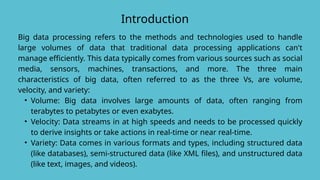
Big data processing refers to the methods and technologies used to handle
large volumes of data that traditional data processing applications can't
manage efficiently. This data typically comes from various sources such as social
media, sensors, machines, transactions, and more. The three main

characteristics of big data, often referred to as the three Vs, are volume,
velocity, and variety:
• Volume: Big data involves large amounts of data, often ranging from
terabytes to petabytes or even exabytes.
• Velocity: Data streams in at high speeds and needs to be processed quickly
to derive insights or take actions in real-time or near real-time.
• Variety: Data comes in various formats and types, including structured data
(like databases), semi-structured data (like XML files), and unstructured data
(like text, images, and videos).
components of Big data processing
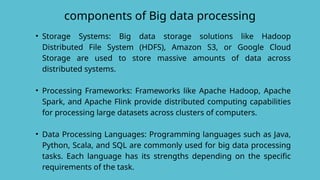
• Storage Systems: Big data storage solutions like Hadoop
Distributed File System (HDFS), Amazon S3, or Google Cloud
Storage are used to store massive amounts of data across
distributed systems.
• Processing Frameworks: Frameworks like Apache Hadoop, Apache
Spark, and Apache Flink provide distributed computing capabilities
for processing large datasets across clusters of computers.
• Data Processing Languages: Programming languages such as Java,
Python, Scala, and SQL are commonly used for big data processing
tasks. Each language has its strengths depending on the specific
requirements of the task.
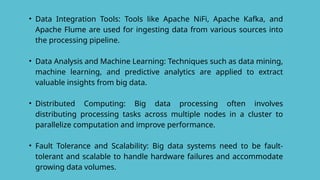
• Data Integration Tools: Tools like Apache NiFi, Apache Kafka, and
Apache Flume are used for ingesting data from various sources into
the processing pipeline.
• Data Analysis and Machine Learning: Techniques such as data mining,
machine learning, and predictive analytics are applied to extract
valuable insights from big data.
• Distributed Computing: Big data processing often involves
distributing processing tasks across multiple nodes in a cluster to
parallelize computation and improve performance.
• Fault Tolerance and Scalability: Big data systems need to be fault-
tolerant and scalable to handle hardware failures and accommodate
growing data volumes.
Introduction to
hadoop
What is
Hadoop?
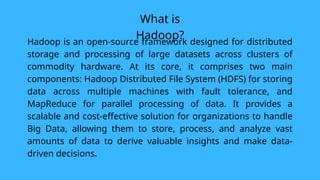
Hadoop is an open-source framework designed for distributed
storage and processing of large datasets across clusters of
commodity hardware. At its core, it comprises two main
components: Hadoop Distributed File System (HDFS) for storing
data across multiple machines with fault tolerance, and
MapReduce for parallel processing of data. It provides a
scalable and cost-effective solution for organizations to handle
Big Data, allowing them to store, process, and analyze vast
amounts of data to derive valuable insights and make data-
driven decisions.
Components of Hadoop ecosystem
• Hadoop Distributed File System (HDFS): HDFS is the primary storage system
used by Hadoop. It is designed to store large files across multiple machines in
a reliable and fault-tolerant manner. HDFS divides large files into smaller
blocks and distributes them across a cluster of commodity hardware.
• Hadoop MapReduce: MapReduce is a programming model and processing
engine for parallel processing of large datasets across a distributed cluster. It
consists of two main phases: the Map phase, where data is processed in
parallel across multiple nodes, and the Reduce phase, where the results from
the Map phase are aggregated.
• YARN (Yet Another Resource Negotiator): YARN is the resource management
layer of Hadoop. It is responsible for managing and allocating resources
(CPU, memory, etc.) to various applications running on the Hadoop cluster.
YARN decouples the resource management and job scheduling functionalities
• Hadoop Common: Hadoop Common contains libraries and utilities
that support other Hadoop modules. It includes common utilities,
configuration files, and libraries used by various components in the
Hadoop ecosystem.
• Hadoop HBase: HBase is a distributed, scalable, and column-oriented
NoSQL database built on top of Hadoop. It provides real-time
read/write access to large datasets and is suitable for applications
requiring random, real-time read/write access to Big Data.
• Hadoop Hive: Hive is a data warehouse infrastructure built on top of
Hadoop that provides a SQL-like interface (HiveQL) for querying and
managing large datasets stored in HDFS. Hive translates SQL queries
into MapReduce or Tez jobs, allowing users familiar with SQL to
analyze Big Data without needing to learn complex programming
models.
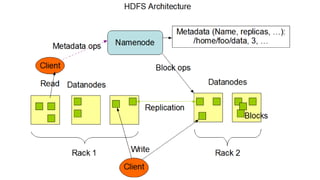
The Hadoop Distributed File System (HDFS) architecture
comprises two main components: the NameNode and
DataNodes. The NameNode, serving as the master node,
manages metadata including file structure and block locations,
while DataNodes, acting as slaves, store data blocks and
communicate with the NameNode for read/write operations.
HDFS stores large files by dividing them into blocks, replicating
these blocks across multiple DataNodes for fault tolerance, and
enabling parallel processing of data across the cluster, ensuring
scalability, reliability, and efficient storage and retrieval of data in
distributed Hadoop environments.
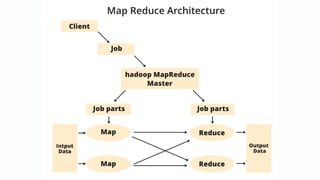
Hadoop MapReduce is a parallel processing framework designed to
efficiently process vast amounts of data across distributed clusters. It
operates through two main components: the JobTracker and TaskTrackers.
The JobTracker coordinates job execution, managing tasks such as task
scheduling, monitoring, and task failure recovery. TaskTrackers, deployed
on individual cluster nodes, execute specific map and reduce tasks assigned
by the JobTracker. MapReduce employs a map phase for data
transformation and a reduce phase for aggregation, enabling data
processing in parallel across nodes. Its fault-tolerant design, facilitated by
data replication and task re-execution, ensures resilience in the face of
node failures. Hadoop MapReduce facilitates scalable and distributed data
processing, making it a fundamental component in the Hadoop ecosystem
for batch processing of large datasets.
Apache Spark : an
overview
what is apache spark?
Apache Spark is an open-source, distributed computing framework that
provides an in-memory processing engine for fast and efficient data
processing. It offers a versatile set of libraries and APIs for various
tasks including batch processing, real-time streaming, machine
learning, and graph processing. Spark's resilient distributed dataset
(RDD) abstraction allows for fault-tolerant parallel processing of data
across distributed clusters. Its unified architecture combines multiple
processing workloads, enabling seamless integration and faster data
analysis compared to traditional disk-based processing frameworks like
Hadoop MapReduce. Spark's ease of use, scalability, and rich
ecosystem make it a popular choice for big data processing and
analytics applications.
Advantages of Apache
Spark over Hadoop Map
Reduce
• In-Memory Processing: Spark performs in-memory processing, reducing the
need for disk I/O and improving processing speed significantly compared to
MapReduce, which relies heavily on disk storage for intermediate data.
• Unified Computing Engine: Spark provides a unified platform for various
data processing tasks including batch processing, interactive queries, real-
time streaming, machine learning, and graph processing, whereas
MapReduce is primarily suited for batch processing.
• Ease of Use: Spark offers a more user-friendly and expressive API compared
to the low-level programming model of MapReduce, allowing developers to
write complex data processing pipelines more efficiently and with fewer
lines of code.
• Fault Tolerance with Resilient Distributed Datasets (RDDs): Spark's RDD
abstraction provides built-in fault tolerance by tracking the lineage of
transformations applied to the data, allowing lost data to be recomputed from
the original source. This makes Spark more resilient to failures compared to
MapReduce.
• Efficient Caching and Data Reuse: Spark allows datasets to be cached in memory
across multiple operations, enabling iterative and interactive processing with
reduced latency by avoiding repetitive data reads from disk, which is not
efficiently supported in MapReduce.
• Optimized Execution Plan with Directed Acyclic Graph (DAG) Scheduler: Spark
optimizes the execution of data processing tasks using a DAG scheduler, which
generates an optimal execution plan based on the dependencies between tasks,
resulting in better performance compared to the static execution plan of
MapReduce.
Spark architecture
Spark core
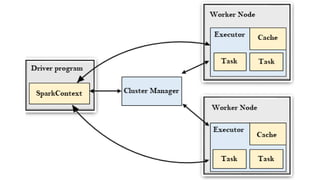
Spark Core serves as the foundational engine of the Apache Spark
framework, providing the distributed computing infrastructure for
processing large-scale data sets. At its core, Spark Core introduces
the concept of Resilient Distributed Datasets (RDDs), immutable
distributed collections of data objects that allow for fault-tolerant
parallel processing across a cluster. With its in-memory processing
capabilities, Spark Core significantly enhances processing speed by
minimizing disk I/O overhead. Additionally, it offers a rich set of
transformations and actions, fault tolerance through lineage
information, and distributed task execution, making it a versatile and
efficient engine for a wide range of data processing tasks in Spark.
spark sql
Spark SQL is a component of Apache Spark designed to facilitate
seamless interaction with structured data using SQL queries,
DataFrame API, and SQL-compatible functions. It extends
Spark's capabilities to include SQL queries and manipulation of
structured data, enabling integration with existing SQL-based
tools and expertise. With Spark SQL, users can perform complex
data analysis, join multiple data sources, and execute SQL
queries directly against data stored in various formats such as
Parquet, JSON, CSV, and Hive tables, thus bridging the gap
between traditional relational databases and big data
processing frameworks.
Spark Streaming is an extension of the Apache Spark core that enables
scalable, fault-tolerant processing of live data streams. It provides high-
level abstractions like DStream (Discretized Stream), allowing
developers to process continuous data streams in real-time using the
same programming model as batch processing. Spark Streaming
ingests data from various sources such as Kafka, Flume, and TCP
sockets, and divides it into micro-batches for parallel processing,
offering low-latency stream processing with fault tolerance and exactly-
once semantics. With its seamless integration with Spark's ecosystem,
Spark Streaming empowers developers to build robust and scalable
stream processing applications for a wide range of use cases, including
real-time analytics, monitoring, and anomaly detection.
spark streaming
spark Mlib
Spark MLlib, part of the Apache Spark ecosystem, is a scalable
machine learning library designed for distributed data processing. It
provides a rich set of algorithms and utilities for common machine
learning tasks such as classification, regression, clustering,
collaborative filtering, and dimensionality reduction. Leveraging
Spark's distributed computing capabilities, MLlib enables efficient
processing of large-scale datasets, parallel model training, and
distributed model inference. With its user-friendly APIs and seamless
integration with other Spark components, MLlib empowers data
scientists and developers to build and deploy scalable machine
learning pipelines for real-world applications, accelerating the
development and deployment of machine learning models at scale.
Spark GraphX
Spark GraphX is a component of the Apache Spark ecosystem
designed for scalable graph processing and analytics. It provides
an API for constructing and manipulating graphs, along with a set
of distributed graph algorithms for tasks such as graph traversal,
pattern matching, and graph analytics. GraphX leverages Spark's
distributed computing framework to efficiently process large-
scale graphs in parallel, making it suitable for analyzing social
networks, recommendation systems, and other graph-structured
data. With its seamless integration with other Spark components,
GraphX enables developers to build and execute complex graph
algorithms on distributed datasets, facilitating the exploration
and analysis of interconnected data at scale.
performance comparision
• Processing Speed: Spark generally outperforms Hadoop
MapReduce due to its in-memory processing capability, which
reduces the need for disk I/O and improves processing speed
significantly, especially for iterative and interactive workloads.
• Resource Utilization: Spark's ability to cache data in memory
and reuse it across multiple operations leads to better
resource utilization compared to Hadoop MapReduce, which
relies heavily on disk storage for intermediate data.
• Fault Tolerance: Hadoop relies on data replication and task re-
execution, while Spark employs RDD lineage and distributed
execution for faster recovery from failures.
• Scalability: Both systems scale horizontally, but Spark's unified
engine and efficient processing make it more scalable, especially
for real-time streaming and interactive analysis.
• Ease of Use: Spark's user-friendly API enables developers to write
complex data processing pipelines more efficiently and with less
code compared to the lower-level programming model of
Hadoop MapReduce.
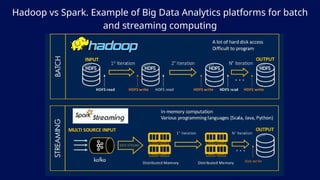
Hadoop vs Spark. Example of Big Data Analytics platforms for batch
and streaming computing
• Amazon Elastic MapReduce (EMR): Offers Hadoop clusters
distributed across multiple Amazon EC2 instances. It supports
processing frameworks like Apache Spark and HBase and
integrates with various data stores within Amazon Web Services
(AWS).
• Google Cloud Dataproc: Provides Apache Spark services on
Hadoop clusters for batch processing, querying, streaming, and
machine learning, enabling scalable and efficient data processing
tasks in the cloud environment.
• Microsoft Azure HDInsight: Offers an HDP Hadoop distribution in
the cloud, providing scalable and reliable Hadoop clusters for
processing large-scale data workloads, along with integration
with other Azure services for enhanced analytics capabilities.

Big Data Analytics Presentation on the resourcefulness of Big data

  • 1.
    P R ES E N T A T I O N O N BIG DATA ANALYSIS AND PROCESSING
  • 2.
  • 3.
    Introduction Big data processingrefers to the methods and technologies used to handle large volumes of data that traditional data processing applications can't manage efficiently. This data typically comes from various sources such as social media, sensors, machines, transactions, and more. The three main characteristics of big data, often referred to as the three Vs, are volume, velocity, and variety: • Volume: Big data involves large amounts of data, often ranging from terabytes to petabytes or even exabytes. • Velocity: Data streams in at high speeds and needs to be processed quickly to derive insights or take actions in real-time or near real-time. • Variety: Data comes in various formats and types, including structured data (like databases), semi-structured data (like XML files), and unstructured data (like text, images, and videos).

  • 4.
    components of Bigdata processing • Storage Systems: Big data storage solutions like Hadoop Distributed File System (HDFS), Amazon S3, or Google Cloud Storage are used to store massive amounts of data across distributed systems. • Processing Frameworks: Frameworks like Apache Hadoop, Apache Spark, and Apache Flink provide distributed computing capabilities for processing large datasets across clusters of computers. • Data Processing Languages: Programming languages such as Java, Python, Scala, and SQL are commonly used for big data processing tasks. Each language has its strengths depending on the specific requirements of the task.
  • 5.
    • Data IntegrationTools: Tools like Apache NiFi, Apache Kafka, and Apache Flume are used for ingesting data from various sources into the processing pipeline. • Data Analysis and Machine Learning: Techniques such as data mining, machine learning, and predictive analytics are applied to extract valuable insights from big data. • Distributed Computing: Big data processing often involves distributing processing tasks across multiple nodes in a cluster to parallelize computation and improve performance. • Fault Tolerance and Scalability: Big data systems need to be fault- tolerant and scalable to handle hardware failures and accommodate growing data volumes.
  • 6.
  • 7.
    What is Hadoop? Hadoop isan open-source framework designed for distributed storage and processing of large datasets across clusters of commodity hardware. At its core, it comprises two main components: Hadoop Distributed File System (HDFS) for storing data across multiple machines with fault tolerance, and MapReduce for parallel processing of data. It provides a scalable and cost-effective solution for organizations to handle Big Data, allowing them to store, process, and analyze vast amounts of data to derive valuable insights and make data- driven decisions.
  • 8.
    Components of Hadoopecosystem • Hadoop Distributed File System (HDFS): HDFS is the primary storage system used by Hadoop. It is designed to store large files across multiple machines in a reliable and fault-tolerant manner. HDFS divides large files into smaller blocks and distributes them across a cluster of commodity hardware. • Hadoop MapReduce: MapReduce is a programming model and processing engine for parallel processing of large datasets across a distributed cluster. It consists of two main phases: the Map phase, where data is processed in parallel across multiple nodes, and the Reduce phase, where the results from the Map phase are aggregated. • YARN (Yet Another Resource Negotiator): YARN is the resource management layer of Hadoop. It is responsible for managing and allocating resources (CPU, memory, etc.) to various applications running on the Hadoop cluster. YARN decouples the resource management and job scheduling functionalities
  • 9.
    • Hadoop Common:Hadoop Common contains libraries and utilities that support other Hadoop modules. It includes common utilities, configuration files, and libraries used by various components in the Hadoop ecosystem. • Hadoop HBase: HBase is a distributed, scalable, and column-oriented NoSQL database built on top of Hadoop. It provides real-time read/write access to large datasets and is suitable for applications requiring random, real-time read/write access to Big Data. • Hadoop Hive: Hive is a data warehouse infrastructure built on top of Hadoop that provides a SQL-like interface (HiveQL) for querying and managing large datasets stored in HDFS. Hive translates SQL queries into MapReduce or Tez jobs, allowing users familiar with SQL to analyze Big Data without needing to learn complex programming models.
  • 11.
    The Hadoop DistributedFile System (HDFS) architecture comprises two main components: the NameNode and DataNodes. The NameNode, serving as the master node, manages metadata including file structure and block locations, while DataNodes, acting as slaves, store data blocks and communicate with the NameNode for read/write operations. HDFS stores large files by dividing them into blocks, replicating these blocks across multiple DataNodes for fault tolerance, and enabling parallel processing of data across the cluster, ensuring scalability, reliability, and efficient storage and retrieval of data in distributed Hadoop environments.
  • 13.
    Hadoop MapReduce isa parallel processing framework designed to efficiently process vast amounts of data across distributed clusters. It operates through two main components: the JobTracker and TaskTrackers. The JobTracker coordinates job execution, managing tasks such as task scheduling, monitoring, and task failure recovery. TaskTrackers, deployed on individual cluster nodes, execute specific map and reduce tasks assigned by the JobTracker. MapReduce employs a map phase for data transformation and a reduce phase for aggregation, enabling data processing in parallel across nodes. Its fault-tolerant design, facilitated by data replication and task re-execution, ensures resilience in the face of node failures. Hadoop MapReduce facilitates scalable and distributed data processing, making it a fundamental component in the Hadoop ecosystem for batch processing of large datasets.
  • 14.
    Apache Spark :an overview
  • 15.
    what is apachespark? Apache Spark is an open-source, distributed computing framework that provides an in-memory processing engine for fast and efficient data processing. It offers a versatile set of libraries and APIs for various tasks including batch processing, real-time streaming, machine learning, and graph processing. Spark's resilient distributed dataset (RDD) abstraction allows for fault-tolerant parallel processing of data across distributed clusters. Its unified architecture combines multiple processing workloads, enabling seamless integration and faster data analysis compared to traditional disk-based processing frameworks like Hadoop MapReduce. Spark's ease of use, scalability, and rich ecosystem make it a popular choice for big data processing and analytics applications.
  • 16.
    Advantages of Apache Sparkover Hadoop Map Reduce
  • 17.
    • In-Memory Processing:Spark performs in-memory processing, reducing the need for disk I/O and improving processing speed significantly compared to MapReduce, which relies heavily on disk storage for intermediate data. • Unified Computing Engine: Spark provides a unified platform for various data processing tasks including batch processing, interactive queries, real- time streaming, machine learning, and graph processing, whereas MapReduce is primarily suited for batch processing. • Ease of Use: Spark offers a more user-friendly and expressive API compared to the low-level programming model of MapReduce, allowing developers to write complex data processing pipelines more efficiently and with fewer lines of code.
  • 18.
    • Fault Tolerancewith Resilient Distributed Datasets (RDDs): Spark's RDD abstraction provides built-in fault tolerance by tracking the lineage of transformations applied to the data, allowing lost data to be recomputed from the original source. This makes Spark more resilient to failures compared to MapReduce. • Efficient Caching and Data Reuse: Spark allows datasets to be cached in memory across multiple operations, enabling iterative and interactive processing with reduced latency by avoiding repetitive data reads from disk, which is not efficiently supported in MapReduce. • Optimized Execution Plan with Directed Acyclic Graph (DAG) Scheduler: Spark optimizes the execution of data processing tasks using a DAG scheduler, which generates an optimal execution plan based on the dependencies between tasks, resulting in better performance compared to the static execution plan of MapReduce.
  • 19.
  • 21.
    Spark core Spark Coreserves as the foundational engine of the Apache Spark framework, providing the distributed computing infrastructure for processing large-scale data sets. At its core, Spark Core introduces the concept of Resilient Distributed Datasets (RDDs), immutable distributed collections of data objects that allow for fault-tolerant parallel processing across a cluster. With its in-memory processing capabilities, Spark Core significantly enhances processing speed by minimizing disk I/O overhead. Additionally, it offers a rich set of transformations and actions, fault tolerance through lineage information, and distributed task execution, making it a versatile and efficient engine for a wide range of data processing tasks in Spark.
  • 22.
    spark sql Spark SQLis a component of Apache Spark designed to facilitate seamless interaction with structured data using SQL queries, DataFrame API, and SQL-compatible functions. It extends Spark's capabilities to include SQL queries and manipulation of structured data, enabling integration with existing SQL-based tools and expertise. With Spark SQL, users can perform complex data analysis, join multiple data sources, and execute SQL queries directly against data stored in various formats such as Parquet, JSON, CSV, and Hive tables, thus bridging the gap between traditional relational databases and big data processing frameworks.
  • 23.
    Spark Streaming isan extension of the Apache Spark core that enables scalable, fault-tolerant processing of live data streams. It provides high- level abstractions like DStream (Discretized Stream), allowing developers to process continuous data streams in real-time using the same programming model as batch processing. Spark Streaming ingests data from various sources such as Kafka, Flume, and TCP sockets, and divides it into micro-batches for parallel processing, offering low-latency stream processing with fault tolerance and exactly- once semantics. With its seamless integration with Spark's ecosystem, Spark Streaming empowers developers to build robust and scalable stream processing applications for a wide range of use cases, including real-time analytics, monitoring, and anomaly detection. spark streaming
  • 24.
    spark Mlib Spark MLlib,part of the Apache Spark ecosystem, is a scalable machine learning library designed for distributed data processing. It provides a rich set of algorithms and utilities for common machine learning tasks such as classification, regression, clustering, collaborative filtering, and dimensionality reduction. Leveraging Spark's distributed computing capabilities, MLlib enables efficient processing of large-scale datasets, parallel model training, and distributed model inference. With its user-friendly APIs and seamless integration with other Spark components, MLlib empowers data scientists and developers to build and deploy scalable machine learning pipelines for real-world applications, accelerating the development and deployment of machine learning models at scale.
  • 25.
    Spark GraphX Spark GraphXis a component of the Apache Spark ecosystem designed for scalable graph processing and analytics. It provides an API for constructing and manipulating graphs, along with a set of distributed graph algorithms for tasks such as graph traversal, pattern matching, and graph analytics. GraphX leverages Spark's distributed computing framework to efficiently process large- scale graphs in parallel, making it suitable for analyzing social networks, recommendation systems, and other graph-structured data. With its seamless integration with other Spark components, GraphX enables developers to build and execute complex graph algorithms on distributed datasets, facilitating the exploration and analysis of interconnected data at scale.
  • 27.
    performance comparision • ProcessingSpeed: Spark generally outperforms Hadoop MapReduce due to its in-memory processing capability, which reduces the need for disk I/O and improves processing speed significantly, especially for iterative and interactive workloads. • Resource Utilization: Spark's ability to cache data in memory and reuse it across multiple operations leads to better resource utilization compared to Hadoop MapReduce, which relies heavily on disk storage for intermediate data.
  • 28.
    • Fault Tolerance:Hadoop relies on data replication and task re- execution, while Spark employs RDD lineage and distributed execution for faster recovery from failures. • Scalability: Both systems scale horizontally, but Spark's unified engine and efficient processing make it more scalable, especially for real-time streaming and interactive analysis. • Ease of Use: Spark's user-friendly API enables developers to write complex data processing pipelines more efficiently and with less code compared to the lower-level programming model of Hadoop MapReduce.
  • 29.
    Hadoop vs Spark.Example of Big Data Analytics platforms for batch and streaming computing
  • 30.
    • Amazon ElasticMapReduce (EMR): Offers Hadoop clusters distributed across multiple Amazon EC2 instances. It supports processing frameworks like Apache Spark and HBase and integrates with various data stores within Amazon Web Services (AWS). • Google Cloud Dataproc: Provides Apache Spark services on Hadoop clusters for batch processing, querying, streaming, and machine learning, enabling scalable and efficient data processing tasks in the cloud environment. • Microsoft Azure HDInsight: Offers an HDP Hadoop distribution in the cloud, providing scalable and reliable Hadoop clusters for processing large-scale data workloads, along with integration with other Azure services for enhanced analytics capabilities.