DESIGN THINKING in
EDUCATION:
Empathy, Challenge,
Discovery & Sharing
SESSION OBJECTIVE:
Apply DESIGN THINKING in
developing INNOVATIONS in
our teaching strategies
A PICTURE IS
WORTH A
THOUSAND
WORDS
— ALBERT EINSTEIN
“Everybody is a genius.
But if you judge a fish by its
ability to climb a tree, it will
live its whole life believing
that
it is stupid.”
A Picture Always
Reinforces the
Concept
gfycat.com
OPTIONS! OPTIONS!
OPTIONS!
WHY DESIGN THINKING (DT)
As a model for reframing
methods and outcomes, design
thinking reconnects educators
to their creativity and aspirations
for helping students develop
as deep thinkers and doers.
Fostering Skills
through DT
Critical
Thinking
and
Problem
Solving
Creativity
Skill 1 Skill 2
Collaboration
Skill 3
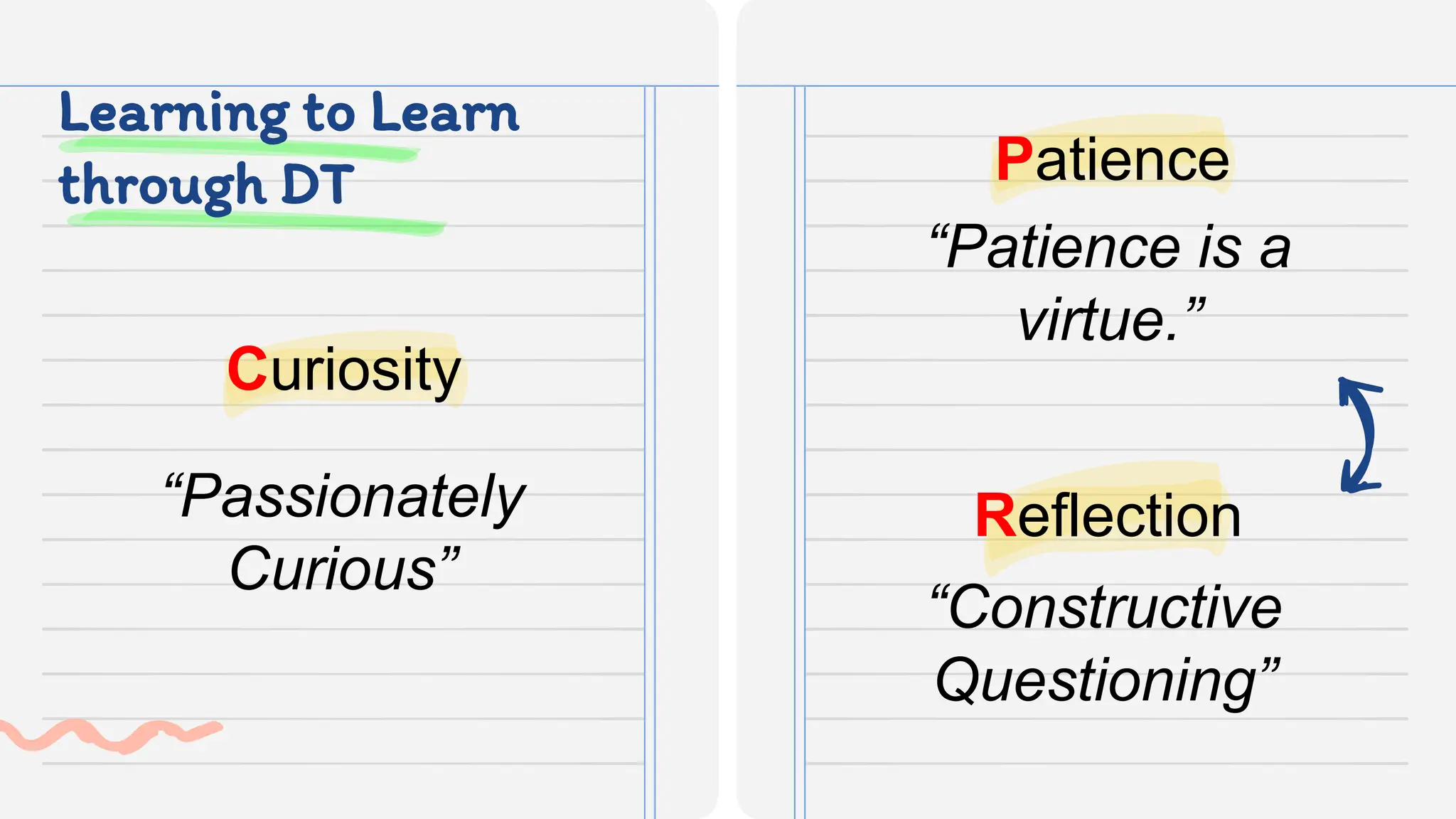
Curiosity
Patience
Reflection
Learning to Learn
through DT
“Passionately
Curious”
“Patience is a
virtue.”
“Constructive
Questioning”
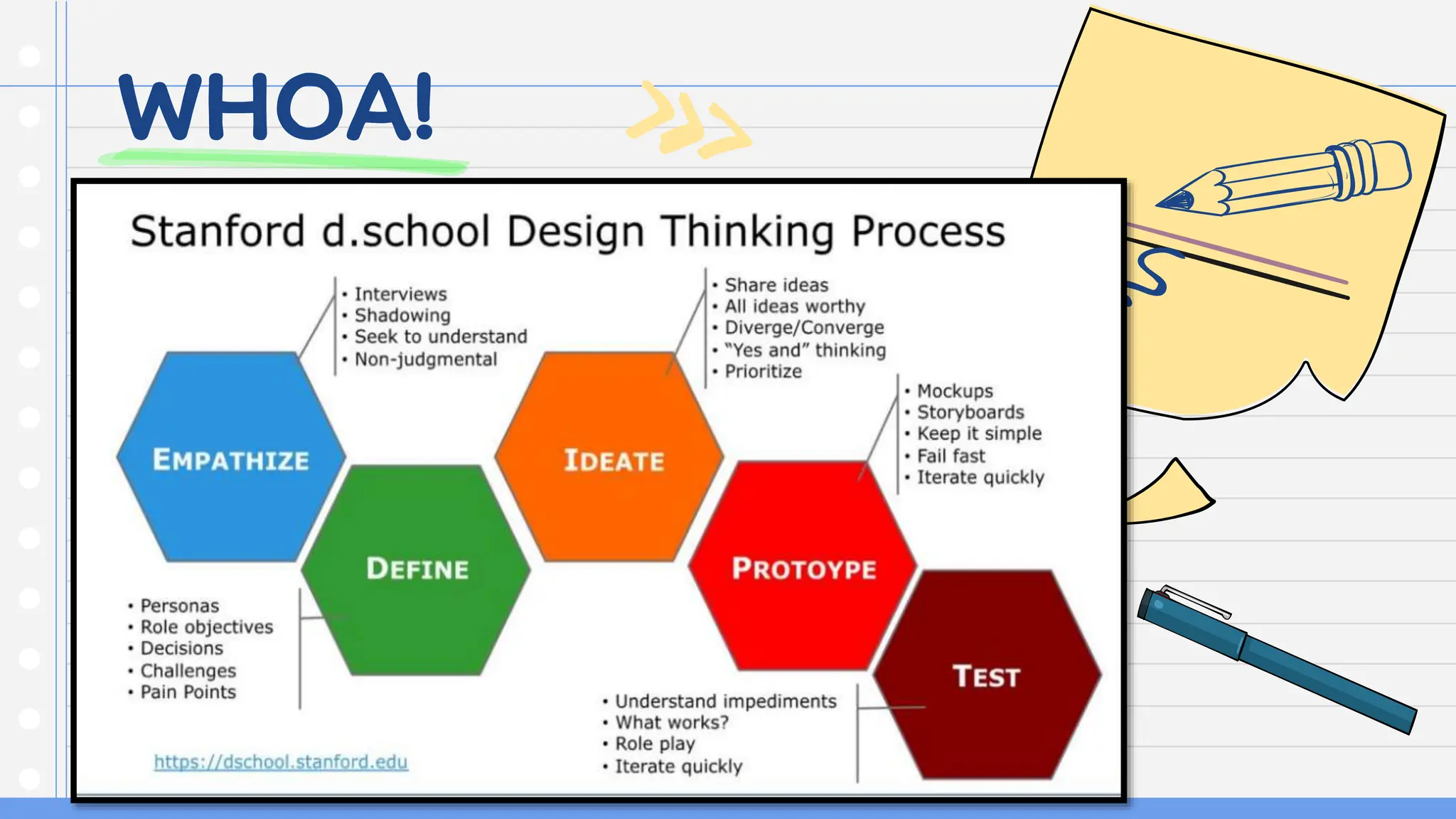
WHOA!
KEY IDEAS ABOUT DT
Demonstrating
Empathy
Put ourselves in
the shoes of the
intended users.
Set aside our
own
assumptions to
gain insight into
the users and
their needs.
Defining Problem
Clearly
Have a clear
understanding of
what needs to
be addressed.
Align these to
the needs and
wants of the
intended users.
Solving Problem
Iteratively
Developing
ideas,
prototypes, and
eventually testing
solutions does
not end the
process.
Iteration leads to
improvements.
KEY IDEAS ABOUT DT
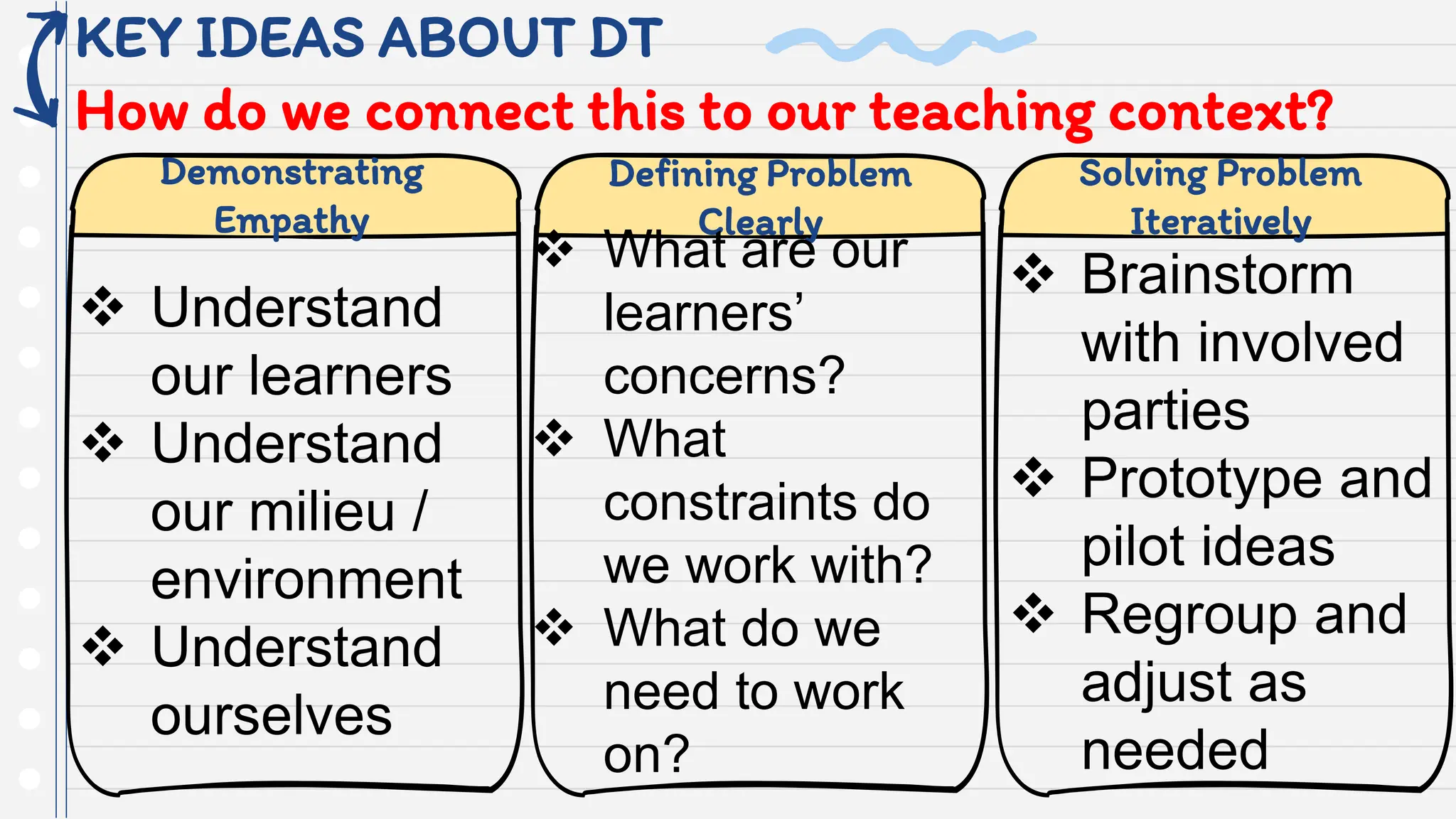
How do we connect this to our teaching context?
Demonstrating
Empathy
 Understand
our learners
 Understand
our milieu /
environment
 Understand
ourselves
Defining Problem
Clearly
 What are our
learners’
concerns?
 What
constraints do
we work with?
 What do we
need to work
on?
Solving Problem
Iteratively
 Brainstorm
with involved
parties
 Prototype and
pilot ideas
 Regroup and
adjust as
needed
Many people / things on
An empathy map is an illustration
that helps design thinkers more clearly
understand their customers. More than
that, it is a tool to help designers gain a
deeper understanding of their target
audience.
This is useful in design thinking,
where the first stage is discovering how to
empathize with your users.
What is an
Empathy Map?
Why is it that ...
Why is it that ...
Why is it that ....
Why is it that ...
Why is it that ...
My students’ problem: Their modules/answer sheets are
NOT submitted on time for monitoring and rechecking.
Start here!
1. Flexible Teaching
2. Home Visitation
3. Time Management
4. Motivational Strategies
5. Maximizing Technology
6. Authentic Assessment
You may add more pages if you have more ideas in mind!
Design Thinking in
Learner-Centered Education
Apprehensions arise
in designing
assessments prior to
planning instruction
and basing the latter
Indicators
of
Learning
Success
1 Assessment
Activities
2 Instructional
Activities
3
This does NOT teach
the test --- this avoids
assessing based only
on instructional
activities.
We assess based
on indicators of
learning success.
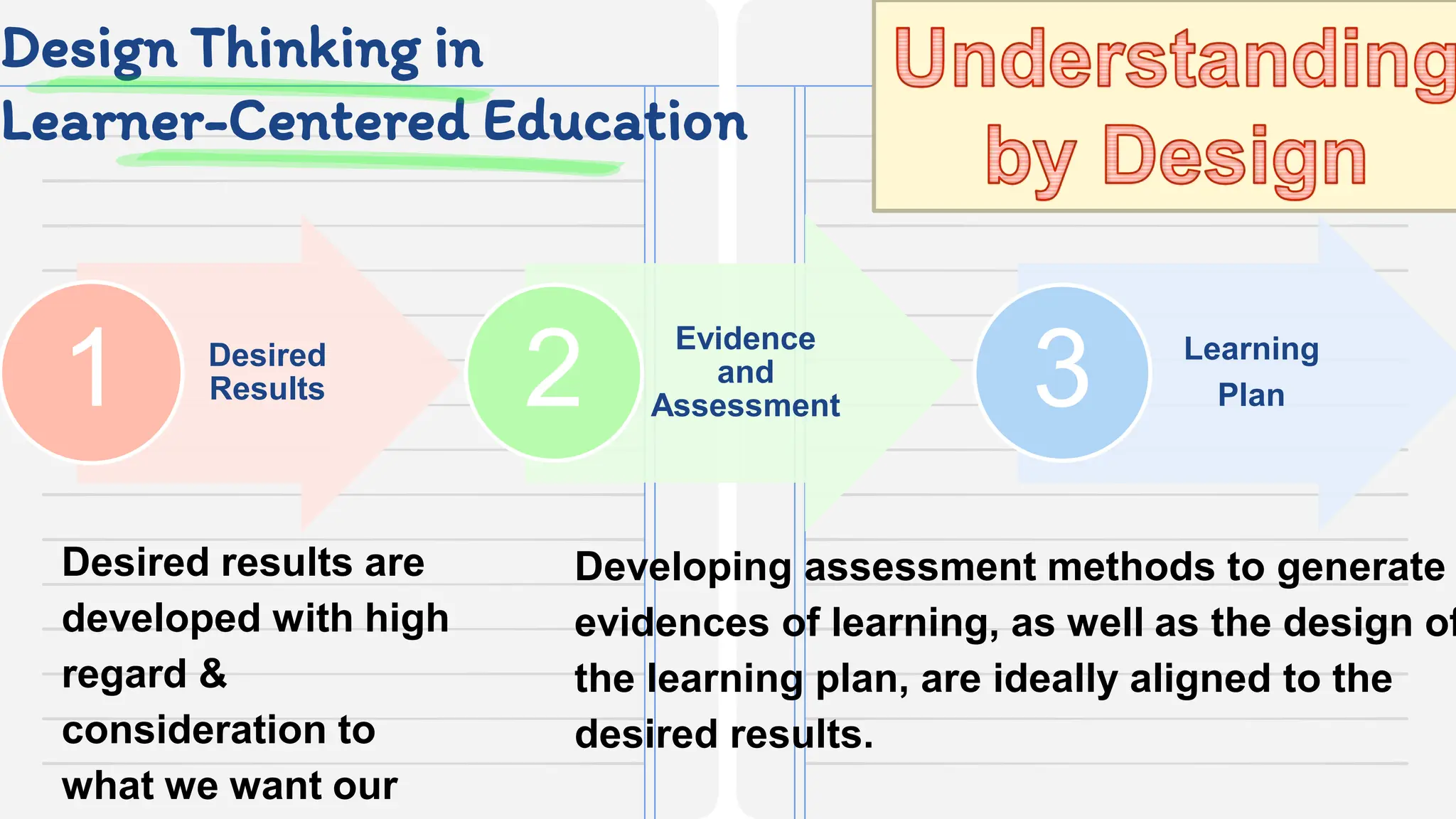
Design Thinking in
Learner-Centered Education
Desired results are
developed with high
regard &
consideration to
what we want our
Desired
Results
1
Evidence
and
Assessment
2 Learning
Plan
3
Developing assessment methods to generate
evidences of learning, as well as the design of
the learning plan, are ideally aligned to the
desired results.
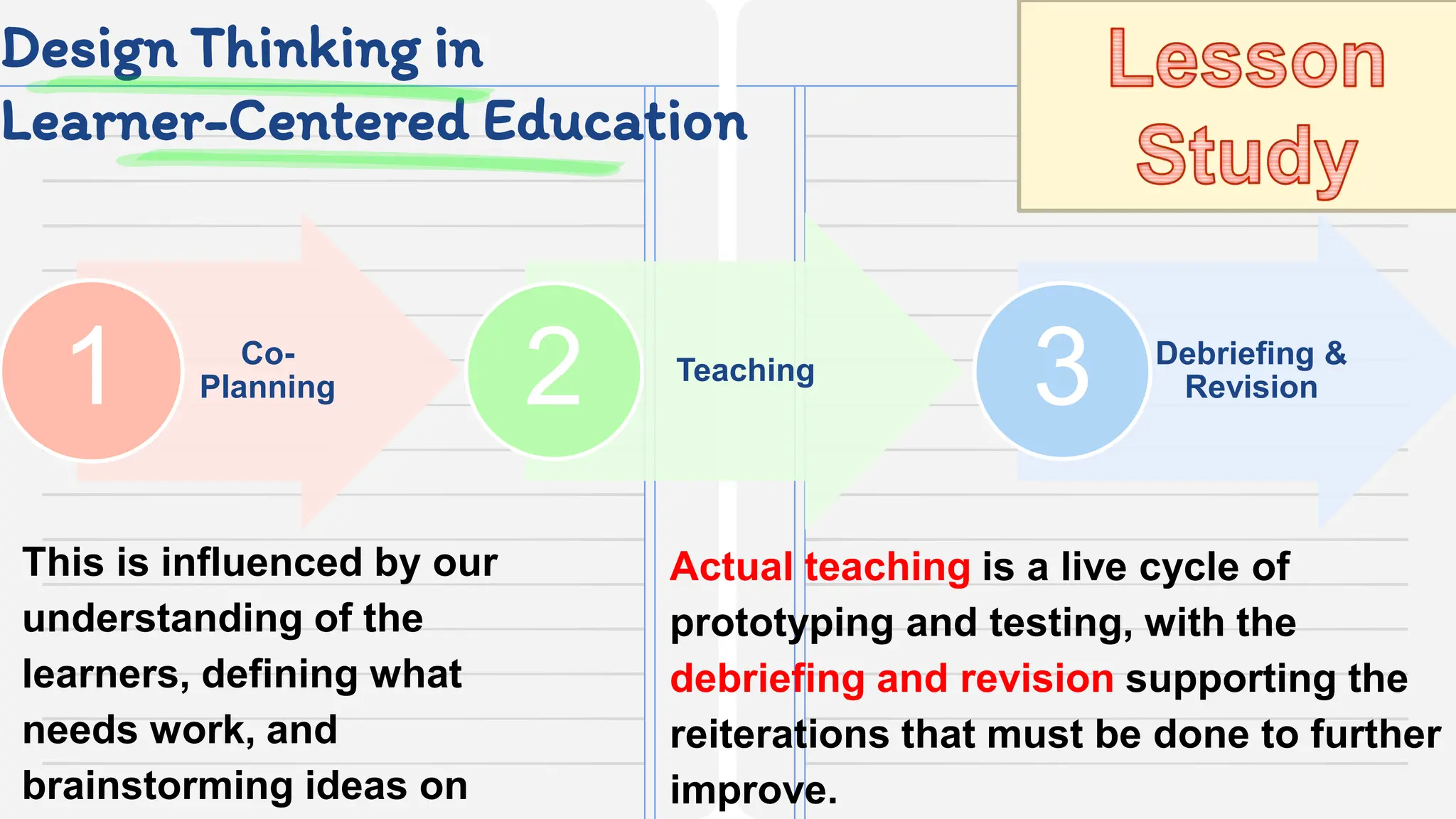
Design Thinking in
Learner-Centered Education
This is influenced by our
understanding of the
learners, defining what
needs work, and
brainstorming ideas on
Co-
Planning
1 Teaching
2 Debriefing &
Revision
3
Actual teaching is a live cycle of
prototyping and testing, with the
debriefing and revision supporting the
reiterations that must be done to further
improve.
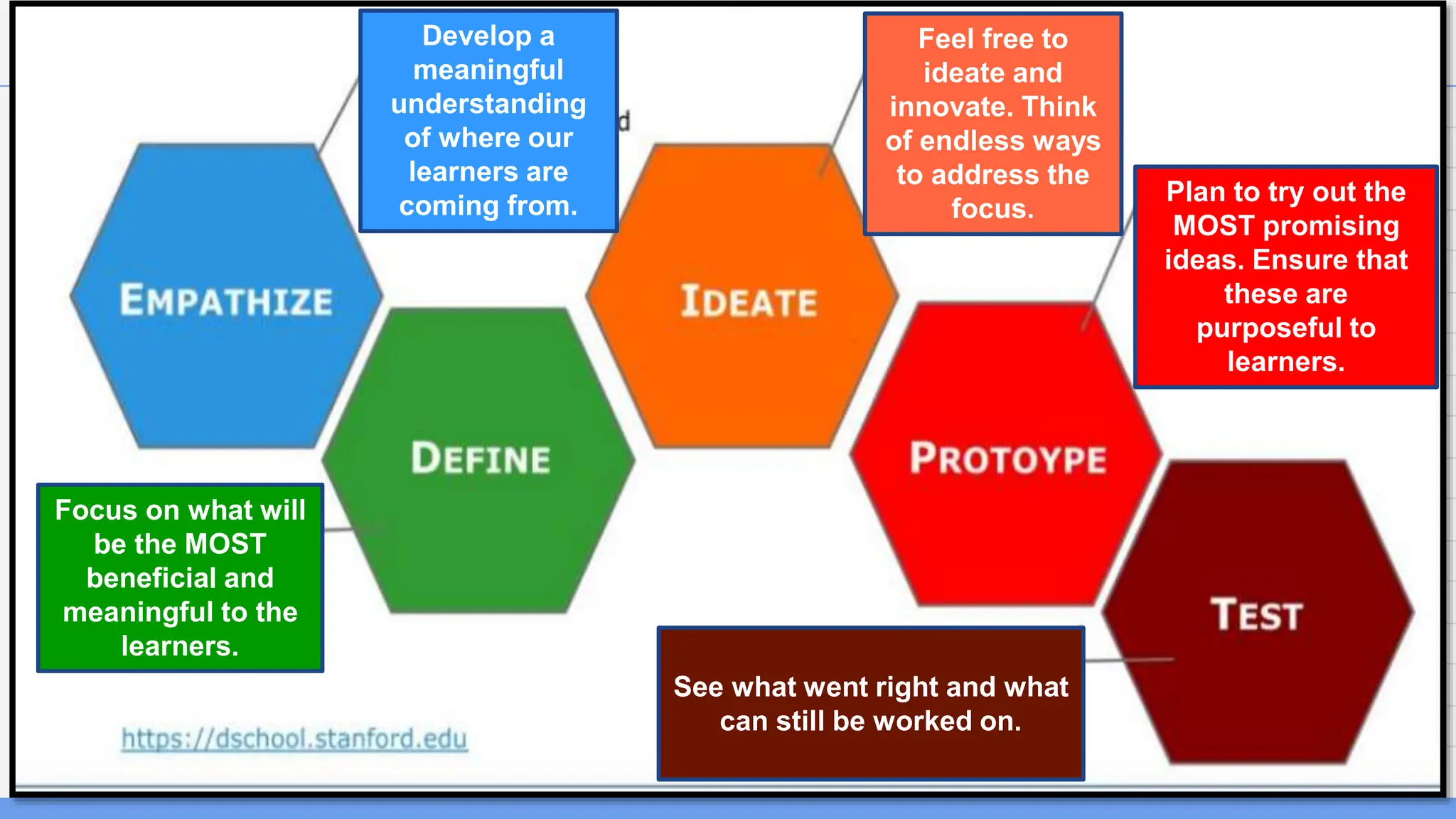
DESIGN
THINKING IN
INNOVATIVE
INSTRUCTION
Focus on what will
be the MOST
beneficial and
meaningful to the
learners.
Develop a
meaningful
understanding
of where our
learners are
coming from. Plan to try out the
MOST promising
ideas. Ensure that
these are
purposeful to
learners.
Feel free to
ideate and
innovate. Think
of endless ways
to address the
focus.
See what went right and what
can still be worked on.
AWESOME
WORDS!
AWESOME
WORDS!
AWESOME
WORDS!
WATCH OUT &
BE PREPARED
ALWAYS!
References:
 Flex2Educate/Thames International Business
School (Templates)
 VIBAL Learn@Home: Design Thinking in the
Education Context (by: Mr. Jejomar Bongat,
Special Science Teacher II)
Link: Learn@Home | Design Thinking in the
Education Context – YouTube
 Edutopia: Design Thinking: A Problem Solving
Framework
Link: Design Thinking: A Problem Solving
Framework - YouTube
CREDITS: This presentation template was created by
Slidesgo, including icons by Flaticon, and infographics &
images by Freepik.
Do you have any questions?
addyouremail@freepik.com
+91 620 421 838 yourcompany.com
Thanks!
Please keep this slide for attribution.

DESIGN THINKING in EDUCATION.pptx

  • 1.
    DESIGN THINKING in EDUCATION: Empathy,Challenge, Discovery & Sharing
  • 2.
    SESSION OBJECTIVE: Apply DESIGNTHINKING in developing INNOVATIONS in our teaching strategies
  • 3.
    A PICTURE IS WORTHA THOUSAND WORDS
  • 5.
    — ALBERT EINSTEIN “Everybodyis a genius. But if you judge a fish by its ability to climb a tree, it will live its whole life believing that it is stupid.”
  • 6.
    A Picture Always Reinforcesthe Concept gfycat.com OPTIONS! OPTIONS! OPTIONS!
  • 7.
    WHY DESIGN THINKING(DT) As a model for reframing methods and outcomes, design thinking reconnects educators to their creativity and aspirations for helping students develop as deep thinkers and doers.
  • 8.
  • 9.
    Curiosity Patience Reflection Learning to Learn throughDT “Passionately Curious” “Patience is a virtue.” “Constructive Questioning”
  • 10.
  • 11.
    KEY IDEAS ABOUTDT Demonstrating Empathy Put ourselves in the shoes of the intended users. Set aside our own assumptions to gain insight into the users and their needs. Defining Problem Clearly Have a clear understanding of what needs to be addressed. Align these to the needs and wants of the intended users. Solving Problem Iteratively Developing ideas, prototypes, and eventually testing solutions does not end the process. Iteration leads to improvements.
  • 12.
    KEY IDEAS ABOUTDT How do we connect this to our teaching context? Demonstrating Empathy  Understand our learners  Understand our milieu / environment  Understand ourselves Defining Problem Clearly  What are our learners’ concerns?  What constraints do we work with?  What do we need to work on? Solving Problem Iteratively  Brainstorm with involved parties  Prototype and pilot ideas  Regroup and adjust as needed
  • 13.
    Many people /things on
  • 14.
    An empathy mapis an illustration that helps design thinkers more clearly understand their customers. More than that, it is a tool to help designers gain a deeper understanding of their target audience. This is useful in design thinking, where the first stage is discovering how to empathize with your users. What is an Empathy Map?
  • 15.
    Why is itthat ... Why is it that ... Why is it that .... Why is it that ... Why is it that ... My students’ problem: Their modules/answer sheets are NOT submitted on time for monitoring and rechecking. Start here!
  • 16.
    1. Flexible Teaching 2.Home Visitation 3. Time Management 4. Motivational Strategies 5. Maximizing Technology 6. Authentic Assessment You may add more pages if you have more ideas in mind!
  • 17.
    Design Thinking in Learner-CenteredEducation Apprehensions arise in designing assessments prior to planning instruction and basing the latter Indicators of Learning Success 1 Assessment Activities 2 Instructional Activities 3 This does NOT teach the test --- this avoids assessing based only on instructional activities. We assess based on indicators of learning success.
  • 18.
    Design Thinking in Learner-CenteredEducation Desired results are developed with high regard & consideration to what we want our Desired Results 1 Evidence and Assessment 2 Learning Plan 3 Developing assessment methods to generate evidences of learning, as well as the design of the learning plan, are ideally aligned to the desired results.
  • 19.
    Design Thinking in Learner-CenteredEducation This is influenced by our understanding of the learners, defining what needs work, and brainstorming ideas on Co- Planning 1 Teaching 2 Debriefing & Revision 3 Actual teaching is a live cycle of prototyping and testing, with the debriefing and revision supporting the reiterations that must be done to further improve.
  • 20.
  • 21.
    Focus on whatwill be the MOST beneficial and meaningful to the learners. Develop a meaningful understanding of where our learners are coming from. Plan to try out the MOST promising ideas. Ensure that these are purposeful to learners. Feel free to ideate and innovate. Think of endless ways to address the focus. See what went right and what can still be worked on.
  • 23.
  • 24.
  • 25.
  • 26.
    WATCH OUT & BEPREPARED ALWAYS!
  • 28.
    References:  Flex2Educate/Thames InternationalBusiness School (Templates)  VIBAL Learn@Home: Design Thinking in the Education Context (by: Mr. Jejomar Bongat, Special Science Teacher II) Link: Learn@Home | Design Thinking in the Education Context – YouTube  Edutopia: Design Thinking: A Problem Solving Framework Link: Design Thinking: A Problem Solving Framework - YouTube
  • 30.
    CREDITS: This presentationtemplate was created by Slidesgo, including icons by Flaticon, and infographics & images by Freepik. Do you have any questions? addyouremail@freepik.com +91 620 421 838 yourcompany.com Thanks! Please keep this slide for attribution.