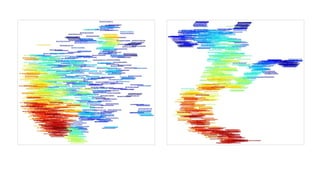
Let the music play!
Recommendation Systems in
Banking & Financial Services
Pycon8
Florence
April 7th, 14.30
Andrea Gigli @andrgig
andrgig@gmail.com
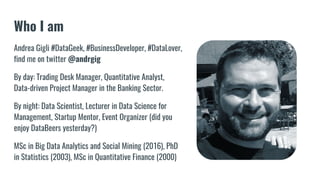
Who I am
Andrea Gigli #DataGeek, #BusinessDeveloper, #DataLover,
find me on twitter @andrgig
By day: Trading Desk Manager, Quantitative Analyst,
Data-driven Project Manager in the Banking Sector.
By night: Data Scientist, Lecturer in Data Science for
Management, Startup Mentor, Event Organizer (did you
enjoy DataBeers yesterday?)
MSc in Big Data Analytics and Social Mining (2016), PhD
in Statistics (2003), MSc in Quantitative Finance (2000)
Florence, April 6th 2017
powered by
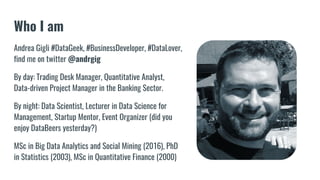
Who I am
Andrea Gigli #DataGeek, #BusinessDeveloper, #DataLover,
find me on twitter @andrgig
By day: Trading Desk Manager, Quantitative Analyst,
Data-driven Project Manager in the Banking Sector.
By night: Data Scientist, Lecturer in Data Science for
Management, Startup Mentor, Event Organizer (did you
enjoy DataBeers yesterday?)
MSc in Big Data Analytics and Social Mining (2016), PhD
in Statistics (2003), MSc in Quantitative Finance (2000)
“All models are wrong,
but some are useful.”
George E. P. Box, 1976
Why Recommendation Systems are useful
Alternative to Search Engines
Useful in the era of Information Deluge and Digital Laziness
Very successful stories around (my favourites are Spotify, Pandora, Last.fm)
Type of Recomendation Systems
Content-based Filtering
Collaborative Filtering
Hybrid Filtering
Type of Recomendation Systems
Content-based Filtering
Collaborative Filtering
Hybrid Filtering
Content-based Filtering
Requires an understanding of the item
The understanding is expressed as a set of features
Usually the weight of each feature, for each user, is adjusted accordingly to
explicit user feedbacks
… limited scope start problem
Collaborative Filtering
Doesn’t require an understanding of the item itself
Requires large amount of data
Assumes that people who agreed in the past will agree in the future
Hybrid System
Combines multiple techniques together to achieve some synergy between
them
Solve the “cold start” problem in Collaborative Filtering
Solve the “limited scope” problem in Content-based Filtering
Are Recommendation Systems useful in banking?
Tons of papers have been written on quantitative models for “Portfolio
Selection” problems
● built on features which are asset-specific (for example risk and return)
● based on hypotheses which are not always true (for example investors
are risk-adverse)
“Beware of geeks
bearing formulas.”
W. Buffet, 2009
“In God we trust,
all the others must bring Data.”
W. E. Deming
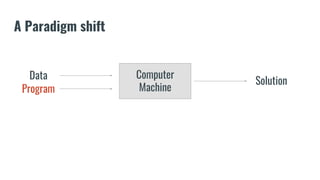
A Paradigm shift
Computer
Machine
Data
Program
Solution
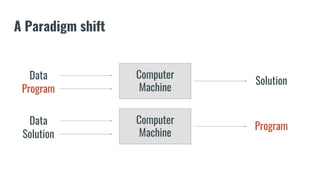
A Paradigm shift
Computer
Machine
Data
Program
Solution
Computer
Machine
Program
Data
Solution
Euler, 1736
Euler, 1736
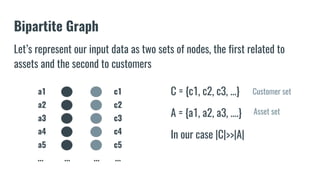
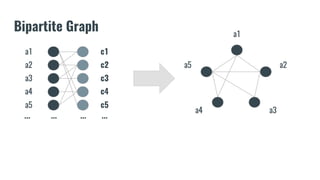
Let’s represent our input data as two sets of nodes, the first related to
assets and the second to customers
C = {c1, c2, c3, ...}
A = {a1, a2, a3, ….}
In our case |C|>>|A|
Bipartite Graph
a1
a2
a3
a4
a5
c1
c2
c3
c4
c5
............
Customer set
Asset set
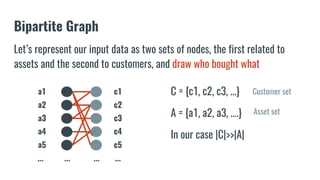
Let’s represent our input data as two sets of nodes, the first related to
assets and the second to customers, and draw who bought what
C = {c1, c2, c3, ...}
A = {a1, a2, a3, ….}
In our case |C|>>|A|
Bipartite Graph
a1
a2
a3
a4
a5
c1
c2
c3
c4
c5
............
Customer set
Asset set
Bipartite Graph
a1
a2
a3
a4
a5
c1
c2
c3
c4
c5
a1
a2
a3a4
a5
............
Bipartite Graph
a1
a2
a3
a4
a5
c1
c2
c3
c4
c5
a1
a2
a3a4
a5
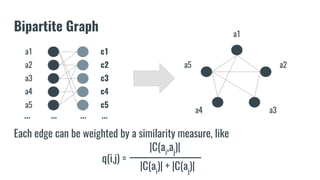
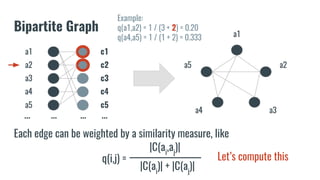
Each edge can be weighted by a similarity measure, like
|C(ai
)| + |C(aj
)|
|C(ai
,aj
)|
q(i,j) =
............
Bipartite Graph
a1
a2
a3
a4
a5
c1
c2
c3
c4
c5
a1
a2
a3a4
a5
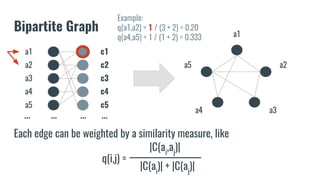
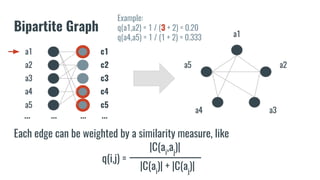
Each edge can be weighted by a similarity measure, like
|C(ai
)| + |C(aj
)|
|C(ai
,aj
)|
q(i,j) =
Example:
q(a1,a2) = 1 / (3 + 2) = 0.20
q(a4,a5) = 1 / (1 + 2) = 0.333
............
Bipartite Graph
a1
a2
a3
a4
a5
c1
c2
c3
c4
c5
a1
a2
a3a4
a5
Each edge can be weighted by a similarity measure, like
|C(ai
)| + |C(aj
)|
|C(ai
,aj
)|
q(i,j) =
Example:
q(a1,a2) = 1 / (3 + 2) = 0.20
q(a4,a5) = 1 / (1 + 2) = 0.333
............
Bipartite Graph
a1
a2
a3
a4
a5
c1
c2
c3
c4
c5
a1
a2
a3a4
a5
Each edge can be weighted by a similarity measure, like
|C(ai
)| + |C(aj
)|
|C(ai
,aj
)|
q(i,j) =
Example:
q(a1,a2) = 1 / (3 + 2) = 0.20
q(a4,a5) = 1 / (1 + 2) = 0.333
............
Let’s compute this
Hands on code now
Counting assets
a1 t 200
a2 t 1850
a3 t 800
a4 t 1100
a5 t 120
... ... ...
asset_counts = {}
with open("asset_counts.txt", 'r') as f:
for line in f:
items = line.split(‘t’)
asset, count = items[0], items[1]
dict_asset_counts[asset] = count
Let’s assume we saved on the file “asset_counts.txt” the counts for each
available asset on our dataset and we want to save them in a dict()
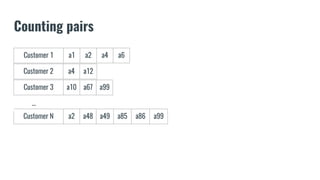
Counting pairs
Customer 1 a1 a2 a4 a6
Customer 2 a4 a12
Customer 3 a10 a67 a99
Customer N a2 a48 a49 a85 a86 a99
...
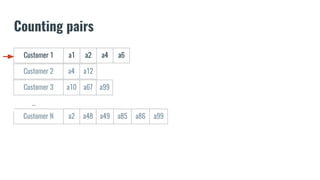
Counting pairs
Customer 1 a1 a2 a4 a6
Customer 2 a4 a12
Customer 3 a10 a67 a99
Customer N a2 a48 a49 a85 a86 a99
...
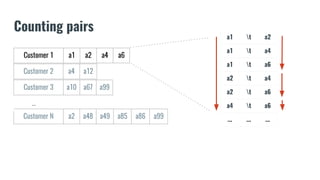
Counting pairs
Customer 1 a1 a2 a4 a6
Customer 2 a4 a12
Customer 3 a10 a67 a99
Customer N a2 a48 a49 a85 a86 a99
...
a1 t a2
a1 t a4
a1 t a6
a2 t a4
a2 t a6
a4 t a6
... ... ...
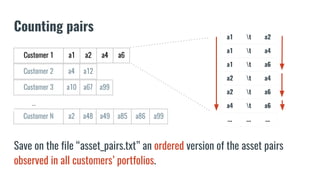
Counting pairs
Customer 1 a1 a2 a4 a6
Customer 2 a4 a12
Customer 3 a10 a67 a99
Customer N a2 a48 a49 a85 a86 a99
...
a1 t a2
a1 t a4
a1 t a6
a2 t a4
a2 t a6
a4 t a6
... ... ...
Save on the file “asset_pairs.txt” an ordered version of the asset pairs
observed in all customers’ portfolios.
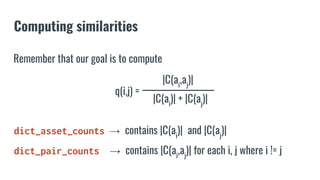
Computing similarities
|C(ai
)| + |C(aj
)|
|C(ai
,aj
)|
q(i,j) =
Remember that our goal is to compute
dict_asset_counts → contains |C(ai
)| and |C(aj
)|
dict_pair_counts → contains |C(ai
,aj
)| for each i, j where i != j
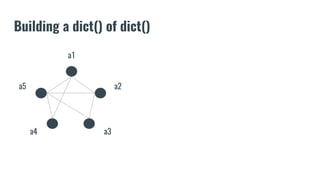
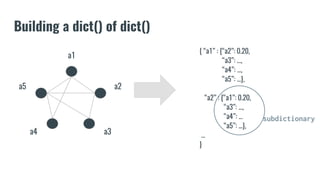
Building a dict() of dict()
a1
a2
a3a4
a5
Building a dict() of dict()
{ “a1” : {“a2”: 0.20,
“a3”: ...,
“a4”: ...,
“a5”: ...},
“a2” : {“a1”: 0.20,
“a3”: ...,
“a4”: ...
“a5”: ...},
…
}
a1
a2
a3a4
a5
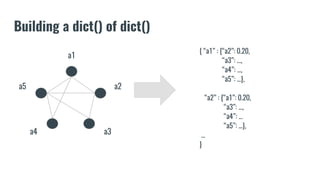
Building a dict() of dict()
{ “a1” : {“a2”: 0.20,
“a3”: ...,
“a4”: ...,
“a5”: ...},
“a2” : {“a1”: 0.20,
“a3”: ...,
“a4”: ...
“a5”: ...},
…
}
a1
a2
a3a4
a5
subdictionary
“Markets are
conversations.”
The Cluetrain Manifesto, 1999
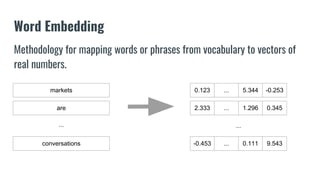
Word Embedding
Methodology for mapping words or phrases from vocabulary to vectors of
real numbers.
0.123 ... 5.344 -0.253
...
2.333 ... 1.296 0.345
-0.453 ... 0.111 9.543
markets
are
conversations
...
Word2Vec
Word2vec model takes as its input a large corpus of text and produces a
vector space, with each unique word in the corpus being assigned a
corresponding vector in the space.
Word vectors are positioned in the vector space such that words that
share common contexts in the corpus are located in close
proximity to one another in the space.
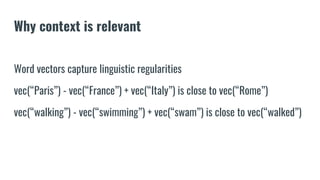
Why context is relevant
Word vectors capture linguistic regularities
vec(“Paris”) - vec(“France”) + vec(“Italy”) is close to vec(“Rome”)
vec(“walking”) - vec(“swimming”) + vec(“swam”) is close to vec(“walked”)
“You shall know a word
by the company it keeps”
J.R. Firth, 1957
“You shall know an asset
by the portfolios it belongs to”
Andrea Gigli, PyCon8, 2017
Asset embedding
If word embedding can project words in a vector space taking into account
of the other words along with they are usually accompanied...
… then asset embedding can project assets in a vector space taking
into account of the other assets along with they are usually
accompanied
Hands on code now
That’s it!
Now you can
- Build a dictionary of dictionaries
- Order and Save your dict() of dict()’s
- Ask for a recommendation
as in the previous application!
Conclusions
We wrote the code for two toy-applications of Recommendation Systems
for Banking and Fin Services: one based on graph theory, the other on word
embedding
Conclusions
We wrote the code for two toy-applications of Recommendation Systems
for Banking and Fin Services: one based on graph theory, the other on word
embedding
Many more recommendation system can be implemented
Conclusions
We wrote the code for two toy-applications of Recommendation Systems
for Banking and Fin Services: one based on graph theory, the other on word
embedding
Many more recommendation system can be implemented
Bear in mind that testing a Recommendation System is not easy!
“Cinderella never asked for a prince...
She asked for a dress and a night off.”
Kiera Cass, 2012
Thanks!Pycon8
Florence
6th-9th April 2017
Andrea Gigli @andrgig
andrgig@gmail.com
Questions?Pycon8
Florence
6th-9th April 2017
Andrea Gigli @andrgig
andrgig@gmail.com

Recommendation Systems in banking and Financial Services

  • 1.
    Let the musicplay! Recommendation Systems in Banking & Financial Services Pycon8 Florence April 7th, 14.30 Andrea Gigli @andrgig andrgig@gmail.com
  • 2.
    Who I am AndreaGigli #DataGeek, #BusinessDeveloper, #DataLover, find me on twitter @andrgig By day: Trading Desk Manager, Quantitative Analyst, Data-driven Project Manager in the Banking Sector. By night: Data Scientist, Lecturer in Data Science for Management, Startup Mentor, Event Organizer (did you enjoy DataBeers yesterday?) MSc in Big Data Analytics and Social Mining (2016), PhD in Statistics (2003), MSc in Quantitative Finance (2000)
  • 3.
    Florence, April 6th2017 powered by
  • 4.
    Who I am AndreaGigli #DataGeek, #BusinessDeveloper, #DataLover, find me on twitter @andrgig By day: Trading Desk Manager, Quantitative Analyst, Data-driven Project Manager in the Banking Sector. By night: Data Scientist, Lecturer in Data Science for Management, Startup Mentor, Event Organizer (did you enjoy DataBeers yesterday?) MSc in Big Data Analytics and Social Mining (2016), PhD in Statistics (2003), MSc in Quantitative Finance (2000)
  • 5.
    “All models arewrong, but some are useful.” George E. P. Box, 1976
  • 6.
    Why Recommendation Systemsare useful Alternative to Search Engines Useful in the era of Information Deluge and Digital Laziness Very successful stories around (my favourites are Spotify, Pandora, Last.fm)
  • 7.
    Type of RecomendationSystems Content-based Filtering Collaborative Filtering Hybrid Filtering
  • 8.
    Type of RecomendationSystems Content-based Filtering Collaborative Filtering Hybrid Filtering
  • 9.
    Content-based Filtering Requires anunderstanding of the item The understanding is expressed as a set of features Usually the weight of each feature, for each user, is adjusted accordingly to explicit user feedbacks … limited scope start problem
  • 10.
    Collaborative Filtering Doesn’t requirean understanding of the item itself Requires large amount of data Assumes that people who agreed in the past will agree in the future
  • 11.
    Hybrid System Combines multipletechniques together to achieve some synergy between them Solve the “cold start” problem in Collaborative Filtering Solve the “limited scope” problem in Content-based Filtering
  • 12.
    Are Recommendation Systemsuseful in banking? Tons of papers have been written on quantitative models for “Portfolio Selection” problems ● built on features which are asset-specific (for example risk and return) ● based on hypotheses which are not always true (for example investors are risk-adverse)
  • 13.
    “Beware of geeks bearingformulas.” W. Buffet, 2009
  • 14.
    “In God wetrust, all the others must bring Data.” W. E. Deming
  • 15.
  • 16.
  • 17.
  • 18.
  • 19.
    Let’s represent ourinput data as two sets of nodes, the first related to assets and the second to customers C = {c1, c2, c3, ...} A = {a1, a2, a3, ….} In our case |C|>>|A| Bipartite Graph a1 a2 a3 a4 a5 c1 c2 c3 c4 c5 ............ Customer set Asset set
  • 20.
    Let’s represent ourinput data as two sets of nodes, the first related to assets and the second to customers, and draw who bought what C = {c1, c2, c3, ...} A = {a1, a2, a3, ….} In our case |C|>>|A| Bipartite Graph a1 a2 a3 a4 a5 c1 c2 c3 c4 c5 ............ Customer set Asset set
  • 21.
  • 22.
    Bipartite Graph a1 a2 a3 a4 a5 c1 c2 c3 c4 c5 a1 a2 a3a4 a5 Each edgecan be weighted by a similarity measure, like |C(ai )| + |C(aj )| |C(ai ,aj )| q(i,j) = ............
  • 23.
    Bipartite Graph a1 a2 a3 a4 a5 c1 c2 c3 c4 c5 a1 a2 a3a4 a5 Each edgecan be weighted by a similarity measure, like |C(ai )| + |C(aj )| |C(ai ,aj )| q(i,j) = Example: q(a1,a2) = 1 / (3 + 2) = 0.20 q(a4,a5) = 1 / (1 + 2) = 0.333 ............
  • 24.
    Bipartite Graph a1 a2 a3 a4 a5 c1 c2 c3 c4 c5 a1 a2 a3a4 a5 Each edgecan be weighted by a similarity measure, like |C(ai )| + |C(aj )| |C(ai ,aj )| q(i,j) = Example: q(a1,a2) = 1 / (3 + 2) = 0.20 q(a4,a5) = 1 / (1 + 2) = 0.333 ............
  • 25.
    Bipartite Graph a1 a2 a3 a4 a5 c1 c2 c3 c4 c5 a1 a2 a3a4 a5 Each edgecan be weighted by a similarity measure, like |C(ai )| + |C(aj )| |C(ai ,aj )| q(i,j) = Example: q(a1,a2) = 1 / (3 + 2) = 0.20 q(a4,a5) = 1 / (1 + 2) = 0.333 ............ Let’s compute this
  • 26.
  • 27.
    Counting assets a1 t200 a2 t 1850 a3 t 800 a4 t 1100 a5 t 120 ... ... ... asset_counts = {} with open("asset_counts.txt", 'r') as f: for line in f: items = line.split(‘t’) asset, count = items[0], items[1] dict_asset_counts[asset] = count Let’s assume we saved on the file “asset_counts.txt” the counts for each available asset on our dataset and we want to save them in a dict()
  • 28.
    Counting pairs Customer 1a1 a2 a4 a6 Customer 2 a4 a12 Customer 3 a10 a67 a99 Customer N a2 a48 a49 a85 a86 a99 ...
  • 29.
    Counting pairs Customer 1a1 a2 a4 a6 Customer 2 a4 a12 Customer 3 a10 a67 a99 Customer N a2 a48 a49 a85 a86 a99 ...
  • 30.
    Counting pairs Customer 1a1 a2 a4 a6 Customer 2 a4 a12 Customer 3 a10 a67 a99 Customer N a2 a48 a49 a85 a86 a99 ... a1 t a2 a1 t a4 a1 t a6 a2 t a4 a2 t a6 a4 t a6 ... ... ...
  • 31.
    Counting pairs Customer 1a1 a2 a4 a6 Customer 2 a4 a12 Customer 3 a10 a67 a99 Customer N a2 a48 a49 a85 a86 a99 ... a1 t a2 a1 t a4 a1 t a6 a2 t a4 a2 t a6 a4 t a6 ... ... ... Save on the file “asset_pairs.txt” an ordered version of the asset pairs observed in all customers’ portfolios.
  • 32.
    Computing similarities |C(ai )| +|C(aj )| |C(ai ,aj )| q(i,j) = Remember that our goal is to compute dict_asset_counts → contains |C(ai )| and |C(aj )| dict_pair_counts → contains |C(ai ,aj )| for each i, j where i != j
  • 33.
    Building a dict()of dict() a1 a2 a3a4 a5
  • 34.
    Building a dict()of dict() { “a1” : {“a2”: 0.20, “a3”: ..., “a4”: ..., “a5”: ...}, “a2” : {“a1”: 0.20, “a3”: ..., “a4”: ... “a5”: ...}, … } a1 a2 a3a4 a5
  • 35.
    Building a dict()of dict() { “a1” : {“a2”: 0.20, “a3”: ..., “a4”: ..., “a5”: ...}, “a2” : {“a1”: 0.20, “a3”: ..., “a4”: ... “a5”: ...}, … } a1 a2 a3a4 a5 subdictionary
  • 36.
  • 37.
    Word Embedding Methodology formapping words or phrases from vocabulary to vectors of real numbers. 0.123 ... 5.344 -0.253 ... 2.333 ... 1.296 0.345 -0.453 ... 0.111 9.543 markets are conversations ...
  • 38.
    Word2Vec Word2vec model takesas its input a large corpus of text and produces a vector space, with each unique word in the corpus being assigned a corresponding vector in the space. Word vectors are positioned in the vector space such that words that share common contexts in the corpus are located in close proximity to one another in the space.
  • 39.
    Why context isrelevant Word vectors capture linguistic regularities vec(“Paris”) - vec(“France”) + vec(“Italy”) is close to vec(“Rome”) vec(“walking”) - vec(“swimming”) + vec(“swam”) is close to vec(“walked”)
  • 40.
    “You shall knowa word by the company it keeps” J.R. Firth, 1957
  • 41.
    “You shall knowan asset by the portfolios it belongs to” Andrea Gigli, PyCon8, 2017
  • 42.
    Asset embedding If wordembedding can project words in a vector space taking into account of the other words along with they are usually accompanied... … then asset embedding can project assets in a vector space taking into account of the other assets along with they are usually accompanied
  • 44.
  • 45.
    That’s it! Now youcan - Build a dictionary of dictionaries - Order and Save your dict() of dict()’s - Ask for a recommendation as in the previous application!
  • 46.
    Conclusions We wrote thecode for two toy-applications of Recommendation Systems for Banking and Fin Services: one based on graph theory, the other on word embedding
  • 47.
    Conclusions We wrote thecode for two toy-applications of Recommendation Systems for Banking and Fin Services: one based on graph theory, the other on word embedding Many more recommendation system can be implemented
  • 48.
    Conclusions We wrote thecode for two toy-applications of Recommendation Systems for Banking and Fin Services: one based on graph theory, the other on word embedding Many more recommendation system can be implemented Bear in mind that testing a Recommendation System is not easy!
  • 49.
    “Cinderella never askedfor a prince... She asked for a dress and a night off.” Kiera Cass, 2012
  • 50.
    Thanks!Pycon8 Florence 6th-9th April 2017 AndreaGigli @andrgig andrgig@gmail.com
  • 51.