COSMETICS
Dr. S. Kumara Swamy
F a c u l t y o f P h a r m a c e u t i c a l S c i e n c e
A S S A M D O W N T O W N U N I V E R S I T Y
INTRODUCTION
7/8/2016
COSMETICS:-
Cosmetic it is derived from Greek word
‘kosm tikos’ which means to adorn (make more beautiful or
attractive)
According to FD&C Act.
It means any articles intended to be rubbed, poured, sprinkled, or
sprayed on or introduced into or applied to any part of the human
body, for cleaning, beautifying, promoting - attractiveness or altering
the appearance.
e.g. Cosmetics Products includes;
Creams, Emulsions, lotions, Gels, Oils, for skin, hand, hair,
eye, nails.etc……
3
• DRUG
• "articles intended for use in the diagnosis, cure,
mitigation, treatment, or prevention of disease"
and "articles (other than food) intended to affect
the structure or any function of the body of man
or other animals
2. History of cosmetics
 The Romans and Ancient Egyptians used cosmetics (mercury
and often lead) .
 The Palestine, Jezebel painted her eyes—approximately 840 BC
recorded in the Old Testament—2 Kings 9:30
 The Biblical book of Esther describes various beauty
treatments as well.
 Cosmetic use was frowned upon at some points in history.
 in the 1800s, make-up was used primarily by prostitutes, and Queen
Victoria publicly declared makeup improper, vulgar, and acceptable only
for use by actors
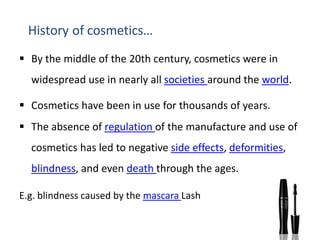
History of cosmetics…
 By the middle of the 20th century, cosmetics were in
widespread use in nearly all societies around the world.
 Cosmetics have been in use for thousands of years.
 The absence of regulation of the manufacture and use of
cosmetics has led to negative side effects, deformities,
blindness, and even death through the ages.
E.g. blindness caused by the mascara Lash
Introduction
 Cosmetics: are substances used to enhance or protect the
appearance or odor of the human skin.
 Cosmetics include skin-care creams, lotions, powders,
perfumes, lipsticks, fingernail and toenail polishes, eye and
facial makeup, permanent waves, hair colors, hair sprays
and gels, deodorants, baby products, bath oils, bubble
baths, bath salts, butters and many other types of
products.
 Their use is widespread, especially among women.
Introduction
 Many manufacturers distinguish between decorative
cosmetics and care cosmetics
 recent years have seen an increasing market for prescription
or surgical cosmetic procedures.
range from temporary enhancements, such as cosmetic
colored contact lenses, to major cosmetic surgery.
⦿ Maintain body health & hygiene.
⦿ Avoid premature ageing of skin.
⦿ Give a sense of well being.
⦿ Improve overall looks &
personality.
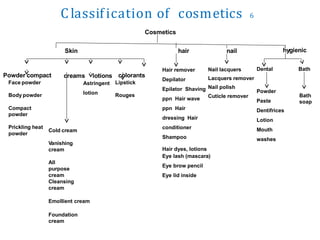
Classification of cosmetics 6
Cosmetics
Skin hair nail hygienic
Powder compact
Face powder
creams lotions colorants
Lipstick
Body powder
Compact
powder
Prickling heat
powder
Cold cream
Vanishing
cream
All
purpose
cream
Cleansing
cream
Emollient cream
Foundation
cream
Astringent
lotion Rouges
Hair remover
Depilator
Epilator Shaving
ppn Hair wave
ppn Hair
dressing Hair
conditioner
Shampoo
Hair dyes, lotions
Eye lash (mascara)
Eye brow pencil
Eye lid inside
Nail lacquers
Lacquers remover
Nail polish
Cuticle remover
Dental Bath
Powder
Paste
Dentifrices
Lotion
Mouth
washes
Bath
soap
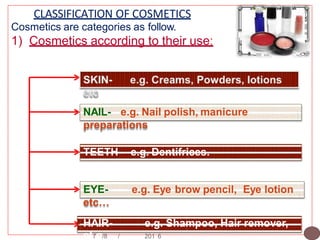
CLASSIFICATION OF COSMETICS
Cosmetics are categories as follow.
1) Cosmetics according to their use:
NAIL- e.g. Nail polish, manicure
preparations
TEETH- e.g. Dentifrices.
EYE- e.g. Eye brow pencil, Eye lotion

etc…
HAIR- e.g. Shampoo, Hair remover,
et7c/8…/ 201.6
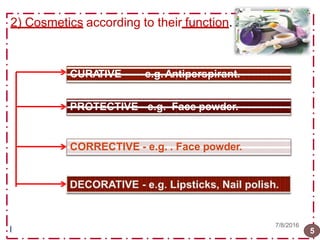
2) Cosmetics according to their function.
l 5
CURA
TIVE - e.g.Antiperspirant.
PROTECTIVE- e.g. Face powder.
CORRECTIVE - e.g. . Face powder.
7/8/2016
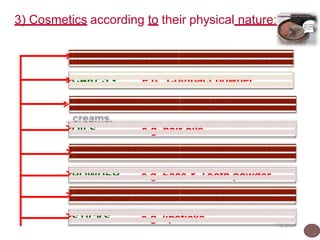
3) Cosmetics according to their physical nature:
AEROSOLS- e.g. Hair perfumes
CAKES - e.g. Compact powder
EMULSION - e.g. Cold & Vanishing
creams.
OILS - e.g. hair oils.
PASTE- e.g. Tooth paste.
POWDER - e.g. Face & Tooth powder.
SOLUTION- e.g. Aftershave & hand Lotion.
STICKS- e.g. lipsticks
7/8/2016
6
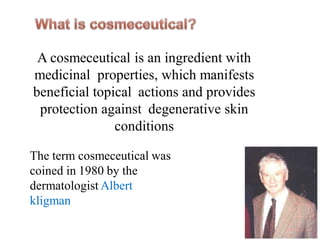
A cosmeceutical is an ingredient with
medicinal properties, which manifests
beneficial topical actions and provides
protection against degenerative skin
conditions
The term cosmeceutical was
coined in 1980 by the
dermatologist Albert
kligman
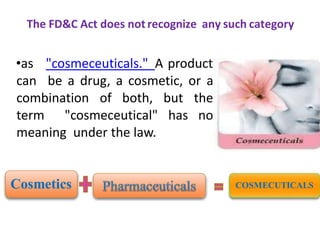
The FD&C Act does notrecognize any such category
•as "cosmeceuticals." A product
can be a drug, a cosmetic, or a
but the
has no
combination of both,
term "cosmeceutical"
meaning under the law.
Cosmetics COSMECUTICALS
•Safe for long-terms use
•Promote beauty throught health and wellness of skin
•cosmeceuticals with natural ingredients are preferred
Advantage of cosmeceticals
Classification of cosmetics…
Skin cosmetics
Epidermis consists of two parts: dead cells on the outside (the
corneal layer) and living cells on the inside, continually replacing
corneal cells.
 Corneal layer is composed of keratin, which has a
moisture content of about 10%.
Sebum, an oily secretion of the sebaccous glands protects skin
from loss of moisture.
Classification of cosmetics…
 Cosmetics are applied to the dead cells of the corneal layer.
Moisturizers hold moisture in the skin.
 work best when applied while the skin is still wet from a bath
or shower.
 don’t actually add moisture to skin.
 form a physical barrier that hinders evaporation of water
from the skin.
Skin cosmetics…
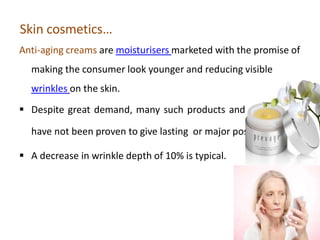
Anti-aging creams are moisturisers marketed with the promise of
making the consumer look younger and reducing visible
wrinkles on the skin.
 Despite great demand, many such products and treatments
have not been proven to give lasting or major positive effects.
 A decrease in wrinkle depth of 10% is typical.
Skin cosmetics…
Depilatories are sulfides of calcium and barium
 have the property of removing hair from the skin and are
generally the active agents in hair removers.
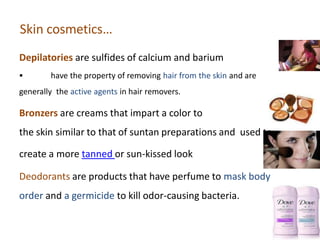
Bronzers are creams that impart a color to
the skin similar to that of suntan preparations and used to
create a more tanned or sun-kissed look
Deodorants are products that have perfume to mask body
order and a germicide to kill odor-causing bacteria.
Skin cosmetics…
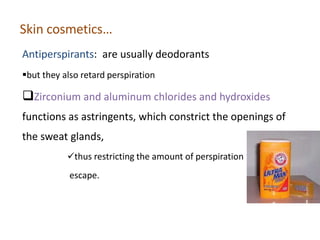
Antiperspirants: are usually deodorants
but they also retard perspiration
Zirconium and aluminum chlorides and hydroxides
functions as astringents, which constrict the openings of
the sweat glands,
thus restricting the amount of perspiration that can
escape.
Skin cosmetics…
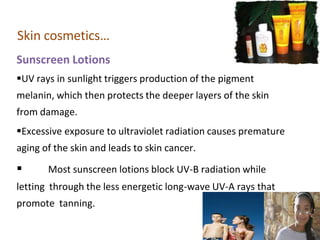
Sunscreen Lotions
UV rays in sunlight triggers production of the pigment
melanin, which then protects the deeper layers of the skin
from damage.
Excessive exposure to ultraviolet radiation causes premature
aging of the skin and leads to skin cancer.
 Most sunscreen lotions block UV-B radiation while
letting through the less energetic long-wave UV-A rays that
promote tanning.
Skin cosmetics…
 PABA derivatives OMC (Octyl methoxycinnamate) is now used
as a UV-B filter in about 90% of all sunscreen lotions.
 Physical sunscreens, or sunblocks, block all UV radiation
Classification of cosmetics…
Face cosmetics
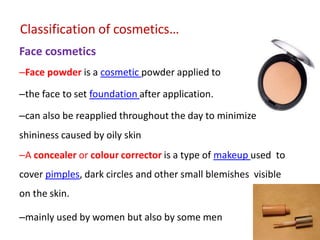
–Face powder is a cosmetic powder applied to
–the face to set foundation after application.
–can also be reapplied throughout the day to minimize
shininess caused by oily skin
–A concealer or colour corrector is a type of makeup used to
cover pimples, dark circles and other small blemishes visible
on the skin.
–mainly used by women but also by some men
Face cosmetics…
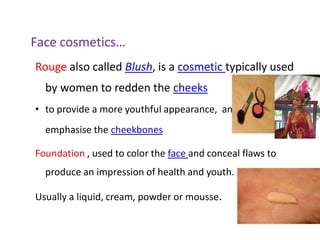
Rouge also called Blush, is a cosmetic typically used
by women to redden the cheeks
• to provide a more youthful appearance, and to
emphasise the cheekbones
Foundation , used to color the face and conceal flaws to
produce an impression of health and youth.
Usually a liquid, cream, powder or mousse.
Classification of cosmetics…
Hair cosmetics
The color of hair and skin is determined by the relative
amounts of two pigments:
 melanin, a brownish black pigment,
 phaeomelanin, a red-brown pigment that colors the
hair and skin of redheads.
Classification of cosmetics…
Hair-coloring dyes, tints, and rinses, available in many shades
and colors, are widely used cosmetic products.
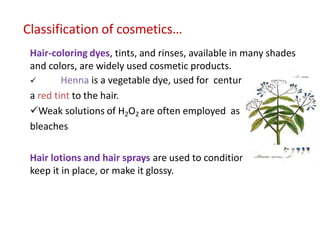
 Henna is a vegetable dye, used for centuries to impart
a red tint to the hair.
Weak solutions of H2O2 are often employed as hair
bleaches
Hair lotions and hair sprays are used to condition the hair,
keep it in place, or make it glossy.
Classification of cosmetics…
Shampoos are based on soap or synthetic detergents
 used to cleanse, glossiffy and leave the hair
lustrous
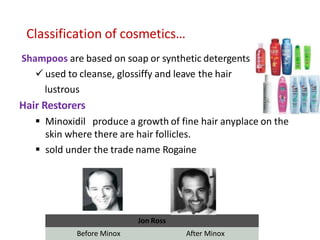
Hair Restorers
 Minoxidil produce a growth of fine hair anyplace on the
skin where there are hair follicles.
 sold under the trade name Rogaine
Jon Ross
Before Minox After Minox
Classification of cosmetics…
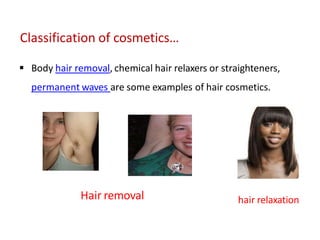
 Body hair removal, chemical hair relaxers or straighteners,
permanent waves are some examples of hair cosmetics.
Hair removal hair relaxation
Classification of cosmetics…
Nail cosmetics
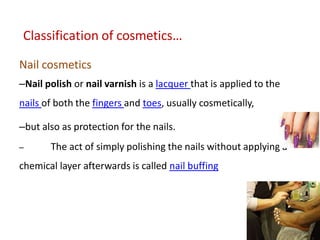
–Nail polish or nail varnish is a lacquer that is applied to the
nails of both the fingers and toes, usually cosmetically,
–but also as protection for the nails.
– The act of simply polishing the nails without applying a
chemical layer afterwards is called nail buffing
Classification of cosmetics…
Eye make ups
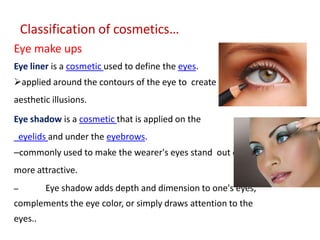
Eye liner is a cosmetic used to define the eyes.
applied around the contours of the eye to create a variety of
aesthetic illusions.
Eye shadow is a cosmetic that is applied on the
eyelids and under the eyebrows.
–commonly used to make the wearer's eyes stand out or look
more attractive.
– Eye shadow adds depth and dimension to one's eyes,
complements the eye color, or simply draws attention to the
eyes..
Classification of cosmetics…
Eye make ups
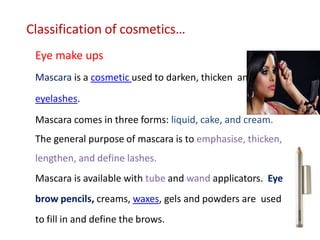
Mascara is a cosmetic used to darken, thicken and define
eyelashes.
Mascara comes in three forms: liquid, cake, and cream.
The general purpose of mascara is to emphasise, thicken,
lengthen, and define lashes.
Mascara is available with tube and wand applicators. Eye
brow pencils, creams, waxes, gels and powders are used
to fill in and define the brows.
Classification of cosmetics…
Lip decorators and carers
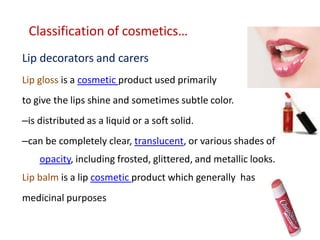
Lip gloss is a cosmetic product used primarily
to give the lips shine and sometimes subtle color.
–is distributed as a liquid or a soft solid.
–can be completely clear, translucent, or various shades of
opacity, including frosted, glittered, and metallic looks.
Lip balm is a lip cosmetic product which generally has
medicinal purposes
Classification of cosmetics…
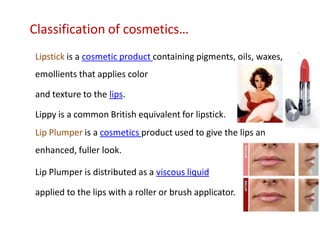
Lipstick is a cosmetic product containing pigments, oils, waxes, and
emollients that applies color
and texture to the lips.
Lippy is a common British equivalent for lipstick.
Lip Plumper is a cosmetics product used to give the lips an
enhanced, fuller look.
Lip Plumper is distributed as a viscous liquid
applied to the lips with a roller or brush applicator.
Classification of cosmetics…
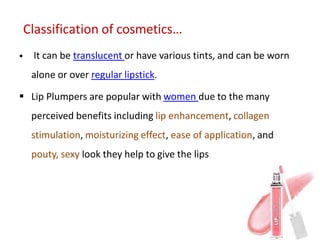
 It can be translucent or have various tints, and can be worn
alone or over regular lipstick.
 Lip Plumpers are popular with women due to the many
perceived benefits including lip enhancement, collagen
stimulation, moisturizing effect, ease of application, and
pouty, sexy look they help to give the lips
Thank you

Cosmetics by Samanthula.pdf

  • 1.
    COSMETICS Dr. S. KumaraSwamy F a c u l t y o f P h a r m a c e u t i c a l S c i e n c e A S S A M D O W N T O W N U N I V E R S I T Y
  • 2.
    INTRODUCTION 7/8/2016 COSMETICS:- Cosmetic it isderived from Greek word ‘kosm tikos’ which means to adorn (make more beautiful or attractive) According to FD&C Act. It means any articles intended to be rubbed, poured, sprinkled, or sprayed on or introduced into or applied to any part of the human body, for cleaning, beautifying, promoting - attractiveness or altering the appearance. e.g. Cosmetics Products includes; Creams, Emulsions, lotions, Gels, Oils, for skin, hand, hair, eye, nails.etc…… 3
  • 3.
    • DRUG • "articlesintended for use in the diagnosis, cure, mitigation, treatment, or prevention of disease" and "articles (other than food) intended to affect the structure or any function of the body of man or other animals
  • 4.
    2. History ofcosmetics  The Romans and Ancient Egyptians used cosmetics (mercury and often lead) .  The Palestine, Jezebel painted her eyes—approximately 840 BC recorded in the Old Testament—2 Kings 9:30  The Biblical book of Esther describes various beauty treatments as well.  Cosmetic use was frowned upon at some points in history.  in the 1800s, make-up was used primarily by prostitutes, and Queen Victoria publicly declared makeup improper, vulgar, and acceptable only for use by actors
  • 5.
    History of cosmetics… By the middle of the 20th century, cosmetics were in widespread use in nearly all societies around the world.  Cosmetics have been in use for thousands of years.  The absence of regulation of the manufacture and use of cosmetics has led to negative side effects, deformities, blindness, and even death through the ages. E.g. blindness caused by the mascara Lash
  • 6.
    Introduction  Cosmetics: aresubstances used to enhance or protect the appearance or odor of the human skin.  Cosmetics include skin-care creams, lotions, powders, perfumes, lipsticks, fingernail and toenail polishes, eye and facial makeup, permanent waves, hair colors, hair sprays and gels, deodorants, baby products, bath oils, bubble baths, bath salts, butters and many other types of products.  Their use is widespread, especially among women.
  • 7.
    Introduction  Many manufacturersdistinguish between decorative cosmetics and care cosmetics  recent years have seen an increasing market for prescription or surgical cosmetic procedures. range from temporary enhancements, such as cosmetic colored contact lenses, to major cosmetic surgery.
  • 8.
    ⦿ Maintain bodyhealth & hygiene. ⦿ Avoid premature ageing of skin. ⦿ Give a sense of well being. ⦿ Improve overall looks & personality.
  • 9.
    Classification of cosmetics6 Cosmetics Skin hair nail hygienic Powder compact Face powder creams lotions colorants Lipstick Body powder Compact powder Prickling heat powder Cold cream Vanishing cream All purpose cream Cleansing cream Emollient cream Foundation cream Astringent lotion Rouges Hair remover Depilator Epilator Shaving ppn Hair wave ppn Hair dressing Hair conditioner Shampoo Hair dyes, lotions Eye lash (mascara) Eye brow pencil Eye lid inside Nail lacquers Lacquers remover Nail polish Cuticle remover Dental Bath Powder Paste Dentifrices Lotion Mouth washes Bath soap
  • 10.
    CLASSIFICATION OF COSMETICS Cosmeticsare categories as follow. 1) Cosmetics according to their use: NAIL- e.g. Nail polish, manicure preparations TEETH- e.g. Dentifrices. EYE- e.g. Eye brow pencil, Eye lotion etc… HAIR- e.g. Shampoo, Hair remover, et7c/8…/ 201.6
  • 11.
    2) Cosmetics accordingto their function. l 5 CURA TIVE - e.g.Antiperspirant. PROTECTIVE- e.g. Face powder. CORRECTIVE - e.g. . Face powder. 7/8/2016
  • 12.
    3) Cosmetics accordingto their physical nature: AEROSOLS- e.g. Hair perfumes CAKES - e.g. Compact powder EMULSION - e.g. Cold & Vanishing creams. OILS - e.g. hair oils. PASTE- e.g. Tooth paste. POWDER - e.g. Face & Tooth powder. SOLUTION- e.g. Aftershave & hand Lotion. STICKS- e.g. lipsticks 7/8/2016 6
  • 13.
    A cosmeceutical isan ingredient with medicinal properties, which manifests beneficial topical actions and provides protection against degenerative skin conditions The term cosmeceutical was coined in 1980 by the dermatologist Albert kligman
  • 14.
    The FD&C Actdoes notrecognize any such category •as "cosmeceuticals." A product can be a drug, a cosmetic, or a but the has no combination of both, term "cosmeceutical" meaning under the law. Cosmetics COSMECUTICALS
  • 15.
    •Safe for long-termsuse •Promote beauty throught health and wellness of skin •cosmeceuticals with natural ingredients are preferred Advantage of cosmeceticals
  • 16.
    Classification of cosmetics… Skincosmetics Epidermis consists of two parts: dead cells on the outside (the corneal layer) and living cells on the inside, continually replacing corneal cells.  Corneal layer is composed of keratin, which has a moisture content of about 10%. Sebum, an oily secretion of the sebaccous glands protects skin from loss of moisture.
  • 17.
    Classification of cosmetics… Cosmetics are applied to the dead cells of the corneal layer. Moisturizers hold moisture in the skin.  work best when applied while the skin is still wet from a bath or shower.  don’t actually add moisture to skin.  form a physical barrier that hinders evaporation of water from the skin.
  • 18.
    Skin cosmetics… Anti-aging creamsare moisturisers marketed with the promise of making the consumer look younger and reducing visible wrinkles on the skin.  Despite great demand, many such products and treatments have not been proven to give lasting or major positive effects.  A decrease in wrinkle depth of 10% is typical.
  • 19.
    Skin cosmetics… Depilatories aresulfides of calcium and barium  have the property of removing hair from the skin and are generally the active agents in hair removers. Bronzers are creams that impart a color to the skin similar to that of suntan preparations and used to create a more tanned or sun-kissed look Deodorants are products that have perfume to mask body order and a germicide to kill odor-causing bacteria.
  • 20.
    Skin cosmetics… Antiperspirants: areusually deodorants but they also retard perspiration Zirconium and aluminum chlorides and hydroxides functions as astringents, which constrict the openings of the sweat glands, thus restricting the amount of perspiration that can escape.
  • 21.
    Skin cosmetics… Sunscreen Lotions UVrays in sunlight triggers production of the pigment melanin, which then protects the deeper layers of the skin from damage. Excessive exposure to ultraviolet radiation causes premature aging of the skin and leads to skin cancer.  Most sunscreen lotions block UV-B radiation while letting through the less energetic long-wave UV-A rays that promote tanning.
  • 22.
    Skin cosmetics…  PABAderivatives OMC (Octyl methoxycinnamate) is now used as a UV-B filter in about 90% of all sunscreen lotions.  Physical sunscreens, or sunblocks, block all UV radiation
  • 23.
    Classification of cosmetics… Facecosmetics –Face powder is a cosmetic powder applied to –the face to set foundation after application. –can also be reapplied throughout the day to minimize shininess caused by oily skin –A concealer or colour corrector is a type of makeup used to cover pimples, dark circles and other small blemishes visible on the skin. –mainly used by women but also by some men
  • 24.
    Face cosmetics… Rouge alsocalled Blush, is a cosmetic typically used by women to redden the cheeks • to provide a more youthful appearance, and to emphasise the cheekbones Foundation , used to color the face and conceal flaws to produce an impression of health and youth. Usually a liquid, cream, powder or mousse.
  • 25.
    Classification of cosmetics… Haircosmetics The color of hair and skin is determined by the relative amounts of two pigments:  melanin, a brownish black pigment,  phaeomelanin, a red-brown pigment that colors the hair and skin of redheads.
  • 26.
    Classification of cosmetics… Hair-coloringdyes, tints, and rinses, available in many shades and colors, are widely used cosmetic products.  Henna is a vegetable dye, used for centuries to impart a red tint to the hair. Weak solutions of H2O2 are often employed as hair bleaches Hair lotions and hair sprays are used to condition the hair, keep it in place, or make it glossy.
  • 27.
    Classification of cosmetics… Shampoosare based on soap or synthetic detergents  used to cleanse, glossiffy and leave the hair lustrous Hair Restorers  Minoxidil produce a growth of fine hair anyplace on the skin where there are hair follicles.  sold under the trade name Rogaine Jon Ross Before Minox After Minox
  • 28.
    Classification of cosmetics… Body hair removal, chemical hair relaxers or straighteners, permanent waves are some examples of hair cosmetics. Hair removal hair relaxation
  • 29.
    Classification of cosmetics… Nailcosmetics –Nail polish or nail varnish is a lacquer that is applied to the nails of both the fingers and toes, usually cosmetically, –but also as protection for the nails. – The act of simply polishing the nails without applying a chemical layer afterwards is called nail buffing
  • 30.
    Classification of cosmetics… Eyemake ups Eye liner is a cosmetic used to define the eyes. applied around the contours of the eye to create a variety of aesthetic illusions. Eye shadow is a cosmetic that is applied on the eyelids and under the eyebrows. –commonly used to make the wearer's eyes stand out or look more attractive. – Eye shadow adds depth and dimension to one's eyes, complements the eye color, or simply draws attention to the eyes..
  • 31.
    Classification of cosmetics… Eyemake ups Mascara is a cosmetic used to darken, thicken and define eyelashes. Mascara comes in three forms: liquid, cake, and cream. The general purpose of mascara is to emphasise, thicken, lengthen, and define lashes. Mascara is available with tube and wand applicators. Eye brow pencils, creams, waxes, gels and powders are used to fill in and define the brows.
  • 32.
    Classification of cosmetics… Lipdecorators and carers Lip gloss is a cosmetic product used primarily to give the lips shine and sometimes subtle color. –is distributed as a liquid or a soft solid. –can be completely clear, translucent, or various shades of opacity, including frosted, glittered, and metallic looks. Lip balm is a lip cosmetic product which generally has medicinal purposes
  • 33.
    Classification of cosmetics… Lipstickis a cosmetic product containing pigments, oils, waxes, and emollients that applies color and texture to the lips. Lippy is a common British equivalent for lipstick. Lip Plumper is a cosmetics product used to give the lips an enhanced, fuller look. Lip Plumper is distributed as a viscous liquid applied to the lips with a roller or brush applicator.
  • 34.
    Classification of cosmetics… It can be translucent or have various tints, and can be worn alone or over regular lipstick.  Lip Plumpers are popular with women due to the many perceived benefits including lip enhancement, collagen stimulation, moisturizing effect, ease of application, and pouty, sexy look they help to give the lips
  • 35.