Extensions
Framework &
Orchestrate
Anything
Lucian Burlacu @ CloudStack European User Group 2025
Credits: The A-Team (Abhisar, Hari, Abhishek & Kiran)
whoami
● PMC and Committer @ Apache
CloudStack project
● Sysadmin & DataCentre Ops
● Passionate about free software, IT
sovereignty & autonomy
● Cloud Architect @ ShapeBlue
Lucian
Why Extensions?
● Plug in External Logic Easily
○ Integrate custom scripts or tools directly into CloudStack workflows
○ Ideal for operators and developers outside the core project
● Decouples external logic from core CloudStack
● Enhances automation use-cases
● Define custom actions
What can be achieved ?
● Can integrate new VM provisioners or hypervisors
○ Proxmox
○ Hyper-V
○ MaaS
○ Baremetal
● Define custom actions like
○ Snapshots
○ Clone operations
○ Backups
● Can integrate new Network extensions
Extensions
Framework
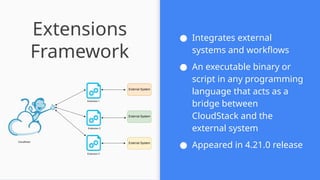
● Integrates external
systems and workflows
● An executable binary or
script in any programming
language that acts as a
bridge between
CloudStack and the
external system
● Appeared in 4.21.0 release
Extensions Framework - contd.
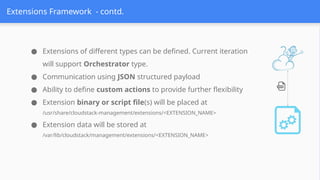
● Extensions of different types can be defined. Current iteration
will support Orchestrator type.
● Communication using JSON structured payload
● Ability to define custom actions to provide further flexibility
● Extension binary or script file(s) will be placed at
/usr/share/cloudstack-management/extensions/<EXTENSION_NAME>
● Extension data will be stored at
/var/lib/cloudstack/management/extensions/<EXTENSION_NAME>
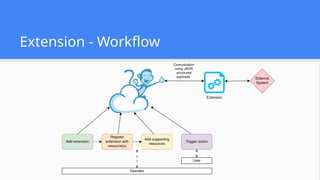
Extension - Workflow
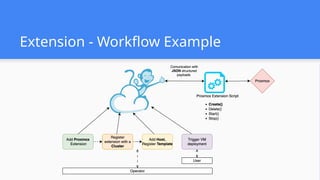
Extension - Workflow Example
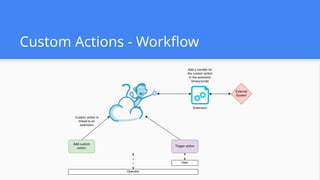
● Operators can define
custom actions for
each extension
● Supports user-defined
input parameters,
success/error
messages, allowed
role types
● Actions can be linked
to specific resource
types
Custom
Actions
Custom Actions - Workflow
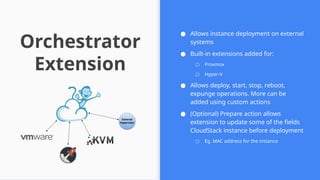
Orchestrator
Extension
● Allows instance deployment on external
systems
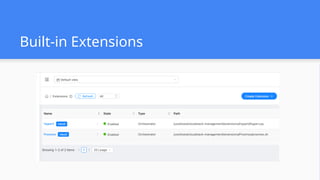
● Built-in extensions added for:
○ Proxmox
○ Hyper-V
● Allows deploy, start, stop, reboot,
expunge operations. More can be
added using custom actions
● (Optional) Prepare action allows
extension to update some of the fields
CloudStack instance before deployment
○ Eg. MAC address for the instance
Built-in Extensions
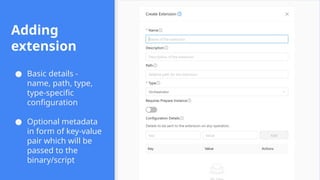
Adding
extension
● Basic details -
name, path, type,
type-specific
configuration
● Optional metadata
in form of key-value
pair which will be
passed to the
binary/script
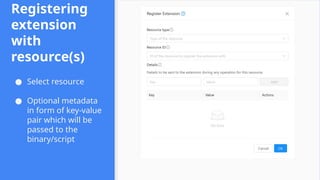
Registering
extension
with
resource(s)
● Select resource
● Optional metadata
in form of key-value
pair which will be
passed to the
binary/script
Add additional resources
For orchestrator,
● Host
● Template
● Service offering (optional)
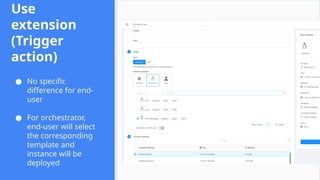
Use
extension
(Trigger
action)
● No specific
difference for end-
user
● For orchestrator,
end-user will select
the corresponding
template and
instance will be
deployed
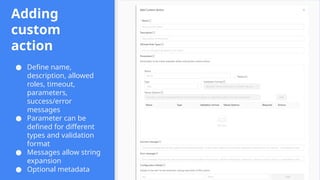
Adding
custom
action
● Define name,
description, allowed
roles, timeout,
parameters,
success/error
messages
● Parameter can be
defined for different
types and validation
format
● Messages allow string
expansion
● Optional metadata
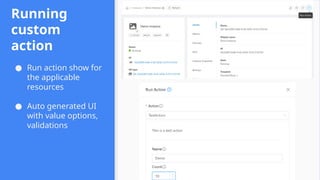
Running
custom
action
● Run action show for
the applicable
resources
● Auto generated UI
with value options,
validations
Demo
Future & What’s Next
● Is a part of CloudStack 4.21.0 release
● New types - network, authenticator, etc
● Usability improvements - feedback from community
● Extension marketplace?
Q&A
https://github.com/apache/cloudstack/pull/9752
https://github.com/apache/cloudstack-documentation/pull/523
https://www.youtube.com/watch?v=TiTCovhkkKI (CSIUG original
presentation)

CloudStack Extensions Framework (XaaS) - Enabling Orchestrate Anything + Demo - Lucian Burlacu

Editor's Notes

  • #11 Continues with VM Ingestion functionality first introduced in CloudStack 4.14 with VMware support Would make CloudStack onboarding easier.
  • #13 CloudStack currently support native, LDAP and SAML based authentication
  • #14 CloudStack currently support native, LDAP and SAML based authentication
  • #16 CloudStack currently support native, LDAP and SAML based authentication
  • #17 CloudStack currently support native, LDAP and SAML based authentication
  • #18 CloudStack currently support native, LDAP and SAML based authentication