Marathwada Mitramandal’s
COLLEGE OF ENGINEERING
Karvenagar, Pune
Accredited with ‘A’ Grade by NAAC
Presentation
On
Subject: Control System Engineering
by
Mr. A. M. Suryawanshi
Department of Electrical Engineering
Unit 1: Basics of Control System
Session- 1/40
Basic concepts of control system, classification of control
systems, types of control system feedback
Session Plan
Outline:
A. Attendance
B. Review of the previous session
C. Learning Outcomes of the session
D. Content
E. Student’s evaluation
F. Preparation for next session
G. Wrap up
B. Review of previous session:
• Dissemination of CO-PO-PSOs
• Introduction to Course
• Course Objective
• Course Outcomes
C. Learning Outcomes of the session:
• Understand basic concepts of control system
• Understand the different types of control system feedback
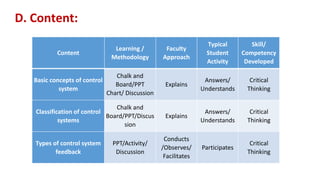
D. Content:
Content
Learning /
Methodology
Faculty
Approach
Typical
Student
Activity
Skill/
Competency
Developed
Basic concepts of control
system
Chalk and
Board/PPT
Chart/ Discussion
Explains
Answers/
Understands
Critical
Thinking
Classification of control
systems
Chalk and
Board/PPT/Discus
sion
Explains
Answers/
Understands
Critical
Thinking
Types of control system
feedback
PPT/Activity/
Discussion
Conducts
/Observes/
Facilitates
Participates
Critical
Thinking
Basic concepts of control system
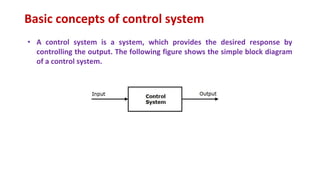
• A control system is a system, which provides the desired response by
controlling the output. The following figure shows the simple block diagram
of a control system.
Classification of control systems
• Based on some parameters, we can classify the control systems into the
following ways
1. Continuous time and Discrete-time Control Systems
2. SISO and MIMO Control Systems
3. Open Loop and Closed Loop Control Systems
1. Continuous time and Discrete-time Control Systems: -
- Control Systems can be classified as continuous time control systems and
discrete time control systems based on the type of the signal used.
- In continuous time control systems, all the signals are continuous in time. But,
in discrete time control systems, there exists one or more discrete time signals.
2. SISO and MIMO Control Systems: -
- Control Systems can be classified as SISO control systems and MIMO control
systems based on the number of inputs and outputs present.
- SISO (Single Input and Single Output) control systems have one input and one
output. Whereas, MIMO (Multiple Inputs and Multiple Outputs) control systems
have more than one input and more than one output.
3. Open Loop and Closed Loop Control Systems: -
- Control Systems can be classified as open loop control systems and closed loop
control systems based on the feedback path.
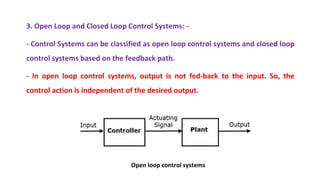
- In open loop control systems, output is not fed-back to the input. So, the
control action is independent of the desired output.
Open loop control systems
- In closed loop control systems, output is fed back to the input. So, the control
action is dependent on the desired output.
Closed loop control systems
Types of control system feedback
• There are two types of feedback −
1. Positive feedback
2. Negative feedback
𝑇 =
𝐺
1 − 𝐺𝐻
𝑇 =
𝐺
1 + 𝐺𝐻
Transfer function of positive feedback control system is, Transfer function of negative feedback control system is,
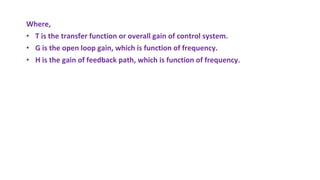
Where,
• T is the transfer function or overall gain of control system.
• G is the open loop gain, which is function of frequency.
• H is the gain of feedback path, which is function of frequency.
E. Student’s evaluation
Quiz 1.1
https://forms.gle/b9QSAFpDqCzHV8GX9
Tracking and regulator system:
1. Effect of Feedback on Overall Gain
2. Effect of Feedback on Sensitivity
3. Effect of Feedback on Stability
4. Effect of Feedback on Noise
Feed forward system:
The basic concept of feedforward control is to measure important disturbance variables
and take corrective action before they upset the process.
Transfer function:
The transfer function of a control system is defined as the ratio of the Laplace transform
of the output variable to Laplace transform of the input variable assuming all initial
conditions to be zero.
F. Preparation for Next Session:-
G. Wrap Up
In this lecture we have learned
Basic concepts of control system:
A control system is a system, which provides the desired response by controlling
the output.
Classification of control systems:
1. Continuous time and Discrete-time Control Systems
2. SISO and MIMO Control Systems
3. Open Loop and Closed Loop Control Systems
Types of control system feedback:
1. Positive feedback
2. Negative feedback

1. Basic concepts of control system.pptx

  • 1.
    Marathwada Mitramandal’s COLLEGE OFENGINEERING Karvenagar, Pune Accredited with ‘A’ Grade by NAAC Presentation On Subject: Control System Engineering by Mr. A. M. Suryawanshi Department of Electrical Engineering
  • 2.
    Unit 1: Basicsof Control System Session- 1/40 Basic concepts of control system, classification of control systems, types of control system feedback Session Plan
  • 3.
    Outline: A. Attendance B. Reviewof the previous session C. Learning Outcomes of the session D. Content E. Student’s evaluation F. Preparation for next session G. Wrap up
  • 4.
    B. Review ofprevious session: • Dissemination of CO-PO-PSOs • Introduction to Course • Course Objective • Course Outcomes
  • 5.
    C. Learning Outcomesof the session: • Understand basic concepts of control system • Understand the different types of control system feedback
  • 6.
    D. Content: Content Learning / Methodology Faculty Approach Typical Student Activity Skill/ Competency Developed Basicconcepts of control system Chalk and Board/PPT Chart/ Discussion Explains Answers/ Understands Critical Thinking Classification of control systems Chalk and Board/PPT/Discus sion Explains Answers/ Understands Critical Thinking Types of control system feedback PPT/Activity/ Discussion Conducts /Observes/ Facilitates Participates Critical Thinking
  • 7.
    Basic concepts ofcontrol system • A control system is a system, which provides the desired response by controlling the output. The following figure shows the simple block diagram of a control system.
  • 8.
    Classification of controlsystems • Based on some parameters, we can classify the control systems into the following ways 1. Continuous time and Discrete-time Control Systems 2. SISO and MIMO Control Systems 3. Open Loop and Closed Loop Control Systems
  • 9.
    1. Continuous timeand Discrete-time Control Systems: - - Control Systems can be classified as continuous time control systems and discrete time control systems based on the type of the signal used. - In continuous time control systems, all the signals are continuous in time. But, in discrete time control systems, there exists one or more discrete time signals.
  • 10.
    2. SISO andMIMO Control Systems: - - Control Systems can be classified as SISO control systems and MIMO control systems based on the number of inputs and outputs present. - SISO (Single Input and Single Output) control systems have one input and one output. Whereas, MIMO (Multiple Inputs and Multiple Outputs) control systems have more than one input and more than one output.
  • 11.
    3. Open Loopand Closed Loop Control Systems: - - Control Systems can be classified as open loop control systems and closed loop control systems based on the feedback path. - In open loop control systems, output is not fed-back to the input. So, the control action is independent of the desired output. Open loop control systems
  • 12.
    - In closedloop control systems, output is fed back to the input. So, the control action is dependent on the desired output. Closed loop control systems
  • 13.
    Types of controlsystem feedback • There are two types of feedback − 1. Positive feedback 2. Negative feedback 𝑇 = 𝐺 1 − 𝐺𝐻 𝑇 = 𝐺 1 + 𝐺𝐻 Transfer function of positive feedback control system is, Transfer function of negative feedback control system is,
  • 14.
    Where, • T isthe transfer function or overall gain of control system. • G is the open loop gain, which is function of frequency. • H is the gain of feedback path, which is function of frequency.
  • 15.
    E. Student’s evaluation Quiz1.1 https://forms.gle/b9QSAFpDqCzHV8GX9
  • 16.
    Tracking and regulatorsystem: 1. Effect of Feedback on Overall Gain 2. Effect of Feedback on Sensitivity 3. Effect of Feedback on Stability 4. Effect of Feedback on Noise Feed forward system: The basic concept of feedforward control is to measure important disturbance variables and take corrective action before they upset the process. Transfer function: The transfer function of a control system is defined as the ratio of the Laplace transform of the output variable to Laplace transform of the input variable assuming all initial conditions to be zero. F. Preparation for Next Session:-
  • 17.
    G. Wrap Up Inthis lecture we have learned Basic concepts of control system: A control system is a system, which provides the desired response by controlling the output. Classification of control systems: 1. Continuous time and Discrete-time Control Systems 2. SISO and MIMO Control Systems 3. Open Loop and Closed Loop Control Systems Types of control system feedback: 1. Positive feedback 2. Negative feedback