Storey: Electrical & Electronic Systems © Pearson Education Limited 2004 OHT 7.‹#›
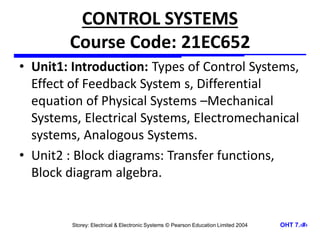
CONTROL SYSTEMS
Course Code: 21EC652
• Unit1: Introduction: Types of Control Systems,
Effect of Feedback System s, Differential
equation of Physical Systems –Mechanical
Systems, Electrical Systems, Electromechanical
systems, Analogous Systems.
• Unit2 : Block diagrams: Transfer functions,
Block diagram algebra.
Storey: Electrical & Electronic Systems © Pearson Education Limited 2004 OHT 7.‹#›
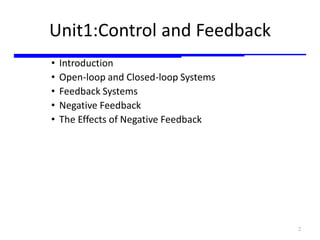
Unit1:Control and Feedback
• Introduction
• Open-loop and Closed-loop Systems
• Feedback Systems
• Negative Feedback
• The Effects of Negative Feedback
2
Storey: Electrical & Electronic Systems © Pearson Education Limited 2004 OHT 7.‹#›
3
Storey: Electrical & Electronic Systems © Pearson Education Limited 2004 OHT 7.‹#›
4
Storey: Electrical & Electronic Systems © Pearson Education Limited 2004 OHT 7.‹#›
Introduction
• Earlier we identified control as one of the
basic functions performed by many systems
– often involves regulation or command
• Invariably, the goal is to determine the value
or state of some physical quantity
– and often to maintain it at that value, despite
variations in the system or the environment
5
Storey: Electrical & Electronic Systems © Pearson Education Limited 2004 OHT 7.‹#›
6
Storey: Electrical & Electronic Systems © Pearson Education Limited 2004 OHT 7.‹#›
7
Storey: Electrical & Electronic Systems © Pearson Education Limited 2004 OHT 7.‹#›
8
Storey: Electrical & Electronic Systems © Pearson Education Limited 2004 OHT 7.‹#›
9
Storey: Electrical & Electronic Systems © Pearson Education Limited 2004 OHT 7.‹#›
10
Storey: Electrical & Electronic Systems © Pearson Education Limited 2004 OHT 7.‹#›
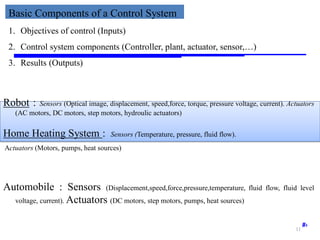
Basic Components of a Control System
1. Objectives of control (Inputs)
2. Control system components (Controller, plant, actuator, sensor,…)
3. Results (Outputs)
Home Heating System : Sensors (Temperature, pressure, fluid flow).
Actuators (Motors, pumps, heat sources)
Automobile : Sensors (Displacement,speed,force,pressure,temperature, fluid flow, fluid level
voltage, current). Actuators (DC motors, step motors, pumps, heat sources)
Robot : Sensors (Optical image, displacement, speed,force, torque, pressure voltage, current). Actuators
(AC motors, DC motors, step motors, hydroulic actuators)
11
Storey: Electrical & Electronic Systems © Pearson Education Limited 2004 OHT 7.‹#›
12
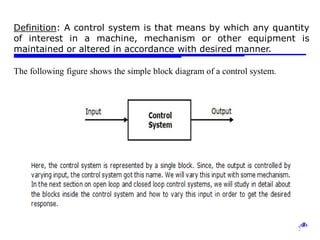
Definition: A control system is that means by which any quantity
of interest in a machine, mechanism or other equipment is
maintained or altered in accordance with desired manner.
The following figure shows the simple block diagram of a control system.
Storey: Electrical & Electronic Systems © Pearson Education Limited 2004 OHT 7.‹#›
13
1.Linear Control Systems
In order to understand the linear control system, we should first understand the principle of
superposition.
The principle of superposition theorem includes two the important properties :
Homogeneity: A system is said to be homogeneous, if we multiply input with some
constant α then the output will also be multiplied by the same value of constant
i.e. f(αx)= αf(x)
Additivity: Suppose we have a system S and we are giving the input to this system as a1 for
the first time and we are getting the output as b1 corresponding to input a1. On the second
time we are giving input a2 and correspond to this we are getting the output as b2.
Now suppose this time we are giving input as a summation of the previous inputs (i.e. a1 +
a2) and corresponding to this input suppose we are getting the output as (b1 + b2) then we
can say that system S is following the property of additivity.
Now we are able to define the linear control systems as those types of control systems
which follow the principle of homogeneity and additivity i.e . superposition theorem .
In Non linear control systems principle of superposition cannot be applied
Storey: Electrical & Electronic Systems © Pearson Education Limited 2004 OHT 7.‹#›
14
2.Time Varying and Time invariant systems:
i. Time Varying control systems are those in which parameters
of systems varying with time.
Ex: A mass of missile varies as a function of time as fuel is
expended during flight.
ii. Time invariant systems :When parameters of control system are
stationary with respect to time during operation of the system,
the system is called as Time invariant system.
Ex: spectroscopy, seismology, circuits, signal processing,
Storey: Electrical & Electronic Systems © Pearson Education Limited 2004 OHT 7.‹#›
15
3.Continuous data and Discrete data control systems
i . A continuous-data system is one in which the signals at various parts
of the system are all functions of the continuous time variable t. The
signals in continuous-data systems may be further classified as ac or dc.
ii. Discrete-data control systems differ from the continuous-data systems
in that the signals at one or more points of the system are in the form of
either a pulse train or a digital code. Usually, discrete-data control
systems are subdivided into sampled-data and digital control systems.
Storey: Electrical & Electronic Systems © Pearson Education Limited 2004 OHT 7.‹#›
16
Control Systems can be classified as SISO control
systems and MIMO control systems based on the
number of inputs and outputs present.
SISO (Single Input and Single Output) control systems
have one input and one output. Whereas, MIMO
(Multiple Inputs and Multiple Outputs) control systems
have more than one input and more than one output.
4.SISO and MIMO Control Systems
Storey: Electrical & Electronic Systems © Pearson Education Limited 2004 OHT 7.‹#›
17
5. Open Loop and Closed Loop Control Systems
Control Systems can be classified as open loop control systems and closed loop control
systems based on the feedback path.
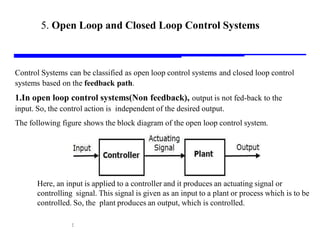
1.In open loop control systems(Non feedback), output is not fed-back to the
input. So, the control action is independent of the desired output.
The following figure shows the block diagram of the open loop control system.
Here, an input is applied to a controller and it produces an actuating signal or
controlling signal. This signal is given as an input to a plant or process which is to be
controlled. So, the plant produces an output, which is controlled.
Storey: Electrical & Electronic Systems © Pearson Education Limited 2004 OHT 7.‹#›
18
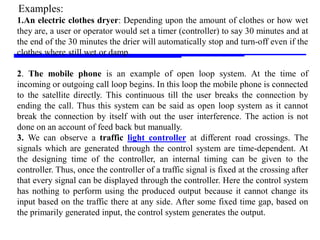
1.An electric clothes dryer: Depending upon the amount of clothes or how wet
they are, a user or operator would set a timer (controller) to say 30 minutes and at
the end of the 30 minutes the drier will automatically stop and turn-off even if the
clothes where still wet or damp.
2. The mobile phone is an example of open loop system. At the time of
incoming or outgoing call loop begins. In this loop the mobile phone is connected
to the satellite directly. This continuous till the user breaks the connection by
ending the call. Thus this system can be said as open loop system as it cannot
break the connection by itself with out the user interference. The action is not
done on an account of feed back but manually.
3. We can observe a traffic light controller at different road crossings. The
signals which are generated through the control system are time-dependent. At
the designing time of the controller, an internal timing can be given to the
controller. Thus, once the controller of a traffic signal is fixed at the crossing after
that every signal can be displayed through the controller. Here the control system
has nothing to perform using the produced output because it cannot change its
input based on the traffic there at any side. After some fixed time gap, based on
the primarily generated input, the control system generates the output.
Examples:
Storey: Electrical & Electronic Systems © Pearson Education Limited 2004 OHT 7.‹#›
19
2.Closed loop control systems
In closed loop control systems, output is fed back to the input. So, the control
action is dependent on the desired output.
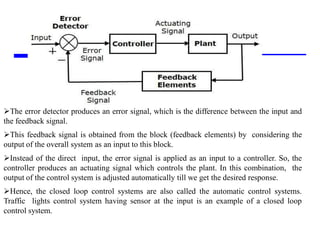
The following figure shows the block diagram of negative feedback closed loop
control system.
Storey: Electrical & Electronic Systems © Pearson Education Limited 2004 OHT 7.‹#›
20
The error detector produces an error signal, which is the difference between the input and
the feedback signal.
This feedback signal is obtained from the block (feedback elements) by considering the
output of the overall system as an input to this block.
Instead of the direct input, the error signal is applied as an input to a controller. So, the
controller produces an actuating signal which controls the plant. In this combination, the
output of the control system is adjusted automatically till we get the desired response.
Hence, the closed loop control systems are also called the automatic control systems.
Traffic lights control system having sensor at the input is an example of a closed loop
control system.
Storey: Electrical & Electronic Systems © Pearson Education Limited 2004 OHT 7.‹#›
21
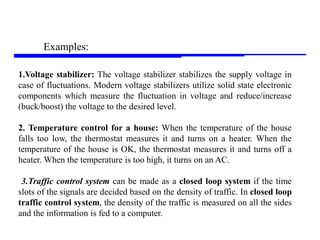
Examples:
1.Voltage stabilizer: The voltage stabilizer stabilizes the supply voltage in
case of fluctuations. Modern voltage stabilizers utilize solid state electronic
components which measure the fluctuation in voltage and reduce/increase
(buck/boost) the voltage to the desired level.
2. Temperature control for a house: When the temperature of the house
falls too low, the thermostat measures it and turns on a heater. When the
temperature of the house is OK, the thermostat measures it and turns off a
heater. When the temperature is too high, it turns on an AC.
3.Traffic control system can be made as a closed loop system if the time
slots of the signals are decided based on the density of traffic. In closed loop
traffic control system, the density of the traffic is measured on all the sides
and the information is fed to a computer.
Storey: Electrical & Electronic Systems © Pearson Education Limited 2004 OHT 7.‹#›
22
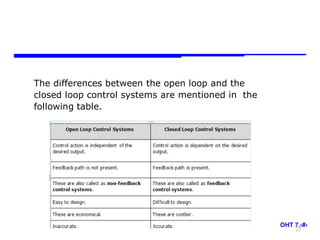
The differences between the open loop and the
closed loop control systems are mentioned in the
following table.
Storey: Electrical & Electronic Systems © Pearson Education Limited 2004 OHT 7.‹#›
23
If either the output or some part of the output is returned to the
input side and utilized as part of the system input, then it is
known as feedback.
Feedback plays an important role in order to improve the
performance of the control systems. In this chapter, let us discuss
the types of feedback & effects of feedback.
There are two types of feedback:
Positive feedback
Negative feedback
Feedback
Storey: Electrical & Electronic Systems © Pearson Education Limited 2004 OHT 7.‹#›
24
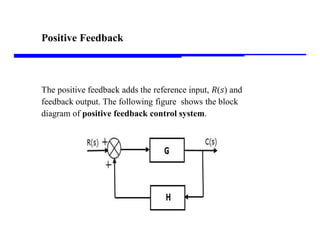
Positive Feedback
The positive feedback adds the reference input, 𝑅(𝑠) and
feedback output. The following figure shows the block
diagram of positive feedback control system.
Storey: Electrical & Electronic Systems © Pearson Education Limited 2004 OHT 7.‹#›
25
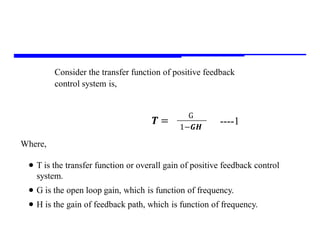
Consider the transfer function of positive feedback
control system is,
Where,
 T is the transfer function or overall gain of positive feedback control
system.
 G is the open loop gain, which is function of frequency.
 H is the gain of feedback path, which is function of frequency.
𝑻 =
G
1−𝑮𝑯
----1
Storey: Electrical & Electronic Systems © Pearson Education Limited 2004 OHT 7.‹#›
26
Negative Feedback
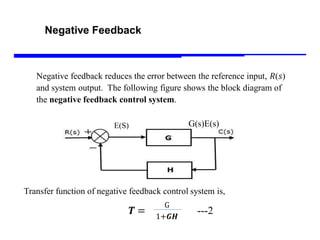
Negative feedback reduces the error between the reference input, 𝑅(𝑠)
and system output. The following figure shows the block diagram of
the negative feedback control system.
Transfer function of negative feedback control system is,
𝑻 =
G
1+𝑮𝑯
---2
E(S) G(s)E(s)
Storey: Electrical & Electronic Systems © Pearson Education Limited 2004 OHT 7.‹#›
27
C(S)=E(S)G(S) ----1
E(S) = R(S)-H(S)C(S) ---2
Use value of E(S) into C(S)
Then C(S) =G(S)[R(S)-H(S)C(S)]
C(S) = G(S)R(S)- G(S)H(S)C(S)
C(S)+ G(S)H(S)C(S)=G(S)R(S)
C(S)[1+G(S)H(S)]= G(S)R(S)
T=C(S)/R(S)=G(S)/1+G(S)H(S)
E(S)
G(s)E(s)
C(S)H(S)
Storey: Electrical & Electronic Systems © Pearson Education Limited 2004 OHT 7.‹#›
28
Storey: Electrical & Electronic Systems © Pearson Education Limited 2004 OHT 7.‹#›
29
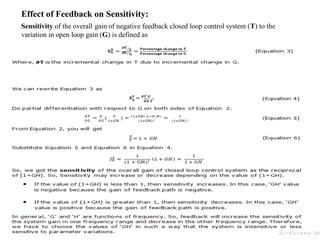
Effect of Feedback on Sensitivity:
Sensitivity of the overall gain of negative feedback closed loop control system (T) to the
variation in open loop gain (G) is defined as
Storey: Electrical & Electronic Systems © Pearson Education Limited 2004 OHT 7.‹#›
30
Effects of Feedback:
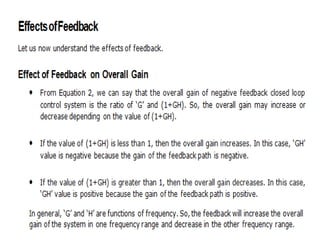
Effect of Feedback on Overall Gain
From Equation 2, we can say that the overall gain of negative feedback
closed loop control system is the ratio of ‘G’ and (1+GH). So, the overall gain
may increase or decrease depending on the value of (1+GH).
If the value of (1+GH) is less than 1, then the overall gain increases. In this
case, ‘GH’ value is negative because the gain of the feedback path is
negative.
If the value of (1+GH) is greater than 1, then the overall gain decreases. In
this case, ‘GH’ value is positive because the gain of the feedback path is
positive.
In general, ‘G’ and ‘H’ are functions of frequency. So, the feedback will
increase the overall gain of the system in one frequency range and decrease
in the other frequency range.

Module1-types, effect.pdf shsbshbsvshshshsg

  • 1.
    Storey: Electrical &Electronic Systems © Pearson Education Limited 2004 OHT 7.‹#› CONTROL SYSTEMS Course Code: 21EC652 • Unit1: Introduction: Types of Control Systems, Effect of Feedback System s, Differential equation of Physical Systems –Mechanical Systems, Electrical Systems, Electromechanical systems, Analogous Systems. • Unit2 : Block diagrams: Transfer functions, Block diagram algebra.
  • 2.
    Storey: Electrical &Electronic Systems © Pearson Education Limited 2004 OHT 7.‹#› Unit1:Control and Feedback • Introduction • Open-loop and Closed-loop Systems • Feedback Systems • Negative Feedback • The Effects of Negative Feedback 2
  • 3.
    Storey: Electrical &Electronic Systems © Pearson Education Limited 2004 OHT 7.‹#› 3
  • 4.
    Storey: Electrical &Electronic Systems © Pearson Education Limited 2004 OHT 7.‹#› 4
  • 5.
    Storey: Electrical &Electronic Systems © Pearson Education Limited 2004 OHT 7.‹#› Introduction • Earlier we identified control as one of the basic functions performed by many systems – often involves regulation or command • Invariably, the goal is to determine the value or state of some physical quantity – and often to maintain it at that value, despite variations in the system or the environment 5
  • 6.
    Storey: Electrical &Electronic Systems © Pearson Education Limited 2004 OHT 7.‹#› 6
  • 7.
    Storey: Electrical &Electronic Systems © Pearson Education Limited 2004 OHT 7.‹#› 7
  • 8.
    Storey: Electrical &Electronic Systems © Pearson Education Limited 2004 OHT 7.‹#› 8
  • 9.
    Storey: Electrical &Electronic Systems © Pearson Education Limited 2004 OHT 7.‹#› 9
  • 10.
    Storey: Electrical &Electronic Systems © Pearson Education Limited 2004 OHT 7.‹#› 10
  • 11.
    Storey: Electrical &Electronic Systems © Pearson Education Limited 2004 OHT 7.‹#› Basic Components of a Control System 1. Objectives of control (Inputs) 2. Control system components (Controller, plant, actuator, sensor,…) 3. Results (Outputs) Home Heating System : Sensors (Temperature, pressure, fluid flow). Actuators (Motors, pumps, heat sources) Automobile : Sensors (Displacement,speed,force,pressure,temperature, fluid flow, fluid level voltage, current). Actuators (DC motors, step motors, pumps, heat sources) Robot : Sensors (Optical image, displacement, speed,force, torque, pressure voltage, current). Actuators (AC motors, DC motors, step motors, hydroulic actuators) 11
  • 12.
    Storey: Electrical &Electronic Systems © Pearson Education Limited 2004 OHT 7.‹#› 12 Definition: A control system is that means by which any quantity of interest in a machine, mechanism or other equipment is maintained or altered in accordance with desired manner. The following figure shows the simple block diagram of a control system.
  • 13.
    Storey: Electrical &Electronic Systems © Pearson Education Limited 2004 OHT 7.‹#› 13 1.Linear Control Systems In order to understand the linear control system, we should first understand the principle of superposition. The principle of superposition theorem includes two the important properties : Homogeneity: A system is said to be homogeneous, if we multiply input with some constant α then the output will also be multiplied by the same value of constant i.e. f(αx)= αf(x) Additivity: Suppose we have a system S and we are giving the input to this system as a1 for the first time and we are getting the output as b1 corresponding to input a1. On the second time we are giving input a2 and correspond to this we are getting the output as b2. Now suppose this time we are giving input as a summation of the previous inputs (i.e. a1 + a2) and corresponding to this input suppose we are getting the output as (b1 + b2) then we can say that system S is following the property of additivity. Now we are able to define the linear control systems as those types of control systems which follow the principle of homogeneity and additivity i.e . superposition theorem . In Non linear control systems principle of superposition cannot be applied
  • 14.
    Storey: Electrical &Electronic Systems © Pearson Education Limited 2004 OHT 7.‹#› 14 2.Time Varying and Time invariant systems: i. Time Varying control systems are those in which parameters of systems varying with time. Ex: A mass of missile varies as a function of time as fuel is expended during flight. ii. Time invariant systems :When parameters of control system are stationary with respect to time during operation of the system, the system is called as Time invariant system. Ex: spectroscopy, seismology, circuits, signal processing,
  • 15.
    Storey: Electrical &Electronic Systems © Pearson Education Limited 2004 OHT 7.‹#› 15 3.Continuous data and Discrete data control systems i . A continuous-data system is one in which the signals at various parts of the system are all functions of the continuous time variable t. The signals in continuous-data systems may be further classified as ac or dc. ii. Discrete-data control systems differ from the continuous-data systems in that the signals at one or more points of the system are in the form of either a pulse train or a digital code. Usually, discrete-data control systems are subdivided into sampled-data and digital control systems.
  • 16.
    Storey: Electrical &Electronic Systems © Pearson Education Limited 2004 OHT 7.‹#› 16 Control Systems can be classified as SISO control systems and MIMO control systems based on the number of inputs and outputs present. SISO (Single Input and Single Output) control systems have one input and one output. Whereas, MIMO (Multiple Inputs and Multiple Outputs) control systems have more than one input and more than one output. 4.SISO and MIMO Control Systems
  • 17.
    Storey: Electrical &Electronic Systems © Pearson Education Limited 2004 OHT 7.‹#› 17 5. Open Loop and Closed Loop Control Systems Control Systems can be classified as open loop control systems and closed loop control systems based on the feedback path. 1.In open loop control systems(Non feedback), output is not fed-back to the input. So, the control action is independent of the desired output. The following figure shows the block diagram of the open loop control system. Here, an input is applied to a controller and it produces an actuating signal or controlling signal. This signal is given as an input to a plant or process which is to be controlled. So, the plant produces an output, which is controlled.
  • 18.
    Storey: Electrical &Electronic Systems © Pearson Education Limited 2004 OHT 7.‹#› 18 1.An electric clothes dryer: Depending upon the amount of clothes or how wet they are, a user or operator would set a timer (controller) to say 30 minutes and at the end of the 30 minutes the drier will automatically stop and turn-off even if the clothes where still wet or damp. 2. The mobile phone is an example of open loop system. At the time of incoming or outgoing call loop begins. In this loop the mobile phone is connected to the satellite directly. This continuous till the user breaks the connection by ending the call. Thus this system can be said as open loop system as it cannot break the connection by itself with out the user interference. The action is not done on an account of feed back but manually. 3. We can observe a traffic light controller at different road crossings. The signals which are generated through the control system are time-dependent. At the designing time of the controller, an internal timing can be given to the controller. Thus, once the controller of a traffic signal is fixed at the crossing after that every signal can be displayed through the controller. Here the control system has nothing to perform using the produced output because it cannot change its input based on the traffic there at any side. After some fixed time gap, based on the primarily generated input, the control system generates the output. Examples:
  • 19.
    Storey: Electrical &Electronic Systems © Pearson Education Limited 2004 OHT 7.‹#› 19 2.Closed loop control systems In closed loop control systems, output is fed back to the input. So, the control action is dependent on the desired output. The following figure shows the block diagram of negative feedback closed loop control system.
  • 20.
    Storey: Electrical &Electronic Systems © Pearson Education Limited 2004 OHT 7.‹#› 20 The error detector produces an error signal, which is the difference between the input and the feedback signal. This feedback signal is obtained from the block (feedback elements) by considering the output of the overall system as an input to this block. Instead of the direct input, the error signal is applied as an input to a controller. So, the controller produces an actuating signal which controls the plant. In this combination, the output of the control system is adjusted automatically till we get the desired response. Hence, the closed loop control systems are also called the automatic control systems. Traffic lights control system having sensor at the input is an example of a closed loop control system.
  • 21.
    Storey: Electrical &Electronic Systems © Pearson Education Limited 2004 OHT 7.‹#› 21 Examples: 1.Voltage stabilizer: The voltage stabilizer stabilizes the supply voltage in case of fluctuations. Modern voltage stabilizers utilize solid state electronic components which measure the fluctuation in voltage and reduce/increase (buck/boost) the voltage to the desired level. 2. Temperature control for a house: When the temperature of the house falls too low, the thermostat measures it and turns on a heater. When the temperature of the house is OK, the thermostat measures it and turns off a heater. When the temperature is too high, it turns on an AC. 3.Traffic control system can be made as a closed loop system if the time slots of the signals are decided based on the density of traffic. In closed loop traffic control system, the density of the traffic is measured on all the sides and the information is fed to a computer.
  • 22.
    Storey: Electrical &Electronic Systems © Pearson Education Limited 2004 OHT 7.‹#› 22 The differences between the open loop and the closed loop control systems are mentioned in the following table.
  • 23.
    Storey: Electrical &Electronic Systems © Pearson Education Limited 2004 OHT 7.‹#› 23 If either the output or some part of the output is returned to the input side and utilized as part of the system input, then it is known as feedback. Feedback plays an important role in order to improve the performance of the control systems. In this chapter, let us discuss the types of feedback & effects of feedback. There are two types of feedback: Positive feedback Negative feedback Feedback
  • 24.
    Storey: Electrical &Electronic Systems © Pearson Education Limited 2004 OHT 7.‹#› 24 Positive Feedback The positive feedback adds the reference input, 𝑅(𝑠) and feedback output. The following figure shows the block diagram of positive feedback control system.
  • 25.
    Storey: Electrical &Electronic Systems © Pearson Education Limited 2004 OHT 7.‹#› 25 Consider the transfer function of positive feedback control system is, Where,  T is the transfer function or overall gain of positive feedback control system.  G is the open loop gain, which is function of frequency.  H is the gain of feedback path, which is function of frequency. 𝑻 = G 1−𝑮𝑯 ----1
  • 26.
    Storey: Electrical &Electronic Systems © Pearson Education Limited 2004 OHT 7.‹#› 26 Negative Feedback Negative feedback reduces the error between the reference input, 𝑅(𝑠) and system output. The following figure shows the block diagram of the negative feedback control system. Transfer function of negative feedback control system is, 𝑻 = G 1+𝑮𝑯 ---2 E(S) G(s)E(s)
  • 27.
    Storey: Electrical &Electronic Systems © Pearson Education Limited 2004 OHT 7.‹#› 27 C(S)=E(S)G(S) ----1 E(S) = R(S)-H(S)C(S) ---2 Use value of E(S) into C(S) Then C(S) =G(S)[R(S)-H(S)C(S)] C(S) = G(S)R(S)- G(S)H(S)C(S) C(S)+ G(S)H(S)C(S)=G(S)R(S) C(S)[1+G(S)H(S)]= G(S)R(S) T=C(S)/R(S)=G(S)/1+G(S)H(S) E(S) G(s)E(s) C(S)H(S)
  • 28.
    Storey: Electrical &Electronic Systems © Pearson Education Limited 2004 OHT 7.‹#› 28
  • 29.
    Storey: Electrical &Electronic Systems © Pearson Education Limited 2004 OHT 7.‹#› 29 Effect of Feedback on Sensitivity: Sensitivity of the overall gain of negative feedback closed loop control system (T) to the variation in open loop gain (G) is defined as
  • 30.
    Storey: Electrical &Electronic Systems © Pearson Education Limited 2004 OHT 7.‹#› 30 Effects of Feedback: Effect of Feedback on Overall Gain From Equation 2, we can say that the overall gain of negative feedback closed loop control system is the ratio of ‘G’ and (1+GH). So, the overall gain may increase or decrease depending on the value of (1+GH). If the value of (1+GH) is less than 1, then the overall gain increases. In this case, ‘GH’ value is negative because the gain of the feedback path is negative. If the value of (1+GH) is greater than 1, then the overall gain decreases. In this case, ‘GH’ value is positive because the gain of the feedback path is positive. In general, ‘G’ and ‘H’ are functions of frequency. So, the feedback will increase the overall gain of the system in one frequency range and decrease in the other frequency range.