Introduction to
Augmented Reality
Head of Mivielab, Faculty of Computing,
Universiti Teknologi Malaysia
Dr. Ajunewanis Ismail
ajune@utm.my
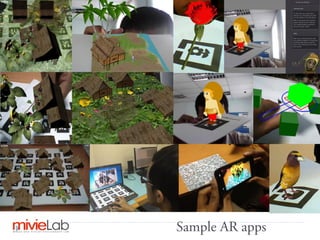
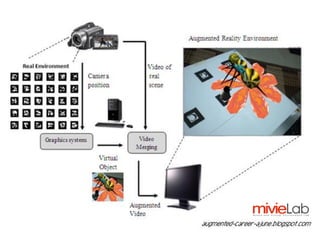
 Augmented reality (AR) is a field of computer research
which deals with the combination of real-world (reality) and
computer-generated data (virtual).
 Real world exists in virtual
world
AR Displays
Technologies
AR Application :
Advertisement & Catalog
AR Application :
Edutainment
AR Application :
Tourism Guide and Travel
AR Application :
Augmented Surfaces
AR Application :
Historical/Cultural
Heritage
AR Application :
Medical
AR Application :
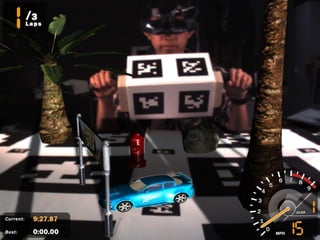
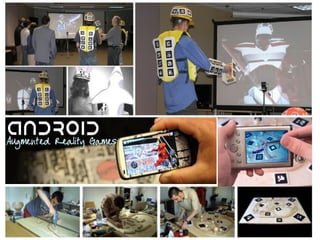
GAME
AR Application : Marketing
AR Trends
USB
Camera /
Webcam
HMD –
Optical
camera
Console –
Xbox360,
Kinect, PS3
.etc
Handheld –
Android-
based
PDA/mobile
based
PlayStation
Move for PS3
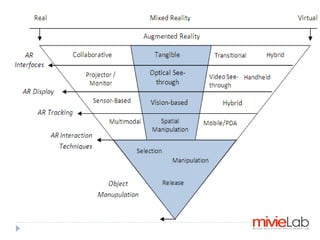
AR Interfaces
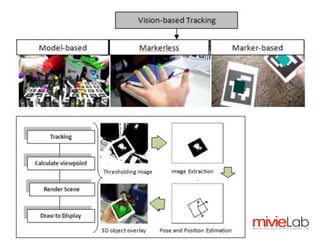
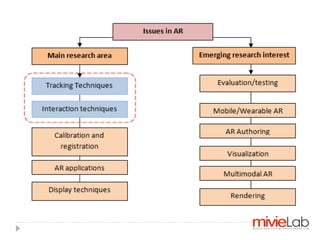
Tracking in AR
Static errors Dynamic errors
- Optical distortion, glare,
focus
- Mechanical misalignments
-Tracker errors
- Incorrect viewing
parameters
- When the viewpoint or the real objects
begin moving
- System delays which is must respond
within milliseconds
Rule-of-thumb: 1 ms delay = 1 mm error
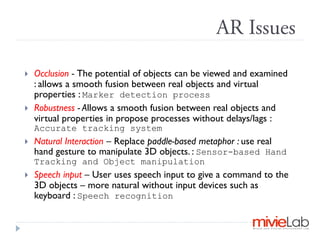
 Occlusion - The potential of objects can be viewed and examined
: allows a smooth fusion between real objects and virtual
properties : Marker detection process
 Robustness - Allows a smooth fusion between real objects and
virtual properties in propose processes without delays/lags :
Accurate tracking system
 Natural Interaction – Replace paddle-based metaphor : use real
hand gesture to manipulate 3D objects. : Sensor-based Hand
Tracking and Object manipulation
 Speech input – User uses speech input to give a command to the
3D objects – more natural without input devices such as
keyboard : Speech recognition
Introduction to Augmented Reality

Introduction to Augmented Reality