A SEMINAR REPORT ON
“AUGMENTED REALITY”
A link between virtual and real world
SESSION: 2013-2014
Submitted By
VIVEK KUMAR GAUTAM
B. Tech 3rd. YEAR (ECE)
Roll no. 1104231070
DEPARTMENT OF ELECTRONICS AND COMMUNICATION ENGINEERING
MADAN MOHAN MALAVIYA
UNIVERSITY OF TECHNOLOGY, GORAKHPUR, UTTAR PRADESH 1
CONTENTS
o Augmented Reality.
o History
o Components used in Augmented Reality system.
 Head Mounted Display.
 Tracking System.
 Mobile Computing Power.
o Working
o Applications.
o Advantages
o Disadvantages
o Scope in future.
o Conclusions and References.
2
AUGMENTED REALITY
 Augmented Reality is a field
of Electronics which deals
with combination of
reality with the computer
generated data.
 The basic idea of augmented
reality is to superimpose
graphics, audio and other
sensory enhancements over
a real world environment in
real time.
Augmented-reality displays will
overlay computer-generated
graphics onto the real world.
3
AUGMENTED REALITY
 An augmented reality system generates a composite
view for the user. It is a combination of the real scene
viewed by the user and a virtual scene generated by the
computer that augments the scene with additional
information.
 Augmented Reality(AR) is a combination of three
factors .These are :
Real and virtual world.
Interaction in the real time.
3D world.
4
HISTORY
 1966: Ivan Sutherland invents the head-mounted display and
positions it as a window into a virtual world.
 1994: Julie Martin creates first ‘Augmented Reality Theater
production’.
 2013: Google announces an open beta test of its Google Glass
augmented reality glasses.
The glasses reach the Internet through
Bluetooth, which connects to the
wireless service on a user’s cellphone.
The glasses respond when a user speaks,
touches the frame or moves the head.
Fig.2. Ivan Sutherland in 1968
5
COMPONENTS USED IN
AUGMENTED REALITY
Head mounted display.
Tracking system.
Mobile computing power(High
speed portable computers).
6
HEAD-MOUNTED DISPLAY
 Head mounted display will
enable us to view graphics
and text created by
Augmented reality systems.
 A typical HMD has either one
or two small displays with
lenses and semi-transparent
mirrors embedded in a helmet,
eye-glasses (also known
as data glasses) or visor. The
display units are miniaturized
and may include CRT, LED
or OLED.
Head mounted display
7
TRACKING SYSTEM
 It is used in order to track
user’s location with
respect to the surrounding.
For this two tracking
system is used :
Global Positioning
System(GPS).
Hi-Ball Tracking System
The Hi ball Tracking
System uses an optical
sensing device
and LED-embedded ceiling
tiles to track movements
over a short range. 8
MOBILE COMPUTING POWER
 For augmented reality systems to work mobile computers
are a good option.
 Mobile computing can be accomplished with help of
wearable computers ,which is the battery powered computer
system worn on the user’s body.
9
WORKING
10
APPLICATIONS
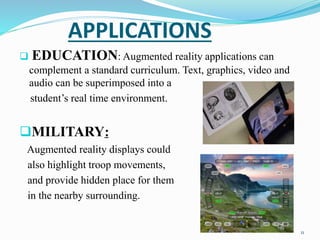
 EDUCATION: Augmented reality applications can
complement a standard curriculum. Text, graphics, video and
audio can be superimposed into a
student’s real time environment.
MILITARY:
Augmented reality displays could
also highlight troop movements,
and provide hidden place for them
in the nearby surrounding.
11
APPLICATIONS
Sports and Entertainment
AR has become common in sports telecasting. Sports and
entertainment venues are provided with see-through and overlay
augmentation through tracked camera.
Medical
Augmented Reality can provide the
surgeon with information, which are
otherwise hidden, such as showing the
heartbeat rate, the blood pressure, the
state of the patient’s organ, etc. as an
X-ray with another such as video.
Fig- AR used in sports
and entertainment
12
ADVANTAGES
• It is UNIQUE
• Have vast majority Content .
• Interactivity maintains a viral loop .
• Personalization
13
DISADVANTAGES
• Physical danger
• Privacy control
• Difficult to IMPLEMENT
14
SCOPE IN THE FUTURE
 Enhanced media applications ,like pseudo
holographic virtual screens, virtual surround
cinema.
 Replacement of cell phones: eye dialing,
insertion of information directly into
environment.
 You may learn things about the city you've lived
in for years just by pointing your AR-enabled
phone at a nearby park or building.
15
CONCLUSION
Augmented reality will further blur the line
between what's real and what's computer
generated by enhancing what we see, hear, feel.
It has possibilities beyond our imagination and
perception. It will have huge applications in
almost every field.
16
REFERENCES
 Shuangbao Paul Wang, Robert S. Ledley , “Computer
Architecture and Security” 25-Oct-2012 ,page 118
 IEEE monthly newspaper The Institute, Oct. 1,
2003, "New Mexico Professor Creates Software for
Virtual Worlds"
 Greg Kipper, Joseph Rampolla, “Augmented Reality: An
Emerging Technologies Guide to AR” page 39.
 Borko Furht, “Handbook of Augmented Reality “ 20
February 2013,page 5.
 Stewart-Smith, Hanna, “Education with Augmented
Reality”, 4 April 2012 ,page 374.
17
18

AUGMENTED REALITY

  • 1.
    A SEMINAR REPORTON “AUGMENTED REALITY” A link between virtual and real world SESSION: 2013-2014 Submitted By VIVEK KUMAR GAUTAM B. Tech 3rd. YEAR (ECE) Roll no. 1104231070 DEPARTMENT OF ELECTRONICS AND COMMUNICATION ENGINEERING MADAN MOHAN MALAVIYA UNIVERSITY OF TECHNOLOGY, GORAKHPUR, UTTAR PRADESH 1
  • 2.
    CONTENTS o Augmented Reality. oHistory o Components used in Augmented Reality system.  Head Mounted Display.  Tracking System.  Mobile Computing Power. o Working o Applications. o Advantages o Disadvantages o Scope in future. o Conclusions and References. 2
  • 3.
    AUGMENTED REALITY  AugmentedReality is a field of Electronics which deals with combination of reality with the computer generated data.  The basic idea of augmented reality is to superimpose graphics, audio and other sensory enhancements over a real world environment in real time. Augmented-reality displays will overlay computer-generated graphics onto the real world. 3
  • 4.
    AUGMENTED REALITY  Anaugmented reality system generates a composite view for the user. It is a combination of the real scene viewed by the user and a virtual scene generated by the computer that augments the scene with additional information.  Augmented Reality(AR) is a combination of three factors .These are : Real and virtual world. Interaction in the real time. 3D world. 4
  • 5.
    HISTORY  1966: IvanSutherland invents the head-mounted display and positions it as a window into a virtual world.  1994: Julie Martin creates first ‘Augmented Reality Theater production’.  2013: Google announces an open beta test of its Google Glass augmented reality glasses. The glasses reach the Internet through Bluetooth, which connects to the wireless service on a user’s cellphone. The glasses respond when a user speaks, touches the frame or moves the head. Fig.2. Ivan Sutherland in 1968 5
  • 6.
    COMPONENTS USED IN AUGMENTEDREALITY Head mounted display. Tracking system. Mobile computing power(High speed portable computers). 6
  • 7.
    HEAD-MOUNTED DISPLAY  Headmounted display will enable us to view graphics and text created by Augmented reality systems.  A typical HMD has either one or two small displays with lenses and semi-transparent mirrors embedded in a helmet, eye-glasses (also known as data glasses) or visor. The display units are miniaturized and may include CRT, LED or OLED. Head mounted display 7
  • 8.
    TRACKING SYSTEM  Itis used in order to track user’s location with respect to the surrounding. For this two tracking system is used : Global Positioning System(GPS). Hi-Ball Tracking System The Hi ball Tracking System uses an optical sensing device and LED-embedded ceiling tiles to track movements over a short range. 8
  • 9.
    MOBILE COMPUTING POWER For augmented reality systems to work mobile computers are a good option.  Mobile computing can be accomplished with help of wearable computers ,which is the battery powered computer system worn on the user’s body. 9
  • 10.
  • 11.
    APPLICATIONS  EDUCATION: Augmentedreality applications can complement a standard curriculum. Text, graphics, video and audio can be superimposed into a student’s real time environment. MILITARY: Augmented reality displays could also highlight troop movements, and provide hidden place for them in the nearby surrounding. 11
  • 12.
    APPLICATIONS Sports and Entertainment ARhas become common in sports telecasting. Sports and entertainment venues are provided with see-through and overlay augmentation through tracked camera. Medical Augmented Reality can provide the surgeon with information, which are otherwise hidden, such as showing the heartbeat rate, the blood pressure, the state of the patient’s organ, etc. as an X-ray with another such as video. Fig- AR used in sports and entertainment 12
  • 13.
    ADVANTAGES • It isUNIQUE • Have vast majority Content . • Interactivity maintains a viral loop . • Personalization 13
  • 14.
    DISADVANTAGES • Physical danger •Privacy control • Difficult to IMPLEMENT 14
  • 15.
    SCOPE IN THEFUTURE  Enhanced media applications ,like pseudo holographic virtual screens, virtual surround cinema.  Replacement of cell phones: eye dialing, insertion of information directly into environment.  You may learn things about the city you've lived in for years just by pointing your AR-enabled phone at a nearby park or building. 15
  • 16.
    CONCLUSION Augmented reality willfurther blur the line between what's real and what's computer generated by enhancing what we see, hear, feel. It has possibilities beyond our imagination and perception. It will have huge applications in almost every field. 16
  • 17.
    REFERENCES  Shuangbao PaulWang, Robert S. Ledley , “Computer Architecture and Security” 25-Oct-2012 ,page 118  IEEE monthly newspaper The Institute, Oct. 1, 2003, "New Mexico Professor Creates Software for Virtual Worlds"  Greg Kipper, Joseph Rampolla, “Augmented Reality: An Emerging Technologies Guide to AR” page 39.  Borko Furht, “Handbook of Augmented Reality “ 20 February 2013,page 5.  Stewart-Smith, Hanna, “Education with Augmented Reality”, 4 April 2012 ,page 374. 17
  • 18.