Making a difference in the world:
Engineering in middle school math
and science classrooms*
Presenters: Amy Wendt and Amy Schiebel
STEM Smart NSF Workshop
Atlanta, GA, June 22, 2013
*Results from “Society's Grand Challenges for Engineering as a context for middle school
STEM instruction,” NSF Award #1030126 (ITEST) with additional support from the Young
Scientists of America and Plexus Charitable Foundation
2
Next Generation Science Standards
(NGSS): middle school sciences
• Physical: Performance
expectations…blend core ideas with
scientific and engineering practices
• Life: Evaluate competing design
solutions …for ecosystem services
• Space and Earth: … strong human
connection to engineering through the
instruments and technologies that have
allowed us to explore the objects in our
solar system
 Human Impacts: Students understand the
ways that human activities impact Earth’s
other systems
3
NGSS: middle school engineering
• Disciplinary core ideas:
 Defining and delimiting engineering problems
 Developing possible solutions
 Optimizing the design solution
• Crosscutting Concepts:
 Influence of science, engineering and
technology on society and the natural world
4
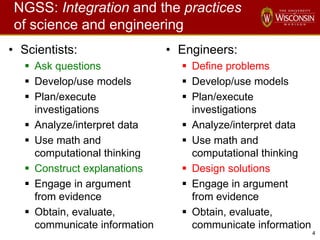
NGSS: Integration and the practices
of science and engineering
• Scientists:
 Ask questions
 Develop/use models
 Plan/execute
investigations
 Analyze/interpret data
 Use math and
computational thinking
 Construct explanations
 Engage in argument
from evidence
 Obtain, evaluate,
communicate information
• Engineers:
 Define problems
 Develop/use models
 Plan/execute
investigations
 Analyze/interpret data
 Use math and
computational thinking
 Design solutions
 Engage in argument
from evidence
 Obtain, evaluate,
communicate information
5
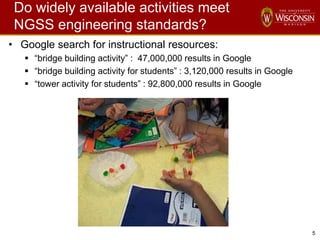
Do widely available activities meet
NGSS engineering standards?
• Google search for instructional resources:
 “bridge building activity” : 47,000,000 results in Google
 “bridge building activity for students” : 3,120,000 results in Google
 “tower activity for students” : 92,800,000 results in Google
6
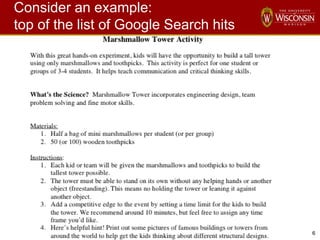
Consider an example:
top of the list of Google Search hits
7
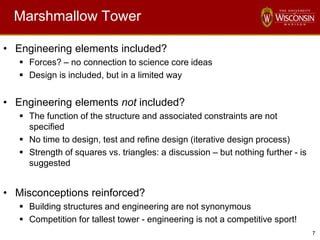
Marshmallow Tower
• Engineering elements included?
 Forces? – no connection to science core ideas
 Design is included, but in a limited way
• Engineering elements not included?
 The function of the structure and associated constraints are not
specified
 No time to design, test and refine design (iterative design process)
 Strength of squares vs. triangles: a discussion – but nothing further - is
suggested
• Misconceptions reinforced?
 Building structures and engineering are not synonymous
 Competition for tallest tower - engineering is not a competitive sport!
8
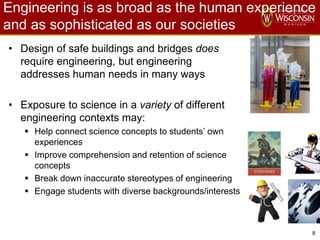
Engineering is as broad as the human experience
and as sophisticated as our societies
• Design of safe buildings and bridges does
require engineering, but engineering
addresses human needs in many ways
• Exposure to science in a variety of different
engineering contexts may:
 Help connect science concepts to students’ own
experiences
 Improve comprehension and retention of science
concepts
 Break down inaccurate stereotypes of engineering
 Engage students with diverse backgrounds/interests
Society's Grand Challenges for
Engineering
as a context for middle school STEM instruction
NSF Award #1030126 Innovative Technology Experiences for Students and
Teachers (ITEST) with additional support from the Young Scientists of
America and Plexus Charitable Foundation
Investigators:
Amy Wendt, Susan Hagness and Steven Cramer (Engineering, UW)
Kimberly Howard (Education, Boston University)
10
UW “Grand Challenges”
• Project goal:
 create interest in engineering among a larger and more diverse
population of middle school students
• Strategy (2010-2013):
 Society’s Grand Challenges for Engineering embedded in core math
and science curriculum
 “Summer institute” for teachers/school staff in 2011 and 2012
 Curriculum modules piloted in 6 partner schools
 Research study -- collect and use data to:
 evaluate:
• classroom implementation of instructional materials
• Effect on student and teacher perceptions about engineering
careers, science and math
 improve/expand instructional resources
11
Making a difference in the world
• Women’s Experiences in College Engineering Project (2001)
 A top reason why women enter engineering:
 attraction to the altruistic kind of work engineers do
 Critical factor in retention:
 exposing women early on to how engineering has led to
improvements in society and the quality of people’s lives
• “Extraordinary Women Engineers” high school survey (2005)
 Survey results show that girls:
 often don’t know what engineering is
 think it is only for those with innate love of math and science
 However, they:
 want to be creative and “make a difference”
 react positively to personal stories about engineering lifestyles
 Peers and educators are key influencers and motivators
12
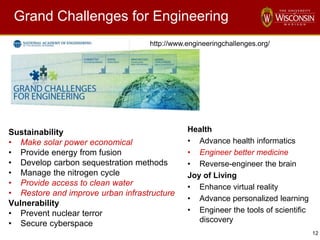
Grand Challenges for Engineering
Sustainability
• Make solar power economical
• Provide energy from fusion
• Develop carbon sequestration methods
• Manage the nitrogen cycle
• Provide access to clean water
• Restore and improve urban infrastructure
Vulnerability
• Prevent nuclear terror
• Secure cyberspace
Health
• Advance health informatics
• Engineer better medicine
• Reverse-engineer the brain
Joy of Living
• Enhance virtual reality
• Advance personalized learning
• Engineer the tools of scientific
discovery
http://www.engineeringchallenges.org/
13
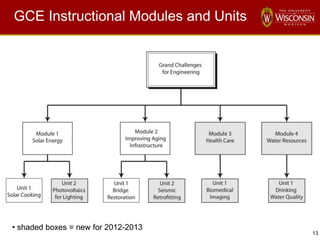
GCE Instructional Modules and Units
• shaded boxes = new for 2012-2013
14
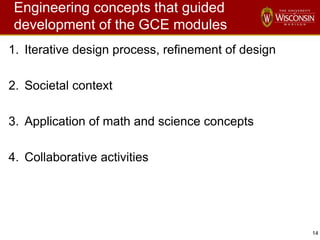
Engineering concepts that guided
development of the GCE modules
1. Iterative design process, refinement of design
2. Societal context
3. Application of math and science concepts
4. Collaborative activities
15
Activities link math/science concepts to Grand
Challenges – Municipal Infrastructure
Infrastructure example
• Aging bridge story line:
 age-compromised strength
 increased performance needs due to expanded population
• Students develop math and science skills as they
 role-play as engineers
 build and test scale-model truss bridge
 make recommendations to city council on whether to repair or relocate
bridge based on:
 load-bearing capacity needs
 cost
 environmental impact
 impact on nearby communities
16
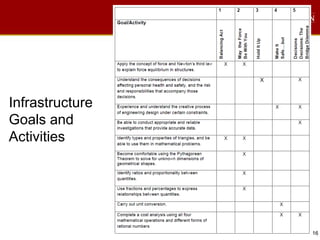
Infrastructure
Goals and
Activities
X
17
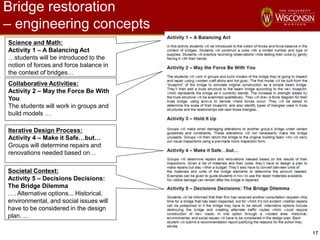
Bridge restoration
– engineering concepts
Science and Math:
Activity 1 – A Balancing Act
…students will be introduced to the
notion of forces and force balance in
the context of bridges…
Societal Context:
Activity 5 – Decisions Decisions:
The Bridge Dilemma
…. Alternative options... Historical,
environmental, and social issues will
have to be considered in the design
plan. …
Collaborative Activities:
Activity 2 – May the Force Be With
You
The students will work in groups and
build models …
Iterative Design Process:
Activity 4 – Make it Safe…but…
Groups will determine repairs and
renovations needed based on…
18
Bridges Activity 5: example of
curriculum materials
• Improving Aging Infrastructure: Bridges
 Activity 5: “Decisions, Decisions: The Bridge Dilemma”
• Handouts – Student guide, teachers guide/student sheets
19
Students evaluate bridge design
considerations
• 8th graders recorded at Edgewood Campus School
20
Activities link math/science concepts to Grand
Challenges – Health Care
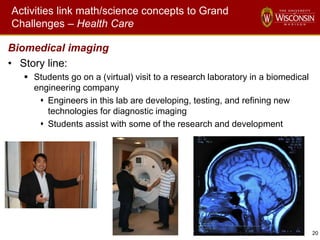
Biomedical imaging
• Story line:
 Students go on a (virtual) visit to a research laboratory in a biomedical
engineering company
 Engineers in this lab are developing, testing, and refining new
technologies for diagnostic imaging
 Students assist with some of the research and development
21
Activities link math/science concepts to Grand
Challenges – Health Care
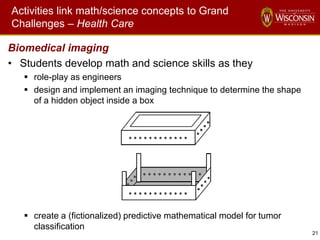
Biomedical imaging
• Students develop math and science skills as they
 role-play as engineers
 design and implement an imaging technique to determine the shape
of a hidden object inside a box
 create a (fictionalized) predictive mathematical model for tumor
classification
22
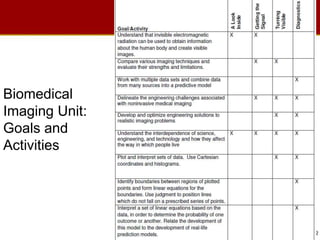
Biomedical
Imaging Unit:
Goals and
Activities
23
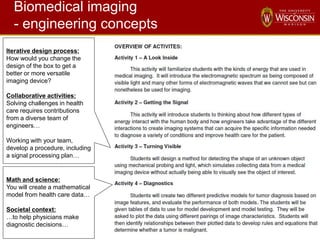
Biomedical imaging
- engineering concepts
Math and science:
You will create a mathematical
model from health care data…
Societal context:
…to help physicians make
diagnostic decisions…
Iterative design process:
How would you change the
design of the box to get a
better or more versatile
imaging device?
Collaborative activities:
Solving challenges in health
care requires contributions
from a diverse team of
engineers…
Working with your team,
develop a procedure, including
a signal processing plan…
24
Biomedical Imaging Activity 3:
example of curriculum materials
• Health Care: Biomedical Imaging
 Activity 3: “Turning Visible”
• Handouts – Student guide, teachers guide/student sheets
25
Summary
• Integration of engineering into math/science curriculum
 Key engineering elements:
1. Iterative design process, refinement of design
2. Societal context
3. Application of math and science concepts
4. Collaborative activities
• Stereotypes: building of structures may or may not use
engineering; it certainly does not define engineering
• Societal context: engineering can be found in every aspect of
the human experience
• Engineering and science are symbiotic, but different
 Science = testable explanations of our universe
 Engineering = application of science in a structured process to solve
problems of human need
26
Grand Challenges Instructional Modules
Because this is an active research project…
• Units not yet available for widespread distribution
 Instructional unit pilot took place 2011-2013
 Data collection and analysis is continuing
 Unit revisions expected
• If you are interested in being contacted about instructional
module availability
 Please sign up!
 Sign up lists are being circulated
27
Acknowledgments
• Curriculum development
 Amy Schiebel – Edgewood
College
 Tam Mayeshiba
 Lauren Aneskavich
 Kevin Cheng
 Benjamin Crary
 Jean DeMerit
 Kevin Anderson
 Steven Cramer
 Susan Hagness
 Amy Wendt
• Research
 Kimberly Howard – Boston
University
 Jake Diestelman
 Tsu-Lun Huang
 Evaluator
 Karen O’Brien – University of
Maryland
 Support
 NSF grant DRL-1020126
 Young Scientists of America
 Plexus Foundation

Making a difference in the world.engineering 0

  • 1.
    Making a differencein the world: Engineering in middle school math and science classrooms* Presenters: Amy Wendt and Amy Schiebel STEM Smart NSF Workshop Atlanta, GA, June 22, 2013 *Results from “Society's Grand Challenges for Engineering as a context for middle school STEM instruction,” NSF Award #1030126 (ITEST) with additional support from the Young Scientists of America and Plexus Charitable Foundation
  • 2.
    2 Next Generation ScienceStandards (NGSS): middle school sciences • Physical: Performance expectations…blend core ideas with scientific and engineering practices • Life: Evaluate competing design solutions …for ecosystem services • Space and Earth: … strong human connection to engineering through the instruments and technologies that have allowed us to explore the objects in our solar system  Human Impacts: Students understand the ways that human activities impact Earth’s other systems
  • 3.
    3 NGSS: middle schoolengineering • Disciplinary core ideas:  Defining and delimiting engineering problems  Developing possible solutions  Optimizing the design solution • Crosscutting Concepts:  Influence of science, engineering and technology on society and the natural world
  • 4.
    4 NGSS: Integration andthe practices of science and engineering • Scientists:  Ask questions  Develop/use models  Plan/execute investigations  Analyze/interpret data  Use math and computational thinking  Construct explanations  Engage in argument from evidence  Obtain, evaluate, communicate information • Engineers:  Define problems  Develop/use models  Plan/execute investigations  Analyze/interpret data  Use math and computational thinking  Design solutions  Engage in argument from evidence  Obtain, evaluate, communicate information
  • 5.
    5 Do widely availableactivities meet NGSS engineering standards? • Google search for instructional resources:  “bridge building activity” : 47,000,000 results in Google  “bridge building activity for students” : 3,120,000 results in Google  “tower activity for students” : 92,800,000 results in Google
  • 6.
    6 Consider an example: topof the list of Google Search hits
  • 7.
    7 Marshmallow Tower • Engineeringelements included?  Forces? – no connection to science core ideas  Design is included, but in a limited way • Engineering elements not included?  The function of the structure and associated constraints are not specified  No time to design, test and refine design (iterative design process)  Strength of squares vs. triangles: a discussion – but nothing further - is suggested • Misconceptions reinforced?  Building structures and engineering are not synonymous  Competition for tallest tower - engineering is not a competitive sport!
  • 8.
    8 Engineering is asbroad as the human experience and as sophisticated as our societies • Design of safe buildings and bridges does require engineering, but engineering addresses human needs in many ways • Exposure to science in a variety of different engineering contexts may:  Help connect science concepts to students’ own experiences  Improve comprehension and retention of science concepts  Break down inaccurate stereotypes of engineering  Engage students with diverse backgrounds/interests
  • 9.
    Society's Grand Challengesfor Engineering as a context for middle school STEM instruction NSF Award #1030126 Innovative Technology Experiences for Students and Teachers (ITEST) with additional support from the Young Scientists of America and Plexus Charitable Foundation Investigators: Amy Wendt, Susan Hagness and Steven Cramer (Engineering, UW) Kimberly Howard (Education, Boston University)
  • 10.
    10 UW “Grand Challenges” •Project goal:  create interest in engineering among a larger and more diverse population of middle school students • Strategy (2010-2013):  Society’s Grand Challenges for Engineering embedded in core math and science curriculum  “Summer institute” for teachers/school staff in 2011 and 2012  Curriculum modules piloted in 6 partner schools  Research study -- collect and use data to:  evaluate: • classroom implementation of instructional materials • Effect on student and teacher perceptions about engineering careers, science and math  improve/expand instructional resources
  • 11.
    11 Making a differencein the world • Women’s Experiences in College Engineering Project (2001)  A top reason why women enter engineering:  attraction to the altruistic kind of work engineers do  Critical factor in retention:  exposing women early on to how engineering has led to improvements in society and the quality of people’s lives • “Extraordinary Women Engineers” high school survey (2005)  Survey results show that girls:  often don’t know what engineering is  think it is only for those with innate love of math and science  However, they:  want to be creative and “make a difference”  react positively to personal stories about engineering lifestyles  Peers and educators are key influencers and motivators
  • 12.
    12 Grand Challenges forEngineering Sustainability • Make solar power economical • Provide energy from fusion • Develop carbon sequestration methods • Manage the nitrogen cycle • Provide access to clean water • Restore and improve urban infrastructure Vulnerability • Prevent nuclear terror • Secure cyberspace Health • Advance health informatics • Engineer better medicine • Reverse-engineer the brain Joy of Living • Enhance virtual reality • Advance personalized learning • Engineer the tools of scientific discovery http://www.engineeringchallenges.org/
  • 13.
    13 GCE Instructional Modulesand Units • shaded boxes = new for 2012-2013
  • 14.
    14 Engineering concepts thatguided development of the GCE modules 1. Iterative design process, refinement of design 2. Societal context 3. Application of math and science concepts 4. Collaborative activities
  • 15.
    15 Activities link math/scienceconcepts to Grand Challenges – Municipal Infrastructure Infrastructure example • Aging bridge story line:  age-compromised strength  increased performance needs due to expanded population • Students develop math and science skills as they  role-play as engineers  build and test scale-model truss bridge  make recommendations to city council on whether to repair or relocate bridge based on:  load-bearing capacity needs  cost  environmental impact  impact on nearby communities
  • 16.
  • 17.
    17 Bridge restoration – engineeringconcepts Science and Math: Activity 1 – A Balancing Act …students will be introduced to the notion of forces and force balance in the context of bridges… Societal Context: Activity 5 – Decisions Decisions: The Bridge Dilemma …. Alternative options... Historical, environmental, and social issues will have to be considered in the design plan. … Collaborative Activities: Activity 2 – May the Force Be With You The students will work in groups and build models … Iterative Design Process: Activity 4 – Make it Safe…but… Groups will determine repairs and renovations needed based on…
  • 18.
    18 Bridges Activity 5:example of curriculum materials • Improving Aging Infrastructure: Bridges  Activity 5: “Decisions, Decisions: The Bridge Dilemma” • Handouts – Student guide, teachers guide/student sheets
  • 19.
    19 Students evaluate bridgedesign considerations • 8th graders recorded at Edgewood Campus School
  • 20.
    20 Activities link math/scienceconcepts to Grand Challenges – Health Care Biomedical imaging • Story line:  Students go on a (virtual) visit to a research laboratory in a biomedical engineering company  Engineers in this lab are developing, testing, and refining new technologies for diagnostic imaging  Students assist with some of the research and development
  • 21.
    21 Activities link math/scienceconcepts to Grand Challenges – Health Care Biomedical imaging • Students develop math and science skills as they  role-play as engineers  design and implement an imaging technique to determine the shape of a hidden object inside a box  create a (fictionalized) predictive mathematical model for tumor classification
  • 22.
  • 23.
    23 Biomedical imaging - engineeringconcepts Math and science: You will create a mathematical model from health care data… Societal context: …to help physicians make diagnostic decisions… Iterative design process: How would you change the design of the box to get a better or more versatile imaging device? Collaborative activities: Solving challenges in health care requires contributions from a diverse team of engineers… Working with your team, develop a procedure, including a signal processing plan…
  • 24.
    24 Biomedical Imaging Activity3: example of curriculum materials • Health Care: Biomedical Imaging  Activity 3: “Turning Visible” • Handouts – Student guide, teachers guide/student sheets
  • 25.
    25 Summary • Integration ofengineering into math/science curriculum  Key engineering elements: 1. Iterative design process, refinement of design 2. Societal context 3. Application of math and science concepts 4. Collaborative activities • Stereotypes: building of structures may or may not use engineering; it certainly does not define engineering • Societal context: engineering can be found in every aspect of the human experience • Engineering and science are symbiotic, but different  Science = testable explanations of our universe  Engineering = application of science in a structured process to solve problems of human need
  • 26.
    26 Grand Challenges InstructionalModules Because this is an active research project… • Units not yet available for widespread distribution  Instructional unit pilot took place 2011-2013  Data collection and analysis is continuing  Unit revisions expected • If you are interested in being contacted about instructional module availability  Please sign up!  Sign up lists are being circulated
  • 27.
    27 Acknowledgments • Curriculum development Amy Schiebel – Edgewood College  Tam Mayeshiba  Lauren Aneskavich  Kevin Cheng  Benjamin Crary  Jean DeMerit  Kevin Anderson  Steven Cramer  Susan Hagness  Amy Wendt • Research  Kimberly Howard – Boston University  Jake Diestelman  Tsu-Lun Huang  Evaluator  Karen O’Brien – University of Maryland  Support  NSF grant DRL-1020126  Young Scientists of America  Plexus Foundation