Learning Through Looking
How can we use museum objects to
ignite critical enquiry?
Maggie Wood & Richard Lumb
Museum of Domestic Design & Architecture
(MoDA)
Learning through looking:
MoDA Object Analysis
During this workshop we hope to:
• Provide you with an opportunity to engage in an object analysis exercise
using objects from the collections of the Museum of Domestic Design &
Architecture (MoDA).
• Inform you about MoDA and the work we do with undergraduate
students from Middlesex and other HE institutions.
•Provide an opportunity for reflection on the merits of this type of
approach, and its application across disciplines.
Museum of Domestic
Design & Architecture (MoDA)
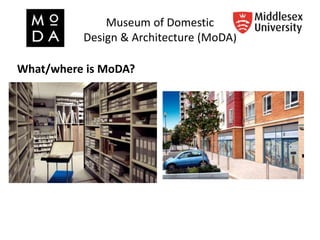
What/where is MoDA?
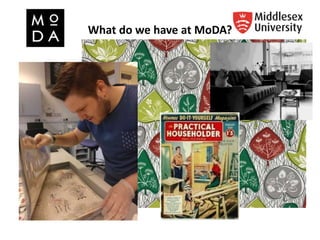
What do we have at MoDA?
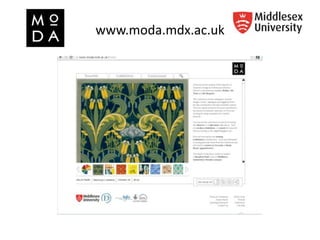
www.moda.mdx.ac.uk
Handling MoDA objects
• Wear gloves
• Pencils only
• Objects in sleeves must stay in sleeves
• No food or drink near the objects
• Be sure not to lean on the objects
• Ask for help if you need it
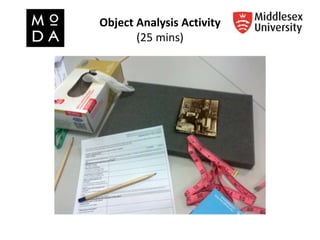
Object Analysis Activity
(25 mins)
Activity 1: Part 1
Object Analysis
• You’ll be working in small groups
• Each group will be given one object
• Examine the object and answer the questions on the Object
Analysis form.
• Complete the form individually but please discuss your answers as a
group.
• Please allow 5 minutes for the drawing activity on page 2
• You have 25 minutes to complete the form
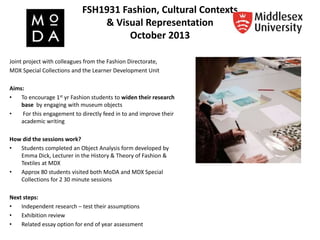
FSH1931 Fashion, Cultural Contexts
& Visual Representation
October 2013
Joint project with colleagues from the Fashion Directorate,
MDX Special Collections and the Learner Development Unit
Aims:
• To encourage 1st yr Fashion students to widen their research
base by engaging with museum objects
• For this engagement to directly feed in to and improve their
academic writing
How did the sessions work?
• Students completed an Object Analysis form developed by
Emma Dick, Lecturer in the History & Theory of Fashion &
Textiles at MDX
• Approx 80 students visited both MoDA and MDX Special
Collections for 2 30 minute sessions
Next steps:
• Independent research – test their assumptions
• Exhibition review
• Related essay option for end of year assessment
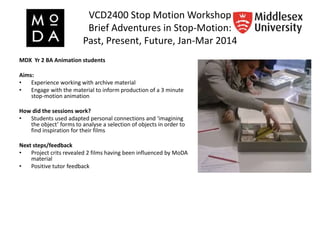
VCD2400 Stop Motion Workshop
Brief Adventures in Stop-Motion:
Past, Present, Future, Jan-Mar 2014
MDX Yr 2 BA Animation students
Aims:
• Experience working with archive material
• Engage with the material to inform production of a 3 minute
stop-motion animation
How did the sessions work?
• Students used adapted personal connections and ‘imagining
the object’ forms to analyse a selection of objects in order to
find inspiration for their films
Next steps/feedback
• Project crits revealed 2 films having been influenced by MoDA
material
• Positive tutor feedback
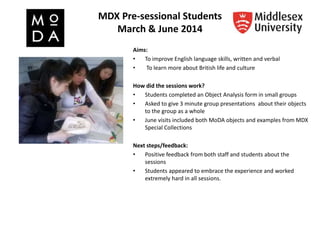
MDX Pre-sessional Students
March & June 2014
Aims:
• To improve English language skills, written and verbal
• To learn more about British life and culture
How did the sessions work?
• Students completed an Object Analysis form in small groups
• Asked to give 3 minute group presentations about their objects
to the group as a whole
• June visits included both MoDA objects and examples from MDX
Special Collections
Next steps/feedback:
• Positive feedback from both staff and students about the
sessions
• Students appeared to embrace the experience and worked
extremely hard in all sessions.
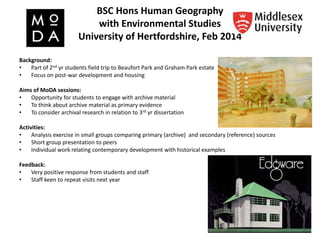
BSC Hons Human Geography
with Environmental Studies
University of Hertfordshire, Feb 2014
Background:
• Part of 2nd yr students field trip to Beaufort Park and Graham Park estate
• Focus on post-war development and housing
Aims of MoDA sessions:
• Opportunity for students to engage with archive material
• To think about archive material as primary evidence
• To consider archival research in relation to 3rd yr dissertation
Activities:
• Analysis exercise in small groups comparing primary (archive) and secondary (reference) sources
• Short group presentation to peers
• Individual work relating contemporary development with historical examples
Feedback:
• Very positive response from students and staff
• Staff keen to repeat visits next year
Object analysis questionnaires:
How successful?
• Object analysis can work for different disciplines
• Focus on active learning leads to more engaged students
• Questionnaires encourage critical thinking
• ‘Personal connections’ focus to encourage creative
outcomes
• Emphasis on improving communication & presentation
skills
• The Student Impact Project – a 3 year project to track
the performance of Art & Design undergraduates who
make use of MoDA’s collections as part of their course.
Learning through looking
What do you think?
• Is this a useful way of encouraging critical
thinking in our students?
• Has anyone tried different or similar
approaches?
• What are the challenges to incorporating this
type of object based learning/analysis
approach?
Find out more….
•Arrange a visit to see more of the collections
•Discuss using MoDA’s collections as part of your own
teaching and research
Maggie Wood, Assistant Curator
m.wood@mdx.ac.uk, T: 020 8411 5445
Richard Lumb, Learning Officer
r.lumb@mdx.ac.uk, T: 020 8411 4380
www.moda.mdx.ac.uk

Track d learning through looking_moda

  • 1.
    Learning Through Looking Howcan we use museum objects to ignite critical enquiry? Maggie Wood & Richard Lumb Museum of Domestic Design & Architecture (MoDA)
  • 2.
    Learning through looking: MoDAObject Analysis During this workshop we hope to: • Provide you with an opportunity to engage in an object analysis exercise using objects from the collections of the Museum of Domestic Design & Architecture (MoDA). • Inform you about MoDA and the work we do with undergraduate students from Middlesex and other HE institutions. •Provide an opportunity for reflection on the merits of this type of approach, and its application across disciplines.
  • 3.
    Museum of Domestic Design& Architecture (MoDA) What/where is MoDA?
  • 4.
    What do wehave at MoDA?
  • 5.
  • 6.
    Handling MoDA objects •Wear gloves • Pencils only • Objects in sleeves must stay in sleeves • No food or drink near the objects • Be sure not to lean on the objects • Ask for help if you need it
  • 7.
  • 8.
    Activity 1: Part1 Object Analysis • You’ll be working in small groups • Each group will be given one object • Examine the object and answer the questions on the Object Analysis form. • Complete the form individually but please discuss your answers as a group. • Please allow 5 minutes for the drawing activity on page 2 • You have 25 minutes to complete the form
  • 9.
    FSH1931 Fashion, CulturalContexts & Visual Representation October 2013 Joint project with colleagues from the Fashion Directorate, MDX Special Collections and the Learner Development Unit Aims: • To encourage 1st yr Fashion students to widen their research base by engaging with museum objects • For this engagement to directly feed in to and improve their academic writing How did the sessions work? • Students completed an Object Analysis form developed by Emma Dick, Lecturer in the History & Theory of Fashion & Textiles at MDX • Approx 80 students visited both MoDA and MDX Special Collections for 2 30 minute sessions Next steps: • Independent research – test their assumptions • Exhibition review • Related essay option for end of year assessment
  • 10.
    VCD2400 Stop MotionWorkshop Brief Adventures in Stop-Motion: Past, Present, Future, Jan-Mar 2014 MDX Yr 2 BA Animation students Aims: • Experience working with archive material • Engage with the material to inform production of a 3 minute stop-motion animation How did the sessions work? • Students used adapted personal connections and ‘imagining the object’ forms to analyse a selection of objects in order to find inspiration for their films Next steps/feedback • Project crits revealed 2 films having been influenced by MoDA material • Positive tutor feedback
  • 11.
    MDX Pre-sessional Students March& June 2014 Aims: • To improve English language skills, written and verbal • To learn more about British life and culture How did the sessions work? • Students completed an Object Analysis form in small groups • Asked to give 3 minute group presentations about their objects to the group as a whole • June visits included both MoDA objects and examples from MDX Special Collections Next steps/feedback: • Positive feedback from both staff and students about the sessions • Students appeared to embrace the experience and worked extremely hard in all sessions.
  • 12.
    BSC Hons HumanGeography with Environmental Studies University of Hertfordshire, Feb 2014 Background: • Part of 2nd yr students field trip to Beaufort Park and Graham Park estate • Focus on post-war development and housing Aims of MoDA sessions: • Opportunity for students to engage with archive material • To think about archive material as primary evidence • To consider archival research in relation to 3rd yr dissertation Activities: • Analysis exercise in small groups comparing primary (archive) and secondary (reference) sources • Short group presentation to peers • Individual work relating contemporary development with historical examples Feedback: • Very positive response from students and staff • Staff keen to repeat visits next year
  • 13.
    Object analysis questionnaires: Howsuccessful? • Object analysis can work for different disciplines • Focus on active learning leads to more engaged students • Questionnaires encourage critical thinking • ‘Personal connections’ focus to encourage creative outcomes • Emphasis on improving communication & presentation skills • The Student Impact Project – a 3 year project to track the performance of Art & Design undergraduates who make use of MoDA’s collections as part of their course.
  • 14.
    Learning through looking Whatdo you think? • Is this a useful way of encouraging critical thinking in our students? • Has anyone tried different or similar approaches? • What are the challenges to incorporating this type of object based learning/analysis approach?
  • 15.
    Find out more…. •Arrangea visit to see more of the collections •Discuss using MoDA’s collections as part of your own teaching and research Maggie Wood, Assistant Curator m.wood@mdx.ac.uk, T: 020 8411 5445 Richard Lumb, Learning Officer r.lumb@mdx.ac.uk, T: 020 8411 4380 www.moda.mdx.ac.uk

Editor's Notes

  • #4 The Museum of Domestic Design & Architecture – MoDA for short – is part of Middlesex University We’re located at Beaufort Park Collections Centre – Store and a Study Room for individual researchers and group visits Collections available for everyone – MDX staff and students, other academic researchers, members of the public, commercial interest etc.
  • #5  What do we have at MoDA? MoDAs collections relate to British domestic life between the late nineteenth century to the late 20th century: 1880s – 1970s How did people furnish and decorate their homes? How did they live in those homes What did houses look like, what factors affected their layout and appearance? What sort of objects do we have? Textile samples – the sorts of fabrics that would have been used to cover furniture, make curtains etc. Also some dress fabrics. Wallpapers – loose samples and sample books Printed material like books, magazines and journals. Also catalogues produced by retailers and manufacturers of domestic products. E.g. furniture catalogues, kitchen catalogues etc. Printed ephemera – cigarette cards, photographs, greetings cards
  • #6 How can I find out more about MoDA’s collections? MoDA website Search the Collections
  • #7 Object analysis exercise involves handling objects from MoDA’s collections. The following rules apply:
  • #8 We’d now like you to work in small groups to complete a MoDA Object Analysis worksheet Each group has one MoDA object which we would like you to analyse. Examine the object and answer the questions on the Object analysis form. Complete the form individually but please discuss your answers as a group. Please note that there is a drawing activity after the first set of questions. Spend no more than 5 minutes on the drawing activity before continuing with the remaining questions. Total time on form is 25 mins
  • #9 Leave slide up while participants undertake activity.
  • #10 Project which led to us incorporating an object analysis approach in our teaching: Theory behind the process: Improve the students evidence-based research skills Give them the experience of handling museum and archive material Process encourages them to start by examining an object, gathering clues, making informed assumptions about that object and its context Next step: students required to go away and carry out additional research in order to test their ideas and assumptions. Exhibition review Essay – end of year assessment
  • #11 Students used a ‘Personal Connections’ worksheet we’re developing Aim to encourage students to explore how they might connect with an object or set of objects, either on a personal level – what/who does the object remind them of etc., but also encouraging them to give the object a personality or character. This was particularly relevant for the animation students who were being asked to …. Series of questions for students to answer individually Questions can be adapted in conjunction with tutors – typical questions…. Aim – to encourage creative responses, object as a starting point for a creative journey
  • #12 Aims for these students were rather different: 1. To improve their English language skills, both written and verbal 2. To learn more about British life and culture We therefore needed the objects we selected for these students to perform two specific functions: 1. To act as a focal point for active engagement, and enable the students to employ a broad range of descriptive vocabulary 2. To allow the students to make connections with particular aspects of British cultural life They were then given time to prepare a 3 minute group presentation about their object, using the results of the object analysis task. This presentation should be based on answering the following three questions about their object: When did they think it was made? How did they think it was made? What did they think the object was, what was its function?
  • #13 Aims: Familiarise students with the idea of using museum and archive material as research material Encourage them to use this type of material as the basis for their final year dissertation Students were currently over-reliant on survey-based research methods Encourage them to relate historical examples to current practice – to understand the links and place contemporary examples of development in its historical context. Record the museum number and the date Answer the following two questions: 1. Who is the publication for? Who is it’s intended audience? 2. Who has produced this publication? Do you think they would have any kind of agenda? Is it biased towards a particular viewpoint or way of thinking? Is it presenting an idealised view of life, or what you would consider a realistic representation?