Centre for Inquiry-based Learning in the Arts and Social Sciences www.shef.ac.uk/cilass Pamela McKinney [email_address]
How does CILASS work? £4.5M, initially funded by HEFCE + £350K additional capital funding Strategic departmental curriculum development projects with capital funding Individual curriculum development projects Creation of innovative learning spaces: collaboratories
What is Inquiry-based Learning? Approaches to learning that are based on a process of self-directed inquiry or research  IBL approaches include case-study and problem-based learning  IBL can be used as the design principle for whole modules or programmes, teaching strategies will be designed to support the inquiry process.  IBL could be incorporated into  a traditional curriculum The stimulus for an inquiry could, be an intriguing fieldwork problem, a complex `real-life´ case-study, or an interesting research question inquiry is an active, self-directed, questioning and critical approach to developing knowledge
Information literacy and IBL Information literacy is a key theme of CILASS Information literacy skills equip students with  the means to conduct independent inquiry and puts them on the path to lifelong learning The development of strong information literacy capabilities is fundamental to the success of IBL
LTA Strategy: key to embedding IBL carry out extended independent enquiry, formulating relevant questions and engaging critically with a wide range of evidence; IL demonstrate the core capabilities and skills of information literacy, interacting confidently with the nature and structure of information in their subject and handling information in a professional and ethical manner;
Technology rich   Collaboratories in the Information Commons Interactive whiteboards Access grid videoconferencing  Mobile technologies e.g. laptops and scanners Personal response systems In Bartolom é House Large  plasma screens Mobile technologies
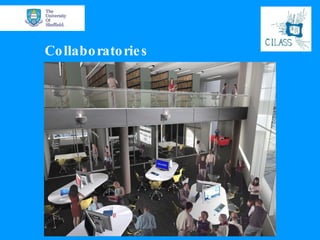
Collaboratories
Learning Development and Research Associate: Information Literacy Raise awareness of information literacy with CILASS project leaders Support project leaders by conducting research on their behalf into IL issues relevant to their projects. Contribute to the development of learning materials in relation to IBL and IL Contribute to the dissemination objectives of CILASS in relation to IL. Contribute to the CILASS evaluation strategy
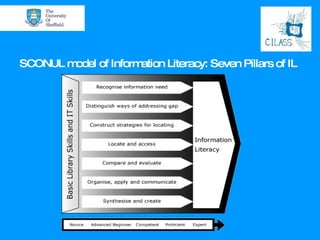
SCONUL model of Information Literacy: Seven Pillars of IL
Information Literacy Network Partnership between CILASS, Library and DIS Chaired by Prof. Sheila Corrall, DIS Electronic community Programme of events IL Resources, including online resource list Workshops for CILASS (and other) departments developing LTA strategies  Learning Through Enquiry Alliance conference: workshop on IL and IBL
Information Literacy Audit Review of current approaches to IL skills development in Department of Information Studies Interviews with all module leaders Map their practice onto the “seven pillars” model Identify areas in programmes where IL skills development should be enhanced Complicated by IL as a subject Scalable to other departments
Embedding IL in the curriculum Some projects have an information literacy theme and proposals already identify ways this can be addressed e.g. Use of the Library’s information skills tutorials Extra support for literature searching Additional tutorials to teach information literacy in the context of specific assignments
Embedding IL in the curriculum Other project leaders have not even thought about IL! Introduce them to the concept and to how IL and IBL interact Promote Library’s information skills tutorial Develop their approach to resources Suggest techniques to build IL skills through IBL
“ Good” IL Projects: Philosophy Compulsory completion of “Guide to the Library catalogue” and “Effective searching on the Internet” Students to attend one hour “Advanced Google skills” seminar LDRA associate to train the trainers Use annotated bibliographies Will be seeking to adapt Information skills resource for Philosophy
Projects that needed IL development: Archaeology Need to define IL and say why it is a ‘good thing’ Overcome resistance to WebCT and introduce Library’s tutorials Interacting with information in structured sessions (IBL and IL together!) Reflection on search process through annotated bibliographies
Dissemination Talk to project leaders about what others have done IL Network events IBL toolkit: Process support for building IL skills and competencies in students CILASS events LILAC 2006 “ Recognising the need” conference Links with HE Academy ICS subject centre

CILASS and Information Literacy

  • 1.
    Centre for Inquiry-basedLearning in the Arts and Social Sciences www.shef.ac.uk/cilass Pamela McKinney [email_address]
  • 2.
    How does CILASSwork? £4.5M, initially funded by HEFCE + £350K additional capital funding Strategic departmental curriculum development projects with capital funding Individual curriculum development projects Creation of innovative learning spaces: collaboratories
  • 3.
    What is Inquiry-basedLearning? Approaches to learning that are based on a process of self-directed inquiry or research IBL approaches include case-study and problem-based learning IBL can be used as the design principle for whole modules or programmes, teaching strategies will be designed to support the inquiry process. IBL could be incorporated into a traditional curriculum The stimulus for an inquiry could, be an intriguing fieldwork problem, a complex `real-life´ case-study, or an interesting research question inquiry is an active, self-directed, questioning and critical approach to developing knowledge
  • 4.
    Information literacy andIBL Information literacy is a key theme of CILASS Information literacy skills equip students with the means to conduct independent inquiry and puts them on the path to lifelong learning The development of strong information literacy capabilities is fundamental to the success of IBL
  • 5.
    LTA Strategy: keyto embedding IBL carry out extended independent enquiry, formulating relevant questions and engaging critically with a wide range of evidence; IL demonstrate the core capabilities and skills of information literacy, interacting confidently with the nature and structure of information in their subject and handling information in a professional and ethical manner;
  • 6.
    Technology rich Collaboratories in the Information Commons Interactive whiteboards Access grid videoconferencing Mobile technologies e.g. laptops and scanners Personal response systems In Bartolom é House Large plasma screens Mobile technologies
  • 7.
  • 8.
    Learning Development andResearch Associate: Information Literacy Raise awareness of information literacy with CILASS project leaders Support project leaders by conducting research on their behalf into IL issues relevant to their projects. Contribute to the development of learning materials in relation to IBL and IL Contribute to the dissemination objectives of CILASS in relation to IL. Contribute to the CILASS evaluation strategy
  • 9.
    SCONUL model ofInformation Literacy: Seven Pillars of IL
  • 10.
    Information Literacy NetworkPartnership between CILASS, Library and DIS Chaired by Prof. Sheila Corrall, DIS Electronic community Programme of events IL Resources, including online resource list Workshops for CILASS (and other) departments developing LTA strategies Learning Through Enquiry Alliance conference: workshop on IL and IBL
  • 11.
    Information Literacy AuditReview of current approaches to IL skills development in Department of Information Studies Interviews with all module leaders Map their practice onto the “seven pillars” model Identify areas in programmes where IL skills development should be enhanced Complicated by IL as a subject Scalable to other departments
  • 12.
    Embedding IL inthe curriculum Some projects have an information literacy theme and proposals already identify ways this can be addressed e.g. Use of the Library’s information skills tutorials Extra support for literature searching Additional tutorials to teach information literacy in the context of specific assignments
  • 13.
    Embedding IL inthe curriculum Other project leaders have not even thought about IL! Introduce them to the concept and to how IL and IBL interact Promote Library’s information skills tutorial Develop their approach to resources Suggest techniques to build IL skills through IBL
  • 14.
    “ Good” ILProjects: Philosophy Compulsory completion of “Guide to the Library catalogue” and “Effective searching on the Internet” Students to attend one hour “Advanced Google skills” seminar LDRA associate to train the trainers Use annotated bibliographies Will be seeking to adapt Information skills resource for Philosophy
  • 15.
    Projects that neededIL development: Archaeology Need to define IL and say why it is a ‘good thing’ Overcome resistance to WebCT and introduce Library’s tutorials Interacting with information in structured sessions (IBL and IL together!) Reflection on search process through annotated bibliographies
  • 16.
    Dissemination Talk toproject leaders about what others have done IL Network events IBL toolkit: Process support for building IL skills and competencies in students CILASS events LILAC 2006 “ Recognising the need” conference Links with HE Academy ICS subject centre