Challenging Extremism and
Radicalisation
Learning Objectives
• To learn about what we mean by terms
like radicalisation and extremism;
• To learn about why people become
radicalised;
• To understand what we can do if we are
worried about someone being
radicalised;
My understanding at the start of
the lesson
POOR OKAY EXCELLENT
Can you unscramble the British
Values?
1. EOMCRCYAD
2. HET ULER FO AWL
3. IDIVDAULIN
ILBETYR NDA
MTUALU RSPEETC
4. OTLEACNER OF
HOEST WITH
IFFEINRGD
AITSHF NDA
ELIESFB
1. DEMOCRACY
2. THE RULE OF LAW
3. INDIVIDUAL
LIBERTY AND
MUTUAL RESPECT
4. TOLERANCE OF
THOSE WITH
DIFFERING
FAITHS AND
BELIEFS
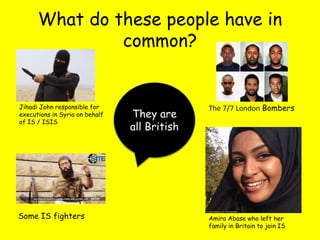
What do these people have in
common?
Jihadi John responsible for
executions in Syria on behalf
of IS / ISIS
The 7/7 London Bombers
Some IS fighters Amira Abase who left her
family in Britain to join IS
They are
all British
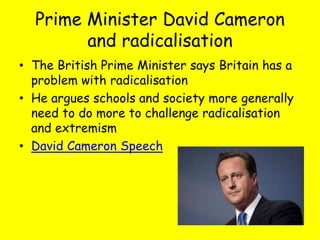
Prime Minister David Cameron
and radicalisation
• The British Prime Minister says Britain has a
problem with radicalisation
• He argues schools and society more generally
need to do more to challenge radicalisation
and extremism
• David Cameron Speech
What does radicalisation mean?
• Is a process by which an individual or
group comes to adopt increasingly extreme
political, social, or religious ideals and
aspirations that
• (1) reject or undermine the status quo or
• (2) reject and/or undermine contemporary
ideas and expressions of freedom of
choice.
In pairs discuss
what
radicalisation
means to you
Extension: What
does extremism
mean?
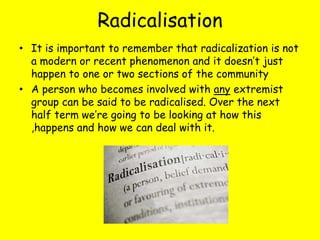
Radicalisation
• It is important to remember that radicalization is not
a modern or recent phenomenon and it doesn’t just
happen to one or two sections of the community
• A person who becomes involved with any extremist
group can be said to be radicalised. Over the next
half term we’re going to be looking at how this
,happens and how we can deal with it.
Radicalisation in the UK
• There have been some stories about
school children and families leaving
home and travelling to Syria to join
Islamic State. Watch the following and
think about their reasons for leaving;
• News Report 1
• News Report 2
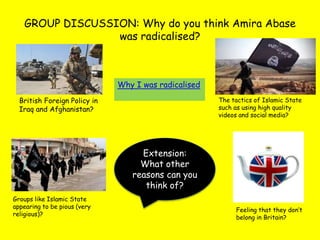
GROUP DISCUSSION: Why do you think Amira Abase
was radicalised?
British Foreign Policy in
Iraq and Afghanistan?
The tactics of Islamic State
such as using high quality
videos and social media?
Groups like Islamic State
appearing to be pious (very
religious)?
Feeling that they don’t
belong in Britain?
Why I was radicalised
Extension:
What other
reasons can you
think of?
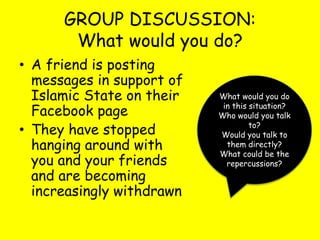
GROUP DISCUSSION:
What would you do?
• A friend is posting
messages in support of
Islamic State on their
Facebook page
• They have stopped
hanging around with
you and your friends
and are becoming
increasingly withdrawn
What would you do
in this situation?
Who would you talk
to?
Would you talk to
them directly?
What could be the
repercussions?
My understanding in the middle
of the lesson
POOR OKAY EXCELLENT
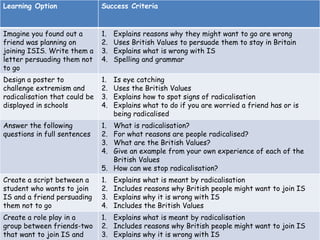
Learning Option Success Criteria
Imagine you found out a
friend was planning on
joining ISIS. Write them a
letter persuading them not
to go
1. Explains reasons why they might want to go are wrong
2. Uses British Values to persuade them to stay in Britain
3. Explains what is wrong with IS
4. Spelling and grammar
Design a poster to
challenge extremism and
radicalisation that could be
displayed in schools
1. Is eye catching
2. Uses the British Values
3. Explains how to spot signs of radicalisation
4. Explains what to do if you are worried a friend has or is
being radicalised
Answer the following
questions in full sentences
1. What is radicalisation?
2. For what reasons are people radicalised?
3. What are the British Values?
4. Give an example from your own experience of each of the
British Values
5. How can we stop radicalisation?
Create a script between a
student who wants to join
IS and a friend persuading
them not to go
1. Explains what is meant by radicalisation
2. Includes reasons why British people might want to join IS
3. Explains why it is wrong with IS
4. Includes the British Values
Create a role play in a
group between friends-two
that want to join IS and
1. Explains what is meant by radicalisation
2. Includes reasons why British people might want to join IS
3. Explains why it is wrong with IS
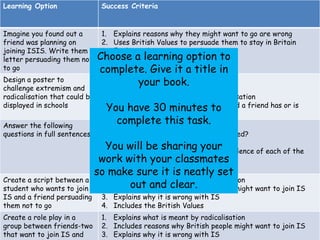
Learning Option Success Criteria
Imagine you found out a
friend was planning on
joining ISIS. Write them a
letter persuading them not
to go
1. Explains reasons why they might want to go are wrong
2. Uses British Values to persuade them to stay in Britain
3. Explains what is wrong with IS
4. Spelling and grammar
Design a poster to
challenge extremism and
radicalisation that could be
displayed in schools
1. Is eye catching
2. Uses the British Values
3. Explains how to spot signs of radicalisation
4. Explains what to do if you are worried a friend has or is
being radicalised
Answer the following
questions in full sentences
1. What is radicalisation?
2. For what reasons are people radicalised?
3. What are the British Values?
4. Give an example from your own experience of each of the
British Values
5. How can we stop radicalisation?
Create a script between a
student who wants to join
IS and a friend persuading
them not to go
1. Explains what is meant by radicalisation
2. Includes reasons why British people might want to join IS
3. Explains why it is wrong with IS
4. Includes the British Values
Create a role play in a
group between friends-two
that want to join IS and
1. Explains what is meant by radicalisation
2. Includes reasons why British people might want to join IS
3. Explains why it is wrong with IS
Choose a learning option to
complete. Give it a title in
your book.
You have 30 minutes to
complete this task.
You will be sharing your
work with your classmates
so make sure it is neatly set
out and clear.
Radicalisation - What have you
learned in today’s lesson?
• Sky News Report on Radicalisation
• Aim to write a paragraph explaining
what you have learned in today’s lesson
My understanding at the end of the
lesson
POOR OKAY EXCELLENT
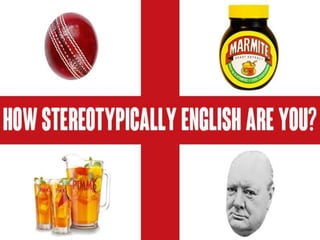
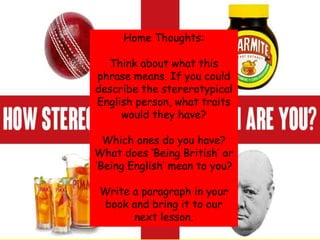
Home Thoughts:
Think about what this
phrase means. If you could
describe the stererotypical
English person, what traits
would they have?
Which ones do you have?
What does ‘Being British’ or
‘Being English’ mean to you?
Write a paragraph in your
book and bring it to our
next lesson.

Intro to radicalisation

  • 1.
  • 2.
    Learning Objectives • Tolearn about what we mean by terms like radicalisation and extremism; • To learn about why people become radicalised; • To understand what we can do if we are worried about someone being radicalised;
  • 3.
    My understanding atthe start of the lesson POOR OKAY EXCELLENT
  • 4.
    Can you unscramblethe British Values? 1. EOMCRCYAD 2. HET ULER FO AWL 3. IDIVDAULIN ILBETYR NDA MTUALU RSPEETC 4. OTLEACNER OF HOEST WITH IFFEINRGD AITSHF NDA ELIESFB 1. DEMOCRACY 2. THE RULE OF LAW 3. INDIVIDUAL LIBERTY AND MUTUAL RESPECT 4. TOLERANCE OF THOSE WITH DIFFERING FAITHS AND BELIEFS
  • 5.
    What do thesepeople have in common? Jihadi John responsible for executions in Syria on behalf of IS / ISIS The 7/7 London Bombers Some IS fighters Amira Abase who left her family in Britain to join IS They are all British
  • 6.
    Prime Minister DavidCameron and radicalisation • The British Prime Minister says Britain has a problem with radicalisation • He argues schools and society more generally need to do more to challenge radicalisation and extremism • David Cameron Speech
  • 7.
    What does radicalisationmean? • Is a process by which an individual or group comes to adopt increasingly extreme political, social, or religious ideals and aspirations that • (1) reject or undermine the status quo or • (2) reject and/or undermine contemporary ideas and expressions of freedom of choice. In pairs discuss what radicalisation means to you Extension: What does extremism mean?
  • 8.
    Radicalisation • It isimportant to remember that radicalization is not a modern or recent phenomenon and it doesn’t just happen to one or two sections of the community • A person who becomes involved with any extremist group can be said to be radicalised. Over the next half term we’re going to be looking at how this ,happens and how we can deal with it.
  • 9.
    Radicalisation in theUK • There have been some stories about school children and families leaving home and travelling to Syria to join Islamic State. Watch the following and think about their reasons for leaving; • News Report 1 • News Report 2
  • 10.
    GROUP DISCUSSION: Whydo you think Amira Abase was radicalised? British Foreign Policy in Iraq and Afghanistan? The tactics of Islamic State such as using high quality videos and social media? Groups like Islamic State appearing to be pious (very religious)? Feeling that they don’t belong in Britain? Why I was radicalised Extension: What other reasons can you think of?
  • 11.
    GROUP DISCUSSION: What wouldyou do? • A friend is posting messages in support of Islamic State on their Facebook page • They have stopped hanging around with you and your friends and are becoming increasingly withdrawn What would you do in this situation? Who would you talk to? Would you talk to them directly? What could be the repercussions?
  • 12.
    My understanding inthe middle of the lesson POOR OKAY EXCELLENT
  • 13.
    Learning Option SuccessCriteria Imagine you found out a friend was planning on joining ISIS. Write them a letter persuading them not to go 1. Explains reasons why they might want to go are wrong 2. Uses British Values to persuade them to stay in Britain 3. Explains what is wrong with IS 4. Spelling and grammar Design a poster to challenge extremism and radicalisation that could be displayed in schools 1. Is eye catching 2. Uses the British Values 3. Explains how to spot signs of radicalisation 4. Explains what to do if you are worried a friend has or is being radicalised Answer the following questions in full sentences 1. What is radicalisation? 2. For what reasons are people radicalised? 3. What are the British Values? 4. Give an example from your own experience of each of the British Values 5. How can we stop radicalisation? Create a script between a student who wants to join IS and a friend persuading them not to go 1. Explains what is meant by radicalisation 2. Includes reasons why British people might want to join IS 3. Explains why it is wrong with IS 4. Includes the British Values Create a role play in a group between friends-two that want to join IS and 1. Explains what is meant by radicalisation 2. Includes reasons why British people might want to join IS 3. Explains why it is wrong with IS
  • 14.
    Learning Option SuccessCriteria Imagine you found out a friend was planning on joining ISIS. Write them a letter persuading them not to go 1. Explains reasons why they might want to go are wrong 2. Uses British Values to persuade them to stay in Britain 3. Explains what is wrong with IS 4. Spelling and grammar Design a poster to challenge extremism and radicalisation that could be displayed in schools 1. Is eye catching 2. Uses the British Values 3. Explains how to spot signs of radicalisation 4. Explains what to do if you are worried a friend has or is being radicalised Answer the following questions in full sentences 1. What is radicalisation? 2. For what reasons are people radicalised? 3. What are the British Values? 4. Give an example from your own experience of each of the British Values 5. How can we stop radicalisation? Create a script between a student who wants to join IS and a friend persuading them not to go 1. Explains what is meant by radicalisation 2. Includes reasons why British people might want to join IS 3. Explains why it is wrong with IS 4. Includes the British Values Create a role play in a group between friends-two that want to join IS and 1. Explains what is meant by radicalisation 2. Includes reasons why British people might want to join IS 3. Explains why it is wrong with IS Choose a learning option to complete. Give it a title in your book. You have 30 minutes to complete this task. You will be sharing your work with your classmates so make sure it is neatly set out and clear.
  • 15.
    Radicalisation - Whathave you learned in today’s lesson? • Sky News Report on Radicalisation • Aim to write a paragraph explaining what you have learned in today’s lesson
  • 16.
    My understanding atthe end of the lesson POOR OKAY EXCELLENT
  • 18.
    Home Thoughts: Think aboutwhat this phrase means. If you could describe the stererotypical English person, what traits would they have? Which ones do you have? What does ‘Being British’ or ‘Being English’ mean to you? Write a paragraph in your book and bring it to our next lesson.