The United Nations Security Council
1
Unit 2 in GCSE Government and Politics is
concerned with International Politics in Action. This
includes the issue of conflict and its resolution.
The United Nations is an organisation designed
to prevent and resolve conflict and this Factfile
provides information on the UN Security Council
which is one of the main elements of the UN.
Origins and aims
The United Nations was formed after World War
II and was designed to replace the League of
Nations. It is an intergovernmental organisation
which means it is made up of representatives from
almost all states and governments around the
world. When it was formed in October 1945 there
were 53 member states: today there are 193. The
headquarters of the UN is in New York and there
are main offices in other big cities such as Vienna,
Geneva and Nairobi. Its overall aim was to prevent
another world war but it also has additional aims
including:
•	 Maintaining international peace and security;
•	 Promoting human rights;
•	 Encouraging social and economic development
around the globe;
•	 Protecting the environment;
•	 Providing aid in cases of famine, natural disaster
or war.
The United Nations Charter makes its aims clear
and acts like a constitution for the organisation.
In order to fulfil its aims the United Nations has
six main bodies or principal organs as they are
known. These are the General Assembly, the
Security Council, the Economic and Social Council,
the Trusteeship Council, the International Court
of Justice, and the Secretariat. The United Nations
Security Council is one of these main bodies and
its task is to maintain world peace. It held its first
session in January 1946.
The UN Security Council will determine appropriate
action if there is a threat to peace. It has the power
to establish a peacekeeping mission, to apply
sanctions to aggressive countries or rulers, to help
with mediation and if all of this fails to authorize
military action.
The decision-making process
including the right to veto
There are five permanent members of the
Security Council and fifteen members in total.
Each member has one vote however all of the
permanent members have the power of veto. In
other words, any action needs the support of the
five permanent members if it is to go ahead. The
five permanent members are: China, France, Russia,
United Kingdom and United States. These five were
deemed to be the major world powers at the time
the UN was set up and that is why they gained this
additional power. Once a decision has been taken
all member states are obliged to comply with it.
FACTFILE:
GCSE
GOVERNMENT
AND POLITICS
Unit 2
FACTFILE: GCE HISTORY OF ART / ARCHITECTURE
FACTFILE:GCSE GOVERNMENT AND POLITICS / UNIT 2 / THE UNITED NATIONS SECURITY COUNCIL
2
The Role of the United Kingdom in
the United Nations
As one of the five permanent members the UK
plays an important role in the Security Council. It
has played a key role in recent years in a range of
UN actions in countries such as Yemen, Somalia,
Libya and Sudan. The UK is the fifth largest
financial contributor to the UN and in 2015 the UK
contributed 6.7% of the peace keeping budget.
English is one of the six official languages of the
UN and being a key member of the UN is seen as
important for maintaining Britain’s position in the
world. The UK has used its veto power a total of 32
times between 1956 and 1989. It has taken part
in a number of UN military operations starting
with the intervention in the Korean War 1950-
53, peacekeeping in Bosnia in 1992-95, the 2000
intervention in Sierra Leone and in 2011 the UK was
part of the NATO intervention in Libya that helped
topple Gaddafi’s regime.
There are four main methods used by the UN to try
to maintain peace and end conflict, they are:
1.	 Mediation. The UN provides help in planning
and implementing a mediation process for
use in areas where it is seen as the best way
to maintain peace. Training is provided for
mediators on negotiation skills and techniques
and on targeted thematic areas such as the
prevention of sexual violence in conflict. The UN
has produced a Guidance for Effective Mediation
which highlights best practice for mediation,
in addition there is a Special Envoy Briefing
Package which compiles key UN policies and
approaches to mediation. Examples of the
effective use of mediation by the UN can be
found in Sri Lanka and the Sudan. In both cases
post-conflict mediation helped maintain peace
and deal with difficult issues regarding land and
natural resource management.
2.	 Imposing sanctions. The UN can impose
a range of sanctions intended to restore
international peace. Since 1966 they have
established 26 sanctions regimes in the
following countries; Southern Rhodesia, South
Africa, the former Yugoslavia, Haiti, Iraq,
Angola, Sierra Leone, Somalia, Eritrea, Liberia,
Democratic Republic of the Congo (DRC), Cote
d’Ivoire, Sudan, Lebanon, Democratic People’s
Republic of Korea (DPRK), Iran, Libya, Guinea-
Bissau, Central African Republic (CAR), Yemen,
South Sudan and against ISIL (Da’esh) and
Al-Qaida and the Taliban. Sanctions can take
a number of forms and include: economic
and trade sanctions, arms embargoes, travel
bans, and financial restrictions. Sanctions are
most effective when they are supported by
other peacekeeping measures. Sanctions are
not always punitive and maybe used a way
of helping regimes and governments make
the transition to peace, for example sanctions
imposed on Libya were designed to do this
rather than to punish the regime. Today there
are 13 ongoing sanction regimes around the
world. Each of these is supervised by sanctions
committee and the rights of those effected and
conditions governing both the imposition and
lifting of sanctions is closely monitored.
3.	 Sending a peacekeeping mission. In order to
maintain and promote peace the UN will send
in peacekeeping missions to areas affected
by conflict or emerging from conflict. These
peacekeeping missions are made up of soldiers,
police officers, and civilian personnel. The
international community looks to the UN to
provide this service as its operations are seen as
valid. So most peacekeeping missions across the
world are led by the UN. Since 1945 there have
been 55 completed peacekeeping missions and
there are currently 16 peacekeeping missions in
countries as diverse as Haiti, Lebanon, Central
African Republic (CAR) and Kosovo.
FACTFILE: GCE HISTORY OF ART / ARCHITECTURE
FACTFILE:GCSE GOVERNMENT AND POLITICS / UNIT 2 / THE UNITED NATIONS SECURITY COUNCIL
3
4.	 Military intervention/the use of force. There
are occasions when the UN is called upon to
pass resolutions in favour of more direct military
intervention. This can be difficult for the UN as
it is often hard to tell if military intervention will
make things better or worse. An example of a
NATO intervention which was backed by the UN
was the intervention in Libya in 2011 which saw
Colonel Gaddafi toppled from power. This has
been criticised subsequently as unnecessary
as Libya remains a war torn and devastated
country. Military force can only be used once
a UN resolution supporting it has been passed
however since it has no standing army of its own
it can take a while after passing a resolution
to get troops on the ground. However in the
1990s the UN found itself being called upon to
intervene in situations where the conflict was
ongoing, for example in Somalia, Rwanda and
the former Yugoslavia. This was difficult for
UN forces and difficulties in protecting both
civilians and UN personnel in these regions led
to criticism.
The Effectiveness of the UN
Security Council in Resolving
Conflict
In this section the effectiveness of the UN in
resolving conflict will be examined by means of two
case studies. Given the range and ever changing
nature of UN operations students are encouraged
to look at other case studies in addition to the two
examined below to gain a broader knowledge of the
work of the UN security council and the challenges
it faces in carrying out that work.
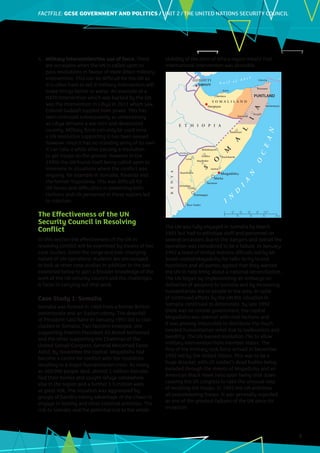
Case Study 1: Somalia
Somalia was formed in 1960 from a former British
protectorate and an Italian colony. The downfall
of President Said Barre in January 1991 led to clan
clashes in Somalia. Two factions emerged, one
supporting Interim President Ali Mahdi Mohamed
and the other supporting the Chairman of the
United Somali Congress, General Mohamed Farah
Aidid. By November the capital, Mogadishu had
become a centre for conflict with the hostilities
resulting in a major humanitarian crisis. As many
as 300,000 people died, almost 1 million Somalis
fled their homes and sought refuge somewhere
else in the region and a further 1.5 million were
at great risk. The situation was aggravated by
groups of bandits taking advantage of the chaos to
engage in looting and other criminal activities. The
risk to Somalis and the potential risk to the whole
stability of the Horn of Africa region meant that
international intervention was desirable.
The UN was fully engaged in Somalia by March
1991 but had to withdraw staff and personnel on
several occasions due to the dangers and overall the
operation was considered to be a failure. In January
1992 a team of United Nations officials led by Mr
Jonah visited Mogadishu for talks to try to end
hostilities and all parties agreed that they wanted
the UN to help bring about a national reconciliation.
The UN began by implementing an embargo on
deliveries of weapons to Somalia and by increasing
humanitarian aid to people in the area. In spite
of continued efforts by the UN the situation in
Somalia continued to deteriorate, by late 1992
there was no central government, the capital
Mogadishu was overrun with rival factions and
it was proving impossible to distribute the much
needed humanitarian relief due to lawlessness and
banditry. The UN passed resolution 794 to allow
military intervention from member states. The
first of the military task force arrived in December
1992 led by the United States. This was to be a
huge disaster, with US soldier’s dead bodies being
paraded through the streets of Mogadishu and an
American Black Hawk helicopter being shot down
causing the US congress to take the unusual step
of recalling the troops. In 1995 the UN withdrew
all peacekeeping troops. It was generally regarded
as one of the greatest failures of the UN since its
inception.
PUNTLAND
FACTFILE: GCE HISTORY OF ART / ARCHITECTURE
FACTFILE:GCSE GOVERNMENT AND POLITICS / UNIT 2 / THE UNITED NATIONS SECURITY COUNCIL
© CCEA 2017
Case Study 2: Sierra Leone
In 1999 the UN sent a peacekeeping force to Sierra
Leone to help oversee the peace process and the
transition to democratic government. The UN spent
six years in Sierra Leone and unlike the situation
in Rwanda and in Somalia, in Sierra Leone the UN
involvement was not only seen as a success but as
an example of what could be achieved in the right
circumstances. During its time there the UN helped
disarm and retrain 75,000 ex-combatants including
a large number (7,000) child soldiers. It helped
with rebuilding a police force and establishing
democratic structures such as elections at both
national and local level. The UN took the lead in
stopping the illicit trade in diamonds or ‘blood’
diamonds as they came to be known because of
their association with violent factions in the civil
war, and helped establish a viable diamond trade
which the government could control bringing much
needed resources back to the country as a whole.
For example the government earned $10 million
from the diamond trade in 2000 but by 2004 this
had risen to $160 million.
There was a point when the UN mission looked
likely to fail. In 2000 rebel Revolutionary United
Front (RUF) fighters kidnapped hundreds of
peacekeepers and renounced their ceasefire.
International sponsors condemned the action and
put pressure on the RUF to fulfil the ceasefire. More
mediation and an increase in the number of troops
ended this threat to peace.
The UN mission in Sierra Leone was a success
because it was able to do a number of things,
including:
•	 Provided mediation and a military force to help
maintain the peace;
•	 Assisted the voluntary return of half a million
refugees and internally displaced persons;
•	 Helped the government to restore social services;
•	 Set up and trained a new police force all citizens
could have faith in;
•	 Restructured the army under the guidance of the
British army personnel who went to Sierra Leone
to help;
•	 Trained local people in human rights and oversaw
the setting up a Special Court to try people for
war crimes;
•	 Set up a Truth and Reconciliation Commission;
•	 Brought in income generating schemes to try
to provide jobs for the unemployed and for ex-
fighters so they could see a ‘peace dividend’;
•	 Built new schools and clinics and tried to help
agricultural recovery by funding projects in
agricultural areas.
In 2014 the UN offices in Sierra Leone were
officially closed and the peace process was declared
to be a success. At the ceremony to celebrate
the peace and the end of UN involvement Mr Ban
declared the following: “Our blue helmets disarmed
more than 75 000 ex-fighters, including hundreds of
child soldiers. The UN destroyed more than 42 000
weapons and 1.2 million rounds of ammunition – a
potentially deadly arsenal that is now itself dead.”
There are a number of other areas in which United
Nations intervention has been seen as either a
success or as a failure. The following article gives a
useful overview of a number of the best known.
http://www.telegraph.co.uk/news/worldnews/
europe/bosnia/11729436/Srebrenica-20-years-on-
What-have-been-the-successes-and-failures-of-UN-
peacekeeping-missions.html
©
Images:
ThinkstockPhotos.com

Un security council

  • 1.
    The United NationsSecurity Council 1 Unit 2 in GCSE Government and Politics is concerned with International Politics in Action. This includes the issue of conflict and its resolution. The United Nations is an organisation designed to prevent and resolve conflict and this Factfile provides information on the UN Security Council which is one of the main elements of the UN. Origins and aims The United Nations was formed after World War II and was designed to replace the League of Nations. It is an intergovernmental organisation which means it is made up of representatives from almost all states and governments around the world. When it was formed in October 1945 there were 53 member states: today there are 193. The headquarters of the UN is in New York and there are main offices in other big cities such as Vienna, Geneva and Nairobi. Its overall aim was to prevent another world war but it also has additional aims including: • Maintaining international peace and security; • Promoting human rights; • Encouraging social and economic development around the globe; • Protecting the environment; • Providing aid in cases of famine, natural disaster or war. The United Nations Charter makes its aims clear and acts like a constitution for the organisation. In order to fulfil its aims the United Nations has six main bodies or principal organs as they are known. These are the General Assembly, the Security Council, the Economic and Social Council, the Trusteeship Council, the International Court of Justice, and the Secretariat. The United Nations Security Council is one of these main bodies and its task is to maintain world peace. It held its first session in January 1946. The UN Security Council will determine appropriate action if there is a threat to peace. It has the power to establish a peacekeeping mission, to apply sanctions to aggressive countries or rulers, to help with mediation and if all of this fails to authorize military action. The decision-making process including the right to veto There are five permanent members of the Security Council and fifteen members in total. Each member has one vote however all of the permanent members have the power of veto. In other words, any action needs the support of the five permanent members if it is to go ahead. The five permanent members are: China, France, Russia, United Kingdom and United States. These five were deemed to be the major world powers at the time the UN was set up and that is why they gained this additional power. Once a decision has been taken all member states are obliged to comply with it. FACTFILE: GCSE GOVERNMENT AND POLITICS Unit 2
  • 2.
    FACTFILE: GCE HISTORYOF ART / ARCHITECTURE FACTFILE:GCSE GOVERNMENT AND POLITICS / UNIT 2 / THE UNITED NATIONS SECURITY COUNCIL 2 The Role of the United Kingdom in the United Nations As one of the five permanent members the UK plays an important role in the Security Council. It has played a key role in recent years in a range of UN actions in countries such as Yemen, Somalia, Libya and Sudan. The UK is the fifth largest financial contributor to the UN and in 2015 the UK contributed 6.7% of the peace keeping budget. English is one of the six official languages of the UN and being a key member of the UN is seen as important for maintaining Britain’s position in the world. The UK has used its veto power a total of 32 times between 1956 and 1989. It has taken part in a number of UN military operations starting with the intervention in the Korean War 1950- 53, peacekeeping in Bosnia in 1992-95, the 2000 intervention in Sierra Leone and in 2011 the UK was part of the NATO intervention in Libya that helped topple Gaddafi’s regime. There are four main methods used by the UN to try to maintain peace and end conflict, they are: 1. Mediation. The UN provides help in planning and implementing a mediation process for use in areas where it is seen as the best way to maintain peace. Training is provided for mediators on negotiation skills and techniques and on targeted thematic areas such as the prevention of sexual violence in conflict. The UN has produced a Guidance for Effective Mediation which highlights best practice for mediation, in addition there is a Special Envoy Briefing Package which compiles key UN policies and approaches to mediation. Examples of the effective use of mediation by the UN can be found in Sri Lanka and the Sudan. In both cases post-conflict mediation helped maintain peace and deal with difficult issues regarding land and natural resource management. 2. Imposing sanctions. The UN can impose a range of sanctions intended to restore international peace. Since 1966 they have established 26 sanctions regimes in the following countries; Southern Rhodesia, South Africa, the former Yugoslavia, Haiti, Iraq, Angola, Sierra Leone, Somalia, Eritrea, Liberia, Democratic Republic of the Congo (DRC), Cote d’Ivoire, Sudan, Lebanon, Democratic People’s Republic of Korea (DPRK), Iran, Libya, Guinea- Bissau, Central African Republic (CAR), Yemen, South Sudan and against ISIL (Da’esh) and Al-Qaida and the Taliban. Sanctions can take a number of forms and include: economic and trade sanctions, arms embargoes, travel bans, and financial restrictions. Sanctions are most effective when they are supported by other peacekeeping measures. Sanctions are not always punitive and maybe used a way of helping regimes and governments make the transition to peace, for example sanctions imposed on Libya were designed to do this rather than to punish the regime. Today there are 13 ongoing sanction regimes around the world. Each of these is supervised by sanctions committee and the rights of those effected and conditions governing both the imposition and lifting of sanctions is closely monitored. 3. Sending a peacekeeping mission. In order to maintain and promote peace the UN will send in peacekeeping missions to areas affected by conflict or emerging from conflict. These peacekeeping missions are made up of soldiers, police officers, and civilian personnel. The international community looks to the UN to provide this service as its operations are seen as valid. So most peacekeeping missions across the world are led by the UN. Since 1945 there have been 55 completed peacekeeping missions and there are currently 16 peacekeeping missions in countries as diverse as Haiti, Lebanon, Central African Republic (CAR) and Kosovo.
  • 3.
    FACTFILE: GCE HISTORYOF ART / ARCHITECTURE FACTFILE:GCSE GOVERNMENT AND POLITICS / UNIT 2 / THE UNITED NATIONS SECURITY COUNCIL 3 4. Military intervention/the use of force. There are occasions when the UN is called upon to pass resolutions in favour of more direct military intervention. This can be difficult for the UN as it is often hard to tell if military intervention will make things better or worse. An example of a NATO intervention which was backed by the UN was the intervention in Libya in 2011 which saw Colonel Gaddafi toppled from power. This has been criticised subsequently as unnecessary as Libya remains a war torn and devastated country. Military force can only be used once a UN resolution supporting it has been passed however since it has no standing army of its own it can take a while after passing a resolution to get troops on the ground. However in the 1990s the UN found itself being called upon to intervene in situations where the conflict was ongoing, for example in Somalia, Rwanda and the former Yugoslavia. This was difficult for UN forces and difficulties in protecting both civilians and UN personnel in these regions led to criticism. The Effectiveness of the UN Security Council in Resolving Conflict In this section the effectiveness of the UN in resolving conflict will be examined by means of two case studies. Given the range and ever changing nature of UN operations students are encouraged to look at other case studies in addition to the two examined below to gain a broader knowledge of the work of the UN security council and the challenges it faces in carrying out that work. Case Study 1: Somalia Somalia was formed in 1960 from a former British protectorate and an Italian colony. The downfall of President Said Barre in January 1991 led to clan clashes in Somalia. Two factions emerged, one supporting Interim President Ali Mahdi Mohamed and the other supporting the Chairman of the United Somali Congress, General Mohamed Farah Aidid. By November the capital, Mogadishu had become a centre for conflict with the hostilities resulting in a major humanitarian crisis. As many as 300,000 people died, almost 1 million Somalis fled their homes and sought refuge somewhere else in the region and a further 1.5 million were at great risk. The situation was aggravated by groups of bandits taking advantage of the chaos to engage in looting and other criminal activities. The risk to Somalis and the potential risk to the whole stability of the Horn of Africa region meant that international intervention was desirable. The UN was fully engaged in Somalia by March 1991 but had to withdraw staff and personnel on several occasions due to the dangers and overall the operation was considered to be a failure. In January 1992 a team of United Nations officials led by Mr Jonah visited Mogadishu for talks to try to end hostilities and all parties agreed that they wanted the UN to help bring about a national reconciliation. The UN began by implementing an embargo on deliveries of weapons to Somalia and by increasing humanitarian aid to people in the area. In spite of continued efforts by the UN the situation in Somalia continued to deteriorate, by late 1992 there was no central government, the capital Mogadishu was overrun with rival factions and it was proving impossible to distribute the much needed humanitarian relief due to lawlessness and banditry. The UN passed resolution 794 to allow military intervention from member states. The first of the military task force arrived in December 1992 led by the United States. This was to be a huge disaster, with US soldier’s dead bodies being paraded through the streets of Mogadishu and an American Black Hawk helicopter being shot down causing the US congress to take the unusual step of recalling the troops. In 1995 the UN withdrew all peacekeeping troops. It was generally regarded as one of the greatest failures of the UN since its inception. PUNTLAND
  • 4.
    FACTFILE: GCE HISTORYOF ART / ARCHITECTURE FACTFILE:GCSE GOVERNMENT AND POLITICS / UNIT 2 / THE UNITED NATIONS SECURITY COUNCIL © CCEA 2017 Case Study 2: Sierra Leone In 1999 the UN sent a peacekeeping force to Sierra Leone to help oversee the peace process and the transition to democratic government. The UN spent six years in Sierra Leone and unlike the situation in Rwanda and in Somalia, in Sierra Leone the UN involvement was not only seen as a success but as an example of what could be achieved in the right circumstances. During its time there the UN helped disarm and retrain 75,000 ex-combatants including a large number (7,000) child soldiers. It helped with rebuilding a police force and establishing democratic structures such as elections at both national and local level. The UN took the lead in stopping the illicit trade in diamonds or ‘blood’ diamonds as they came to be known because of their association with violent factions in the civil war, and helped establish a viable diamond trade which the government could control bringing much needed resources back to the country as a whole. For example the government earned $10 million from the diamond trade in 2000 but by 2004 this had risen to $160 million. There was a point when the UN mission looked likely to fail. In 2000 rebel Revolutionary United Front (RUF) fighters kidnapped hundreds of peacekeepers and renounced their ceasefire. International sponsors condemned the action and put pressure on the RUF to fulfil the ceasefire. More mediation and an increase in the number of troops ended this threat to peace. The UN mission in Sierra Leone was a success because it was able to do a number of things, including: • Provided mediation and a military force to help maintain the peace; • Assisted the voluntary return of half a million refugees and internally displaced persons; • Helped the government to restore social services; • Set up and trained a new police force all citizens could have faith in; • Restructured the army under the guidance of the British army personnel who went to Sierra Leone to help; • Trained local people in human rights and oversaw the setting up a Special Court to try people for war crimes; • Set up a Truth and Reconciliation Commission; • Brought in income generating schemes to try to provide jobs for the unemployed and for ex- fighters so they could see a ‘peace dividend’; • Built new schools and clinics and tried to help agricultural recovery by funding projects in agricultural areas. In 2014 the UN offices in Sierra Leone were officially closed and the peace process was declared to be a success. At the ceremony to celebrate the peace and the end of UN involvement Mr Ban declared the following: “Our blue helmets disarmed more than 75 000 ex-fighters, including hundreds of child soldiers. The UN destroyed more than 42 000 weapons and 1.2 million rounds of ammunition – a potentially deadly arsenal that is now itself dead.” There are a number of other areas in which United Nations intervention has been seen as either a success or as a failure. The following article gives a useful overview of a number of the best known. http://www.telegraph.co.uk/news/worldnews/ europe/bosnia/11729436/Srebrenica-20-years-on- What-have-been-the-successes-and-failures-of-UN- peacekeeping-missions.html © Images: ThinkstockPhotos.com