WT Case Studies
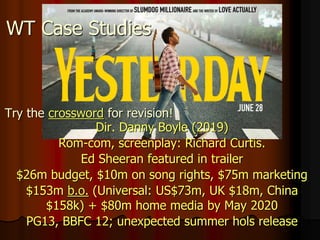
Dir. Danny Boyle (2019)
Rom-com, screenplay: Richard Curtis.
Ed Sheeran featured in trailer
$26m budget, $10m on song rights, $75m marketing
$153m b.o. (Universal: US$73m, UK $18m, China
$158k) + $80m home media by May 2020
PG13, BBFC 12; unexpected summer hols release
Try the crossword for revision!
Stuart Hall’s theory of readings
 Hall argued that semiotics is flawed; it
ignores how different audiences read the
same text, so as well as the preferred
reading (how the creators hope we
respond through their use of media
language), he also coined the terms
contested (aka negotiated) and
oppositional reading
 Lets see how far YOU can follow the
preferred reading of the poster…
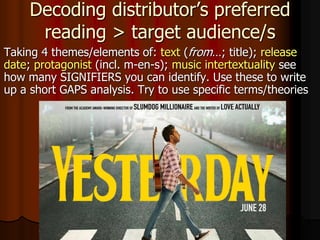
Decoding distributor’s preferred
reading > target audience/s
Taking 4 themes/elements of: text (from…; title); release
date; protagonist (incl. m-en-s); music intertextuality see
how many SIGNIFIERS you can identify. Use these to write
up a short GAPS analysis. Try to use specific terms/theories
Some useful terms + hints
Commercial writer/film-maker; credible/acclaimed director;
genre, hybridity; assumed knowledge – film names only; Oscar
bounce, award-winning; upper case; font, size, colour;
anchorage; 3-part list (on tagline versions); A-list (absent)
Release strategy; summer blockbuster; counter-programming;
wide release; moved up
Protagonist – Proppian archetype of…; framing; clothing (mise-
en-scene), props, hair, body language, Campbell’s hero’s
journey (monomyth), Todorov, narrative enigma, (lack of?)
binary opposition), Intertextuality; postmodernism; preferred
(etc) reading + polysemy; Ed Sheeran/Lewis Capaldi –
zeitgeist; nostalgia (Simon Reynolds’ Retromania); (fe)male
gaze?; BAME (ethnicity)
GENERAL: signifier, signified, signifies, connote, connotation,
denote, anchor, polysemy/ic, Hall’s readings, framing + mise-
en-scene, retro/nostalgia, hybridity, U+G, Dyer’s star system
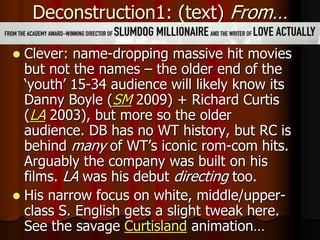
Deconstruction1: (text) From…
 Clever: name-dropping massive hit movies
but not the names – the older end of the
‘youth’ 15-34 audience will likely know its
Danny Boyle (SM 2009) + Richard Curtis
(LA 2003), but more so the older
audience. DB has no WT history, but RC is
behind many of WT’s iconic rom-com hits.
Arguably the company was built on his
films. LA was his debut directing too.
 His narrow focus on white, middle/upper-
class S. English gets a slight tweak here.
See the savage Curtisland animation…
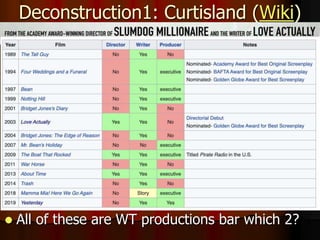
Deconstruction1: Curtisland (Wiki)
 All of these are WT productions bar which 2?
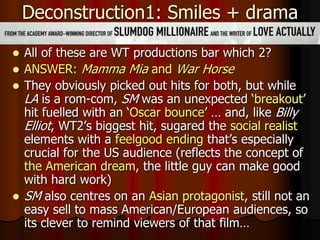
Deconstruction1: Smiles + drama
 All of these are WT productions bar which 2?
 ANSWER: Mamma Mia and War Horse
 They obviously picked out hits for both, but while
LA is a rom-com, SM was an unexpected ‘breakout’
hit fuelled with an ‘Oscar bounce’ … and, like Billy
Elliot, WT2’s biggest hit, sugared the social realist
elements with a feelgood ending that’s especially
crucial for the US audience (reflects the concept of
the American dream, the little guy can make good
with hard work)
 SM also centres on an Asian protagonist, still not an
easy sell to mass American/European audiences, so
its clever to remind viewers of that film…
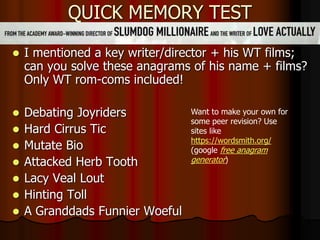
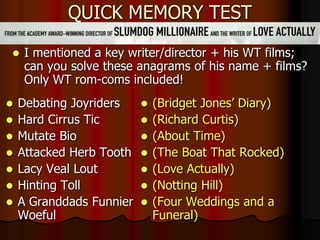
QUICK MEMORY TEST
 I mentioned a key writer/director + his WT films;
can you solve these anagrams of his name + films?
Only WT rom-coms included!
 Debating Joyriders
 Hard Cirrus Tic
 Mutate Bio
 Attacked Herb Tooth
 Lacy Veal Lout
 Hinting Toll
 A Granddads Funnier Woeful
Want to make your own for
some peer revision? Use
sites like
https://wordsmith.org/
(google free anagram
generator)
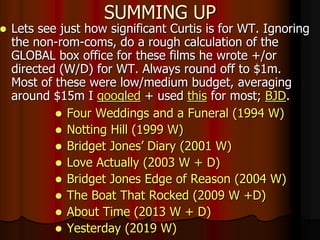
QUICK MEMORY TEST
 I mentioned a key writer/director + his WT films;
can you solve these anagrams of his name + films?
Only WT rom-coms included!
 Debating Joyriders
 Hard Cirrus Tic
 Mutate Bio
 Attacked Herb Tooth
 Lacy Veal Lout
 Hinting Toll
 A Granddads Funnier
Woeful
 (Bridget Jones’ Diary)
 (Richard Curtis)
 (About Time)
 (The Boat That Rocked)
 (Love Actually)
 (Notting Hill)
 (Four Weddings and a
Funeral)
SUMMING UP
 Lets see just how significant Curtis is for WT. Ignoring
the non-rom-coms, do a rough calculation of the
GLOBAL box office for these films he wrote +/or
directed (W/D) for WT. Always round off to $1m.
Most of these were low/medium budget, averaging
around $15m I googled + used this for most; BJD.
 Four Weddings and a Funeral (1994 W)
 Notting Hill (1999 W)
 Bridget Jones’ Diary (2001 W)
 Love Actually (2003 W + D)
 Bridget Jones Edge of Reason (2004 W)
 The Boat That Rocked (2009 W +D)
 About Time (2013 W + D)
 Yesterday (2019 W)
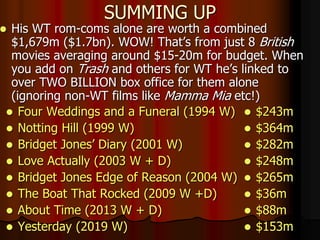
SUMMING UP
 His WT rom-coms alone are worth a combined
$1,679m ($1.7bn). WOW! That’s from just 8 British
movies averaging around $15-20m for budget. When
you add on Trash and others for WT he’s linked to
over TWO BILLION box office for them alone
(ignoring non-WT films like Mamma Mia etc!)
 Four Weddings and a Funeral (1994 W)
 Notting Hill (1999 W)
 Bridget Jones’ Diary (2001 W)
 Love Actually (2003 W + D)
 Bridget Jones Edge of Reason (2004 W)
 The Boat That Rocked (2009 W +D)
 About Time (2013 W + D)
 Yesterday (2019 W)
 $243m
 $364m
 $282m
 $248m
 $265m
 $36m
 $88m
 $153m
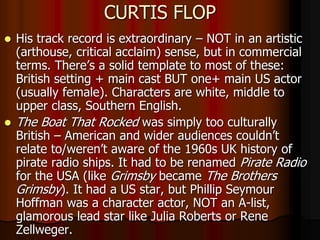
CURTIS FLOP
 His track record is extraordinary – NOT in an artistic
(arthouse, critical acclaim) sense, but in commercial
terms. There’s a solid template to most of these:
British setting + main cast BUT one+ main US actor
(usually female). Characters are white, middle to
upper class, Southern English.
 The Boat That Rocked was simply too culturally
British – American and wider audiences couldn’t
relate to/weren’t aware of the 1960s UK history of
pirate radio ships. It had to be renamed Pirate Radio
for the USA (like Grimsby became The Brothers
Grimsby). It had a US star, but Phillip Seymour
Hoffman was a character actor, NOT an A-list,
glamorous lead star like Julia Roberts or Rene
Zellweger.
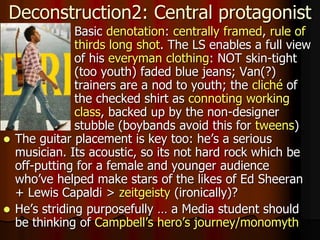
 Basic denotation: centrally framed, rule of
thirds long shot. The LS enables a full view
of his everyman clothing: NOT skin-tight
(too youth) faded blue jeans; Van(?)
trainers are a nod to youth; the cliché of
the checked shirt as connoting working
class, backed up by the non-designer
stubble (boybands avoid this for tweens)
Deconstruction2: Central protagonist
 The guitar placement is key too: he’s a serious
musician. Its acoustic, so its not hard rock which be
off-putting for a female and younger audience
who’ve helped make stars of the likes of Ed Sheeran
+ Lewis Capaldi > zeitgeisty (ironically)?
 He’s striding purposefully … a Media student should
be thinking of Campbell’s hero’s journey/monomyth
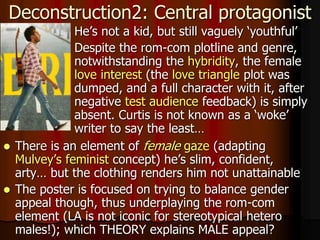
 He’s not a kid, but still vaguely ‘youthful’
 Despite the rom-com plotline and genre,
notwithstanding the hybridity, the female
love interest (the love triangle plot was
dumped, and a full character with it, after
negative test audience feedback) is simply
absent. Curtis is not known as a ‘woke’
writer to say the least…
Deconstruction2: Central protagonist
 There is an element of female gaze (adapting
Mulvey’s feminist concept) he’s slim, confident,
arty… but the clothing renders him not unattainable
 The poster is focused on trying to balance gender
appeal though, thus underplaying the rom-com
element (LA is not iconic for stereotypical hetero
males!); which THEORY explains MALE appeal?
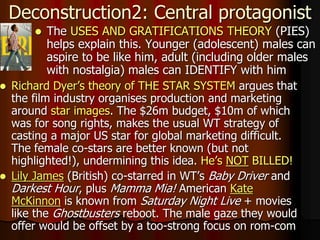
 The USES AND GRATIFICATIONS THEORY (PIES)
helps explain this. Younger (adolescent) males can
aspire to be like him, adult (including older males
with nostalgia) males can IDENTIFY with him
Deconstruction2: Central protagonist
 Richard Dyer’s theory of THE STAR SYSTEM argues that
the film industry organises production and marketing
around star images. The $26m budget, $10m of which
was for song rights, makes the usual WT strategy of
casting a major US star for global marketing difficult.
The female co-stars are better known (but not
highlighted!), undermining this idea. He’s NOT BILLED!
 Lily James (British) co-starred in WT’s Baby Driver and
Darkest Hour, plus Mamma Mia! American Kate
McKinnon is known from Saturday Night Live + movies
like the Ghostbusters reboot. The male gaze they would
offer would be offset by a too-strong focus on rom-com
Deconstruction3: Release date
 The distribution of Indie productions doesn’t cease
over the summer, but, as with Easter and Xmas, they
are mostly crowded out by the big 5’s tentpole
releases.
 With adolescents on school holidays, these (along with
Halloween) are the biggest periods for box office, so
the studios hold back their very biggest films for these
periods (like Xmas, home of the latest Star Wars
release). Some distributors attempt counter-
programming, putting up serious low budget drama
 Yesterday was intended for a low-key September
release, but got bumped up to the lucrative summer
period, and a hefty $75m spent on marketing the
$26m production! Can you explain WHY?
Deconstruction4: Music intertextuality
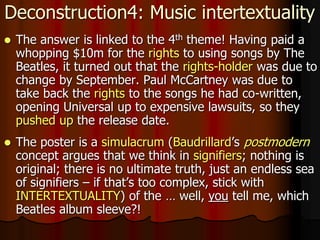
 The answer is linked to the 4th theme! Having paid a
whopping $10m for the rights to using songs by The
Beatles, it turned out that the rights-holder was due to
change by September. Paul McCartney was due to
take back the rights to the songs he had co-written,
opening Universal up to expensive lawsuits, so they
pushed up the release date.
 The poster is a simulacrum (Baudrillard’s postmodern
concept argues that we think in signifiers; nothing is
original; there is no ultimate truth, just an endless sea
of signifiers – if that’s too complex, stick with
INTERTEXTUALITY) of the … well, you tell me, which
Beatles album sleeve?!
Deconstruction4: Music intertextuality
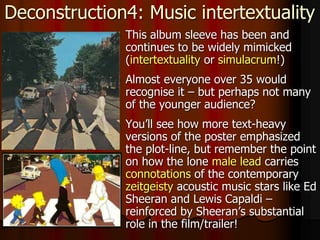
 This album sleeve has been and
continues to be widely mimicked
(intertextuality or simulacrum!)
 Almost everyone over 35 would
recognise it – but perhaps not many
of the younger audience?
 You’ll see how more text-heavy
versions of the poster emphasized
the plot-line, but remember the point
on how the lone male lead carries
connotations of the contemporary
zeitgeisty acoustic music stars like Ed
Sheeran and Lewis Capaldi –
reinforced by Sheeran’s substantial
role in the film/trailer!
Deconstruction4: Music intertextuality
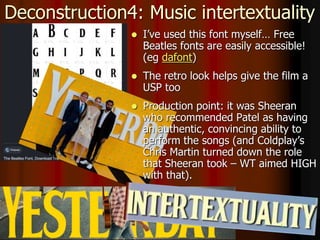
 I’ve used this font myself… Free
Beatles fonts are easily accessible!
(eg dafont)
 The retro look helps give the film a
USP too
 Production point: it was Sheeran
who recommended Patel as having
an authentic, convincing ability to
perform the songs (and Coldplay’s
Chris Martin turned down the role
that Sheeran took – WT aimed HIGH
with that).
Deconstruction4: Music intertextuality
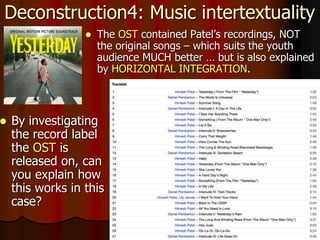
 The OST contained Patel’s recordings, NOT
the original songs – which suits the youth
audience MUCH better … but is also explained
by HORIZONTAL INTEGRATION.
 By investigating
the record label
the OST is
released on, can
you explain how
this works in this
case?
Deconstruction4: Music intertextuality
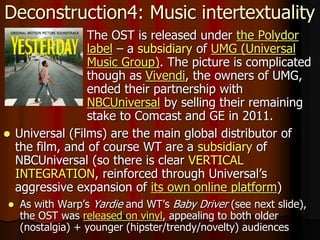
 The OST is released under the Polydor
label – a subsidiary of UMG (Universal
Music Group). The picture is complicated
though as Vivendi, the owners of UMG,
ended their partnership with
NBCUniversal by selling their remaining
stake to Comcast and GE in 2011.
 Universal (Films) are the main global distributor of
the film, and of course WT are a subsidiary of
NBCUniversal (so there is clear VERTICAL
INTEGRATION, reinforced through Universal’s
aggressive expansion of its own online platform)
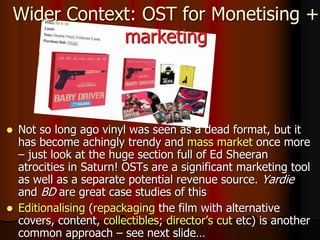
 As with Warp’s Yardie and WT’s Baby Driver (see next slide),
the OST was released on vinyl, appealing to both older
(nostalgia) + younger (hipster/trendy/novelty) audiences
 Not so long ago vinyl was seen as a dead format, but it
has become achingly trendy and mass market once more
– just look at the huge section full of Ed Sheeran
atrocities in Saturn! OSTs are a significant marketing tool
as well as a separate potential revenue source. Yardie
and BD are great case studies of this
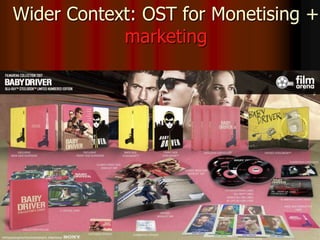
 Editionalising (repackaging the film with alternative
covers, content, collectibles; director’s cut etc) is another
common approach – see next slide…
Wider Context: OST for Monetising +
marketing
 d
Wider Context: OST for Monetising +
marketing
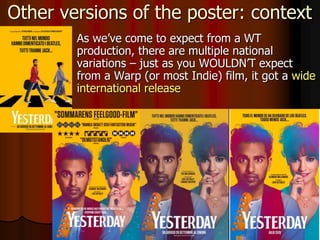
Other versions of the poster
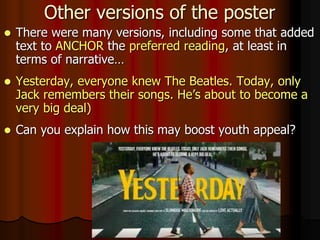
 There were many versions, including some that added
text to ANCHOR the preferred reading, at least in
terms of narrative…
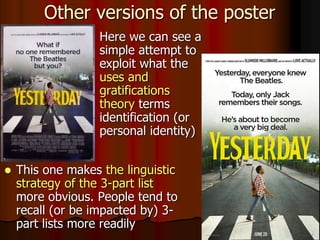
 Yesterday, everyone knew The Beatles. Today, only
Jack remembers their songs. He’s about to become a
very big deal)
 Can you explain how this may boost youth appeal?
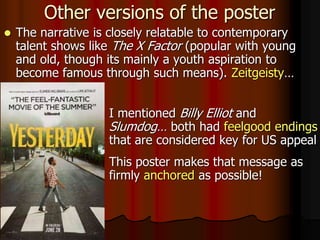
 I mentioned Billy Elliot and
Slumdog… both had feelgood endings
that are considered key for US appeal
 This poster makes that message as
firmly anchored as possible!
Other versions of the poster
 The narrative is closely relatable to contemporary
talent shows like The X Factor (popular with young
and old, though its mainly a youth aspiration to
become famous through such means). Zeitgeisty…
 This one makes the linguistic
strategy of the 3-part list
more obvious. People tend to
recall (or be impacted by) 3-
part lists more readily
Other versions of the poster
 Here we can see a
simple attempt to
exploit what the
uses and
gratifications
theory terms
identification (or
personal identity)
 This one makes the linguistic
strategy of the 3-part list
more obvious. People tend to
recall (or be impacted by) 3-
part lists more readily
Other versions of the poster
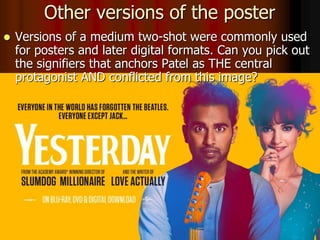
 Versions of a medium two-shot were commonly used
for posters and later digital formats. Can you pick out
the signifiers that anchors Patel as THE central
protagonist AND conflicted from this image?
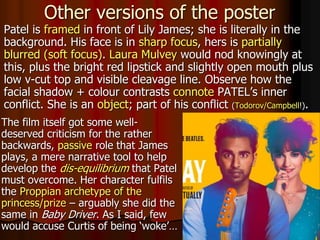
The film itself got some well-
deserved criticism for the rather
backwards, passive role that James
plays, a mere narrative tool to help
develop the dis-equilibrium that Patel
must overcome. Her character fulfils
the Proppian archetype of the
princess/prize – arguably she did the
same in Baby Driver. As I said, few
would accuse Curtis of being ‘woke’…
Other versions of the poster
Patel is framed in front of Lily James; she is literally in the
background. His face is in sharp focus, hers is partially
blurred (soft focus). Laura Mulvey would nod knowingly at
this, plus the bright red lipstick and slightly open mouth plus
low v-cut top and visible cleavage line. Observe how the
facial shadow + colour contrasts connote PATEL’s inner
conflict. She is an object; part of his conflict (Todorov/Campbell!).
 As we’ve come to expect from a WT
production, there are multiple national
variations – just as you WOULDN’T expect
from a Warp (or most Indie) film, it got a wide
international release
Other versions of the poster: context
Summary: write a GAPS analysis
You’ve been guided through a lot of details of one main
promo poster, plus insights into additional designs. You’ve
got a blog post (+ a v simple summary of some key facts on
the 1st slide!). Now put this together into a brief (2-4
paragraphs) summary of who the distributors (and the
production company that made key decisions that would
shape the marketing potential) sought to target. Who was
the target audience(s) for this film?
Use the GAPS idea to ensure you address basic elements of
audience.
Use key terms and theories
Never speculate - always make points backed up with clear
and specific evidence.
You can present this in Ppt or Word + use images + any
additional sources/evidence you like. It is always useful to
try to make links to other exam case studies.
Summary: write a GAPS analysis
While Yesterday can best be summed up as a rom-com, the marketing
sometimes steered clear of anchoring this preferred reading. The promo
poster that intertextualises The Beatles’ iconic Abbey Road album cover (a
meme that is so common, eg appearing twice in The Simpsons, that it can
safely be used as an example of Baudrillard’s simulacrum concept) does this.
Only Patel is pictured, centrally framed and applying the rule of thirds in a
long shot, which is crucial to highlight his clothing, and the specifically
acoustic guitar he has strapped to his back. The film’s use of Ed Sheeran
points to how the easy familiarity of an older audience with The Beatles’ songs
is kept appealing for a youth audience with a more zeitgeisty acoustic
performance by Patel himself. The pop success of Sheeran and Lewis Capaldi
reflect a strong youth market for such simplified, ‘authentic’ music. We can
see further signs of a four quadrant approach with the ploy of releasing the
OST on vinyl – featuring Patel’s performances; the $10m paid for film rights to
Beatles songs did not cover any OST! Vinyl is of course a nostalgic format for
older audiences and an ironically zeitgeisty, contemporary (‘hipster’) format
for youth too. Poster taglines challenging audiences to “imagine YOU…” woke
up like Patel also reflect an exploitation of what the uses and gratifications
model terms personal identification. This carries connotations of modern talent
shows like The X Factor – big, mainstream hits with young and old, even if it’s
the younger end that mainly aspire to achieving fame in such a manner.
Summary: write a GAPS analysis
In common with most Working Title productions, the age rating is kept low to
ensure at least the better potential for broad, even four quadrant, appeal (PG13 in
the US, BBFC 12 in the UK). Much of the younger audience wouldn’t follow the full
preferred reading of the Beatles font and Abbey Road intertextuality, so the main
tagline, written as a 3-part list to make it memorable, anchors this for them. A
second variant of the poster uses a more traditional rom-com format: a medium
two-shot of Patel and main love interest Lily James. Reflecting that the film itself
would easily fall foul of Laura Mulvey’s feminist ‘male gaze’ critique, James is
clearly positioned as secondary and passive, her role being that of the Proppian
princess/prize archetype. She is positioned behind Patel, is slightly out of focus (or
soft focus) compared to Patel – who has distinct shadow over one side of his face
and a clear colour contrast to connote his inner conflict. She is a mere part of this
conflict, not the ‘hero’ whose ‘journey’ we shall follow, to employ Campbell’s
monomyth. She is a secondary dis-equilibrium for Patel to resolve! Her slightly
open mouth, bright red lipstick and distinct cleavage line with a v-cut top all
further reinforce the visual element of Mulvey’s critique of female objectification.
It is also important to note that while this may seem to indicate a male audience
(identification!) focus, Patel is slim and carries sex appeal, and James’s glamour
and romantic role can carry identification and aspiration for females. Screenplay
writer Richard Curtis (working again for WT) pulled a similar trick with About Time
– which in the #metoo age looks very creepy indeed – using sci-fi style hybridity
to sell a rom-com to a male audience.
Summary: write a GAPS analysis
Overall, while there are clear elements of a four quadrant strategy at play, the
focus on the youthful Patel (and a similarly youthful James), the contemporary
styling of his Beatles cover versions, the age rating and small but smart signifiers
like his Van sneakers all point towards a slight emphasis on the younger end of
the market as the primary target audience. There are clear advantages for an
older audience in easily recognising the Beatles signifiers. Likewise we can more
likely assume familiarity with 2003’s Love Actually (Curtis’ smash hit rom-com) and
2009’s Slumdog Millionaire (Danny Boyle’s Oscar-winning social realist film used a
feelgood ending, just like WT2’s Billy Elliot, to gain unlikely US success – not
coincidentally showing that a movie led by an Asian actor can be a hit). Both films
are highlighted in the ‘from the…’ poster text used across all variants and the
teaser. Nonetheless, it’s a smart production from WT, exemplified by the use of Ed
Sheeran, a global pop megastar who appeals across the age range using precisely
the style of music Patel does, highlighted by the acoustic slung over his back. If
WT had succeeded with their original attempt to cast Coldplay’s Chris Martin in
this key role it may have rendered the film an easier sell to a more adult audience!

Yesterday

  • 1.
    WT Case Studies Dir.Danny Boyle (2019) Rom-com, screenplay: Richard Curtis. Ed Sheeran featured in trailer $26m budget, $10m on song rights, $75m marketing $153m b.o. (Universal: US$73m, UK $18m, China $158k) + $80m home media by May 2020 PG13, BBFC 12; unexpected summer hols release Try the crossword for revision!
  • 2.
    Stuart Hall’s theoryof readings  Hall argued that semiotics is flawed; it ignores how different audiences read the same text, so as well as the preferred reading (how the creators hope we respond through their use of media language), he also coined the terms contested (aka negotiated) and oppositional reading  Lets see how far YOU can follow the preferred reading of the poster…
  • 3.
    Decoding distributor’s preferred reading> target audience/s Taking 4 themes/elements of: text (from…; title); release date; protagonist (incl. m-en-s); music intertextuality see how many SIGNIFIERS you can identify. Use these to write up a short GAPS analysis. Try to use specific terms/theories
  • 4.
    Some useful terms+ hints Commercial writer/film-maker; credible/acclaimed director; genre, hybridity; assumed knowledge – film names only; Oscar bounce, award-winning; upper case; font, size, colour; anchorage; 3-part list (on tagline versions); A-list (absent) Release strategy; summer blockbuster; counter-programming; wide release; moved up Protagonist – Proppian archetype of…; framing; clothing (mise- en-scene), props, hair, body language, Campbell’s hero’s journey (monomyth), Todorov, narrative enigma, (lack of?) binary opposition), Intertextuality; postmodernism; preferred (etc) reading + polysemy; Ed Sheeran/Lewis Capaldi – zeitgeist; nostalgia (Simon Reynolds’ Retromania); (fe)male gaze?; BAME (ethnicity) GENERAL: signifier, signified, signifies, connote, connotation, denote, anchor, polysemy/ic, Hall’s readings, framing + mise- en-scene, retro/nostalgia, hybridity, U+G, Dyer’s star system
  • 5.
    Deconstruction1: (text) From… Clever: name-dropping massive hit movies but not the names – the older end of the ‘youth’ 15-34 audience will likely know its Danny Boyle (SM 2009) + Richard Curtis (LA 2003), but more so the older audience. DB has no WT history, but RC is behind many of WT’s iconic rom-com hits. Arguably the company was built on his films. LA was his debut directing too.  His narrow focus on white, middle/upper- class S. English gets a slight tweak here. See the savage Curtisland animation…
  • 6.
    Deconstruction1: Curtisland (Wiki) All of these are WT productions bar which 2?
  • 7.
    Deconstruction1: Smiles +drama  All of these are WT productions bar which 2?  ANSWER: Mamma Mia and War Horse  They obviously picked out hits for both, but while LA is a rom-com, SM was an unexpected ‘breakout’ hit fuelled with an ‘Oscar bounce’ … and, like Billy Elliot, WT2’s biggest hit, sugared the social realist elements with a feelgood ending that’s especially crucial for the US audience (reflects the concept of the American dream, the little guy can make good with hard work)  SM also centres on an Asian protagonist, still not an easy sell to mass American/European audiences, so its clever to remind viewers of that film…
  • 8.
    QUICK MEMORY TEST I mentioned a key writer/director + his WT films; can you solve these anagrams of his name + films? Only WT rom-coms included!  Debating Joyriders  Hard Cirrus Tic  Mutate Bio  Attacked Herb Tooth  Lacy Veal Lout  Hinting Toll  A Granddads Funnier Woeful Want to make your own for some peer revision? Use sites like https://wordsmith.org/ (google free anagram generator)
  • 9.
    QUICK MEMORY TEST I mentioned a key writer/director + his WT films; can you solve these anagrams of his name + films? Only WT rom-coms included!  Debating Joyriders  Hard Cirrus Tic  Mutate Bio  Attacked Herb Tooth  Lacy Veal Lout  Hinting Toll  A Granddads Funnier Woeful  (Bridget Jones’ Diary)  (Richard Curtis)  (About Time)  (The Boat That Rocked)  (Love Actually)  (Notting Hill)  (Four Weddings and a Funeral)
  • 10.
    SUMMING UP  Letssee just how significant Curtis is for WT. Ignoring the non-rom-coms, do a rough calculation of the GLOBAL box office for these films he wrote +/or directed (W/D) for WT. Always round off to $1m. Most of these were low/medium budget, averaging around $15m I googled + used this for most; BJD.  Four Weddings and a Funeral (1994 W)  Notting Hill (1999 W)  Bridget Jones’ Diary (2001 W)  Love Actually (2003 W + D)  Bridget Jones Edge of Reason (2004 W)  The Boat That Rocked (2009 W +D)  About Time (2013 W + D)  Yesterday (2019 W)
  • 11.
    SUMMING UP  HisWT rom-coms alone are worth a combined $1,679m ($1.7bn). WOW! That’s from just 8 British movies averaging around $15-20m for budget. When you add on Trash and others for WT he’s linked to over TWO BILLION box office for them alone (ignoring non-WT films like Mamma Mia etc!)  Four Weddings and a Funeral (1994 W)  Notting Hill (1999 W)  Bridget Jones’ Diary (2001 W)  Love Actually (2003 W + D)  Bridget Jones Edge of Reason (2004 W)  The Boat That Rocked (2009 W +D)  About Time (2013 W + D)  Yesterday (2019 W)  $243m  $364m  $282m  $248m  $265m  $36m  $88m  $153m
  • 12.
    CURTIS FLOP  Histrack record is extraordinary – NOT in an artistic (arthouse, critical acclaim) sense, but in commercial terms. There’s a solid template to most of these: British setting + main cast BUT one+ main US actor (usually female). Characters are white, middle to upper class, Southern English.  The Boat That Rocked was simply too culturally British – American and wider audiences couldn’t relate to/weren’t aware of the 1960s UK history of pirate radio ships. It had to be renamed Pirate Radio for the USA (like Grimsby became The Brothers Grimsby). It had a US star, but Phillip Seymour Hoffman was a character actor, NOT an A-list, glamorous lead star like Julia Roberts or Rene Zellweger.
  • 13.
     Basic denotation:centrally framed, rule of thirds long shot. The LS enables a full view of his everyman clothing: NOT skin-tight (too youth) faded blue jeans; Van(?) trainers are a nod to youth; the cliché of the checked shirt as connoting working class, backed up by the non-designer stubble (boybands avoid this for tweens) Deconstruction2: Central protagonist  The guitar placement is key too: he’s a serious musician. Its acoustic, so its not hard rock which be off-putting for a female and younger audience who’ve helped make stars of the likes of Ed Sheeran + Lewis Capaldi > zeitgeisty (ironically)?  He’s striding purposefully … a Media student should be thinking of Campbell’s hero’s journey/monomyth
  • 14.
     He’s nota kid, but still vaguely ‘youthful’  Despite the rom-com plotline and genre, notwithstanding the hybridity, the female love interest (the love triangle plot was dumped, and a full character with it, after negative test audience feedback) is simply absent. Curtis is not known as a ‘woke’ writer to say the least… Deconstruction2: Central protagonist  There is an element of female gaze (adapting Mulvey’s feminist concept) he’s slim, confident, arty… but the clothing renders him not unattainable  The poster is focused on trying to balance gender appeal though, thus underplaying the rom-com element (LA is not iconic for stereotypical hetero males!); which THEORY explains MALE appeal?
  • 15.
     The USESAND GRATIFICATIONS THEORY (PIES) helps explain this. Younger (adolescent) males can aspire to be like him, adult (including older males with nostalgia) males can IDENTIFY with him Deconstruction2: Central protagonist  Richard Dyer’s theory of THE STAR SYSTEM argues that the film industry organises production and marketing around star images. The $26m budget, $10m of which was for song rights, makes the usual WT strategy of casting a major US star for global marketing difficult. The female co-stars are better known (but not highlighted!), undermining this idea. He’s NOT BILLED!  Lily James (British) co-starred in WT’s Baby Driver and Darkest Hour, plus Mamma Mia! American Kate McKinnon is known from Saturday Night Live + movies like the Ghostbusters reboot. The male gaze they would offer would be offset by a too-strong focus on rom-com
  • 16.
    Deconstruction3: Release date The distribution of Indie productions doesn’t cease over the summer, but, as with Easter and Xmas, they are mostly crowded out by the big 5’s tentpole releases.  With adolescents on school holidays, these (along with Halloween) are the biggest periods for box office, so the studios hold back their very biggest films for these periods (like Xmas, home of the latest Star Wars release). Some distributors attempt counter- programming, putting up serious low budget drama  Yesterday was intended for a low-key September release, but got bumped up to the lucrative summer period, and a hefty $75m spent on marketing the $26m production! Can you explain WHY?
  • 17.
    Deconstruction4: Music intertextuality The answer is linked to the 4th theme! Having paid a whopping $10m for the rights to using songs by The Beatles, it turned out that the rights-holder was due to change by September. Paul McCartney was due to take back the rights to the songs he had co-written, opening Universal up to expensive lawsuits, so they pushed up the release date.  The poster is a simulacrum (Baudrillard’s postmodern concept argues that we think in signifiers; nothing is original; there is no ultimate truth, just an endless sea of signifiers – if that’s too complex, stick with INTERTEXTUALITY) of the … well, you tell me, which Beatles album sleeve?!
  • 18.
    Deconstruction4: Music intertextuality This album sleeve has been and continues to be widely mimicked (intertextuality or simulacrum!)  Almost everyone over 35 would recognise it – but perhaps not many of the younger audience?  You’ll see how more text-heavy versions of the poster emphasized the plot-line, but remember the point on how the lone male lead carries connotations of the contemporary zeitgeisty acoustic music stars like Ed Sheeran and Lewis Capaldi – reinforced by Sheeran’s substantial role in the film/trailer!
  • 19.
    Deconstruction4: Music intertextuality I’ve used this font myself… Free Beatles fonts are easily accessible! (eg dafont)  The retro look helps give the film a USP too  Production point: it was Sheeran who recommended Patel as having an authentic, convincing ability to perform the songs (and Coldplay’s Chris Martin turned down the role that Sheeran took – WT aimed HIGH with that).
  • 20.
    Deconstruction4: Music intertextuality The OST contained Patel’s recordings, NOT the original songs – which suits the youth audience MUCH better … but is also explained by HORIZONTAL INTEGRATION.  By investigating the record label the OST is released on, can you explain how this works in this case?
  • 21.
    Deconstruction4: Music intertextuality The OST is released under the Polydor label – a subsidiary of UMG (Universal Music Group). The picture is complicated though as Vivendi, the owners of UMG, ended their partnership with NBCUniversal by selling their remaining stake to Comcast and GE in 2011.  Universal (Films) are the main global distributor of the film, and of course WT are a subsidiary of NBCUniversal (so there is clear VERTICAL INTEGRATION, reinforced through Universal’s aggressive expansion of its own online platform)  As with Warp’s Yardie and WT’s Baby Driver (see next slide), the OST was released on vinyl, appealing to both older (nostalgia) + younger (hipster/trendy/novelty) audiences
  • 22.
     Not solong ago vinyl was seen as a dead format, but it has become achingly trendy and mass market once more – just look at the huge section full of Ed Sheeran atrocities in Saturn! OSTs are a significant marketing tool as well as a separate potential revenue source. Yardie and BD are great case studies of this  Editionalising (repackaging the film with alternative covers, content, collectibles; director’s cut etc) is another common approach – see next slide… Wider Context: OST for Monetising + marketing
  • 23.
     d Wider Context:OST for Monetising + marketing
  • 24.
    Other versions ofthe poster  There were many versions, including some that added text to ANCHOR the preferred reading, at least in terms of narrative…  Yesterday, everyone knew The Beatles. Today, only Jack remembers their songs. He’s about to become a very big deal)  Can you explain how this may boost youth appeal?
  • 25.
     I mentionedBilly Elliot and Slumdog… both had feelgood endings that are considered key for US appeal  This poster makes that message as firmly anchored as possible! Other versions of the poster  The narrative is closely relatable to contemporary talent shows like The X Factor (popular with young and old, though its mainly a youth aspiration to become famous through such means). Zeitgeisty…
  • 26.
     This onemakes the linguistic strategy of the 3-part list more obvious. People tend to recall (or be impacted by) 3- part lists more readily Other versions of the poster  Here we can see a simple attempt to exploit what the uses and gratifications theory terms identification (or personal identity)
  • 27.
     This onemakes the linguistic strategy of the 3-part list more obvious. People tend to recall (or be impacted by) 3- part lists more readily Other versions of the poster  Versions of a medium two-shot were commonly used for posters and later digital formats. Can you pick out the signifiers that anchors Patel as THE central protagonist AND conflicted from this image?
  • 28.
    The film itselfgot some well- deserved criticism for the rather backwards, passive role that James plays, a mere narrative tool to help develop the dis-equilibrium that Patel must overcome. Her character fulfils the Proppian archetype of the princess/prize – arguably she did the same in Baby Driver. As I said, few would accuse Curtis of being ‘woke’… Other versions of the poster Patel is framed in front of Lily James; she is literally in the background. His face is in sharp focus, hers is partially blurred (soft focus). Laura Mulvey would nod knowingly at this, plus the bright red lipstick and slightly open mouth plus low v-cut top and visible cleavage line. Observe how the facial shadow + colour contrasts connote PATEL’s inner conflict. She is an object; part of his conflict (Todorov/Campbell!).
  • 29.
     As we’vecome to expect from a WT production, there are multiple national variations – just as you WOULDN’T expect from a Warp (or most Indie) film, it got a wide international release Other versions of the poster: context
  • 30.
    Summary: write aGAPS analysis You’ve been guided through a lot of details of one main promo poster, plus insights into additional designs. You’ve got a blog post (+ a v simple summary of some key facts on the 1st slide!). Now put this together into a brief (2-4 paragraphs) summary of who the distributors (and the production company that made key decisions that would shape the marketing potential) sought to target. Who was the target audience(s) for this film? Use the GAPS idea to ensure you address basic elements of audience. Use key terms and theories Never speculate - always make points backed up with clear and specific evidence. You can present this in Ppt or Word + use images + any additional sources/evidence you like. It is always useful to try to make links to other exam case studies.
  • 31.
    Summary: write aGAPS analysis While Yesterday can best be summed up as a rom-com, the marketing sometimes steered clear of anchoring this preferred reading. The promo poster that intertextualises The Beatles’ iconic Abbey Road album cover (a meme that is so common, eg appearing twice in The Simpsons, that it can safely be used as an example of Baudrillard’s simulacrum concept) does this. Only Patel is pictured, centrally framed and applying the rule of thirds in a long shot, which is crucial to highlight his clothing, and the specifically acoustic guitar he has strapped to his back. The film’s use of Ed Sheeran points to how the easy familiarity of an older audience with The Beatles’ songs is kept appealing for a youth audience with a more zeitgeisty acoustic performance by Patel himself. The pop success of Sheeran and Lewis Capaldi reflect a strong youth market for such simplified, ‘authentic’ music. We can see further signs of a four quadrant approach with the ploy of releasing the OST on vinyl – featuring Patel’s performances; the $10m paid for film rights to Beatles songs did not cover any OST! Vinyl is of course a nostalgic format for older audiences and an ironically zeitgeisty, contemporary (‘hipster’) format for youth too. Poster taglines challenging audiences to “imagine YOU…” woke up like Patel also reflect an exploitation of what the uses and gratifications model terms personal identification. This carries connotations of modern talent shows like The X Factor – big, mainstream hits with young and old, even if it’s the younger end that mainly aspire to achieving fame in such a manner.
  • 32.
    Summary: write aGAPS analysis In common with most Working Title productions, the age rating is kept low to ensure at least the better potential for broad, even four quadrant, appeal (PG13 in the US, BBFC 12 in the UK). Much of the younger audience wouldn’t follow the full preferred reading of the Beatles font and Abbey Road intertextuality, so the main tagline, written as a 3-part list to make it memorable, anchors this for them. A second variant of the poster uses a more traditional rom-com format: a medium two-shot of Patel and main love interest Lily James. Reflecting that the film itself would easily fall foul of Laura Mulvey’s feminist ‘male gaze’ critique, James is clearly positioned as secondary and passive, her role being that of the Proppian princess/prize archetype. She is positioned behind Patel, is slightly out of focus (or soft focus) compared to Patel – who has distinct shadow over one side of his face and a clear colour contrast to connote his inner conflict. She is a mere part of this conflict, not the ‘hero’ whose ‘journey’ we shall follow, to employ Campbell’s monomyth. She is a secondary dis-equilibrium for Patel to resolve! Her slightly open mouth, bright red lipstick and distinct cleavage line with a v-cut top all further reinforce the visual element of Mulvey’s critique of female objectification. It is also important to note that while this may seem to indicate a male audience (identification!) focus, Patel is slim and carries sex appeal, and James’s glamour and romantic role can carry identification and aspiration for females. Screenplay writer Richard Curtis (working again for WT) pulled a similar trick with About Time – which in the #metoo age looks very creepy indeed – using sci-fi style hybridity to sell a rom-com to a male audience.
  • 33.
    Summary: write aGAPS analysis Overall, while there are clear elements of a four quadrant strategy at play, the focus on the youthful Patel (and a similarly youthful James), the contemporary styling of his Beatles cover versions, the age rating and small but smart signifiers like his Van sneakers all point towards a slight emphasis on the younger end of the market as the primary target audience. There are clear advantages for an older audience in easily recognising the Beatles signifiers. Likewise we can more likely assume familiarity with 2003’s Love Actually (Curtis’ smash hit rom-com) and 2009’s Slumdog Millionaire (Danny Boyle’s Oscar-winning social realist film used a feelgood ending, just like WT2’s Billy Elliot, to gain unlikely US success – not coincidentally showing that a movie led by an Asian actor can be a hit). Both films are highlighted in the ‘from the…’ poster text used across all variants and the teaser. Nonetheless, it’s a smart production from WT, exemplified by the use of Ed Sheeran, a global pop megastar who appeals across the age range using precisely the style of music Patel does, highlighted by the acoustic slung over his back. If WT had succeeded with their original attempt to cast Coldplay’s Chris Martin in this key role it may have rendered the film an easier sell to a more adult audience!