1
FACTFILE:
GCSE
GOVERNMENT & POLITICS
Agreement Grid for Northern Ireland Politics
There are four agreements which have been made to create a stable and peaceful Northern Ireland. These are
as follows:
•	 	 The Good Friday Agreement 1998 was the result of a prolonged peace process involving the British and
Irish governments, the Ulster Unionist Party, the Social Democratic and Labour Party, Sinn Féin and the
Alliance Party. The Democratic Unionist Party did not take part. The Good Friday Agreement established
the power-sharing system of government for Northern Ireland.
•	 	 The St Andrews Agreement 2007 was brought about as a result of the suspension of the power-sharing
Executive and Assembly between 2002 and 2007. This agreement saw the DUP and Sinn Féin take centre
stage as the two biggest parties and some of the features in this agreement reflect this.
•	 	 The Hillsborough Castle Agreement 2010 was set up to transfer more powers to Northern Ireland and was
a sign of confidence in how well power sharing was operating at this time.
•	 	 The Stormont House Agreement 2014 was the result of another difficult political stalemate centring on
disagreements between the DUP and Sinn Féin over the implementation of a welfare reform package
and the failure to deal effectively with legacy issues or ‘dealing with the past ‘ issues.
The most detailed is the original agreement, the 1998 Good Friday Agreement. The other three have all
added to the arrangements for the development of power sharing in Northern Ireland and are designed to
iron out any issues which may have caused problems between the two main sides of the community. There
is no need to know lots of detail about the background to each agreement but having some knowledge of
why there were later agreements can help to explain their key features.
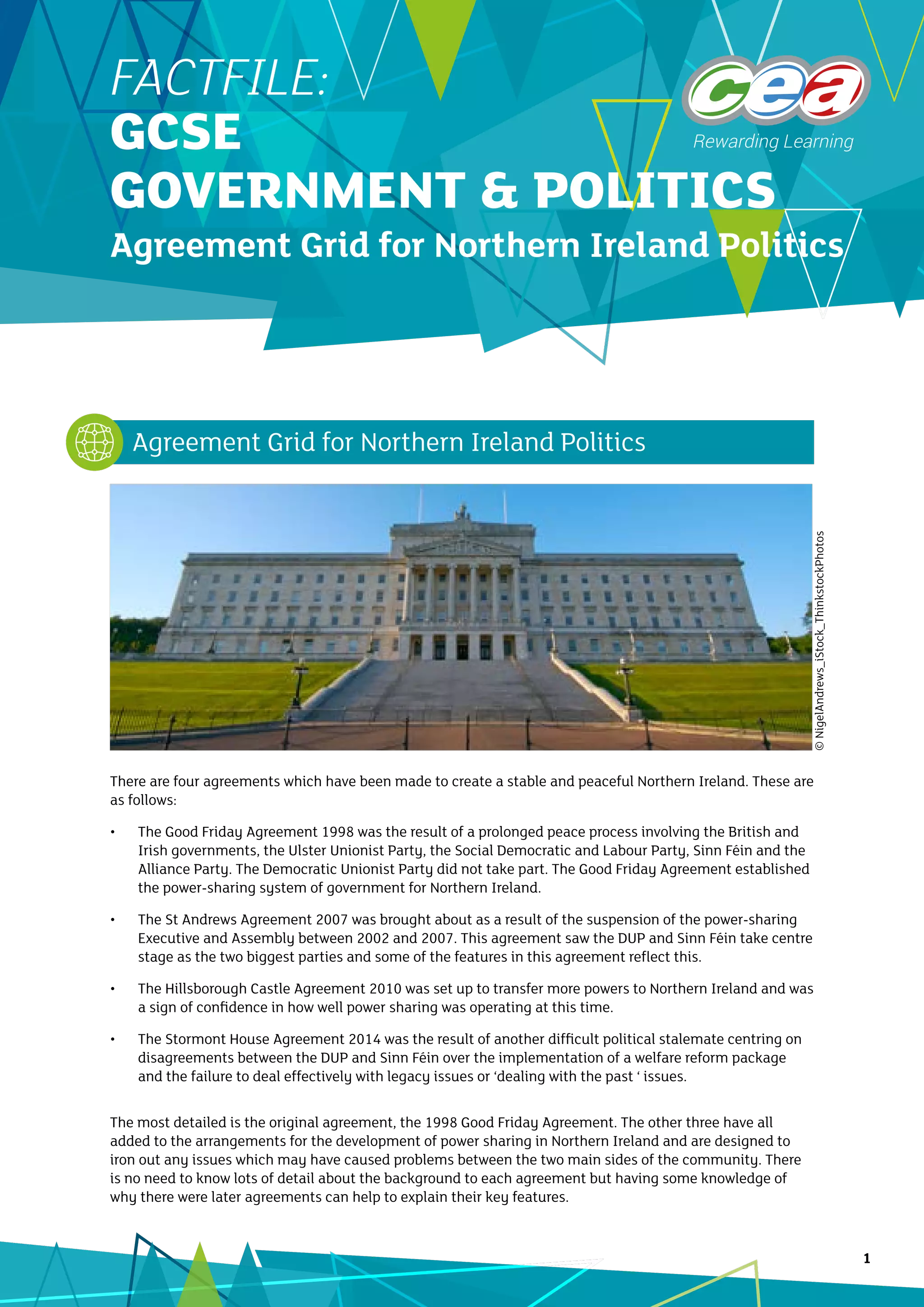
Agreement Grid for Northern Ireland Politics
©
NigelAndrews_iStock_ThinkstockPhotos
FACTFILE: GCE HISTORY OF ART / ARCHITECTURE
FACTFILE:GCSE GOVERNMENT  POLITICS / UNIT 2
© CCEA 2018
The following grid is a summary of the main features of each of the agreements.
The Good Friday Agreement
•	 Set up a local parliament elected by PR-STV and
with 108 members (this is now reduced to 90).
•	 An Executive Committee to act as the
government. It would have to involve power
sharing between Unionist and Nationalist
parties.
•	 A First Minister and deputy First Minister to
head the Executive Committee.
•	 Some matters remained under the control of
Westminster, e.g. foreign affairs.
•	 Cross-community agreement for difficult or
controversial decisions.
•	 Reform of policing, early release of prisoners
and decommissioning of paramilitaries.
The St Andrews Agreement
•	 New Ministerial Code introduced.
•	 Ministers must sign up to supporting police and
rule of law.
•	 Plans for the reintegration of prisoners
including provision for on-the-runs (was not
public at the time).
•	 Plans for the implementation of an Irish
Language Act.
•	 Review of parades policy with the hope that the
Parades Commission could be disbanded.
•	 Ministerial solo runs made more difficult.
•	 First Minister and deputy First Minister given
more power.
The Hillsborough Castle Agreement
•	 Transfer of policing and justice powers to
Northern Ireland.
•	 Chief Constable put in charge of the police
force.
•	 A working group set up to try to deal with
parades (6 members, 3 DUP and 3 SF).
•	 First Minister and deputy First Minister asked
to identify any areas not yet implemented from
the St Andrews Agreement and draw up a plan
to get that work finished.
The Stormont House Agreement
•	 Implementation of austerity measures to
Northern Ireland.
•	 Agreement to reduce the number of MLAs from
108 to 90.
•	 The number of Executive departments to be
reduced to 9.
•	 The provision that parties who did not want to
be in the power-sharing Executive could set up
an official opposition.
•	 £500 million given to promote shared and
integrated education.

Agreement grid for ni parties

  • 1.
    1 FACTFILE: GCSE GOVERNMENT & POLITICS AgreementGrid for Northern Ireland Politics There are four agreements which have been made to create a stable and peaceful Northern Ireland. These are as follows: • The Good Friday Agreement 1998 was the result of a prolonged peace process involving the British and Irish governments, the Ulster Unionist Party, the Social Democratic and Labour Party, Sinn Féin and the Alliance Party. The Democratic Unionist Party did not take part. The Good Friday Agreement established the power-sharing system of government for Northern Ireland. • The St Andrews Agreement 2007 was brought about as a result of the suspension of the power-sharing Executive and Assembly between 2002 and 2007. This agreement saw the DUP and Sinn Féin take centre stage as the two biggest parties and some of the features in this agreement reflect this. • The Hillsborough Castle Agreement 2010 was set up to transfer more powers to Northern Ireland and was a sign of confidence in how well power sharing was operating at this time. • The Stormont House Agreement 2014 was the result of another difficult political stalemate centring on disagreements between the DUP and Sinn Féin over the implementation of a welfare reform package and the failure to deal effectively with legacy issues or ‘dealing with the past ‘ issues. The most detailed is the original agreement, the 1998 Good Friday Agreement. The other three have all added to the arrangements for the development of power sharing in Northern Ireland and are designed to iron out any issues which may have caused problems between the two main sides of the community. There is no need to know lots of detail about the background to each agreement but having some knowledge of why there were later agreements can help to explain their key features. Agreement Grid for Northern Ireland Politics © NigelAndrews_iStock_ThinkstockPhotos
  • 2.
    FACTFILE: GCE HISTORYOF ART / ARCHITECTURE FACTFILE:GCSE GOVERNMENT POLITICS / UNIT 2 © CCEA 2018 The following grid is a summary of the main features of each of the agreements. The Good Friday Agreement • Set up a local parliament elected by PR-STV and with 108 members (this is now reduced to 90). • An Executive Committee to act as the government. It would have to involve power sharing between Unionist and Nationalist parties. • A First Minister and deputy First Minister to head the Executive Committee. • Some matters remained under the control of Westminster, e.g. foreign affairs. • Cross-community agreement for difficult or controversial decisions. • Reform of policing, early release of prisoners and decommissioning of paramilitaries. The St Andrews Agreement • New Ministerial Code introduced. • Ministers must sign up to supporting police and rule of law. • Plans for the reintegration of prisoners including provision for on-the-runs (was not public at the time). • Plans for the implementation of an Irish Language Act. • Review of parades policy with the hope that the Parades Commission could be disbanded. • Ministerial solo runs made more difficult. • First Minister and deputy First Minister given more power. The Hillsborough Castle Agreement • Transfer of policing and justice powers to Northern Ireland. • Chief Constable put in charge of the police force. • A working group set up to try to deal with parades (6 members, 3 DUP and 3 SF). • First Minister and deputy First Minister asked to identify any areas not yet implemented from the St Andrews Agreement and draw up a plan to get that work finished. The Stormont House Agreement • Implementation of austerity measures to Northern Ireland. • Agreement to reduce the number of MLAs from 108 to 90. • The number of Executive departments to be reduced to 9. • The provision that parties who did not want to be in the power-sharing Executive could set up an official opposition. • £500 million given to promote shared and integrated education.