1
FACTFILE:
GCSE
GOVERNMENT & POLITICS
The Equality Commission for Northern Ireland
The purpose of this Fact File is to give students an idea of what the Equality Commission was set up to do
and what it does currently. Students do not need to know any of the detailed information in the Fact File
and will not be expected or required to recall it in examinations. Students should know that the Equality
Commission was set up to safeguard the rights of Northern Ireland’s citizens and should know some of the
ways in which it can perform this role.
The Equality Commission was set up as part of the legislation which brought in the Good Friday Agreement
in 1998. It was set up by the Northern Ireland Act 1998 and first began to operate in September 1999. The
first Chief Commissioner was Joan Harbison. The role of the Equality Commission is to promote equality
and bring an end to discrimination in a range of specific areas. In the Good Friday Agreement the British
government promised to promote diversity and eliminate discrimination and Section 75 of the Act identified
nine characteristics which needed the protection of the law.
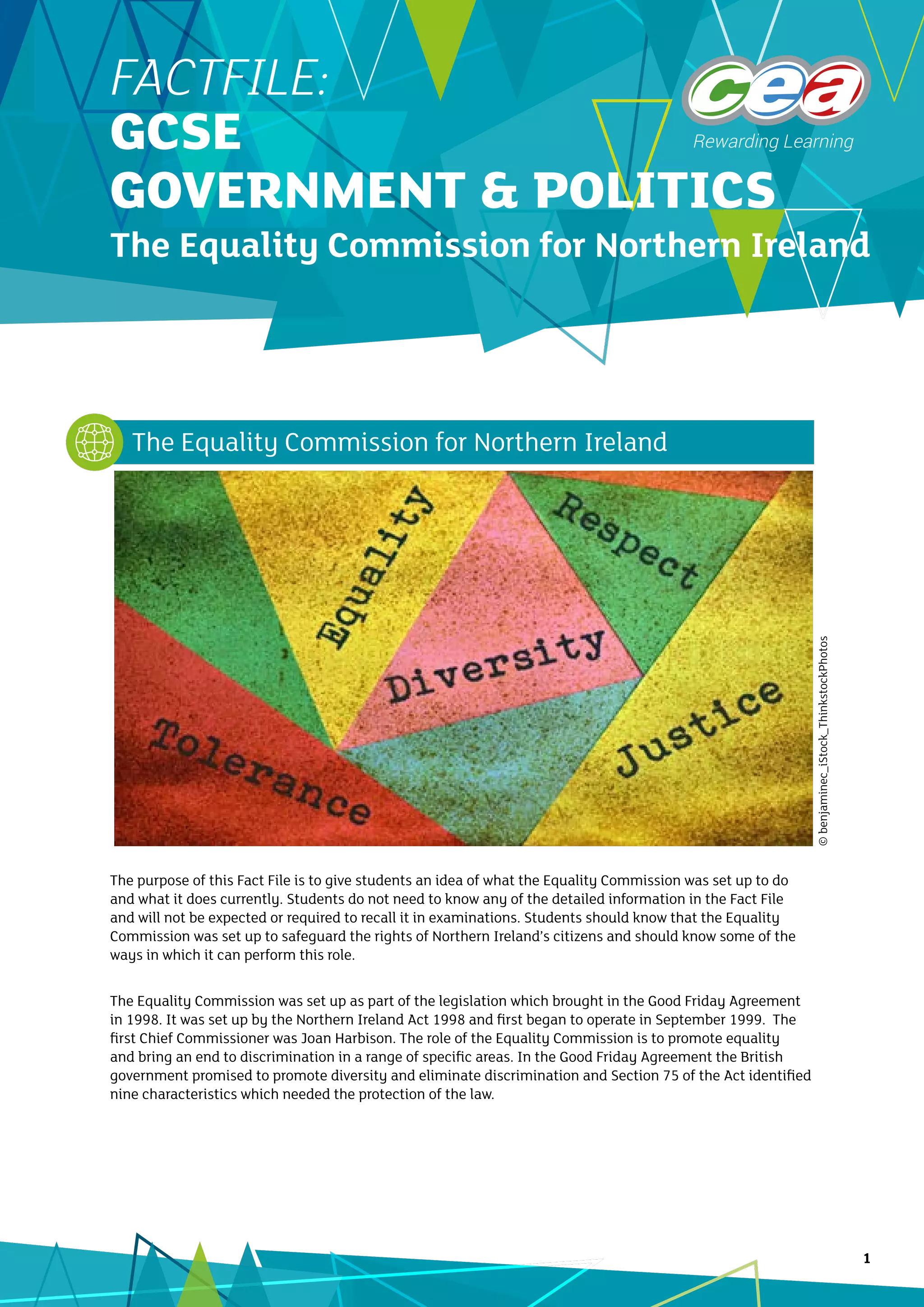
The Equality Commission for Northern Ireland
©
benjaminec_iStock_ThinkstockPhotos
FACTFILE: GCE HISTORY OF ART / ARCHITECTURE
FACTFILE:GCSE GOVERNMENT  POLITICS / UNIT 2
2
These nine protected characteristics are:
1.	Age
2.	Disability
3.	Sexual orientation
4.	Gender reassignment
5.	Marriage and civil partnership
6.	Pregnancy and maternity
7.	Race
8.	Religion or belief
9.	Sex
The Equality Commission and Public
Bodies
It is the duty of the Equality Commission to make
sure that public bodies promote equal opportunities
for everyone and to ensure that those who fall into
one of the nine protected characteristics are not
discriminated against. This is called mainstreaming
and its purpose is to put equality measures at the
heart of all new legislation and practices. To work
properly there needs to be a good relationship
between the Equality Commission and both
Local Councils and the Executive and Assembly.
Without a good relationship there is a risk that
Equality Commission recommendations might be
ignored. For example, the Equality Commission
recommended that there should be gender quotas
to encourage more women to join the police and
the Police Service ignored this.
In addition to the Equality Commission another
related body, the Northern Ireland Human Rights
Commission was also set up. This has a different
set of priorities and was primarily included to
increase confidence in the Good Friday Agreement.
It is the Human Rights Commission that would
play an active role in advising the Northern Ireland
Office (NIO) or the Executive on the construction of
a Bill of Rights for Northern Ireland.
The Equality Commission is based in Belfast but
its work is to cover all of Northern Ireland. It has
a Chief Commissioner and a number of assistant
commissioners who have a team of support staff
to help with research and administration. The
Commissioners are appointed by the Secretary of
State and the Northern Ireland Office. The Equality
Commission provides specialist advice to Ministers
on equality measures and anti-discrimination law.
The Equality Commission helps promote equality
by:
•	 	 Providing information and education on
equality issues.
•	 	 Giving people advice and help if they feel they
have been discriminated against.
•	 	 Carrying out research on relevant equality
issues which can be used to persuade Ministers
of the need for legislation.
•	 	 Using their powers of enquiry to make sure the
law is obeyed.
•	 	 Making sure statutory bodies take equality
matters seriously and consider them in their
work.
•	 	 Suggesting new legislation if appropriate.
How successful has it been?
The Equality Commission publishes a report each
year of what it has achieved. These reports are
available on their website and are a good way to see
how effective they are at promoting equality and
challenging inequality. The report is in the Annual
Review. As these are published documents they
must be accurate and we can therefore trust that
the information in them is statistically correct. The
2016-17 Annual review identifies four key target
areas for that year and breaks down how successful
the Commission was in achieving its aims.
Target 1 – Championing equality and good
relations
•	 	 560 media pieces on equality issues have been
issued by the Commission in 2016/17.
•	 	 The number of people visiting the website has
increased slightly by 3%.
•	 	 The Commission twitter account got 1,000 new
followers.
•	 	 Contributed to the Racial Equality Strategy.
•	 	 Identified that people in Northern Ireland have
less protection against discrimination and
harassment than citizens in the rest of the UK.
•	 	 Warned about the need to make sure that
leaving the EU did not reduce current levels
of protection for rights and did not lead to
worsening race relations or hate crime.
Target 2 – Challenging inequalities
•	 	 The Commission recommended that
there should be more effort to include a
consideration of the needs of Travellers and
FACTFILE: GCE HISTORY OF ART / ARCHITECTURE
FACTFILE:GCSE GOVERNMENT  POLITICS / UNIT 2
© CCEA 2018
minority ethnic groups in the work of the
Department of Communities and this has been
taken on board.
•	 	 Statements from the Commission on
inequalities in housing strategy and in
education have been developed and used to
help the Executive in developing its Programme
for Government.
•	 	 The Commission has worked hard to make sure
that local people benefit from the protection
given by international conventions such as the
United Nations Convention on the Rights of
People with Disabilities (UNCRPD).
Target 3 – Putting the law to work
•	 	 The Commission has:
-	 provided advice and training for employers
on how to comply with equality legislation at
110 training events.
-	 released the results of an investigation into
the treatment of pregnant workers called
the “Expecting Equality” investigation which
has been used by employers and employees
to help them understand their rights and
responsibilities.
-	 released the 26th monitoring report on fair
employment and this showed that there is
greater equality in the workforce. There was
also an increase in the number of people who
participated in this monitoring exercise.
-	 published a Mental Health Charter to help
guide employers on how to help employees
who have mental health issues.
-	 dealt with 3,454 inquiries from people
seeking assistance or advice. The majority
of these were questions about disability
discrimination (1,408). The next biggest
category was gender (941).
Target 4 – Delivering equality effectively and
efficiently
•	 	 Income for the Commission’s work was reduced
by 7.6% by the Executive in 2016/17.
•	 	 In 2016/17 the Commission trained 1,762
people on equality in the workplace.
•	 	 Helped 3,000 employers with free advice.
•	 	 Spoke to thousands of people at information
events in schools and workplaces.
•	 	 Helped give advice to 3,454 people and took 59
cases to tribunal or court.
For more information:
Webpage: www.equalityni.org
Twitter: @EqualityCommNI
Ezine: ezine@equalityni.org

Equality cmsn for ni

  • 1.
    1 FACTFILE: GCSE GOVERNMENT & POLITICS TheEquality Commission for Northern Ireland The purpose of this Fact File is to give students an idea of what the Equality Commission was set up to do and what it does currently. Students do not need to know any of the detailed information in the Fact File and will not be expected or required to recall it in examinations. Students should know that the Equality Commission was set up to safeguard the rights of Northern Ireland’s citizens and should know some of the ways in which it can perform this role. The Equality Commission was set up as part of the legislation which brought in the Good Friday Agreement in 1998. It was set up by the Northern Ireland Act 1998 and first began to operate in September 1999. The first Chief Commissioner was Joan Harbison. The role of the Equality Commission is to promote equality and bring an end to discrimination in a range of specific areas. In the Good Friday Agreement the British government promised to promote diversity and eliminate discrimination and Section 75 of the Act identified nine characteristics which needed the protection of the law. The Equality Commission for Northern Ireland © benjaminec_iStock_ThinkstockPhotos
  • 2.
    FACTFILE: GCE HISTORYOF ART / ARCHITECTURE FACTFILE:GCSE GOVERNMENT POLITICS / UNIT 2 2 These nine protected characteristics are: 1. Age 2. Disability 3. Sexual orientation 4. Gender reassignment 5. Marriage and civil partnership 6. Pregnancy and maternity 7. Race 8. Religion or belief 9. Sex The Equality Commission and Public Bodies It is the duty of the Equality Commission to make sure that public bodies promote equal opportunities for everyone and to ensure that those who fall into one of the nine protected characteristics are not discriminated against. This is called mainstreaming and its purpose is to put equality measures at the heart of all new legislation and practices. To work properly there needs to be a good relationship between the Equality Commission and both Local Councils and the Executive and Assembly. Without a good relationship there is a risk that Equality Commission recommendations might be ignored. For example, the Equality Commission recommended that there should be gender quotas to encourage more women to join the police and the Police Service ignored this. In addition to the Equality Commission another related body, the Northern Ireland Human Rights Commission was also set up. This has a different set of priorities and was primarily included to increase confidence in the Good Friday Agreement. It is the Human Rights Commission that would play an active role in advising the Northern Ireland Office (NIO) or the Executive on the construction of a Bill of Rights for Northern Ireland. The Equality Commission is based in Belfast but its work is to cover all of Northern Ireland. It has a Chief Commissioner and a number of assistant commissioners who have a team of support staff to help with research and administration. The Commissioners are appointed by the Secretary of State and the Northern Ireland Office. The Equality Commission provides specialist advice to Ministers on equality measures and anti-discrimination law. The Equality Commission helps promote equality by: • Providing information and education on equality issues. • Giving people advice and help if they feel they have been discriminated against. • Carrying out research on relevant equality issues which can be used to persuade Ministers of the need for legislation. • Using their powers of enquiry to make sure the law is obeyed. • Making sure statutory bodies take equality matters seriously and consider them in their work. • Suggesting new legislation if appropriate. How successful has it been? The Equality Commission publishes a report each year of what it has achieved. These reports are available on their website and are a good way to see how effective they are at promoting equality and challenging inequality. The report is in the Annual Review. As these are published documents they must be accurate and we can therefore trust that the information in them is statistically correct. The 2016-17 Annual review identifies four key target areas for that year and breaks down how successful the Commission was in achieving its aims. Target 1 – Championing equality and good relations • 560 media pieces on equality issues have been issued by the Commission in 2016/17. • The number of people visiting the website has increased slightly by 3%. • The Commission twitter account got 1,000 new followers. • Contributed to the Racial Equality Strategy. • Identified that people in Northern Ireland have less protection against discrimination and harassment than citizens in the rest of the UK. • Warned about the need to make sure that leaving the EU did not reduce current levels of protection for rights and did not lead to worsening race relations or hate crime. Target 2 – Challenging inequalities • The Commission recommended that there should be more effort to include a consideration of the needs of Travellers and
  • 3.
    FACTFILE: GCE HISTORYOF ART / ARCHITECTURE FACTFILE:GCSE GOVERNMENT POLITICS / UNIT 2 © CCEA 2018 minority ethnic groups in the work of the Department of Communities and this has been taken on board. • Statements from the Commission on inequalities in housing strategy and in education have been developed and used to help the Executive in developing its Programme for Government. • The Commission has worked hard to make sure that local people benefit from the protection given by international conventions such as the United Nations Convention on the Rights of People with Disabilities (UNCRPD). Target 3 – Putting the law to work • The Commission has: - provided advice and training for employers on how to comply with equality legislation at 110 training events. - released the results of an investigation into the treatment of pregnant workers called the “Expecting Equality” investigation which has been used by employers and employees to help them understand their rights and responsibilities. - released the 26th monitoring report on fair employment and this showed that there is greater equality in the workforce. There was also an increase in the number of people who participated in this monitoring exercise. - published a Mental Health Charter to help guide employers on how to help employees who have mental health issues. - dealt with 3,454 inquiries from people seeking assistance or advice. The majority of these were questions about disability discrimination (1,408). The next biggest category was gender (941). Target 4 – Delivering equality effectively and efficiently • Income for the Commission’s work was reduced by 7.6% by the Executive in 2016/17. • In 2016/17 the Commission trained 1,762 people on equality in the workplace. • Helped 3,000 employers with free advice. • Spoke to thousands of people at information events in schools and workplaces. • Helped give advice to 3,454 people and took 59 cases to tribunal or court. For more information: Webpage: www.equalityni.org Twitter: @EqualityCommNI Ezine: ezine@equalityni.org