Terra Incognita
 Exploring Content Strategy Land

            UX Romandie
         November 20th 2012

           Memi Beltrame
          @bratwurstkomet


            Liip - Agile Web Development
            liip.ch
Trust me
   I almost know
what I‘m talking about
Disclaimer
                  ☟
None of this is mine.
 All the important resources at the end of the presentation
Content: Status Quo
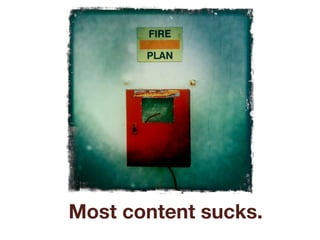
Most content sucks.
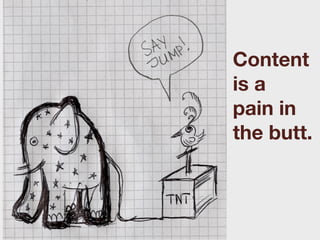
Content
is a
pain in
the butt.
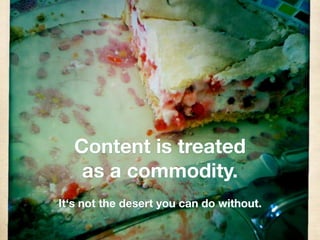
Content is treated
    as a commodity.
It‘s not the desert you can do without.
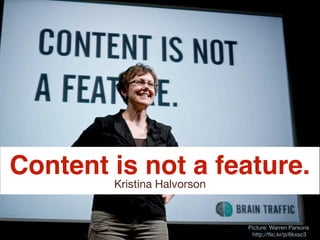
Content is not a feature.
        Kristina Halvorson


                             Picture: Warren Parsons
                              http://flic.kr/p/6kxsc3
Design without content is
      decoration.
         Jeffrey Zeldman
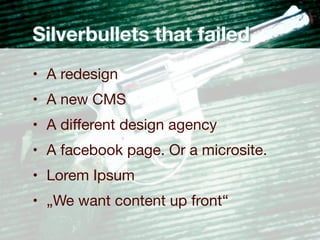
Silverbullets that failed
• A redesign
• A new CMS
• A different design agency
• A facebook page. Or a microsite.
• Lorem Ipsum
• „We want content up front“
H E NC E
Content
Strategy
The boring part that
 sounds like work
    starts here.
       Apologies.
To tackle the challenges of
 content we must have the
answer to a lot of questions.
Not just...

• How?
But...

• How?        • By Whom?
• Why?        • With what?
• What?       • Where?
• When?       • How often?
• For whom?   • What next?
Some definitions
Content Strategy guides
your plans for the creation,
 delivery, and governance
        of content.
Having a content strategy
 means using content to
 achieve business goals.
Content strategy is
change management.
What a strategist does
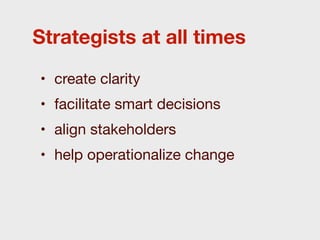
Strategists at all times
• create clarity
• facilitate smart decisions
• align stakeholders
• help operationalize change
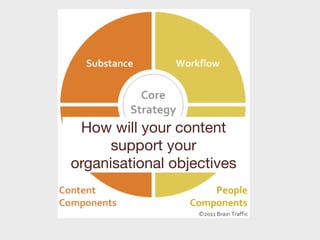
How will your content
      support your
organisational objectives
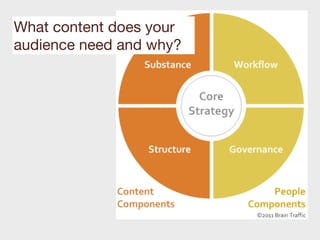
What content does your
audience need and why?
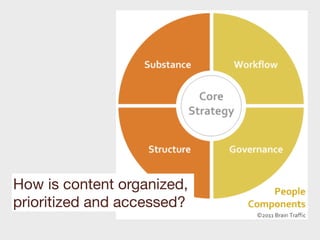
How is content organized,
prioritized and accessed?
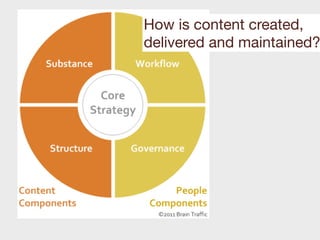
How is content created,
delivered and maintained?
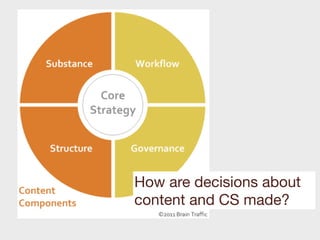
How are decisions about
content and CS made?
Factors of Influence
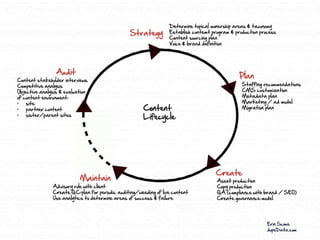
All the factors that impact the contents lifecycle.
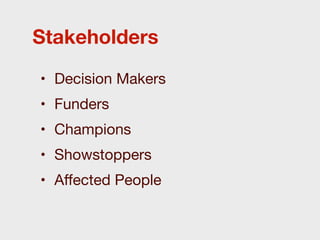
Stakeholders

• Decision Makers
• Funders
• Champions
• Showstoppers
• Affected People
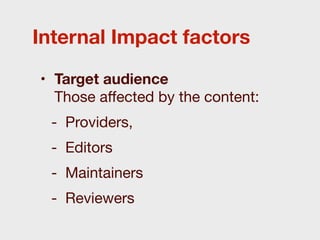
Internal Impact factors

• Target audience
  Those affected by the content:
 - Providers,
 - Editors
 - Maintainers
 - Reviewers
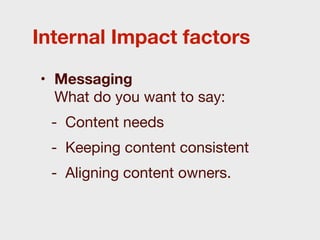
Internal Impact factors

• Messaging
  What do you want to say:
 - Content needs
 - Keeping content consistent
 - Aligning content owners.
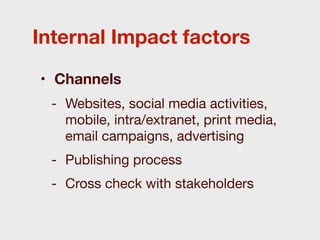
Internal Impact factors

• Channels
 - Websites, social media activities,
   mobile, intra/extranet, print media,
   email campaigns, advertising
 - Publishing process
 - Cross check with stakeholders
External Impact factors

• Users
 - User research
• Competitors
 - Competitor research
Strategy
Core Strategy
The long-term vision for all your
   content related initiatives
„We‘ll develop a state-of-the-art
  content infrastructure that
makes it easy for us to adapt to
 new device formats quickly.“
Achieve • Be • Do

• Achieve: What does your CS need
  to accomplish
• Be: What content product(s) will
  we create?
• Do: What will the company neet to
  do to support the effort?
Content Components
     Substance & Structure
Substance
   What content do you have?
What content do you need and why?
How do you get content that is

Compelling, useful, actionable
    credible, substantial,
influential, meaningful, lovable
Defining Substance
• Topics: The subjects that matter

• Purpose: Every piece of content
  needs to have a function.

• Voice and Tone:
  Watch you language, fuckers!

• Source: Where your content comes from.
Content Audit
An assessment of the state
and actionability of all
available content.
A Note of Warning
Content Audits
★ Assess all available content and
  define its state (Redundant,
  Outdated, Irrelevant)
★ Define what is to happen with the
  content until when
★ Help establish ownership &
  responsibility
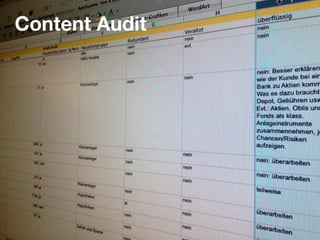
Content Audit
Content Audit

• Quantitative inventory:
  a list of all the content and its state.
 - ID, Title, URL, Format, Source,
   Technical Home, Metadata, Traffic/
   Usage Stats, Last update, Language
 - Roll your own: Choose other factors
   depending on your audit goal.
Content Audit

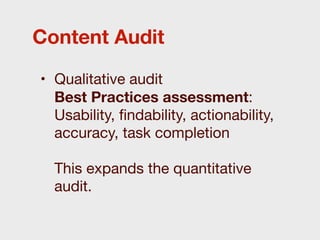
• Qualitative audit
  Best Practices assessment:
  Usability, findability, actionability,
  accuracy, task completion

  This expands the quantitative
  audit.
Content Audit

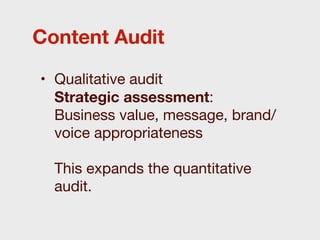
• Qualitative audit
  Strategic assessment:
  Business value, message, brand/
  voice appropriateness

  This expands the quantitative
  audit.
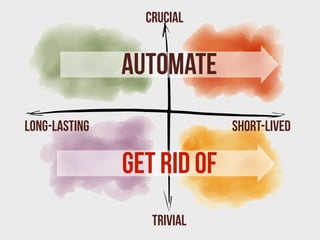
Crucial


               Automate
Long-Lasting                Short-lived

               Get Rid of
                  Trivial
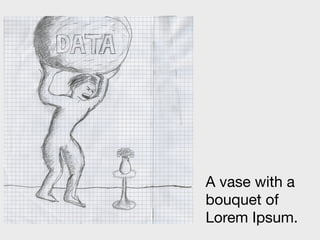
A vase with a
bouquet of
Lorem Ipsum.
Structure
How will your content be prioritized, organized
          formatted and displayed?
How do you get content that is

Reusable, related, shareable,
mobile, responsive, adaptive,
     contextual, orbital
Defining Structure
• Channels, platforms and formats

• Navigation and nomenclature:

• Links

• Microcopy

• Metadata and tagging
People Components
    Workflow & Governance
Workflow: Ownership
• Business units and individuals

• Need: Budget, time, understanding and
  approval to take care of content.
  The power to say NO.

• Roles: Web manager, content creator,
  reviewer/approver, SEO specialist, subject
  matter expert.
Workflow: Content
• Creating and sourcing content

 - Original content

 - curated/aggregated content

 - content migration.
Tools for content creation
• Editorial calendar
  A spreadsheet that captures content ideas and
  schedules current content for publishing.

• Content requirement checklist
  A checklist for preferred content attributes.
Tools for content creation
• Curation/aggregation checklist
  A checklist that helps to select, contract and
  publish third party content.

• Migration spreadsheet
  A spreadsheet that maps content from one
  channel, property or process to another.
Workflow: Content
• Maintaining content

 - Keeping it up to date

 - Keeping it relevant

 - Retiring it
Tools for maintainance
• Content inventory
  A spreadsheed to record and track all of your
  content.

• Content maintainance checklist
  A list of criteria used to evaluate and prioritize
  content for maintainance

• Content maintainance log
  A CMS report or spreadsheet to see dates for last
  update and next scheduled review.
Workflow: Content
• Evaluating content

 - Ongoing audit and analysis

 - Making sure content still meets user
   needs

 - making sure content helps fulfill
   business goals
Tools for evaluation
• Qualitative audit spreadsheet
  Extention of the content inventory

• Measurement scorecard
  A spreadsheet that helps stakeholders understand
  your measurement findings.

• Measurement history
  An ongoing record of your measurements.
Governance
• Authority and ownership policies
  Rules on who can decide what.
• Process an procedures
  How stuff gets done
• Content policies and guidelines
  Non-optional rules and sets of good
  practices
Tools for governance
• Styleguides
  Guidelines that make sure content is consistent
  and follows certain standards.

• Content planning & prioritization matrix
  Which content is done when in what order by
  whom.
Resources
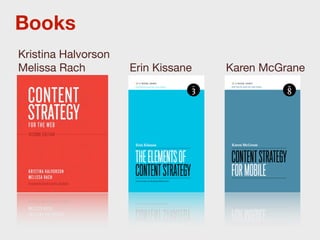
Books
Kristina Halvorson
Melissa Rach         Erin Kissane   Karen McGrane
Links
• Audit spreadsheets:
  http://www.kevinpnichols.com/enterprise_content_strategy/

• Audit Questionnaires:
  http://www.kevinpnichols.com/enterprise_content_strategy/

• Vimeo CS videos:
  http://liip.to/CS_videos
• Reader with Articles on CS:
  http://liip.to/CS_reader
• Contents magazine:
  http://contentsmagazine.com
People
• Kristina Halvorson @halvorson
• Melissa Rach @melissarach
• Erin Kissane @kissane
• Karen McGrane @karenmcgrane
• Rachel Lovinger @rlovinger
• Jeffrey MacIntyre @jeffmacintyre
• Sara Wachter Boettcher @sara_ann_marie
Questions?
MERCI!
I‘m @bratwurstkomet

Content Strategy

  • 1.
    Terra Incognita ExploringContent Strategy Land UX Romandie November 20th 2012 Memi Beltrame @bratwurstkomet Liip - Agile Web Development liip.ch
  • 2.
    Trust me I almost know what I‘m talking about
  • 3.
    Disclaimer ☟ None of this is mine. All the important resources at the end of the presentation
  • 4.
  • 5.
  • 6.
  • 7.
    Content is treated as a commodity. It‘s not the desert you can do without.
  • 8.
    Content is nota feature. Kristina Halvorson Picture: Warren Parsons http://flic.kr/p/6kxsc3
  • 9.
    Design without contentis decoration. Jeffrey Zeldman
  • 10.
    Silverbullets that failed •A redesign • A new CMS • A different design agency • A facebook page. Or a microsite. • Lorem Ipsum • „We want content up front“
  • 11.
    H E NCE Content Strategy
  • 12.
    The boring partthat sounds like work starts here. Apologies.
  • 14.
    To tackle thechallenges of content we must have the answer to a lot of questions.
  • 15.
  • 16.
    But... • How? • By Whom? • Why? • With what? • What? • Where? • When? • How often? • For whom? • What next?
  • 17.
  • 18.
    Content Strategy guides yourplans for the creation, delivery, and governance of content.
  • 19.
    Having a contentstrategy means using content to achieve business goals.
  • 20.
  • 21.
  • 22.
    Strategists at alltimes • create clarity • facilitate smart decisions • align stakeholders • help operationalize change

  • 23.
    How will yourcontent support your organisational objectives
  • 24.
    What content doesyour audience need and why?
  • 25.
    How is contentorganized, prioritized and accessed?
  • 26.
    How is contentcreated, delivered and maintained?
  • 27.
    How are decisionsabout content and CS made?
  • 28.
    Factors of Influence Allthe factors that impact the contents lifecycle.
  • 29.
    Stakeholders • Decision Makers •Funders • Champions • Showstoppers • Affected People
  • 30.
    Internal Impact factors •Target audience Those affected by the content: - Providers, - Editors - Maintainers - Reviewers
  • 31.
    Internal Impact factors •Messaging What do you want to say: - Content needs - Keeping content consistent - Aligning content owners.
  • 32.
    Internal Impact factors •Channels - Websites, social media activities, mobile, intra/extranet, print media, email campaigns, advertising - Publishing process - Cross check with stakeholders
  • 33.
    External Impact factors •Users - User research • Competitors - Competitor research
  • 34.
  • 35.
    Core Strategy The long-termvision for all your content related initiatives
  • 36.
    „We‘ll develop astate-of-the-art content infrastructure that makes it easy for us to adapt to new device formats quickly.“
  • 37.
    Achieve • Be• Do • Achieve: What does your CS need to accomplish • Be: What content product(s) will we create? • Do: What will the company neet to do to support the effort?
  • 38.
    Content Components Substance & Structure
  • 39.
    Substance What content do you have? What content do you need and why?
  • 40.
    How do youget content that is Compelling, useful, actionable credible, substantial, influential, meaningful, lovable
  • 41.
    Defining Substance • Topics:The subjects that matter • Purpose: Every piece of content needs to have a function. • Voice and Tone: Watch you language, fuckers! • Source: Where your content comes from.
  • 42.
    Content Audit An assessmentof the state and actionability of all available content.
  • 43.
    A Note ofWarning
  • 45.
    Content Audits ★ Assessall available content and define its state (Redundant, Outdated, Irrelevant) ★ Define what is to happen with the content until when ★ Help establish ownership & responsibility
  • 46.
  • 47.
    Content Audit • Quantitativeinventory: a list of all the content and its state. - ID, Title, URL, Format, Source, Technical Home, Metadata, Traffic/ Usage Stats, Last update, Language - Roll your own: Choose other factors depending on your audit goal.
  • 48.
    Content Audit • Qualitativeaudit Best Practices assessment: Usability, findability, actionability, accuracy, task completion This expands the quantitative audit.

  • 49.
    Content Audit • Qualitativeaudit Strategic assessment: Business value, message, brand/ voice appropriateness This expands the quantitative audit.
  • 50.
    Crucial Automate Long-Lasting Short-lived Get Rid of Trivial
  • 51.
    A vase witha bouquet of Lorem Ipsum.
  • 52.
    Structure How will yourcontent be prioritized, organized formatted and displayed?
  • 53.
    How do youget content that is Reusable, related, shareable, mobile, responsive, adaptive, contextual, orbital
  • 54.
    Defining Structure • Channels,platforms and formats • Navigation and nomenclature: • Links • Microcopy • Metadata and tagging
  • 55.
    People Components Workflow & Governance
  • 56.
    Workflow: Ownership • Businessunits and individuals • Need: Budget, time, understanding and approval to take care of content. The power to say NO. • Roles: Web manager, content creator, reviewer/approver, SEO specialist, subject matter expert.
  • 57.
    Workflow: Content • Creatingand sourcing content - Original content - curated/aggregated content - content migration.
  • 58.
    Tools for contentcreation • Editorial calendar A spreadsheet that captures content ideas and schedules current content for publishing. • Content requirement checklist A checklist for preferred content attributes.
  • 59.
    Tools for contentcreation • Curation/aggregation checklist A checklist that helps to select, contract and publish third party content. • Migration spreadsheet A spreadsheet that maps content from one channel, property or process to another.
  • 60.
    Workflow: Content • Maintainingcontent - Keeping it up to date - Keeping it relevant - Retiring it
  • 61.
    Tools for maintainance •Content inventory A spreadsheed to record and track all of your content. • Content maintainance checklist A list of criteria used to evaluate and prioritize content for maintainance • Content maintainance log A CMS report or spreadsheet to see dates for last update and next scheduled review.
  • 62.
    Workflow: Content • Evaluatingcontent - Ongoing audit and analysis - Making sure content still meets user needs - making sure content helps fulfill business goals
  • 63.
    Tools for evaluation •Qualitative audit spreadsheet Extention of the content inventory • Measurement scorecard A spreadsheet that helps stakeholders understand your measurement findings. • Measurement history An ongoing record of your measurements.
  • 64.
    Governance • Authority andownership policies Rules on who can decide what. • Process an procedures How stuff gets done • Content policies and guidelines Non-optional rules and sets of good practices
  • 65.
    Tools for governance •Styleguides Guidelines that make sure content is consistent and follows certain standards. • Content planning & prioritization matrix Which content is done when in what order by whom.
  • 66.
  • 67.
    Books Kristina Halvorson Melissa Rach Erin Kissane Karen McGrane
  • 68.
    Links • Audit spreadsheets: http://www.kevinpnichols.com/enterprise_content_strategy/ • Audit Questionnaires: http://www.kevinpnichols.com/enterprise_content_strategy/ • Vimeo CS videos: http://liip.to/CS_videos • Reader with Articles on CS: http://liip.to/CS_reader • Contents magazine: http://contentsmagazine.com
  • 69.
    People • Kristina Halvorson@halvorson • Melissa Rach @melissarach • Erin Kissane @kissane • Karen McGrane @karenmcgrane • Rachel Lovinger @rlovinger • Jeffrey MacIntyre @jeffmacintyre • Sara Wachter Boettcher @sara_ann_marie
  • 70.
  • 71.