
INFORMATION
PROCESSING BY PETER
NORTON
CHAPTER 5A
Types of Storage Devices
Describing Storage Devices
 The purpose of storage device is to hold data
even when the computer is turned off so the
data can be used whenever it is used
 Two processes
 Writing data
 Reading data
Describing Storage Devices
 Storage terms
 Media is the material storing data
 Storage devices manage the media
 Magnetic devices use a magnet
 Optical devices use lasers
 Solid-state devices have physical switches
Magnetic Storage Devices
 Most common form of storage
 Hard drives, floppy drives, tape
 All magnetic drives work the same
Magnetic Storage Devices
Floppy Disk
Hard Disk
Tape
Magnetic Storage Devices
 Data storage and retrieval
 Media is covered with iron oxide
 Read/write head is a magnet
 Magnet writes charges on the media
 Positive charge is a 1
 Negative charge is a 0
 Magnet reads charges
 Drive converts charges into binary
Data Retrieval
Magnetic Storage Devices
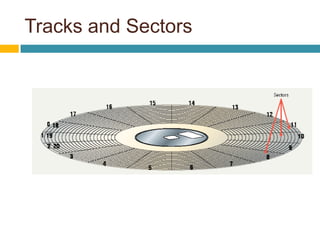
 Data organization
 Disks must be formatted before use
 Format draws tracks on the disk
 Tracks is divided into sectors
 Amount of data a drive can read
Tracks and Sectors
Magnetic Storage Devices
 Finding data on disk
 Each track and sector is labeled
 Some are reserved
 Listing of where files are stored
 File Allocation Table (FAT)
 FAT32
 NTFS
 Data is organized in clusters
 Size of data the OS handles
Magnetic Storage Devices
 Diskettes
 Also known as floppy disks
 Read with a disk drive
 Mylar disk
 Spin at 300 RPM
 Takes .2 second to find data
 3 ½ floppy disk holds 1.44 MB
Magnetic Storage Devices
 Hard disks
 Primary storage device in a computer
 2 or more aluminum platters
 Each platter has 2 sides
 Spin between 5,400 to 15,000 RPM
 Data found in 9.5 ms or less
 Drive capacity greater than 40 GB
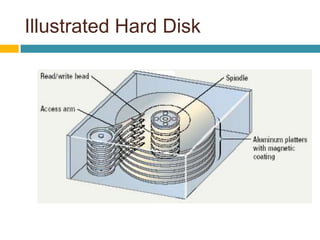
Illustrated Hard Disk
Magnetic Storage Devices
 Removable high capacity disks
 Speed of hard disk
 Portability of floppy disk
 Several variants have emerged
 High capacity floppy disk
 Stores up to 750 MB of data
 Hot swappable hard disks
 Provide GB of data
 Connect via USB
Magnetic Storage Devices
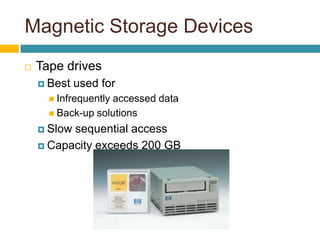
 Tape drives
 Best used for
 Infrequently accessed data
 Back-up solutions
 Slow sequential access
 Capacity exceeds 200 GB
Optical Storage Devices
 CD-ROM
 Most software ships on a CD
 Read using a laser
 Lands, binary 1, reflect data
 Pits scatter data
 Written from the inside out
 CD speed is based on the original
 Original CD read 150 Kbps
 A 10 X will read 1,500 Kbps
 Standard CD holds 650 MB
Optical Storage Devices
 DVD-ROM
 Digital Video Disk
 Use both sides of the disk
 Capacities can reach 18 GB
 DVD players can read CDs
Recordable Optical
Technologies
 CD Recordable (CD-R)
 Create a data or audio CD
 Data cannot be changed
 Can continue adding until full
Recordable Optical
Technologies
 CD Regrettable (CD-RW)
 Create a reusable CD
 Cannot be read in all CD players
 Can reuse about 100 times
Recordable Optical
Technologies
 Photo CD
 Developed by Kodak
 Provides for photo storage
 Photos added to CD until full
 Original pictures cannot be changed
Recordable Optical
Technologies
 DVD Recordable
 Several different formats exist
 None are standardized
 Allows home users to create DVDs
 Cannot be read in all players
Recordable Optical
Technologies
 DVD-RAM
 Allow reusing of DVD media
 Not standardized
 Cannot be read in all players
Solid State Devices
 Data is stored physically
 No magnets or laser
 Very fast
Solid State Devices
 Flash memory
 Found in cameras and USB drives
 Combination of RAM and ROM
 Long term updateable storage
Solid State Devices
 Smart cards
 Credit cards with a chip
 Chip stores data
 Eventually may be used for cash
 Hotels use for electronic keys
Solid State Devices
 Solid-state disks
 Large amount of SDRAM
 Extremely fast
 Volatile storage
 Require battery backups
 Most have hard disks copying data
CHAPTER 6A
End of Chapter

Intro ch 05_a

  • 1.
  • 2.
    Describing Storage Devices The purpose of storage device is to hold data even when the computer is turned off so the data can be used whenever it is used  Two processes  Writing data  Reading data
  • 3.
    Describing Storage Devices Storage terms  Media is the material storing data  Storage devices manage the media  Magnetic devices use a magnet  Optical devices use lasers  Solid-state devices have physical switches
  • 4.
    Magnetic Storage Devices Most common form of storage  Hard drives, floppy drives, tape  All magnetic drives work the same
  • 5.
  • 6.
    Magnetic Storage Devices Data storage and retrieval  Media is covered with iron oxide  Read/write head is a magnet  Magnet writes charges on the media  Positive charge is a 1  Negative charge is a 0  Magnet reads charges  Drive converts charges into binary
  • 7.
  • 8.
    Magnetic Storage Devices Data organization  Disks must be formatted before use  Format draws tracks on the disk  Tracks is divided into sectors  Amount of data a drive can read
  • 9.
  • 10.
    Magnetic Storage Devices Finding data on disk  Each track and sector is labeled  Some are reserved  Listing of where files are stored  File Allocation Table (FAT)  FAT32  NTFS  Data is organized in clusters  Size of data the OS handles
  • 11.
    Magnetic Storage Devices Diskettes  Also known as floppy disks  Read with a disk drive  Mylar disk  Spin at 300 RPM  Takes .2 second to find data  3 ½ floppy disk holds 1.44 MB
  • 12.
    Magnetic Storage Devices Hard disks  Primary storage device in a computer  2 or more aluminum platters  Each platter has 2 sides  Spin between 5,400 to 15,000 RPM  Data found in 9.5 ms or less  Drive capacity greater than 40 GB
  • 13.
  • 14.
    Magnetic Storage Devices Removable high capacity disks  Speed of hard disk  Portability of floppy disk  Several variants have emerged  High capacity floppy disk  Stores up to 750 MB of data  Hot swappable hard disks  Provide GB of data  Connect via USB
  • 15.
    Magnetic Storage Devices Tape drives  Best used for  Infrequently accessed data  Back-up solutions  Slow sequential access  Capacity exceeds 200 GB
  • 16.
    Optical Storage Devices CD-ROM  Most software ships on a CD  Read using a laser  Lands, binary 1, reflect data  Pits scatter data  Written from the inside out  CD speed is based on the original  Original CD read 150 Kbps  A 10 X will read 1,500 Kbps  Standard CD holds 650 MB
  • 17.
    Optical Storage Devices DVD-ROM  Digital Video Disk  Use both sides of the disk  Capacities can reach 18 GB  DVD players can read CDs
  • 18.
    Recordable Optical Technologies  CDRecordable (CD-R)  Create a data or audio CD  Data cannot be changed  Can continue adding until full
  • 19.
    Recordable Optical Technologies  CDRegrettable (CD-RW)  Create a reusable CD  Cannot be read in all CD players  Can reuse about 100 times
  • 20.
    Recordable Optical Technologies  PhotoCD  Developed by Kodak  Provides for photo storage  Photos added to CD until full  Original pictures cannot be changed
  • 21.
    Recordable Optical Technologies  DVDRecordable  Several different formats exist  None are standardized  Allows home users to create DVDs  Cannot be read in all players
  • 22.
    Recordable Optical Technologies  DVD-RAM Allow reusing of DVD media  Not standardized  Cannot be read in all players
  • 23.
    Solid State Devices Data is stored physically  No magnets or laser  Very fast
  • 24.
    Solid State Devices Flash memory  Found in cameras and USB drives  Combination of RAM and ROM  Long term updateable storage
  • 25.
    Solid State Devices Smart cards  Credit cards with a chip  Chip stores data  Eventually may be used for cash  Hotels use for electronic keys
  • 26.
    Solid State Devices Solid-state disks  Large amount of SDRAM  Extremely fast  Volatile storage  Require battery backups  Most have hard disks copying data
  • 27.