BARIUM MEAL
Dr. PRADEEP PATIL
DY PATIL MEDICAL COLLEGE AND
HOSPITAL KOLHAPUR
• Barium meal is the radiological study of oesophagus, stomach, duodenum
and proximal jejunum. It is done by oral administration of contrast media.
• Gross anatomy
• Cardiac sphincter / Oesophageal sphincter
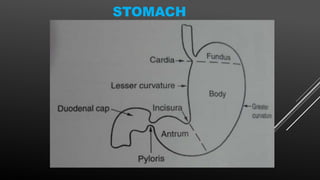
• Stomach
• Fundus
• Body
• Pyloric antrum
• Rugae
• Pyloric sphincter
• Greater/lesser curve
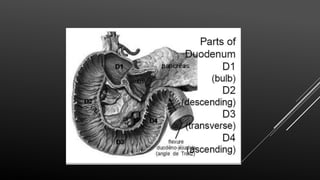
• Duodenum
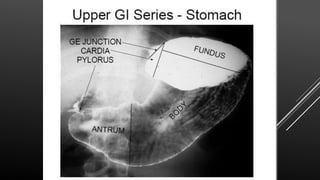
STOMACH
INDICATIONS
• 1. Symptoms which prompts
Barium meal study are :
• (a) Epigastric pain suggestive
of peptic ulceration.
• (b) Anorexia.
• (c) Weight loss.
• (d) Vomiting.
• (e) Anaemia.
• (f) Heart burn.
• (g) Dyspepsia.
2.Upper abdominal mass.
3.Gastro-intestinal haemorrhage.
4.Gastric or duodenal obstruction
5.Malignancies of oesophago-gastric
junction, stomach and duodenum.
6.Systemic diseases like Tuberculosis
7.Motility disorders of gastro-intestinal
tract.
8.In children for vomiting due to :
(i) Gastroesophageal reflux;
(ii) Pyloric obstruction;
(iii) Malrotation
• Suspected cases of gastro-duodenal perforation
• History or suspicion of aspiration.
• Large bowel obstruction (Barium inspissation occurs) •
• Fistulous communication with any organs
• Recent biopsy from GIT, ( barium granuloma may form)
CONTRAINDICATIONS
PREPARATION
Fasting for 6 hours/over night fasting
•Avoid cigarette smoking as it may interfere with optimum coating
of the mucosa.
•In patients with gastric outlet obstruction, prolonged fasting or I.V
Metaclopramide and sometimes nasogastric intubation and aspiration of
the contents may be necessary
CONTRAST MEDIA
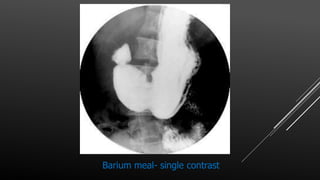
Single Contrast Study
• Low density barium suspension (80-100% w /v) is used.
• Water soluble contrast media are indicated when a
gastro- duodenal perforation is suspected because it
gets resorbed from the mediastinum or peritoneum
unlike barium which can cause granulomatous reaction.
• Use of newer non-ionic water soluble contrast
media(Gastromicro) is used, when there is risk of
CONVENTIONAL SINGLE CONTRAST STUDY
• 10-15 ml of 80-100% w/v barium suspension is given
• patient lying supine is rotated with the right side going up in a continuous
clockwise manner for obtaining a good coating of the entire stomach mucosa.
• 100-250 ml of barium is given. Spot films of the filled fundus in varying
obliquity may be taken.
• Patient is turned prone oblique right side dependent as barium
enters the duodenum through the pylorus. Spot films for
duodenal bulb and C loop can be taken and also in right
anterior oblique view.
• More barium is given to distend the stomach wall . The gastric
peristalsis and rate of emptying through the pylorus is observed.
The patient is rotated under fluoroscopy to observe all margins
• In erect position, right anterior oblique view of stomach shows
incisura angularis & Proximal jejunum
• For retrogastric space, about 200-250 ml of barium is given in
supine position,& translateral film is taken
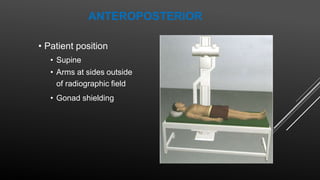
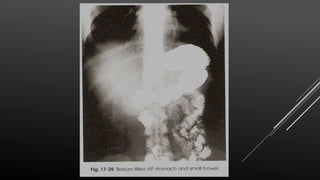
ANTEROPOSTERIOR
• Patient position
• Supine
• Arms at sides outside
of radiographic field
• Gonad shielding
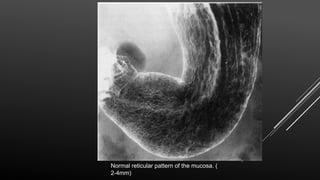
Normal reticular pattern of the mucosa. (
2-4mm)
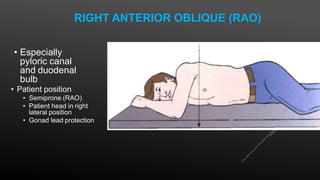
RIGHT ANTERIOR OBLIQUE (RAO)
• Especially
pyloric canal
and duodenal
bulb
• Patient position
• Semiprone (RAO)
• Patient head in right
lateral position
• Gonad lead protection
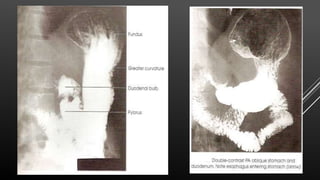
This is a right anterior oblique (RAO) position because the right side of the
anterior body surface is closest to the IMAGE RECEPTOR
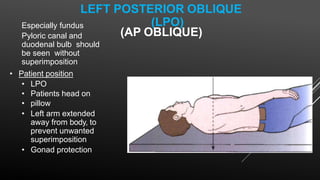
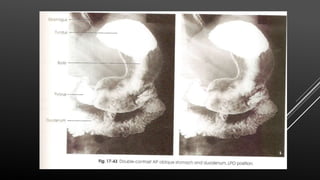
LEFT POSTERIOR OBLIQUE
(LPO)
(AP OBLIQUE)
Especially fundus
Pyloric canal and
duodenal bulb should
be seen without
superimposition
• Patient position
• LPO
• Patients head on
• pillow
• Left arm extended
away from body, to
prevent unwanted
superimposition
• Gonad protection
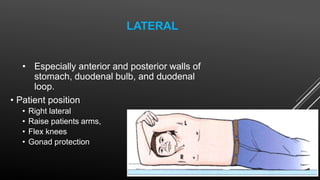
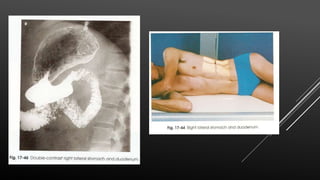
LATERAL
• Especially anterior and posterior walls of
stomach, duodenal bulb, and duodenal
loop.
• Patient position
• Right lateral
• Raise patients arms,
• Flex knees
• Gonad protection
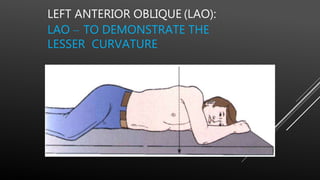
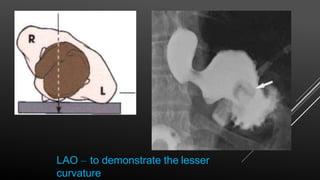
LEFT ANTERIOR OBLIQUE (LAO):
LAO – TO DEMONSTRATE THE
LESSER CURVATURE
LAO – to demonstrate the lesser
curvature
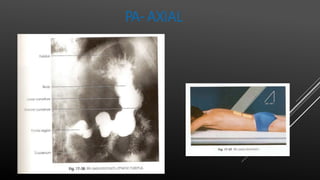
PA-AXIAL
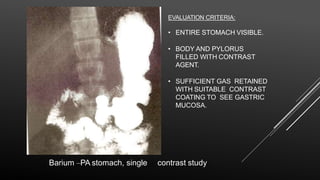
Barium –PA stomach, single contrast study
EVALUATION CRITERIA:
• ENTIRE STOMACH VISIBLE.
• BODY AND PYLORUS
FILLED WITH CONTRAST
AGENT.
• SUFFICIENT GAS RETAINED
WITH SUITABLE CONTRAST
COATING TO SEE GASTRIC
MUCOSA.
ADVANTAGES OF SINGLE CONTRAST STUDIES
•For patients who are immobile or unable to swallow gas
forming tablets.
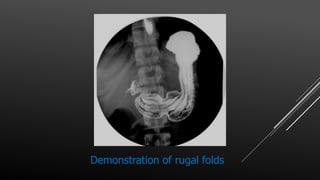
•Pylorospasm, fistulae and enlarged gastric rugae are best
seen.
•Filling defects due to large masses in pyloric and duodenal
region are more easily seen than in double contrast
•It is the procedure of choice to examine patients with
suspected gastric or duodenal obstruction.
DISADVANTAGES OF SINGLE CONTRAST
STUDY
• Lack of sensitivity in detecting small erosion/linear
ulceration, superficial gastric carcinomas and subtle
mucosal abnormalities.
Barium meal- single contrast
Demonstration of rugal folds
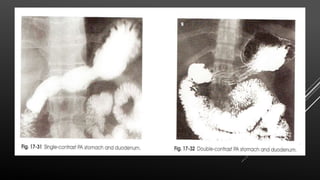
DOUBLE CONTRAST BARIUM STUDY
Used in Japan with high incidence of gastric malignancy, for
mass screening of the gastric tumours for early detection.
Relies much less on fluoroscopy and more on filming which
is done overcouch for better image quality.
Found very useful for small mucosal lesions like polyps,
mucosal erosions and ulcers, recurrent tumours and post
operative studies.
PREPARATION
 A 'dry' fluid free stomach is essential. Double contrast study
should not be done if secretions exist in the stomach. The
secretions will prevent adequate mucosal coating and may
mimic tumours
CONTRAST MEDIA
• High density (200-250% w /v) low viscosity barium sulphate is essential.
High viscosity barium does not flow well and does not coat mucosa well,
hence can produce apparent mucosal lesions.
• Antifoaming agents which are added to barium suspension prevent air
bubble formation. Air bubbles can mimic polyps.
GAS FORMING AGENT
• Sodium bicarbonate and Citric acid are given orally. When
they come in contact in the stomach, carbon dioxide is
produced which acts as negative contrast.
• When Ryle' s tube is placed in the stomach, this can be used
to inject air.
TECHNIQUE OF DOUBLE CONTRAST
About 100-150 ml of high density low viscosity barium is given.
Injection Buscopan IV - given just before giving barium to study the
stomach.
To study the stomach and duodenum, injection its given when barium
enters the duodenum.
Gas forming agents are given.
Then patient is rotated slowly for mucosal coating.
• Advantages ofdouble contrast study
• Highly accurate method of
detecting abnormalities
following gastric surgery
• bile reflux gastritis
• marginal ulceration
• recurrent carcinomas
• abnormalities of the efferent loop.
Disadvantages ofdouble contrast study
•Probably misses somepolyps, ulcers,
erosions, superficial carcinoma.
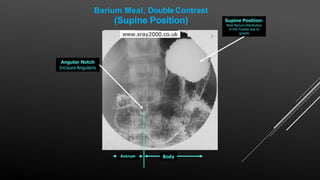
Angular Notch
Incisura Angularis
(Supine Position)
Body
Antrum
Supine Position:
Note Barium Distribution
in the Fundus due to
gravity
Barium Meal, Double Contrast
BIPHASIC STUDY OF UPPER GIT
Introduction
•Gives good anatomic & physiologic information & has accuracy comparable to
endoscopy.
Goal
•To have both mucosal delineation in double contrast phase & full column distention in
single contrast phase
INFLAMMATORY
AND ULCERATIVE
DISEASES
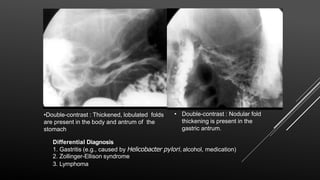
•Double-contrast : Thickened, lobulated folds
are present in the body and antrum of the
stomach
• Double-contrast : Nodular fold
thickening is present in the
gastric antrum.
Differential Diagnosis
1. Gastritis (e.g., caused by Helicobacter pylori, alcohol, medication)
2. Zollinger-Ellison syndrome
3. Lymphoma
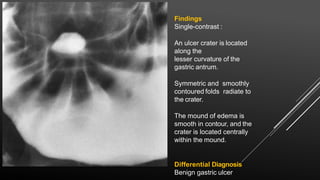
Findings
Single-contrast :
An ulcer crater is located
along the
lesser curvature of the
gastric antrum.
Symmetric and smoothly
contoured folds radiate to
the crater.
The mound of edema is
smooth in contour, and the
crater is located centrally
within the mound.
Differential Diagnosis
Benign gastric ulcer
Findings
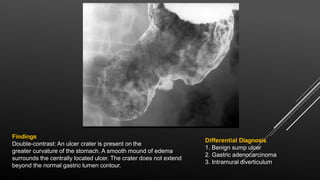
Double-contrast: An ulcer crater is present on the
greater curvature of the stomach. A smooth mound of edema
surrounds the centrally located ulcer. The crater does not extend
beyond the normal gastric lumen contour.
Differential Diagnosis
1. Benign sump ulcer
2. Gastric adenocarcinoma
3. Intramural diverticulum
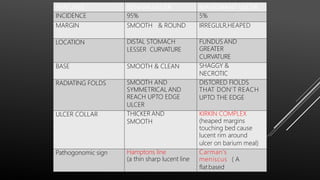
FEATURES BENIGN ULCER MALIGNANT ULCER
INCIDENCE 95% 5%
MARGIN SMOOTH & ROUND IRREGULR,HEAPED
LOCATION DISTAL STOMACH
LESSER CURVATURE
FUNDUS AND
GREATER
CURVATURE
BASE SMOOTH & CLEAN SHAGGY &
NECROTIC
RADIATING FOLDS SMOOTH AND
SYMMETRICAL AND
REACH UPTO EDGE
ULCER
DISTORED FIOLDS
THAT DON’T REACH
UPTO THE EDGE
ULCER COLLAR THICKER AND
SMOOTH
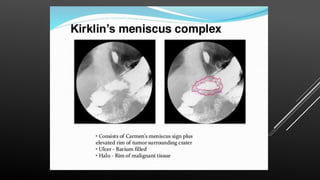
KIRKIN COMPLEX
(heaped margins
touching bed cause
lucent rim around
ulcer on barium meal)
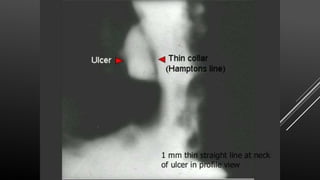
Pathogonomic sign Hamptons line
(a thin sharp lucent line
Carman’s
meniscus ( A
flatbased
• Masses and filling defects
• Benign tumours
• Malignant tumours
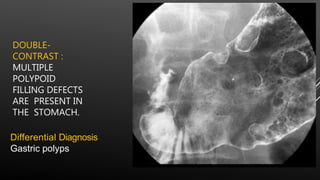
DOUBLE-
CONTRAST :
MULTIPLE
POLYPOID
FILLING DEFECTS
ARE PRESENT IN
THE STOMACH.
Differential Diagnosis
Gastric polyps
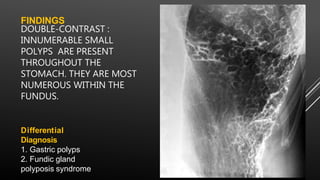
FINDINGS
DOUBLE-CONTRAST :
INNUMERABLE SMALL
POLYPS ARE PRESENT
THROUGHOUT THE
STOMACH. THEY ARE MOST
NUMEROUS WITHIN THE
FUNDUS.
Differential
Diagnosis
1. Gastric polyps
2. Fundic gland
polyposis syndrome
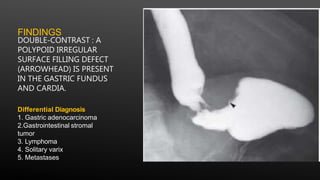
FINDINGS
DOUBLE-CONTRAST : A
POLYPOID IRREGULAR
SURFACE FILLING DEFECT
(ARROWHEAD) IS PRESENT
IN THE GASTRIC FUNDUS
AND CARDIA.
Differential Diagnosis
1. Gastric adenocarcinoma
2.Gastrointestinal stromal
tumor
3. Lymphoma
4. Solitary varix
5. Metastases
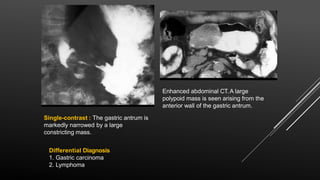
Enhanced abdominal CT. A large
polypoid mass is seen arising from the
anterior wall of the gastric antrum.
Single-contrast : The gastric antrum is
markedly narrowed by a large
constricting mass.
Differential Diagnosis
1. Gastric carcinoma
2. Lymphoma
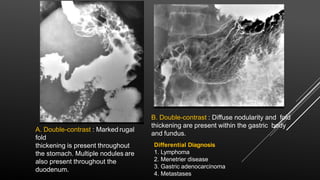
A. Double-contrast : Marked rugal
fold
thickening is present throughout
the stomach. Multiple nodules are
also present throughout the
duodenum.
B. Double-contrast : Diffuse nodularity and fold
thickening are present within the gastric body
and fundus.
Differential Diagnosis
1. Lymphoma
2. Menetrier disease
3. Gastric adenocarcinoma
4. Metastases
NARROWINGS
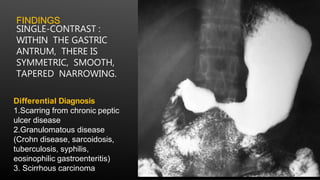
FINDINGS
SINGLE-CONTRAST :
WITHIN THE GASTRIC
ANTRUM, THERE IS
SYMMETRIC, SMOOTH,
TAPERED NARROWING.
Differential Diagnosis
1.Scarring from chronic peptic
ulcer disease
2.Granulomatous disease
(Crohn disease, sarcoidosis,
tuberculosis, syphilis,
eosinophilic gastroenteritis)
3. Scirrhous carcinoma
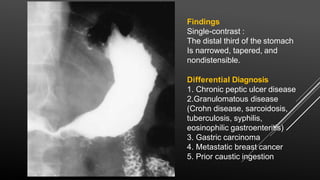
Findings
Single-contrast :
The distal third of the stomach
Is narrowed, tapered, and
nondistensible.
Differential Diagnosis
1. Chronic peptic ulcer disease
2.Granulomatous disease
(Crohn disease, sarcoidosis,
tuberculosis, syphilis,
eosinophilic gastroenteritis)
3. Gastric carcinoma
4. Metastatic breast cancer
5. Prior caustic ingestion
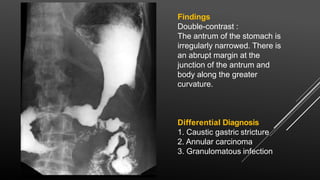
Findings
Double-contrast :
The antrum of the stomach is
irregularly narrowed. There is
an abrupt margin at the
junction of the antrum and
body along the greater
curvature.
Differential Diagnosis
1. Caustic gastric stricture
2. Annular carcinoma
3. Granulomatous infection
DUODENUM
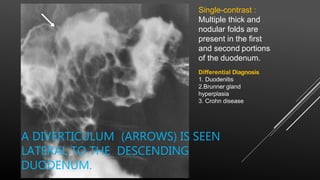
Single-contrast :
Multiple thick and
nodular folds are
present in the first
and second portions
of the duodenum.
A DIVERTICULUM (ARROWS) IS SEEN
LATERAL TO THE DESCENDING
DUODENUM.
Differential Diagnosis
1. Duodenitis
2.Brunner gland
hyperplasia
3. Crohn disease
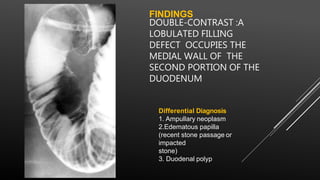
FINDINGS
DOUBLE-CONTRAST :A
LOBULATED FILLING
DEFECT OCCUPIES THE
MEDIAL WALL OF THE
SECOND PORTION OF THE
DUODENUM
Differential Diagnosis
1. Ampullary neoplasm
2.Edematous papilla
(recent stone passage or
impacted
stone)
3. Duodenal polyp
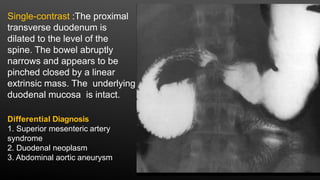
Single-contrast :The proximal
transverse duodenum is
dilated to the level of the
spine. The bowel abruptly
narrows and appears to be
pinched closed by a linear
extrinsic mass. The underlying
duodenal mucosa is intact.
Differential Diagnosis
1. Superior mesenteric artery
syndrome
2. Duodenal neoplasm
3. Abdominal aortic aneurysm
Barium meal

Barium meal

  • 1.
    BARIUM MEAL Dr. PRADEEPPATIL DY PATIL MEDICAL COLLEGE AND HOSPITAL KOLHAPUR
  • 2.
    • Barium mealis the radiological study of oesophagus, stomach, duodenum and proximal jejunum. It is done by oral administration of contrast media. • Gross anatomy • Cardiac sphincter / Oesophageal sphincter • Stomach • Fundus • Body • Pyloric antrum • Rugae • Pyloric sphincter • Greater/lesser curve • Duodenum
  • 3.
  • 5.
    INDICATIONS • 1. Symptomswhich prompts Barium meal study are : • (a) Epigastric pain suggestive of peptic ulceration. • (b) Anorexia. • (c) Weight loss. • (d) Vomiting. • (e) Anaemia. • (f) Heart burn. • (g) Dyspepsia. 2.Upper abdominal mass. 3.Gastro-intestinal haemorrhage. 4.Gastric or duodenal obstruction 5.Malignancies of oesophago-gastric junction, stomach and duodenum. 6.Systemic diseases like Tuberculosis 7.Motility disorders of gastro-intestinal tract. 8.In children for vomiting due to : (i) Gastroesophageal reflux; (ii) Pyloric obstruction; (iii) Malrotation
  • 6.
    • Suspected casesof gastro-duodenal perforation • History or suspicion of aspiration. • Large bowel obstruction (Barium inspissation occurs) • • Fistulous communication with any organs • Recent biopsy from GIT, ( barium granuloma may form) CONTRAINDICATIONS
  • 7.
    PREPARATION Fasting for 6hours/over night fasting •Avoid cigarette smoking as it may interfere with optimum coating of the mucosa. •In patients with gastric outlet obstruction, prolonged fasting or I.V Metaclopramide and sometimes nasogastric intubation and aspiration of the contents may be necessary
  • 8.
    CONTRAST MEDIA Single ContrastStudy • Low density barium suspension (80-100% w /v) is used. • Water soluble contrast media are indicated when a gastro- duodenal perforation is suspected because it gets resorbed from the mediastinum or peritoneum unlike barium which can cause granulomatous reaction. • Use of newer non-ionic water soluble contrast media(Gastromicro) is used, when there is risk of
  • 9.
    CONVENTIONAL SINGLE CONTRASTSTUDY • 10-15 ml of 80-100% w/v barium suspension is given • patient lying supine is rotated with the right side going up in a continuous clockwise manner for obtaining a good coating of the entire stomach mucosa. • 100-250 ml of barium is given. Spot films of the filled fundus in varying obliquity may be taken.
  • 10.
    • Patient isturned prone oblique right side dependent as barium enters the duodenum through the pylorus. Spot films for duodenal bulb and C loop can be taken and also in right anterior oblique view. • More barium is given to distend the stomach wall . The gastric peristalsis and rate of emptying through the pylorus is observed. The patient is rotated under fluoroscopy to observe all margins
  • 11.
    • In erectposition, right anterior oblique view of stomach shows incisura angularis & Proximal jejunum • For retrogastric space, about 200-250 ml of barium is given in supine position,& translateral film is taken
  • 12.
    ANTEROPOSTERIOR • Patient position •Supine • Arms at sides outside of radiographic field • Gonad shielding
  • 14.
    Normal reticular patternof the mucosa. ( 2-4mm)
  • 15.
    RIGHT ANTERIOR OBLIQUE(RAO) • Especially pyloric canal and duodenal bulb • Patient position • Semiprone (RAO) • Patient head in right lateral position • Gonad lead protection This is a right anterior oblique (RAO) position because the right side of the anterior body surface is closest to the IMAGE RECEPTOR
  • 17.
    LEFT POSTERIOR OBLIQUE (LPO) (APOBLIQUE) Especially fundus Pyloric canal and duodenal bulb should be seen without superimposition • Patient position • LPO • Patients head on • pillow • Left arm extended away from body, to prevent unwanted superimposition • Gonad protection
  • 19.
    LATERAL • Especially anteriorand posterior walls of stomach, duodenal bulb, and duodenal loop. • Patient position • Right lateral • Raise patients arms, • Flex knees • Gonad protection
  • 21.
    LEFT ANTERIOR OBLIQUE(LAO): LAO – TO DEMONSTRATE THE LESSER CURVATURE
  • 22.
    LAO – todemonstrate the lesser curvature
  • 23.
  • 24.
    Barium –PA stomach,single contrast study EVALUATION CRITERIA: • ENTIRE STOMACH VISIBLE. • BODY AND PYLORUS FILLED WITH CONTRAST AGENT. • SUFFICIENT GAS RETAINED WITH SUITABLE CONTRAST COATING TO SEE GASTRIC MUCOSA.
  • 25.
    ADVANTAGES OF SINGLECONTRAST STUDIES •For patients who are immobile or unable to swallow gas forming tablets. •Pylorospasm, fistulae and enlarged gastric rugae are best seen. •Filling defects due to large masses in pyloric and duodenal region are more easily seen than in double contrast •It is the procedure of choice to examine patients with suspected gastric or duodenal obstruction.
  • 26.
    DISADVANTAGES OF SINGLECONTRAST STUDY • Lack of sensitivity in detecting small erosion/linear ulceration, superficial gastric carcinomas and subtle mucosal abnormalities.
  • 28.
  • 29.
  • 30.
    DOUBLE CONTRAST BARIUMSTUDY Used in Japan with high incidence of gastric malignancy, for mass screening of the gastric tumours for early detection. Relies much less on fluoroscopy and more on filming which is done overcouch for better image quality. Found very useful for small mucosal lesions like polyps, mucosal erosions and ulcers, recurrent tumours and post operative studies.
  • 31.
    PREPARATION  A 'dry'fluid free stomach is essential. Double contrast study should not be done if secretions exist in the stomach. The secretions will prevent adequate mucosal coating and may mimic tumours
  • 32.
    CONTRAST MEDIA • Highdensity (200-250% w /v) low viscosity barium sulphate is essential. High viscosity barium does not flow well and does not coat mucosa well, hence can produce apparent mucosal lesions. • Antifoaming agents which are added to barium suspension prevent air bubble formation. Air bubbles can mimic polyps.
  • 33.
    GAS FORMING AGENT •Sodium bicarbonate and Citric acid are given orally. When they come in contact in the stomach, carbon dioxide is produced which acts as negative contrast. • When Ryle' s tube is placed in the stomach, this can be used to inject air.
  • 34.
    TECHNIQUE OF DOUBLECONTRAST About 100-150 ml of high density low viscosity barium is given. Injection Buscopan IV - given just before giving barium to study the stomach. To study the stomach and duodenum, injection its given when barium enters the duodenum. Gas forming agents are given. Then patient is rotated slowly for mucosal coating.
  • 35.
    • Advantages ofdoublecontrast study • Highly accurate method of detecting abnormalities following gastric surgery • bile reflux gastritis • marginal ulceration • recurrent carcinomas • abnormalities of the efferent loop. Disadvantages ofdouble contrast study •Probably misses somepolyps, ulcers, erosions, superficial carcinoma.
  • 36.
    Angular Notch Incisura Angularis (SupinePosition) Body Antrum Supine Position: Note Barium Distribution in the Fundus due to gravity Barium Meal, Double Contrast
  • 38.
    BIPHASIC STUDY OFUPPER GIT Introduction •Gives good anatomic & physiologic information & has accuracy comparable to endoscopy. Goal •To have both mucosal delineation in double contrast phase & full column distention in single contrast phase
  • 39.
  • 40.
    •Double-contrast : Thickened,lobulated folds are present in the body and antrum of the stomach • Double-contrast : Nodular fold thickening is present in the gastric antrum. Differential Diagnosis 1. Gastritis (e.g., caused by Helicobacter pylori, alcohol, medication) 2. Zollinger-Ellison syndrome 3. Lymphoma
  • 41.
    Findings Single-contrast : An ulcercrater is located along the lesser curvature of the gastric antrum. Symmetric and smoothly contoured folds radiate to the crater. The mound of edema is smooth in contour, and the crater is located centrally within the mound. Differential Diagnosis Benign gastric ulcer
  • 42.
    Findings Double-contrast: An ulcercrater is present on the greater curvature of the stomach. A smooth mound of edema surrounds the centrally located ulcer. The crater does not extend beyond the normal gastric lumen contour. Differential Diagnosis 1. Benign sump ulcer 2. Gastric adenocarcinoma 3. Intramural diverticulum
  • 43.
    FEATURES BENIGN ULCERMALIGNANT ULCER INCIDENCE 95% 5% MARGIN SMOOTH & ROUND IRREGULR,HEAPED LOCATION DISTAL STOMACH LESSER CURVATURE FUNDUS AND GREATER CURVATURE BASE SMOOTH & CLEAN SHAGGY & NECROTIC RADIATING FOLDS SMOOTH AND SYMMETRICAL AND REACH UPTO EDGE ULCER DISTORED FIOLDS THAT DON’T REACH UPTO THE EDGE ULCER COLLAR THICKER AND SMOOTH KIRKIN COMPLEX (heaped margins touching bed cause lucent rim around ulcer on barium meal) Pathogonomic sign Hamptons line (a thin sharp lucent line Carman’s meniscus ( A flatbased
  • 46.
    • Masses andfilling defects • Benign tumours • Malignant tumours
  • 47.
    DOUBLE- CONTRAST : MULTIPLE POLYPOID FILLING DEFECTS AREPRESENT IN THE STOMACH. Differential Diagnosis Gastric polyps
  • 48.
    FINDINGS DOUBLE-CONTRAST : INNUMERABLE SMALL POLYPSARE PRESENT THROUGHOUT THE STOMACH. THEY ARE MOST NUMEROUS WITHIN THE FUNDUS. Differential Diagnosis 1. Gastric polyps 2. Fundic gland polyposis syndrome
  • 49.
    FINDINGS DOUBLE-CONTRAST : A POLYPOIDIRREGULAR SURFACE FILLING DEFECT (ARROWHEAD) IS PRESENT IN THE GASTRIC FUNDUS AND CARDIA. Differential Diagnosis 1. Gastric adenocarcinoma 2.Gastrointestinal stromal tumor 3. Lymphoma 4. Solitary varix 5. Metastases
  • 50.
    Enhanced abdominal CT.A large polypoid mass is seen arising from the anterior wall of the gastric antrum. Single-contrast : The gastric antrum is markedly narrowed by a large constricting mass. Differential Diagnosis 1. Gastric carcinoma 2. Lymphoma
  • 51.
    A. Double-contrast :Marked rugal fold thickening is present throughout the stomach. Multiple nodules are also present throughout the duodenum. B. Double-contrast : Diffuse nodularity and fold thickening are present within the gastric body and fundus. Differential Diagnosis 1. Lymphoma 2. Menetrier disease 3. Gastric adenocarcinoma 4. Metastases
  • 52.
  • 53.
    FINDINGS SINGLE-CONTRAST : WITHIN THEGASTRIC ANTRUM, THERE IS SYMMETRIC, SMOOTH, TAPERED NARROWING. Differential Diagnosis 1.Scarring from chronic peptic ulcer disease 2.Granulomatous disease (Crohn disease, sarcoidosis, tuberculosis, syphilis, eosinophilic gastroenteritis) 3. Scirrhous carcinoma
  • 54.
    Findings Single-contrast : The distalthird of the stomach Is narrowed, tapered, and nondistensible. Differential Diagnosis 1. Chronic peptic ulcer disease 2.Granulomatous disease (Crohn disease, sarcoidosis, tuberculosis, syphilis, eosinophilic gastroenteritis) 3. Gastric carcinoma 4. Metastatic breast cancer 5. Prior caustic ingestion
  • 55.
    Findings Double-contrast : The antrumof the stomach is irregularly narrowed. There is an abrupt margin at the junction of the antrum and body along the greater curvature. Differential Diagnosis 1. Caustic gastric stricture 2. Annular carcinoma 3. Granulomatous infection
  • 56.
  • 57.
    Single-contrast : Multiple thickand nodular folds are present in the first and second portions of the duodenum. A DIVERTICULUM (ARROWS) IS SEEN LATERAL TO THE DESCENDING DUODENUM. Differential Diagnosis 1. Duodenitis 2.Brunner gland hyperplasia 3. Crohn disease
  • 58.
    FINDINGS DOUBLE-CONTRAST :A LOBULATED FILLING DEFECTOCCUPIES THE MEDIAL WALL OF THE SECOND PORTION OF THE DUODENUM Differential Diagnosis 1. Ampullary neoplasm 2.Edematous papilla (recent stone passage or impacted stone) 3. Duodenal polyp
  • 59.
    Single-contrast :The proximal transverseduodenum is dilated to the level of the spine. The bowel abruptly narrows and appears to be pinched closed by a linear extrinsic mass. The underlying duodenal mucosa is intact. Differential Diagnosis 1. Superior mesenteric artery syndrome 2. Duodenal neoplasm 3. Abdominal aortic aneurysm