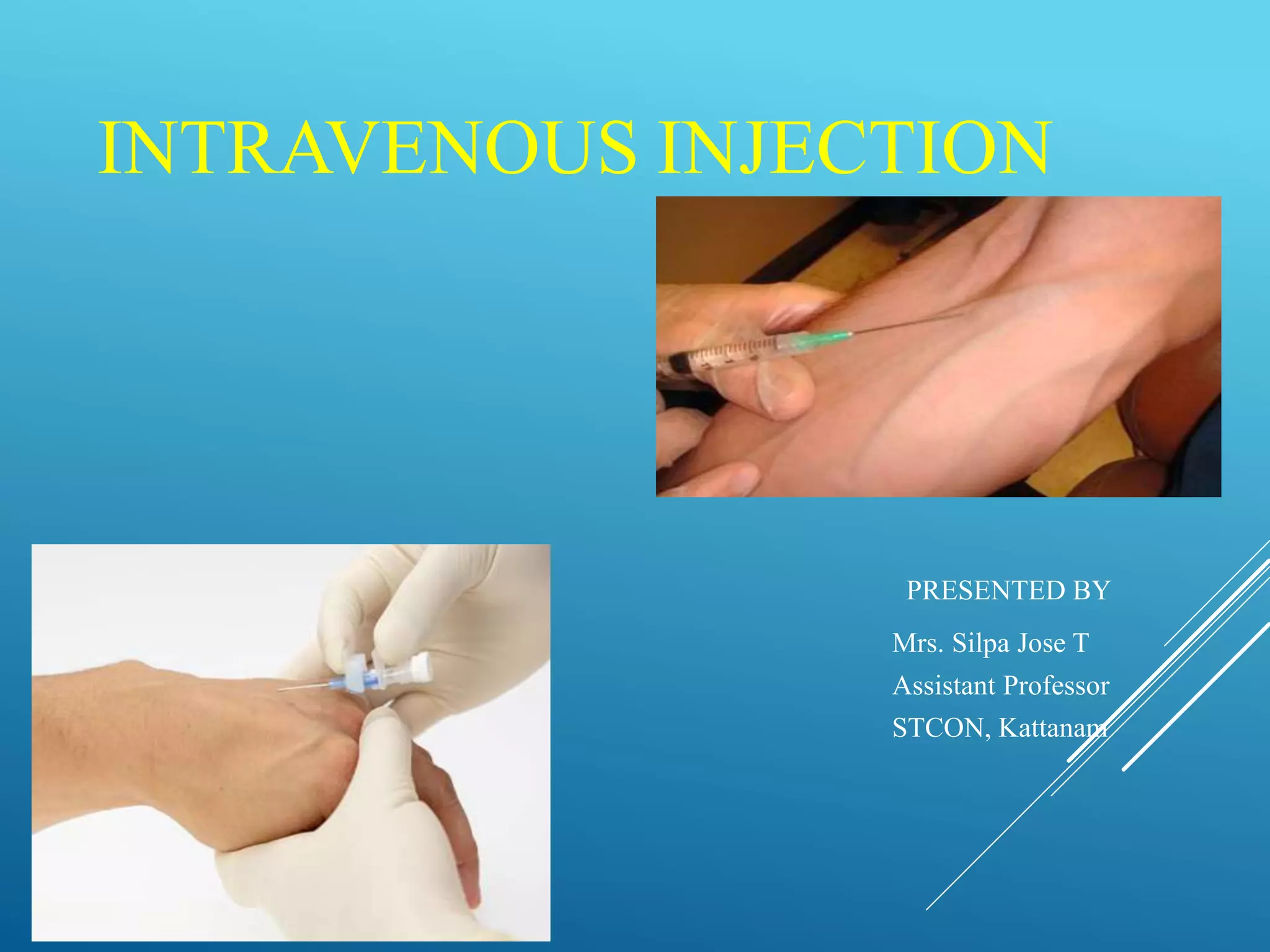
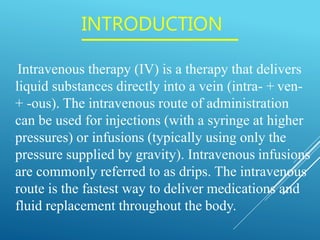
INTRAVENOUS INJECTION
PRESENTED BY
Mrs. Silpa Jose T
Assistant Professor
STCON, Kattanam
INTRODUCTION
Intravenous therapy (IV) is a therapy that delivers
liquid substances directly into a vein (intra- + ven-
+ -ous). The intravenous route of administration
can be used for injections (with a syringe at higher
pressures) or infusions (typically using only the
pressure supplied by gravity). Intravenous infusions
are commonly referred to as drips. The intravenous
route is the fastest way to deliver medications and
fluid replacement throughout the body.
DEFINITION
Intravenous injection is the introduction of the
small quantity of the drug into the vein by venous
puncture. Introduction of the medicine directly
into the blood stream is called intravenous
injection.
PURPOSE
• To have fast action of the drug as in
emergency.
• To give medications that are irritating or
ineffective when given by other routes.
• To have the actions of medicines on the
blood stream or the blood vessels.
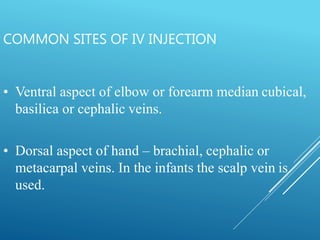
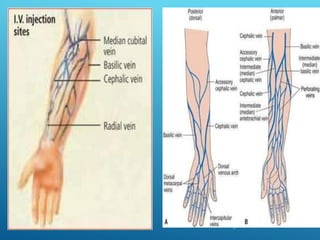
COMMON SITES OF IV INJECTION
• Ventral aspect of elbow or forearm median cubical,
basilica or cephalic veins.
• Dorsal aspect of hand – brachial, cephalic or
metacarpal veins. In the infants the scalp vein is
used.
GENERAL INSTRUCTIONS
• Expel the air from the syringe before giving the
injection by upholding it in upright position and
gently pressing the piston until a drop of solution
comes to the tip of the needle.
• Always dissolve the drug in correct amount of
fluid to minimize the risk of adverse effect of the
medicine.
• Observe the patient closely for the signs of
adverse reaction of the medicine and have
emergency drugs and the antidote in hand while
injecting the medicine.
CON
T..
• Do not give the medicine if the injection site
shows any edema or iv solution is not
following properly to avoid accidental
administration of medicine into the
surrounding tissues.
• When giving iron preparation always confirms
that the patient is not sensitive to it by giving a
test dose.
TYPE OF IV ADMINISTRATION
• Adding the medicine in iv solution bottle
(intravenous infusion)
• Existing iv line for continuous infusion.
• Bolus-direct iv push for immediate or fast action.
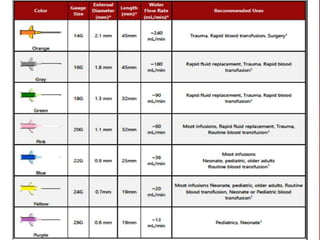
SELECTION OF SYRINGE AND NEEDLE
• The size of syringe used for iv infusion depends
upon the amount of fluids to be injected.
• Size of the needle used are 18 to 21 gauge or 1 to 2
inches.
PRELIMINARY ASSESSMENT
CHECK
• The diagnosis and age of the patient.
• The purpose of injection.
• The doctors order for the type, dosage, time and
route of administration.
• The patient’s name and bed number.
• The nurses record to find out the time at which the
last dose was given.
• The symptoms of over dose or allergic reaction.
• The form of the medicine available and correct
method of administration.
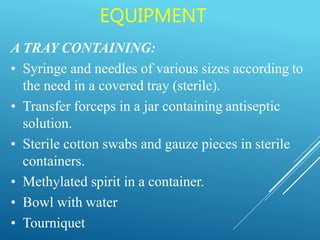
EQUIPMENT
A TRAY CONTAINING:
• Syringe and needles of various sizes according to
the need in a covered tray (sterile).
• Transfer forceps in a jar containing antiseptic
solution.
• Sterile cotton swabs and gauze pieces in sterile
containers.
• Methylated spirit in a container.
• Bowl with water
• Tourniquet
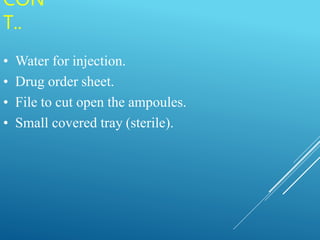
CON
T..
• Water for injection.
• Drug order sheet.
• File to cut open the ampoules.
• Small covered tray (sterile).
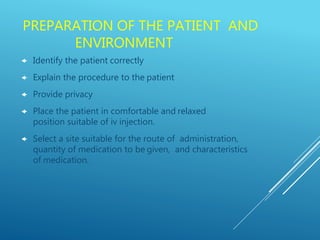
PREPARATION OF THE PATIENT AND
ENVIRONMENT
 Identify the patient correctly
 Explain the procedure to the patient
 Provide privacy
 Place the patient in comfortable and relaxed
position suitable of iv injection.
 Select a site suitable for the route of administration,
quantity of medication to be given, and characteristics
of medication.
PROCEDURE
• Read the doctors order and select the
medication
• Wash hands
• Select appropriate syringe and needle and check
whether they are in good working order
• Recheck the order, medicine card with the label
of the medicine, expiry date, etc
• Mix well and take out the required amount of
solution in the syringe
• Apply a tourniquet on the upper arm
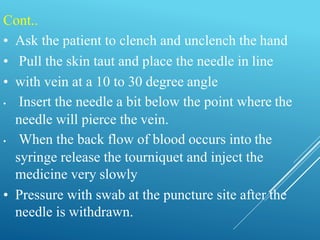
Cont..
• Ask the patient to clench and unclench the hand
• Pull the skin taut and place the needle in line
• with vein at a 10 to 30 degree angle
• Insert the needle a bit below the point where the
needle will pierce the vein.
• When the back flow of blood occurs into the
syringe release the tourniquet and inject the
medicine very slowly
• Pressure with swab at the puncture site after the
needle is withdrawn.
AFTER CARE
• Provide the patient comfortable position
• Observe the area for bleeding if bleeding occurs
apply pressure but do not massage
• Wash hands
• Replace all the articles and dispose off the
disposable articles
• Ask the patient to take rest at least 15 to 30 minutes
so that you can observe him for any reaction
• Observe the patient for any allergic reaction
• Do proper recording and reporting maintain
medication chart
ADVANTAGES OF IV INJECTION
• The therapeutic effect of the drug is seen as
soon as it is administered to the patient.
• IV medication also increases the chances of
removal of toxins from the body cells,
accelerating the healing process
• It also prevents the growth and spread of
cancerous cells. Chemotherapy is given through
IV route so that the drug can move about the
body and destroy the harmful cancerous cell.
DISADVANTAGES OF IV INJECTION
• Very slim chances of drug recall, when the drug
given to patient shows adverse effect
• As the drug moves towards the target area quicker
than the other methods the concentration of the red
blood cells present in the area can get dilated leading
to anemia.
• IV medications sometimes causes precipitate
formation that causes embolism myocardial damage.
COMPLICATIONS WITH
INTRAVENOUS INJECTIONS
• Infiltration
• Hematoma
• Air embolism
• Phlebitis and thrombophlebitis
• Extravascular injection
• Intra-arterial injection
• Allergic reaction
• Sepsis
• Speed shock
Local complication
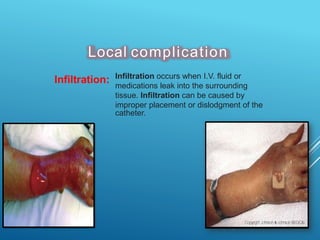
Infiltration: Infiltration occurs when I.V. fluid or
medications leak into the surrounding
tissue. Infiltration can be caused by
improper placement or dislodgment of the
catheter.
LOCAL COMPLICATION
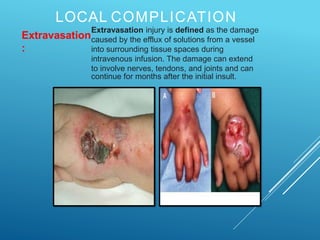
Extravasation
:
Extravasation injury is defined as the damage
caused by the efflux of solutions from a vessel
into surrounding tissue spaces during
intravenous infusion. The damage can extend
to involve nerves, tendons, and joints and can
continue for months after the initial insult.
LOCAL
COMPLICATION
Thrombosis:
Occurs when blood flow through a
vein is obstructed by a local
thrombus
LOCAL COMPLICATION
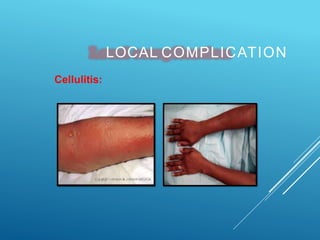
Cellulitis:
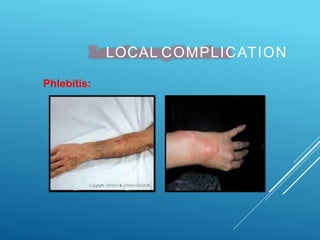
LOCAL COMPLICATION
Phlebitis:
NURSING RESPONSIBILITY
• To verify meds and dosage against the patient's chart
and ascertain if the prescribed injection will be
harmful or the prescription is misstated, and to make
certain the med prescribed is viable for injection site
• To make sure the injection site is sterile.
• To ascertain if the injection site is viable
• To make sure the volume of the injection is
compatible with the site of injection.
CON
T..
• To maintain sterile field and bandage properly
post injection
• To monitor patient's reaction post injection to
RO anaphylactic or synergistic drug reaction.
• To do proper reporting and recording
given by
Medications
administered intermittently
IV are
to treat
usually
emergent
concerns. Medications administered by direct IV
route are given very slowly over Atleast 1 minute.
Administering a medication intravenously
eliminates the process of drug absorption and
breakdown by directly depositing it into the blood.
This results in the immediate elevation of serum
levels and high concentration in vital organs, such
as the heart, brain,and kidneys. Both therapeutic
and adverse effects can occur quickly with direct
intravenous administration.
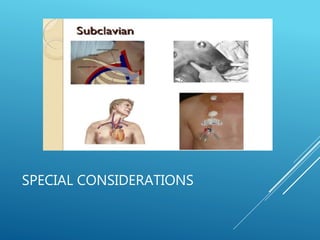
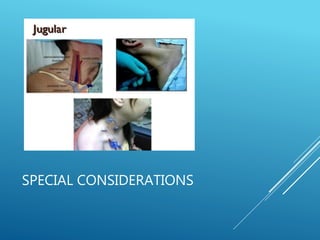
SPECIAL CONSIDERATIONS
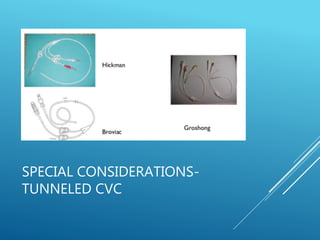
SPECIAL CONSIDERATIONS-
TUNNELED CVC
Intravenous Injection ppt

Intravenous Injection ppt

  • 1.
    INTRAVENOUS INJECTION PRESENTED BY Mrs.Silpa Jose T Assistant Professor STCON, Kattanam
  • 2.
    INTRODUCTION Intravenous therapy (IV)is a therapy that delivers liquid substances directly into a vein (intra- + ven- + -ous). The intravenous route of administration can be used for injections (with a syringe at higher pressures) or infusions (typically using only the pressure supplied by gravity). Intravenous infusions are commonly referred to as drips. The intravenous route is the fastest way to deliver medications and fluid replacement throughout the body.
  • 3.
    DEFINITION Intravenous injection isthe introduction of the small quantity of the drug into the vein by venous puncture. Introduction of the medicine directly into the blood stream is called intravenous injection.
  • 4.
    PURPOSE • To havefast action of the drug as in emergency. • To give medications that are irritating or ineffective when given by other routes. • To have the actions of medicines on the blood stream or the blood vessels.
  • 5.
    COMMON SITES OFIV INJECTION • Ventral aspect of elbow or forearm median cubical, basilica or cephalic veins. • Dorsal aspect of hand – brachial, cephalic or metacarpal veins. In the infants the scalp vein is used.
  • 8.
    GENERAL INSTRUCTIONS • Expelthe air from the syringe before giving the injection by upholding it in upright position and gently pressing the piston until a drop of solution comes to the tip of the needle. • Always dissolve the drug in correct amount of fluid to minimize the risk of adverse effect of the medicine. • Observe the patient closely for the signs of adverse reaction of the medicine and have emergency drugs and the antidote in hand while injecting the medicine.
  • 9.
    CON T.. • Do notgive the medicine if the injection site shows any edema or iv solution is not following properly to avoid accidental administration of medicine into the surrounding tissues. • When giving iron preparation always confirms that the patient is not sensitive to it by giving a test dose.
  • 10.
    TYPE OF IVADMINISTRATION • Adding the medicine in iv solution bottle (intravenous infusion) • Existing iv line for continuous infusion. • Bolus-direct iv push for immediate or fast action. SELECTION OF SYRINGE AND NEEDLE • The size of syringe used for iv infusion depends upon the amount of fluids to be injected. • Size of the needle used are 18 to 21 gauge or 1 to 2 inches.
  • 12.
    PRELIMINARY ASSESSMENT CHECK • Thediagnosis and age of the patient. • The purpose of injection. • The doctors order for the type, dosage, time and route of administration. • The patient’s name and bed number. • The nurses record to find out the time at which the last dose was given. • The symptoms of over dose or allergic reaction. • The form of the medicine available and correct method of administration.
  • 13.
    EQUIPMENT A TRAY CONTAINING: •Syringe and needles of various sizes according to the need in a covered tray (sterile). • Transfer forceps in a jar containing antiseptic solution. • Sterile cotton swabs and gauze pieces in sterile containers. • Methylated spirit in a container. • Bowl with water • Tourniquet
  • 14.
    CON T.. • Water forinjection. • Drug order sheet. • File to cut open the ampoules. • Small covered tray (sterile).
  • 15.
    PREPARATION OF THEPATIENT AND ENVIRONMENT  Identify the patient correctly  Explain the procedure to the patient  Provide privacy  Place the patient in comfortable and relaxed position suitable of iv injection.  Select a site suitable for the route of administration, quantity of medication to be given, and characteristics of medication.
  • 16.
    PROCEDURE • Read thedoctors order and select the medication • Wash hands • Select appropriate syringe and needle and check whether they are in good working order • Recheck the order, medicine card with the label of the medicine, expiry date, etc • Mix well and take out the required amount of solution in the syringe • Apply a tourniquet on the upper arm
  • 17.
    Cont.. • Ask thepatient to clench and unclench the hand • Pull the skin taut and place the needle in line • with vein at a 10 to 30 degree angle • Insert the needle a bit below the point where the needle will pierce the vein. • When the back flow of blood occurs into the syringe release the tourniquet and inject the medicine very slowly • Pressure with swab at the puncture site after the needle is withdrawn.
  • 18.
    AFTER CARE • Providethe patient comfortable position • Observe the area for bleeding if bleeding occurs apply pressure but do not massage • Wash hands • Replace all the articles and dispose off the disposable articles • Ask the patient to take rest at least 15 to 30 minutes so that you can observe him for any reaction • Observe the patient for any allergic reaction • Do proper recording and reporting maintain medication chart
  • 19.
    ADVANTAGES OF IVINJECTION • The therapeutic effect of the drug is seen as soon as it is administered to the patient. • IV medication also increases the chances of removal of toxins from the body cells, accelerating the healing process • It also prevents the growth and spread of cancerous cells. Chemotherapy is given through IV route so that the drug can move about the body and destroy the harmful cancerous cell.
  • 20.
    DISADVANTAGES OF IVINJECTION • Very slim chances of drug recall, when the drug given to patient shows adverse effect • As the drug moves towards the target area quicker than the other methods the concentration of the red blood cells present in the area can get dilated leading to anemia. • IV medications sometimes causes precipitate formation that causes embolism myocardial damage.
  • 21.
    COMPLICATIONS WITH INTRAVENOUS INJECTIONS •Infiltration • Hematoma • Air embolism • Phlebitis and thrombophlebitis • Extravascular injection • Intra-arterial injection • Allergic reaction • Sepsis • Speed shock
  • 22.
    Local complication Infiltration: Infiltrationoccurs when I.V. fluid or medications leak into the surrounding tissue. Infiltration can be caused by improper placement or dislodgment of the catheter.
  • 23.
    LOCAL COMPLICATION Extravasation : Extravasation injuryis defined as the damage caused by the efflux of solutions from a vessel into surrounding tissue spaces during intravenous infusion. The damage can extend to involve nerves, tendons, and joints and can continue for months after the initial insult.
  • 24.
    LOCAL COMPLICATION Thrombosis: Occurs when bloodflow through a vein is obstructed by a local thrombus
  • 25.
  • 26.
  • 27.
    NURSING RESPONSIBILITY • Toverify meds and dosage against the patient's chart and ascertain if the prescribed injection will be harmful or the prescription is misstated, and to make certain the med prescribed is viable for injection site • To make sure the injection site is sterile. • To ascertain if the injection site is viable • To make sure the volume of the injection is compatible with the site of injection.
  • 28.
    CON T.. • To maintainsterile field and bandage properly post injection • To monitor patient's reaction post injection to RO anaphylactic or synergistic drug reaction. • To do proper reporting and recording
  • 29.
    given by Medications administered intermittently IVare to treat usually emergent concerns. Medications administered by direct IV route are given very slowly over Atleast 1 minute. Administering a medication intravenously eliminates the process of drug absorption and breakdown by directly depositing it into the blood. This results in the immediate elevation of serum levels and high concentration in vital organs, such as the heart, brain,and kidneys. Both therapeutic and adverse effects can occur quickly with direct intravenous administration.
  • 30.
  • 31.
  • 32.