Intracellular Compartments / Intracellular fluid
Dr. Naveen Gaurav
Associate Professor and Head
Department of Biotechnology
Shri Guru Ram Rai University
Dehradun
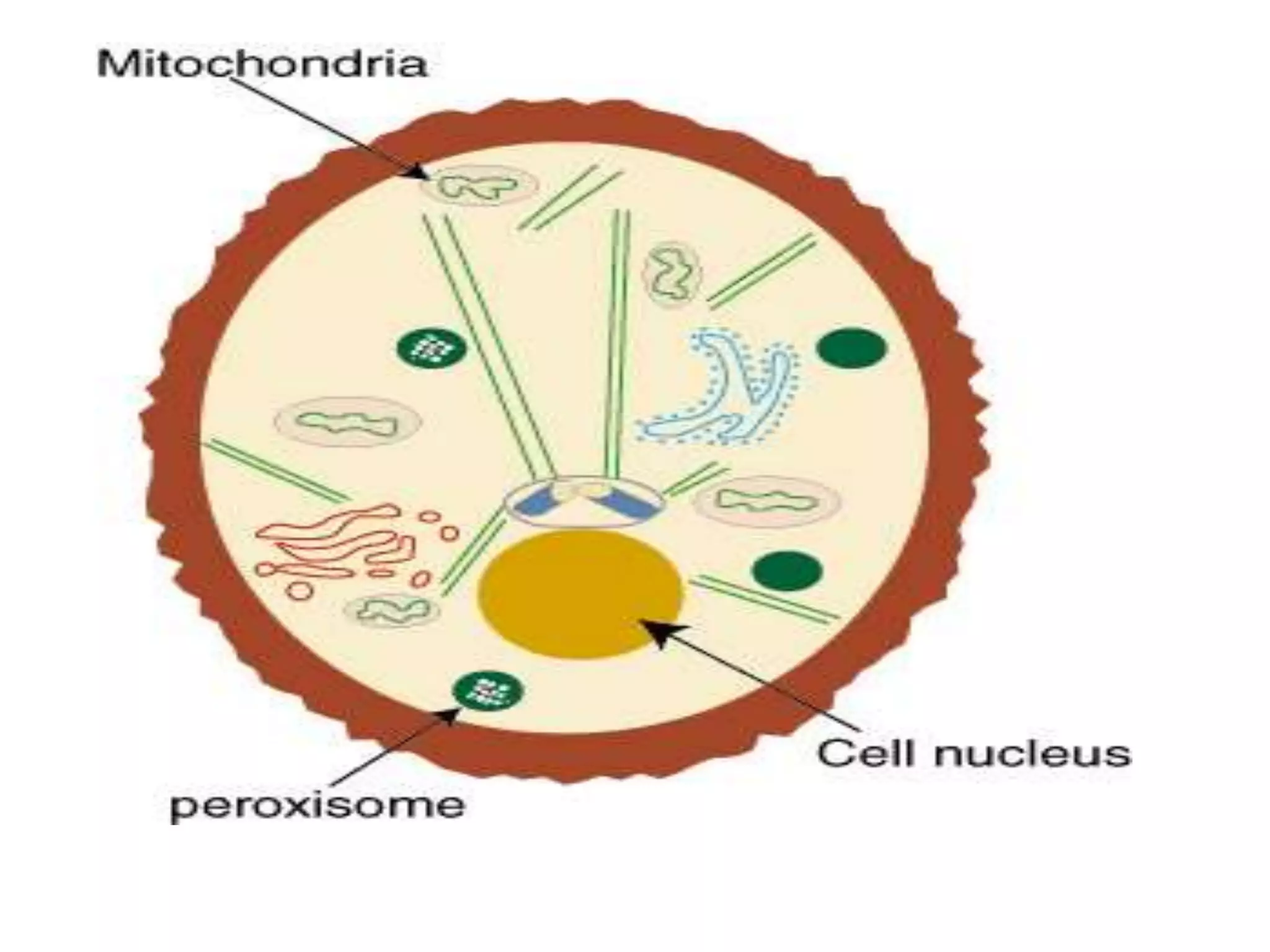
Intracellular Components
We will now begin our discussion of intracellular organelles. As we have mentioned, only
eukaryotic cells have intracellular sub-divisions, so our discussion will exclude prokaryotic
cells. We will also focus on animal cells, since plant cells have a number of further specialized
structures. In this section we will discuss the importance of the cell nucleus, mitochondria,
peroxisomes, endoplasmic reticulum, golgi apparatus, and lysosome.
The Cell Nucleus
The cell nucleus is one of the largest organelles found in cells and also plays an important
biological role. It composes about 10% of the total volume of the cell and is found near the
center of eukaryotic cells. Its importance lies in its function as a storage site for DNA, our
genetic material. The cell nucleus is composed of two membranes that form a porous
nuclear envelope, which allows only select molecules in and out of the cell.
The DNA that is found in the cell nucleus is packaged into structures called chromosomes.
Chromosomes contain DNA and proteins and carry all the genetic information of an
organism. The nucleus gains support from intermediate filaments that both form the
surrounding nuclear lamina and makes direct contact with the endoplasmic reticulum. The
nucleus is also the site of DNA and RNA synthesis.
Mitochondria
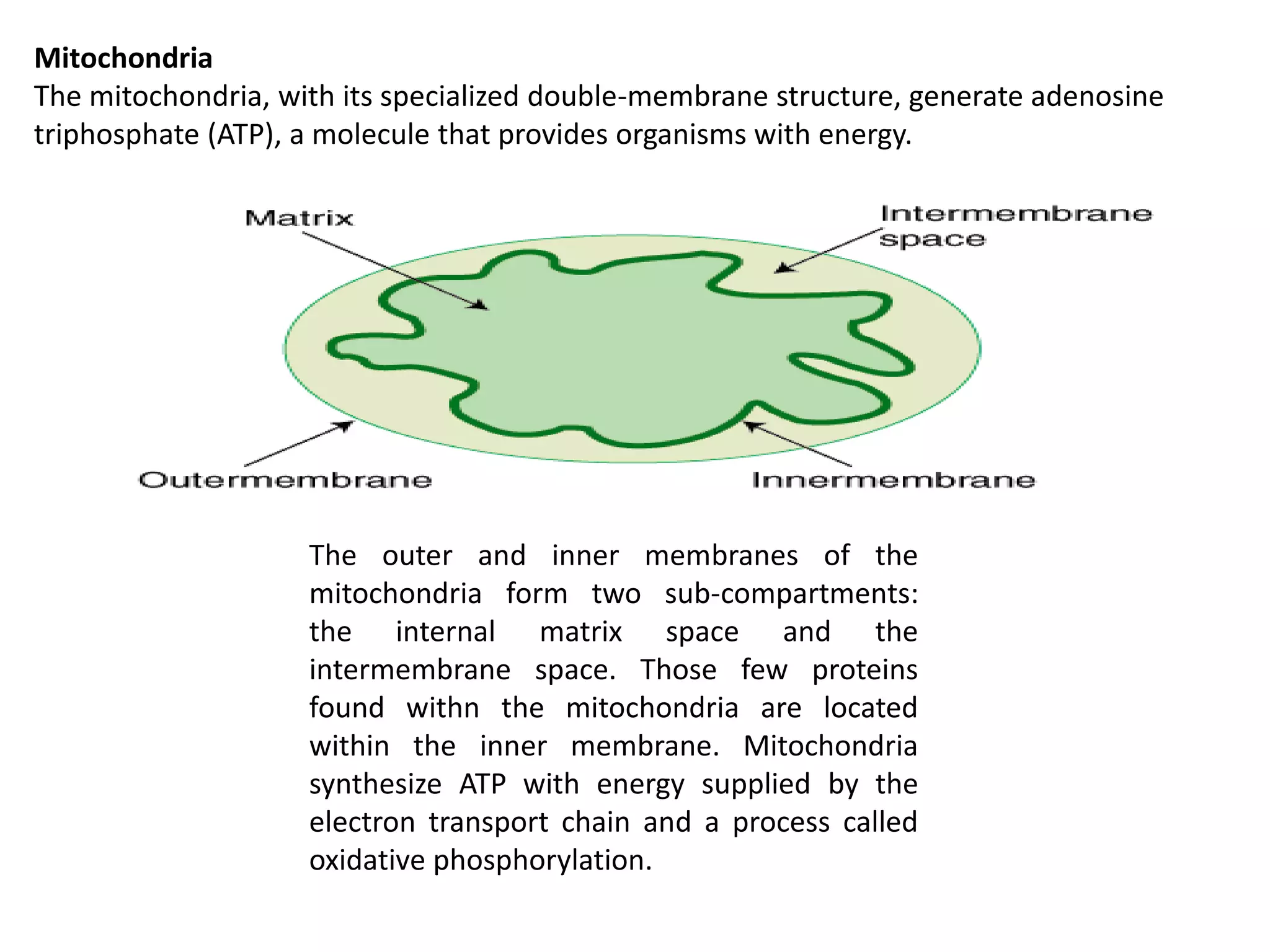
The mitochondria, with its specialized double-membrane structure, generate adenosine
triphosphate (ATP), a molecule that provides organisms with energy.
The outer and inner membranes of the
mitochondria form two sub-compartments:
the internal matrix space and the
intermembrane space. Those few proteins
found withn the mitochondria are located
within the inner membrane. Mitochondria
synthesize ATP with energy supplied by the
electron transport chain and a process called
oxidative phosphorylation.
Peroxisomes
Peroxisomes are single-membrane structures found in all
eukaryotic cells. They are small, membrane-bound structures
that use molecular oxygen to oxidize organic molecules. The
structure is one of the major oxygen utilizing organelles, the
other being the mitochondria. Peroxisomes contain oxidative
enzymes and other enzymes that help produce and degrade
hydrogen peroxide.
Because of their varying enzymatic compositions, peroxisomes
are diverse structures. Their main function is to help
breakdown fatty acids. They perform specific functions in plant
cells.
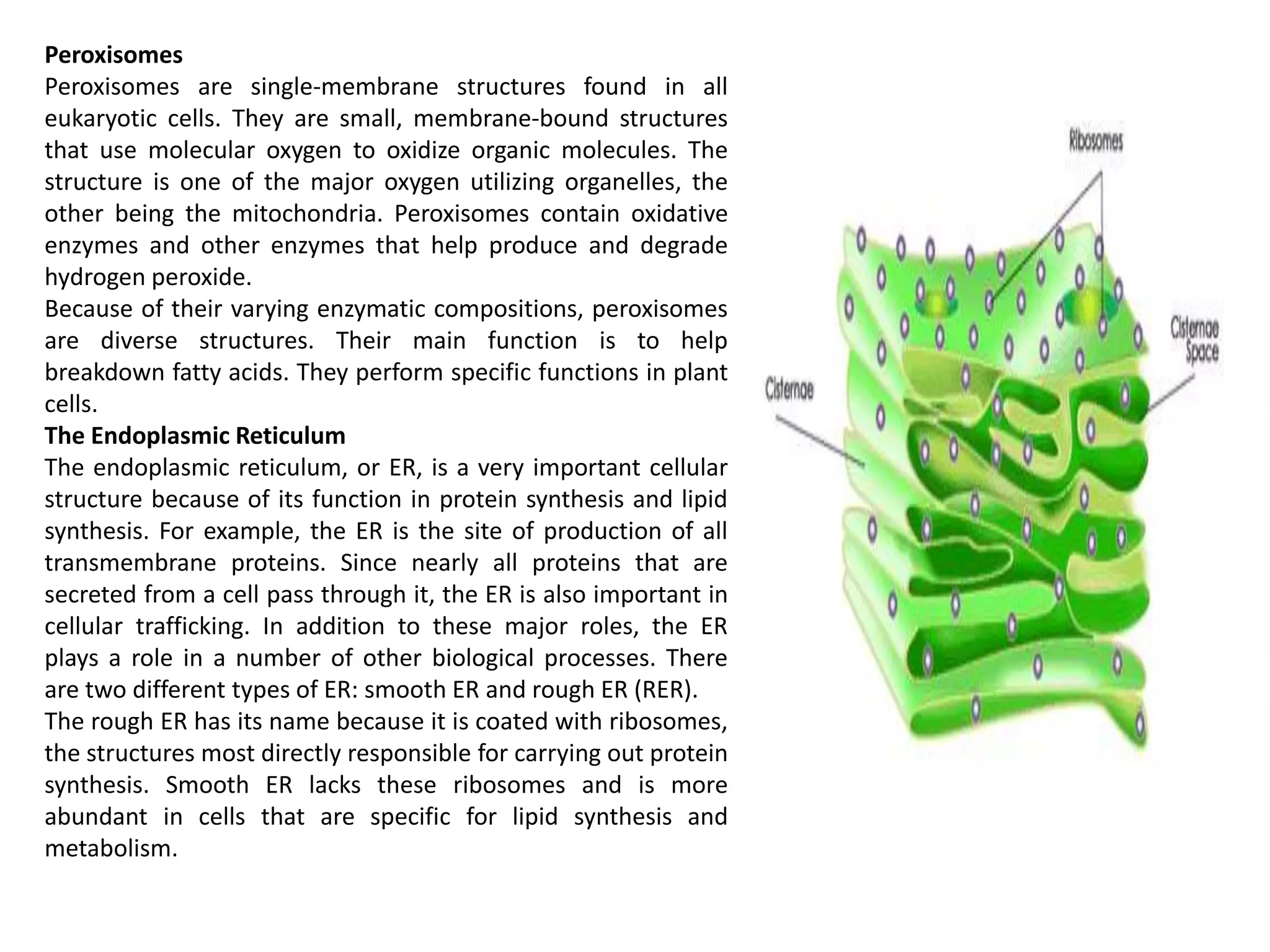
The Endoplasmic Reticulum
The endoplasmic reticulum, or ER, is a very important cellular
structure because of its function in protein synthesis and lipid
synthesis. For example, the ER is the site of production of all
transmembrane proteins. Since nearly all proteins that are
secreted from a cell pass through it, the ER is also important in
cellular trafficking. In addition to these major roles, the ER
plays a role in a number of other biological processes. There
are two different types of ER: smooth ER and rough ER (RER).
The rough ER has its name because it is coated with ribosomes,
the structures most directly responsible for carrying out protein
synthesis. Smooth ER lacks these ribosomes and is more
abundant in cells that are specific for lipid synthesis and
metabolism.
In addtion to protein and lipid synthesis, the ER also conducts post-synthesis
modifications. One such modification involves the addition of carbohydrate chains to the
proteins, though the function of this addition is unknown. Another major modification is
called protein folding, whose name is rather self- explanatory. Another role of the ER is to
capture calcium for the cell from the cytosol. Finally, the ER can secrete proteins into the
cell that are usually destined for the golgi apparatus.
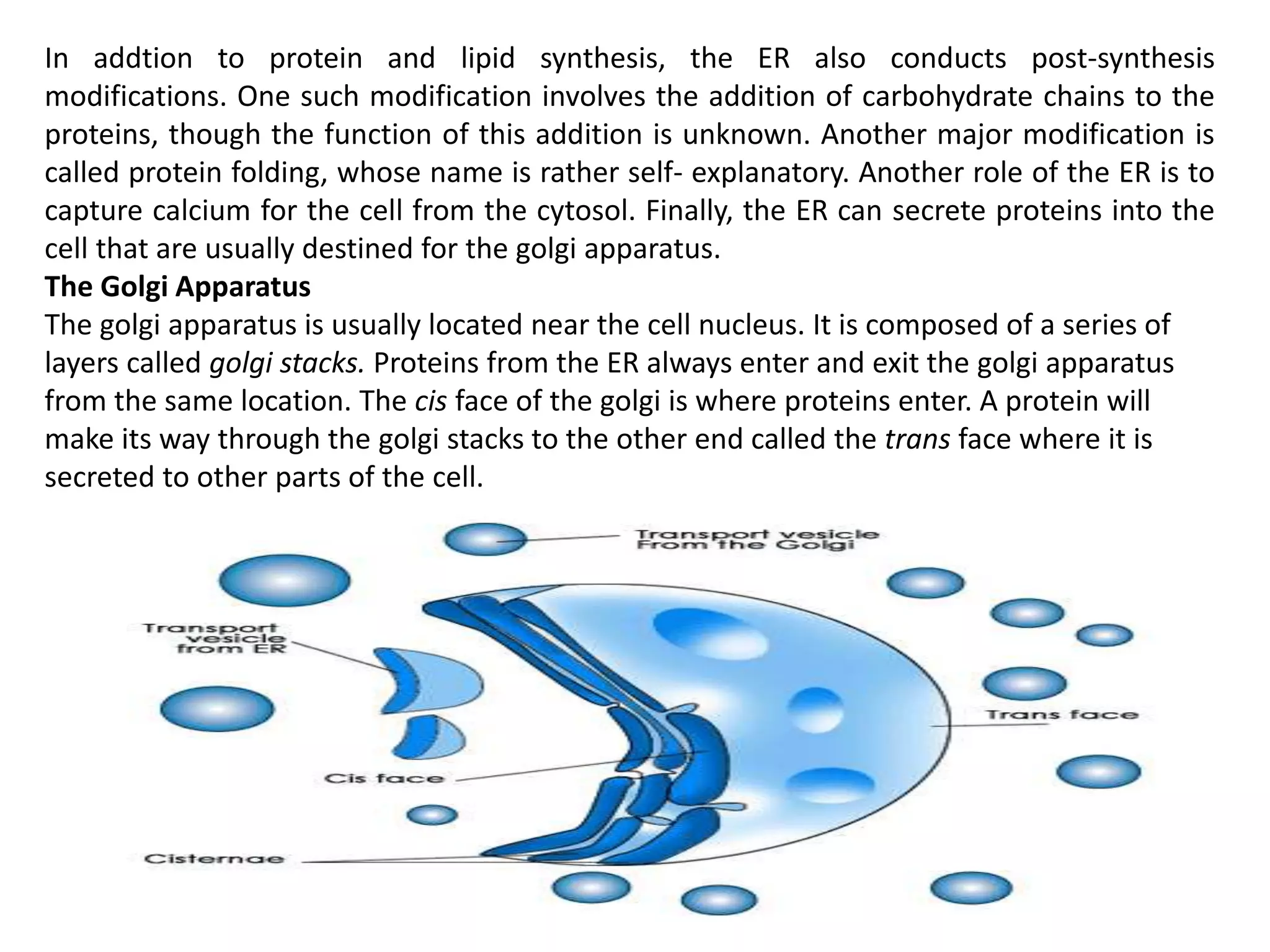
The Golgi Apparatus
The golgi apparatus is usually located near the cell nucleus. It is composed of a series of
layers called golgi stacks. Proteins from the ER always enter and exit the golgi apparatus
from the same location. The cis face of the golgi is where proteins enter. A protein will
make its way through the golgi stacks to the other end called the trans face where it is
secreted to other parts of the cell.
Lysosomes
Lysosomes are sites of molecular degradation found in all eukaryotic cells. They are small,
single-membrane packages of acidic enzymes that digest molecules and are found
throughout eukaryotic cells. As such, Lysosomes are a sort of cellular "garbage can," getting
rid of cellular debris. Proteins that are not correctly folded or have significant mutations can
be secreted to the lysosomes and be degraded instead of taking up space in the cell.
Detritus proteins and other molecules can find their way to the lysosome in a variey of ways.
THANK YOU
References: Online notes, notes from research papers and Books by google
search Engine

Intracellular Compartments / Intracellular fluid

  • 1.
    Intracellular Compartments /Intracellular fluid Dr. Naveen Gaurav Associate Professor and Head Department of Biotechnology Shri Guru Ram Rai University Dehradun
  • 2.
    Intracellular Components We willnow begin our discussion of intracellular organelles. As we have mentioned, only eukaryotic cells have intracellular sub-divisions, so our discussion will exclude prokaryotic cells. We will also focus on animal cells, since plant cells have a number of further specialized structures. In this section we will discuss the importance of the cell nucleus, mitochondria, peroxisomes, endoplasmic reticulum, golgi apparatus, and lysosome. The Cell Nucleus The cell nucleus is one of the largest organelles found in cells and also plays an important biological role. It composes about 10% of the total volume of the cell and is found near the center of eukaryotic cells. Its importance lies in its function as a storage site for DNA, our genetic material. The cell nucleus is composed of two membranes that form a porous nuclear envelope, which allows only select molecules in and out of the cell. The DNA that is found in the cell nucleus is packaged into structures called chromosomes. Chromosomes contain DNA and proteins and carry all the genetic information of an organism. The nucleus gains support from intermediate filaments that both form the surrounding nuclear lamina and makes direct contact with the endoplasmic reticulum. The nucleus is also the site of DNA and RNA synthesis.
  • 4.
    Mitochondria The mitochondria, withits specialized double-membrane structure, generate adenosine triphosphate (ATP), a molecule that provides organisms with energy. The outer and inner membranes of the mitochondria form two sub-compartments: the internal matrix space and the intermembrane space. Those few proteins found withn the mitochondria are located within the inner membrane. Mitochondria synthesize ATP with energy supplied by the electron transport chain and a process called oxidative phosphorylation.
  • 5.
    Peroxisomes Peroxisomes are single-membranestructures found in all eukaryotic cells. They are small, membrane-bound structures that use molecular oxygen to oxidize organic molecules. The structure is one of the major oxygen utilizing organelles, the other being the mitochondria. Peroxisomes contain oxidative enzymes and other enzymes that help produce and degrade hydrogen peroxide. Because of their varying enzymatic compositions, peroxisomes are diverse structures. Their main function is to help breakdown fatty acids. They perform specific functions in plant cells. The Endoplasmic Reticulum The endoplasmic reticulum, or ER, is a very important cellular structure because of its function in protein synthesis and lipid synthesis. For example, the ER is the site of production of all transmembrane proteins. Since nearly all proteins that are secreted from a cell pass through it, the ER is also important in cellular trafficking. In addition to these major roles, the ER plays a role in a number of other biological processes. There are two different types of ER: smooth ER and rough ER (RER). The rough ER has its name because it is coated with ribosomes, the structures most directly responsible for carrying out protein synthesis. Smooth ER lacks these ribosomes and is more abundant in cells that are specific for lipid synthesis and metabolism.
  • 6.
    In addtion toprotein and lipid synthesis, the ER also conducts post-synthesis modifications. One such modification involves the addition of carbohydrate chains to the proteins, though the function of this addition is unknown. Another major modification is called protein folding, whose name is rather self- explanatory. Another role of the ER is to capture calcium for the cell from the cytosol. Finally, the ER can secrete proteins into the cell that are usually destined for the golgi apparatus. The Golgi Apparatus The golgi apparatus is usually located near the cell nucleus. It is composed of a series of layers called golgi stacks. Proteins from the ER always enter and exit the golgi apparatus from the same location. The cis face of the golgi is where proteins enter. A protein will make its way through the golgi stacks to the other end called the trans face where it is secreted to other parts of the cell.
  • 7.
    Lysosomes Lysosomes are sitesof molecular degradation found in all eukaryotic cells. They are small, single-membrane packages of acidic enzymes that digest molecules and are found throughout eukaryotic cells. As such, Lysosomes are a sort of cellular "garbage can," getting rid of cellular debris. Proteins that are not correctly folded or have significant mutations can be secreted to the lysosomes and be degraded instead of taking up space in the cell. Detritus proteins and other molecules can find their way to the lysosome in a variey of ways. THANK YOU References: Online notes, notes from research papers and Books by google search Engine